Key Takeaways
- AMD rose Monday as Nvidia fell on a board inquiry involving CEO Jensen Huang.
- AMD’s data center sales are a tenth of Nvidia’s, but AMD expects 2027 revenue to grow more than 80%, faster than analysts expect from Nvidia.
- Demand for AMD’s chips exceeds supply, and AI buyers wanting a second source are signing on.
- At 30x forward earnings, below its 35x five-year average, AMD isn’t priced for those gains.
Nvidia (NVDA) had a rough Monday. The stock fell after its board said on Sunday that it had opened an independent investigation into reports that CEO Jensen Huang was the target of a foreign intelligence effort. Huang told employees he had been unfaithful to his wife and took full responsibility.
Advanced Micro Devices (AMD) went the other way. AMD’s rally also followed Oppenheimer’s upgrade to Outperform with a $600 target, citing data center momentum after last week’s earnings call.
Malcolm Ethridge, managing partner at Capital Area Planning Group, is selling some Nvidia before its report. On Friday’s CNBC Halftime Report, he pointed to the AI labs and hyperscalers signing with AMD:
“NVIDIA hasn’t really had to worry about competition in a meaningful way for the last four years that we’ve been talking about this AI trade.”
A Watermelon and a Grapefruit
Ethridge admitted the gap is still huge. Nvidia reports $90 billion a quarter in data center revenue, he said, against about $9 billion for AMD. “So I’m comparing like a watermelon to a grapefruit probably.”
AMD’s grapefruit is growing fast. Its data center revenue rose 97% to $8.5 billion in the third quarter. On AMD’s third-quarter call on Nov. 3, CEO Lisa Su raised the bar for next year: “we now expect revenue to grow more than 80% in 2027, which is more than twice the long-term financial model we outlined at our Financial Analyst Day last November.”
She said data center will be the largest contributor. Analysts have already caught up: consensus now calls for $95.7 billion of revenue in 2027, 83% above the $52.2 billion expected this year.
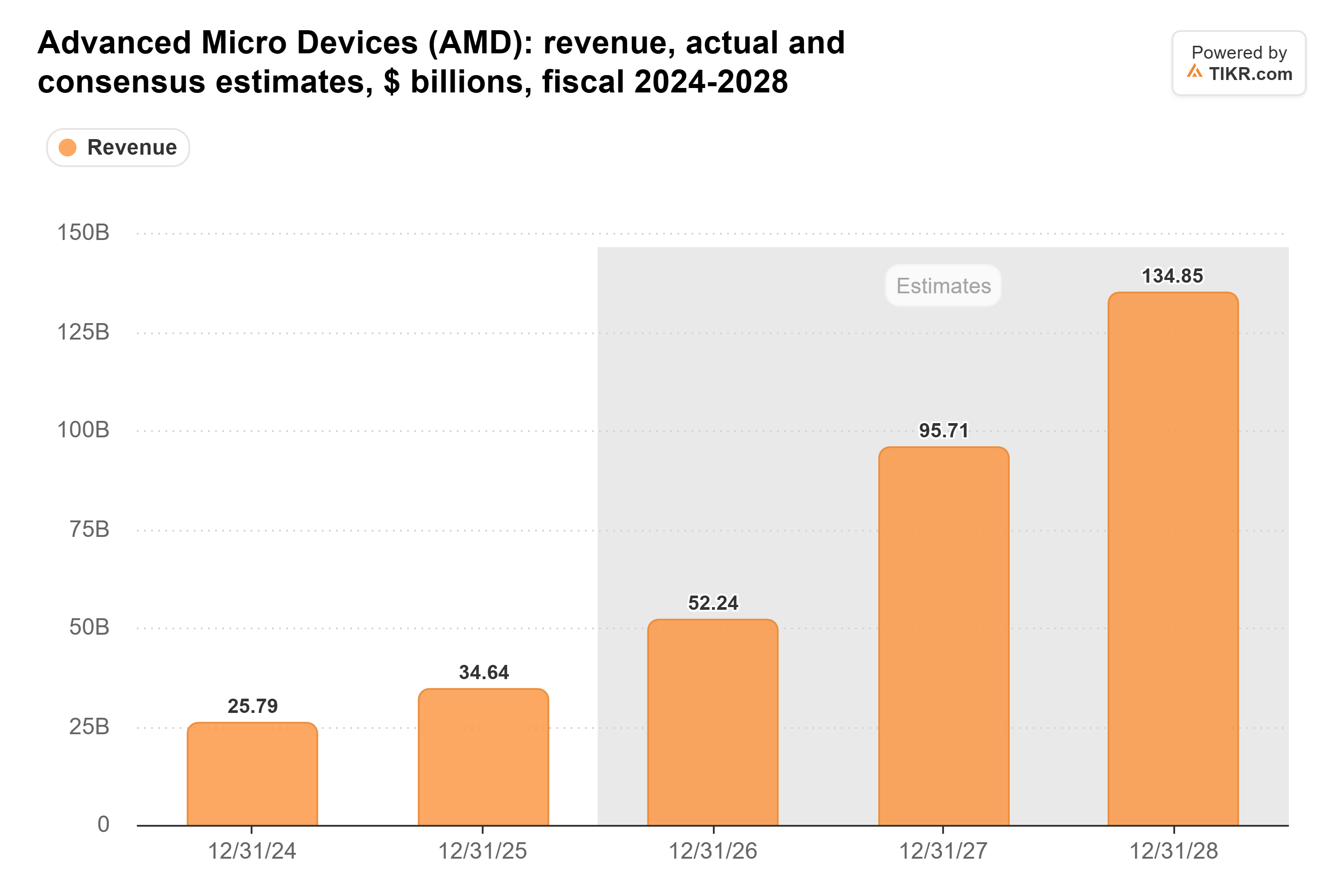
That 2027 figure was $89.2 billion in late October, before the report.
Nvidia Is Still in Another League
Analysts expect Nvidia to bring in $412 billion in the year ending January 2027 and $692 billion the year after that.
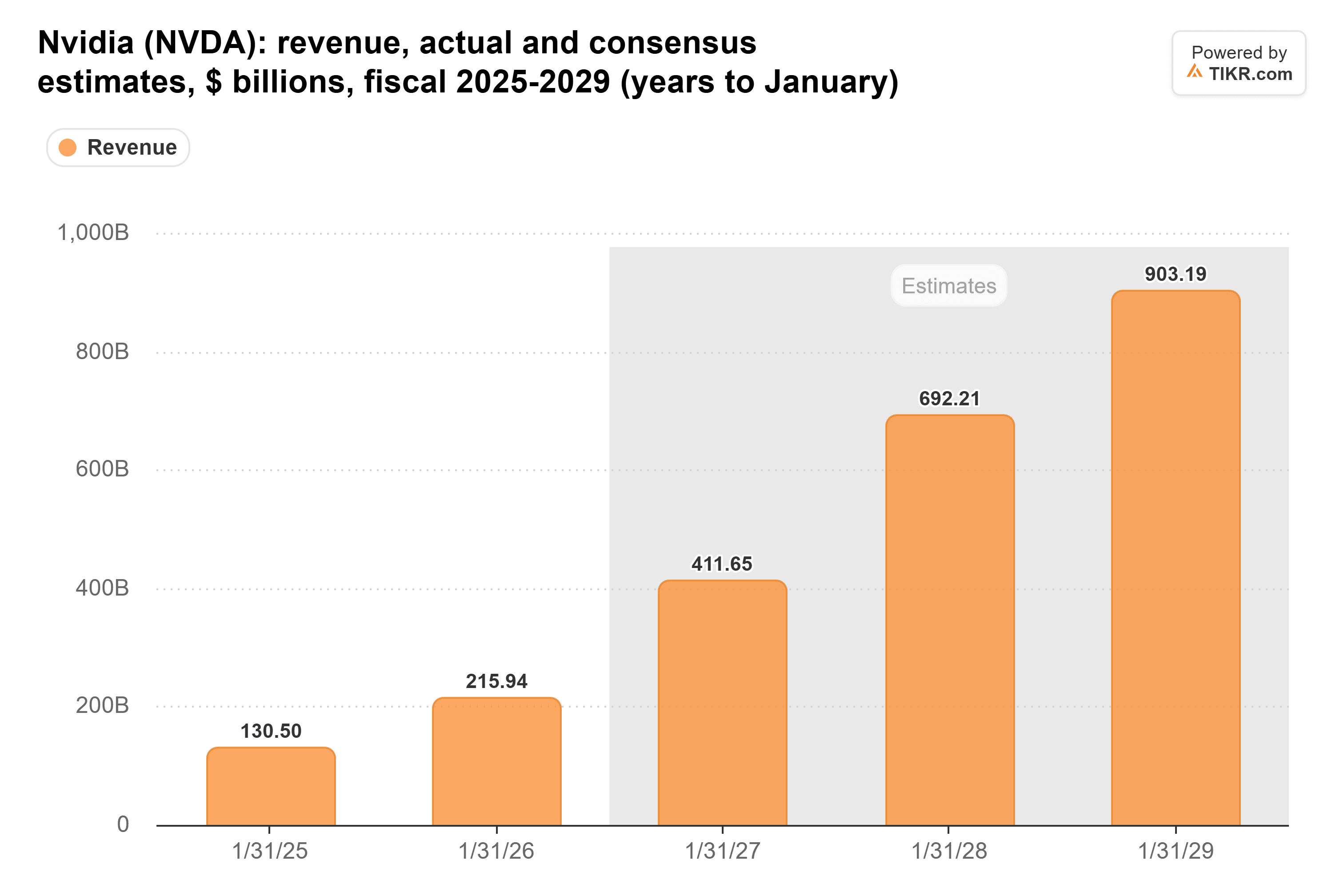
That’s about 7x AMD’s expected 2027 sales. AMD should grow faster, 83% against 68%, which is how a challenger closes in. But 68% on Nvidia’s base adds about $280 billion, so the dollar gap keeps widening for now.
TIKR Tracks 62 Analysts on Nvidia. How Many Say “Buy”?
See the full breakdown of Buy, Hold, and Sell ratings on Nvidia, along with Wall Street’s revenue and earnings estimates, all in one place. More than 500,000 investors use TIKR to research stocks like this one. See Nvidia’s Analyst Ratings
Buyers Want a Second Supplier
The most important line on the call came when Barclays analyst Tom O’Malley asked whether demand would outstrip supply. Su’s answer: “It is true that demand is higher than supply.”
The biggest AI buyers are lining up more than one source. OpenAI has agreed to deploy up to 6 gigawatts of AMD GPUs, and Anthropic up to 2 gigawatts of Helios racks. Those agreements show buyers expanding their hardware options, but AMD must increase its own supply to meet demand.
The Market Isn’t Paying Up for AMD
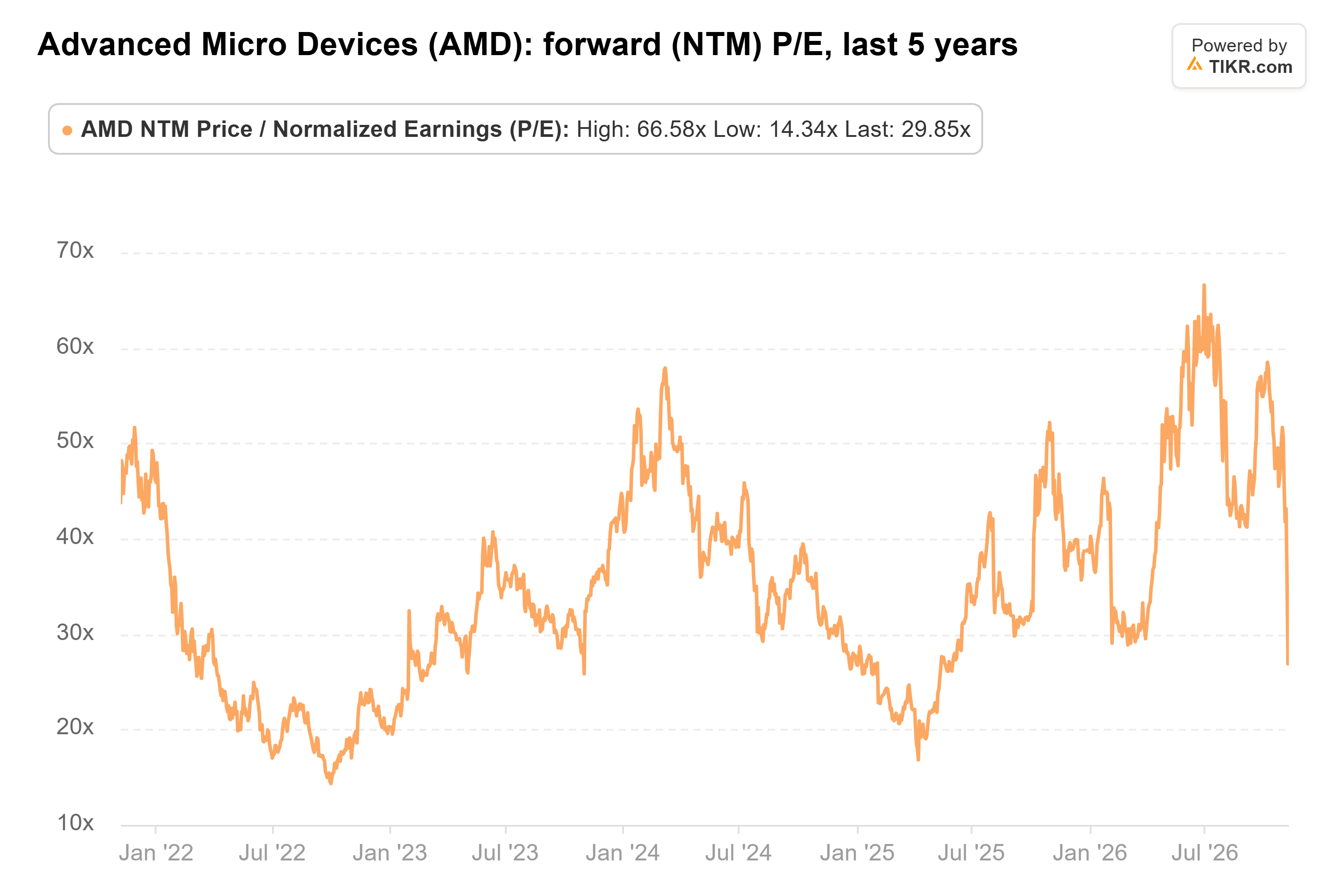
The stock doesn’t price in much of that. It trades at 30x forward earnings, below its five-year average of 35x and less than half its June 30 high of 67x:
The risk is that those 2027 estimates assume Helios ships on time and at scale. Su herself called the ramps “still early,” and any delay in a customer’s data center build would hit numbers that just went up.
Nvidia is still the king of AI chips, and Ethridge’s watermelon isn’t shrinking. But AMD finally looks like a real second supplier, and at 30x, I’d rather own the challenger. Nvidia reports Nov. 17; AMD’s fourth-quarter results, expected in early February, will provide the next update on the Helios ramp.
So What Is AMD Stock Actually Worth?
TIKR lets you forecast the future price of any stock in less than a minute. Just enter a few assumptions into TIKR’s valuation model and see what AMD could be worth. Start from Wall Street consensus estimates, or adjust the inputs to reflect your own view of the business. It’s free to use.
Disclaimer:
Please note that the articles on TIKR are not intended to serve as investment or financial advice from TIKR or our content team, nor are they recommendations to buy or sell any stocks. We create our content based on TIKR Terminal’s investment data and analysts’ estimates. Our analysis might not include recent company news or important updates. TIKR has no position in any of the stocks mentioned. Thank you for reading, and happy investing!