Key Takeaways
- Leopold Aschenbrenner’s latest fund letter argues that AI labs such as Anthropic will bid up component prices until NVIDIA can’t build chips profitably.
- Management has guided NVIDIA’s gross margin to a 71% to 72% bottom in the January quarter as memory prices climb, then a recovery to 72% to 73% next fiscal year.
- Memory makers such as Micron and SK hynix are the ones getting paid.
- A margin in the low 70s is still very profitable, and at about 12x forward earnings, the market already prices in much of the squeeze.
Leopold Aschenbrenner has a new bear case on NVIDIA (NVDA), and it’s about what NVIDIA’s chips cost to build.
Aschenbrenner, a former OpenAI researcher, runs the hedge fund Situational Awareness LP. In the fund’s third-quarter letter, he writes that NVIDIA “cannot survive in its current form for more than a few years on the current trajectory of RSI.” (That’s recursive self-improvement: AI building better AI.)
His reason: AI labs like Anthropic (ANT) will bid up component prices “to the point that NVDA cannot secure additional components to produce chips profitably,” according to excerpts of the letter posted on X on Nov. 27.
Meanwhile, the companies selling the parts, from Micron (MU) to SK hynix (SKHY), are already cashing in.
Wall Street is counting on the margin
Analysts expect NVIDIA’s normalized EPS to more than triple, from $4.77 in the fiscal year ended January 2026 to $16.61 in the year ending January 2028:
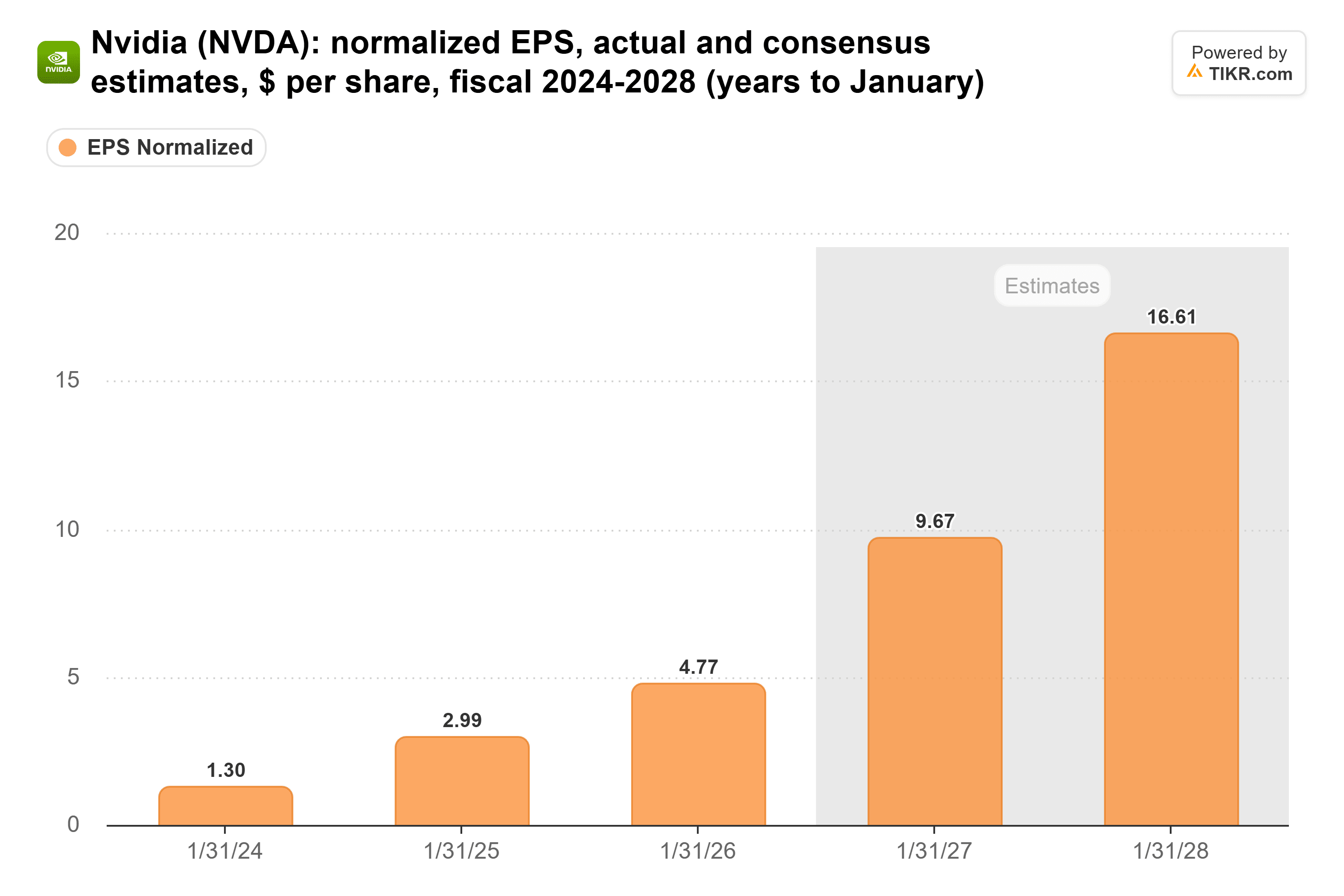
Those estimates assume a gross margin in the low 70s. Analysts expected nearly $700 billion of revenue in fiscal 2028 even before management raised its growth target to about 75% in November, so every point of margin is worth at least $7 billion of gross profit.
NVIDIA’s GAAP gross margin has stayed in the 70s for three straight fiscal years:
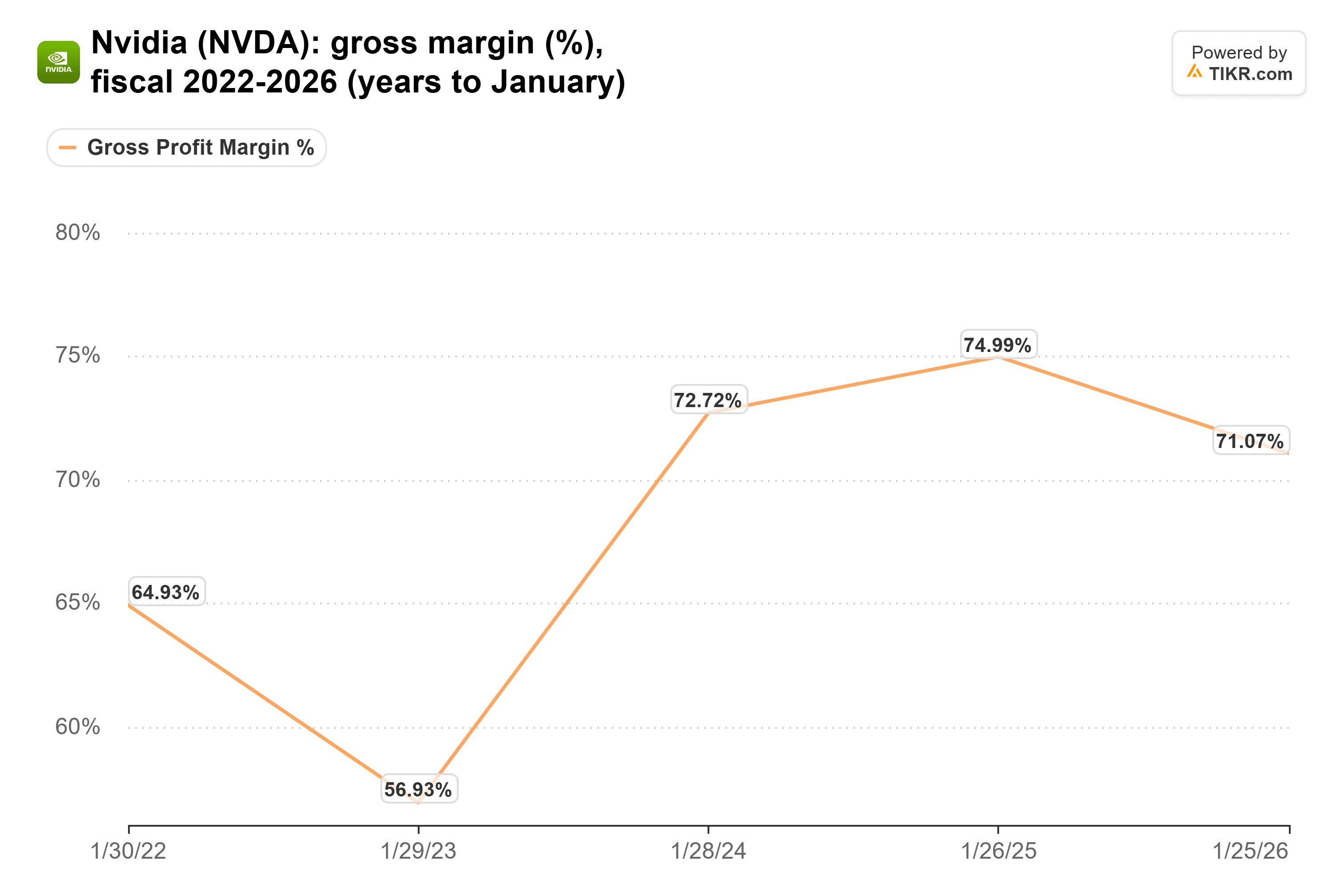
(A $4.5 billion charge on H20 chips meant for China took about two points off fiscal 2026.)
In August, management said memory prices had risen faster than it expected. It guided the margin to bottom at 71% to 72% in the January quarter, after targeting the mid-70s since November 2025. On Nov. 17, it kept that guide and said it still expects 72% to 73% in fiscal 2028.
TIKR tracks 63 analysts on Nvidia. How many say “Buy”?
See the full breakdown of Buy, Hold, and Sell ratings on Nvidia, along with Wall Street’s revenue and earnings estimates, all in one place. More than 500,000 investors use TIKR to research stocks like this one. See Nvidia’s Analyst Ratings
The memory makers are getting paid
Micron’s gross margin went from 2.7% in fiscal 2023 (excluding inventory write-downs; negative 9% on a GAAP basis) to 80.7% in fiscal 2026, which ended Sept. 3:
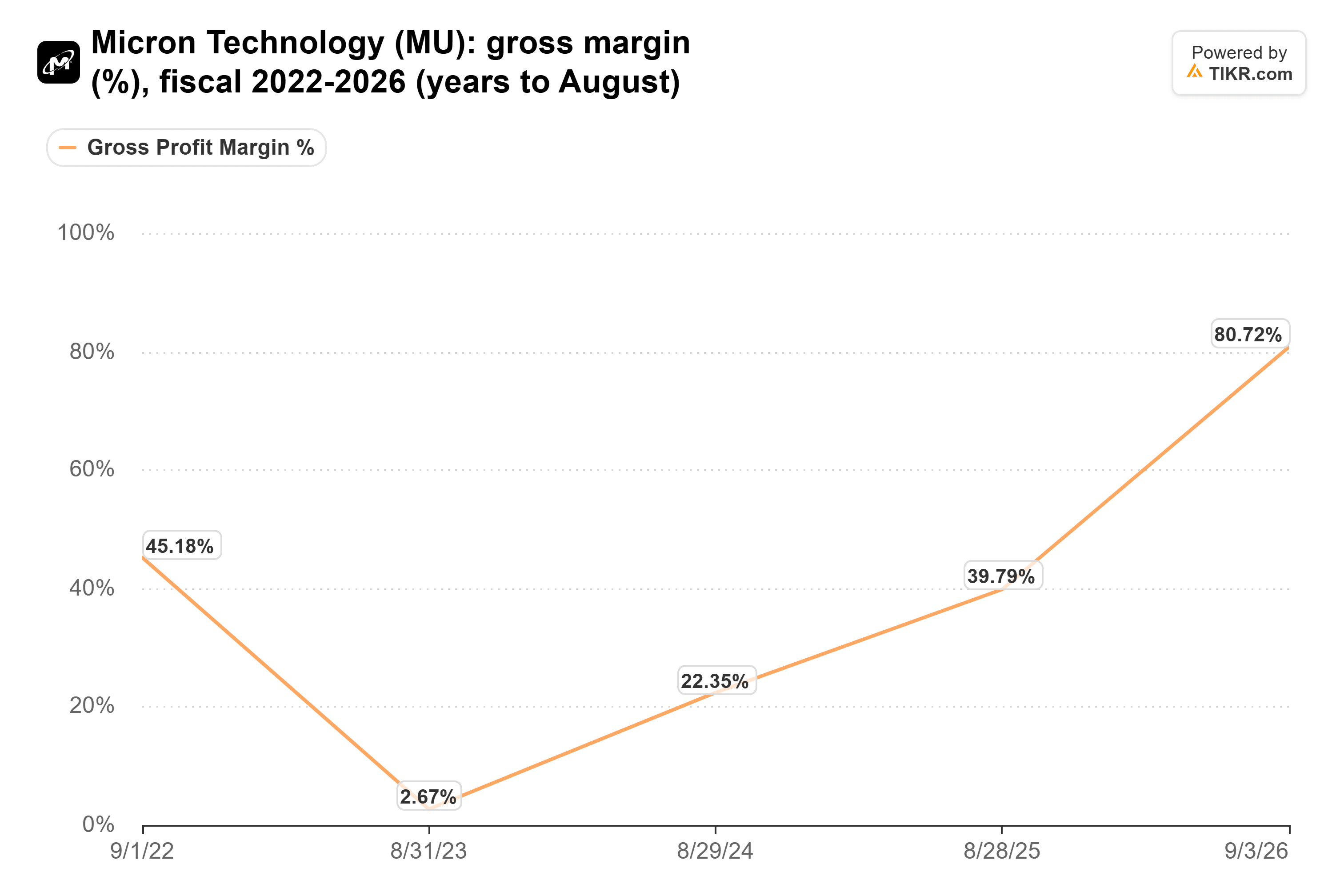
In its fiscal fourth quarter alone, Micron’s GAAP gross margin was about 86.8%, well above the 74.8% NVIDIA posted for the October quarter.
SK hynix’s third-quarter operating profit rose 632% from a year earlier to 83.3 trillion won, and it plans to return about 100 trillion won (roughly $75 billion) to shareholders for 2026.
Of course, memory is the most cyclical corner of the chip world, and if the shortage ends, NVIDIA gets its pricing power back.
Aschenbrenner has skin in this game
His fund lost 65% in the third quarter, the letter shows. The letter calls Anthropic its largest private position, and SK hynix was its largest holding for much of the fund’s history. Its Sept. 30 13F listed no NVIDIA shares, though those filings don’t show short positions. Labs and memory makers taking NVIDIA’s margin is the outcome his portfolio is built for.
NVIDIA has levers of its own, too. Management says price increases it has already put through take effect in the first quarter of fiscal 2028. It also agreed to buy about $10 billion of Anthropic stock in a private placement alongside the Nov. 19 IPO, which would give it a stake in one of the labs Aschenbrenner expects to outbid it.
A squeeze is a long way from a collapse
Aschenbrenner is right about the direction: memory makers are taking a bigger cut of every AI dollar. But a 71% gross margin is a long way from being unable to make chips profitably. And at about 12 times forward earnings in mid-November, its lowest since 2012 by LSEG’s count, the market already prices in plenty of pain.
The margin warning deserves real attention. The survival warning deserves a big grain of salt.
The number to watch is the January quarter’s gross margin, due in late February. At or above 71%, NVIDIA is pricing through its costs. Well below that, and Aschenbrenner’s “few years” might not be so far off.
So what is NVIDIA stock actually worth?
TIKR lets you forecast the future price of any stock in less than a minute. Just enter a few assumptions into TIKR’s valuation model and see what NVIDIA could be worth. Start from Wall Street consensus estimates, or adjust the inputs to reflect your own view of the business. It’s free to use.
Disclaimer:
Please note that the articles on TIKR are not intended to serve as investment or financial advice from TIKR or our content team, nor are they recommendations to buy or sell any stocks. We create our content based on TIKR Terminal’s investment data and analysts’ estimates. Our analysis might not include recent company news or important updates. TIKR has no position in any of the stocks mentioned. Thank you for reading, and happy investing!