Key Takeaways
- NVIDIA guided its January-quarter gross margin to 71% to 72%, roughly 300 basis points below the October quarter’s 74.8%, even as revenue came in far above its own guidance.
- The cut is real, but it’s the bottom management flagged in August, when it blamed rising memory prices.
- NVIDIA can’t pass those costs on until price increases take effect next fiscal year, which shows its pricing power has limits even at peak demand.
- Management sees gross margin recovering to 72% to 73% in the year ending January 2028, close to what analysts already model, and the next report will show whether that holds.
NVIDIA (NVDA) brought in $115.8 billion of revenue in its October quarter, up 103% from a year earlier and well above the $108 billion it had guided to.
But its outlook had one blemish. NVIDIA expects gross margin of 71% to 72% in the January quarter, down from 74.8% in the October quarter.
Dan Nathan didn’t mince words on Wednesday’s episode of the RiskReversal Pod: “they did guide to margins down 300 basis points in the next quarter. That’s a big guide.”
He’s right. NVIDIA guided the January quarter to about $130 billion of revenue. At that size, each point of gross margin is worth about $1.3 billion of gross profit.
NVIDIA called this one in August
The 71% to 72% range isn’t new. On its August call, management said gross margin would bottom at that level in the January quarter as memory prices climbed. It then expected a recovery to 72% to 73% in fiscal 2028 (the year ending January 2028), when price increases it has already put through take effect.
NVIDIA even beat its own margin guide for the October quarter, which pointed to 74.0%, plus or minus 50 basis points.
Analysts have had months to build that path into their models, and they still expect normalized EPS to more than triple, from $4.77 in the year ended January 2026 to $16.24 in fiscal 2028:
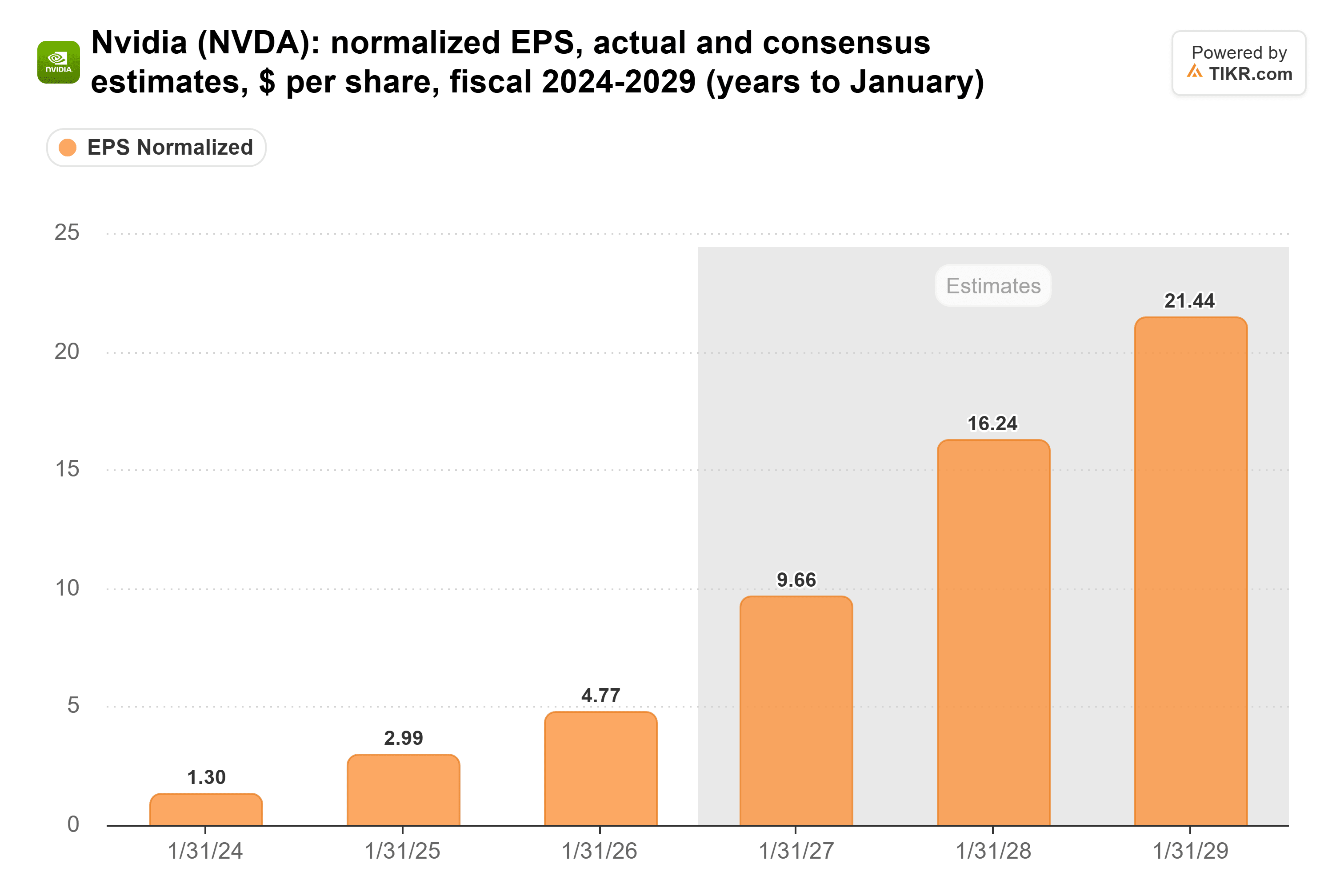
TIKR’s consensus has gross margin at 72.6% for fiscal 2028, right inside management’s range, so analysts have little reason to cut their estimates over this guide alone.
TIKR tracks 63 analysts on Nvidia. How many say “Buy”?
See the full breakdown of Buy, Hold, and Sell ratings on Nvidia, along with Wall Street’s revenue and earnings estimates, all in one place. More than 500,000 investors use TIKR to research stocks like this one. See Nvidia’s Analyst Ratings
A cost NVIDIA can’t pass on yet
Investors watch gross margin for signs of a chipmaker’s pricing power, and NVIDIA’s has been remarkably steady. Outside the April 2025 quarter, when a $4.5 billion H20 charge knocked it down to 60.5%, it has held between 72% and 75% for two years:
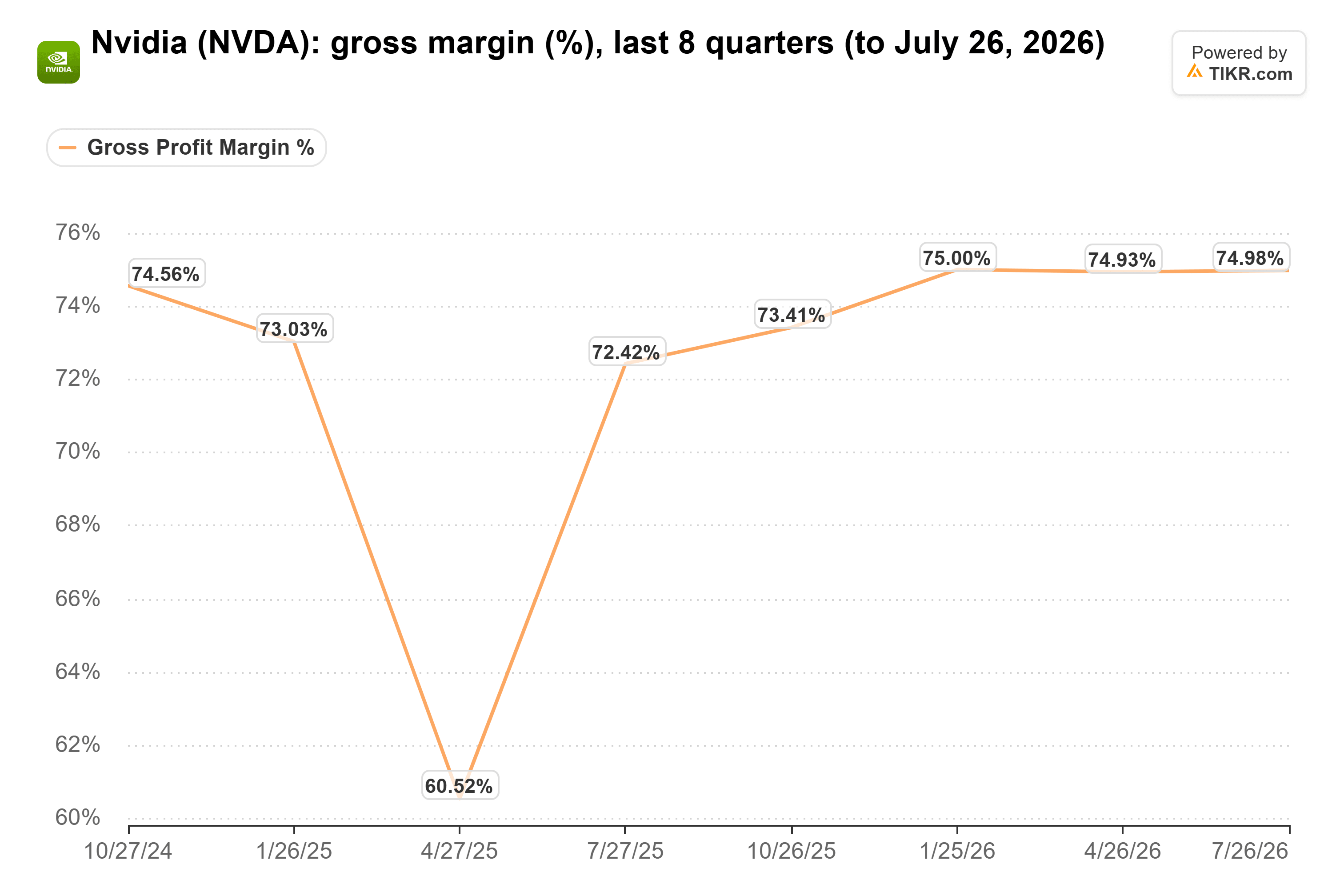
The October quarter’s 74.8% kept that run going.
In August, management blamed memory, saying prices rose faster than it expected and are heading higher into next year. Bloomberg Intelligence’s Mandeep Singh offered another likely cause on Bloomberg’s instant reaction to the report: “maybe it’s related to some of their new product ramps, which has happened in the past.”
Both of those costs should ease with time, but Nathan’s bigger point still holds. On Monday’s episode, the day before the report, he argued that once “their customers have pricing power, then margins are going lower.”
A company with all the pricing power in the world would pass a memory bill straight on to its customers, especially while it’s still short of supply. NVIDIA needs about a year to do it. Even then, management’s 72% to 73% for fiscal 2028 sits below the mid-70s it targeted from November 2025 through May 2026.
Its biggest buyers also have more options than they used to. NVIDIA’s own annual report names Alphabet, Amazon and Microsoft among the cloud companies designing their own AI chips.
Still a 72% business
Demand isn’t the problem. On the call, interim CEO Colette Kress raised NVIDIA’s fiscal 2028 growth outlook to about 75%, up from roughly 70%.
Bottom line: the guide is big, and NVIDIA’s margin ceiling has come down a notch. But a gross margin of 72% is still far above what other chipmakers earn, and analysts’ estimates were already built on about that. The risk is that memory keeps getting more expensive faster than NVIDIA can raise its own prices.
The next test comes when NVIDIA reports its January quarter, likely in late February. A gross margin inside 71% to 72%, along with a fiscal 2028 outlook still at 72% to 73%, would mean the price increases are sticking. If NVIDIA guides below that, I’d side with Nathan.
So what is NVIDIA stock actually worth?
TIKR lets you forecast the future price of any stock in less than a minute. Just enter a few assumptions into TIKR’s valuation model and see what NVIDIA could be worth. Start from Wall Street consensus estimates, or adjust the inputs to reflect your own view of the business. It’s free to use.
Disclaimer:
Please note that the articles on TIKR are not intended to serve as investment or financial advice from TIKR or our content team, nor are they recommendations to buy or sell any stocks. We create our content based on TIKR Terminal’s investment data and analysts’ estimates. Our analysis might not include recent company news or important updates. TIKR has no position in any of the stocks mentioned. Thank you for reading, and happy investing!