Key Takeaways
- Kraft Heinz yields 6.3% and Chevron 3.5%, so $10,000 in Kraft Heinz pays $630 a year today against $350 for Chevron.
- Chevron’s dividend grew 5.8% a year from fiscal 2020 to fiscal 2025, while Kraft Heinz has paid $1.60 a share every year since fiscal 2020.
- Both dividends are well covered by free cash flow over the latest twelve months, but Kraft Heinz carries far more debt and expects 2026 adjusted operating income to fall 16% to 18%.
- At those growth rates, Kraft Heinz pays about $1,730 more over 10 years, and Chevron’s yearly income catches up around 2037.
A 6.3% yield is the first thing a dividend investor will notice about Kraft Heinz (KHC). On Nov. 4, its board declared another $0.40 quarterly dividend, unchanged from prior quarters.
Chevron (CVX) pays a smaller 3.5% yield. But its check has been growing, and on Oct. 30 it reported third-quarter free cash flow of $12.0 billion, up from $4.9 billion a year earlier.
So if I could hold only one of them for the next 10 years, which would it be?
| Metric | Chevron (CVX) | Kraft Heinz (KHC) |
|---|---|---|
| Dividend yield | 3.5% | 6.3% |
| Annual dividend | $7.12 | $1.60 |
| Dividend growth, fiscal 2020-2025 | 5.8% a year | 0.0% a year |
| Cash dividend payout ratio (TTM) | 41% | 50% |
| Net debt/EBITDA | 0.4x | 2.7x |
| Interest coverage | 25.1x | 4.9x |
Source: TIKR, at today’s prices. TTM is the twelve months to Sept. 30, 2026, for Chevron and to June 27, 2026, for Kraft Heinz.
6 safe dividend stocks paying retirees 6%+ yields
There are over 100 stocks paying 6%+ annual dividends today.
But after an extensive investment review leveraging TIKR’s proprietary data, we now believe only six of them are truly safe for retirees.
They’re all yours as part of our new investment report. Learn more about how to get access right here.
Chevron puts the raise first
Chevron’s adjusted earnings rose to $10.4 billion from $3.6 billion in the third quarter of 2025. CFO Eimear Bonner said on the third-quarter call that the first priority is “to grow the dividend consistently,” and Chevron counts 39 straight years of raises.
This chart sets its free cash flow against the dividend over 10 years:
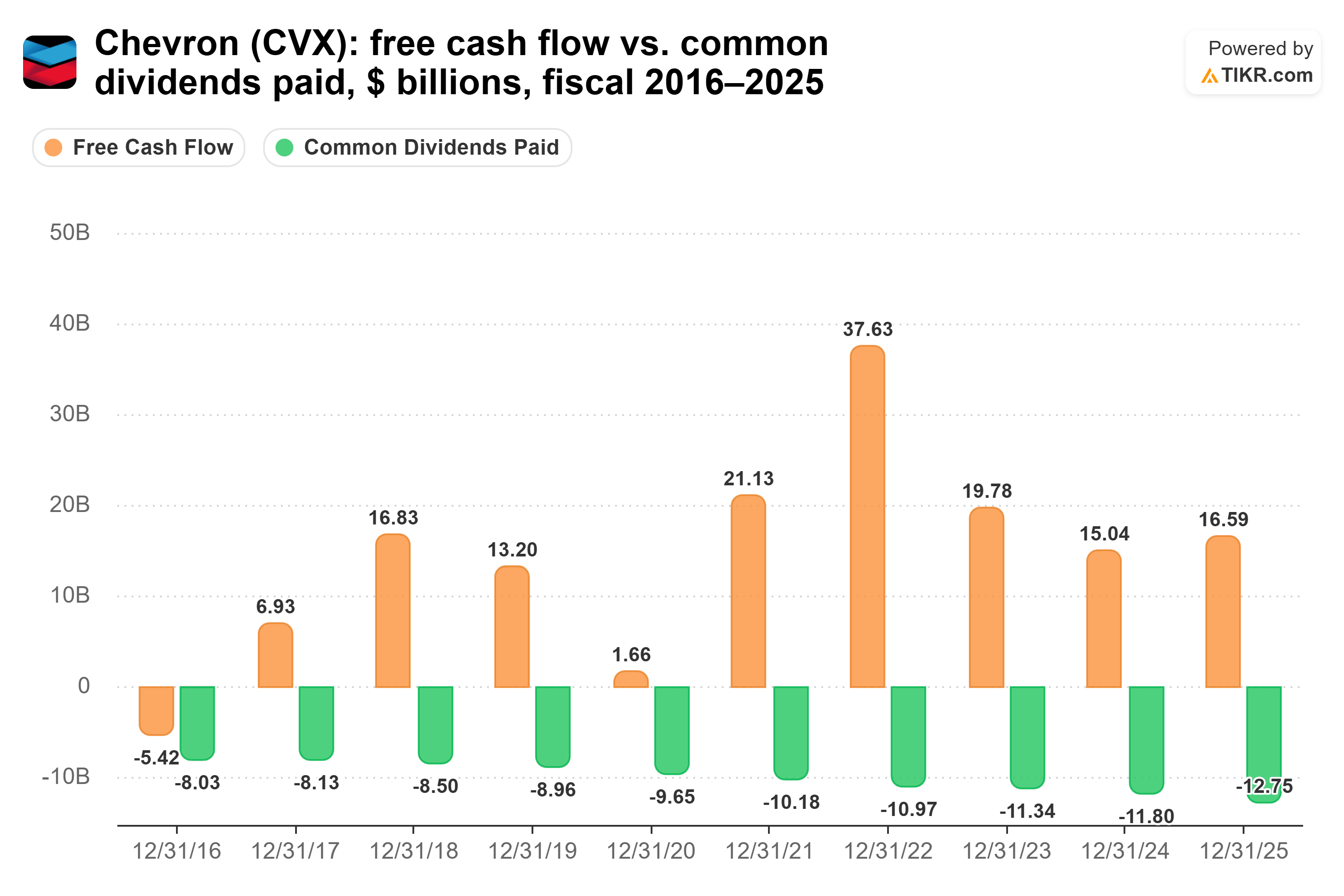
Free cash flow fell short of the dividend in fiscal 2016, fiscal 2017 and fiscal 2020, and covered it in the other seven years. The cash dividend payout ratio ran a tight 78% in fiscal 2024 and 77% in fiscal 2025. It then dropped to a well-covered 41% over the twelve months to Sept. 30, 2026, on the strength of that third quarter.
The risk is the oil price, and a weaker year like fiscal 2025 leaves Chevron far less room.
Kraft Heinz holds the line at $1.60
Chevron’s management talks about growing its dividend. Kraft Heinz’s third-quarter release talks about “sustaining the dividend.” It has paid $1.60 a share every year since fiscal 2020, below the $1.70 it paid in fiscal 2015.
The business is still shrinking. Third-quarter net sales fell 2.0% to $6.1 billion, with North America down 3.4%. Adjusted EPS of $0.53 beat analysts’ estimates of $0.42.
Even so, Kraft Heinz expects 2026 adjusted operating income to fall 16% to 18% in constant currency as it puts about $700 million of extra spending into its brands. On the same day, it agreed to sell its North America coffee business, Maxwell House included, in a deal valued at $650 million.
Kraft Heinz’s free cash flow now covers that smaller dividend comfortably:
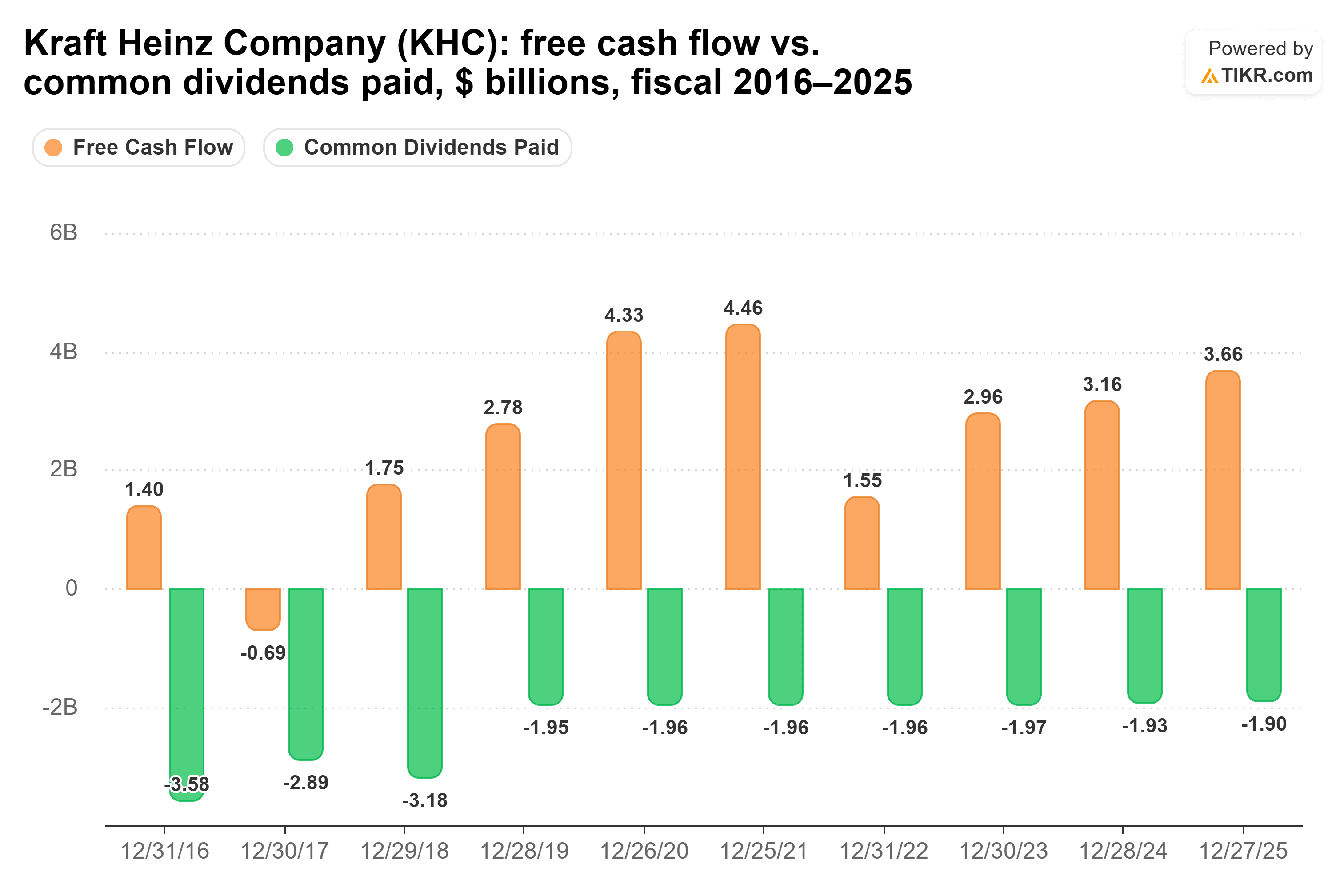
Dividends paid fell to $1.95 billion in fiscal 2019 from $3.18 billion in fiscal 2018, and free cash flow has covered them every year since fiscal 2023. The cash dividend payout ratio slid from 66% in fiscal 2023 to 52% in fiscal 2025. It sits at a well-covered 50% over the twelve months to June 27, 2026.
The main risk is the debt. Net debt is 2.7x EBITDA, and EBIT covers interest 4.9x.
So which dividend wins?
I’d hold Chevron for the next 10 years.
Picking Chevron means giving up income. At today’s yields, $10,000 in Kraft Heinz pays about $6,300 over the decade and Chevron about $4,570, a gap of about $1,730. Chevron’s yearly income only passes Kraft Heinz’s around 2037. Still, Chevron’s $10,000 would pay about $581 in year 10, a 5.8% yield on the original cash, before any gain in the stock.
Over 10 years, what matters most to me is whether each check can keep its pace. Chevron’s balance sheet has carried its dividend through lean years before:
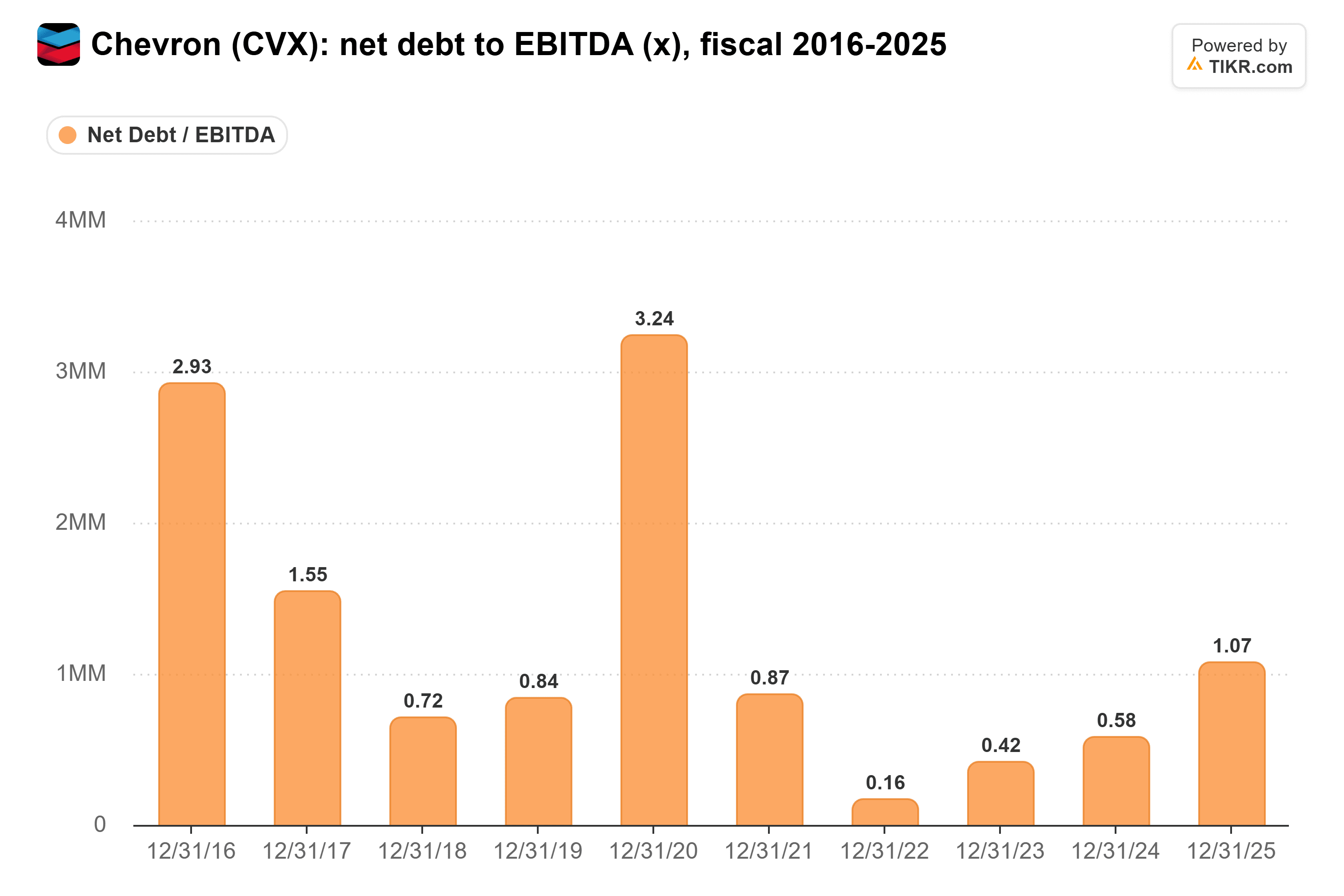
Net debt rose to 3.2x EBITDA in fiscal 2020, when free cash flow covered less than a fifth of the dividend, and Chevron’s dividend payments still rose that year. Net debt is at 0.4x now, after Chevron cut it by $7.8 billion in the third quarter alone.
Kraft Heinz has a real case. It pays the bigger check, and its payout ratio has fallen every year since fiscal 2022. It’s just that I trust Chevron’s growing check more than a flat one from a business guiding operating income down 16% to 18% this year, with 2.7x net debt.
Of course, Chevron still depends on oil. It lays out its 2027 capital program in December. If a weaker oil market pushed its payout ratio back toward fiscal 2024’s 78%, Chevron would lean harder on its balance sheet to keep raising the dividend.
Forget Chevron: 6 safe 6%+ dividend yields you can buy right now
Dividends can hold the key to enormous wealth. But only if you buy the right ones.
Picking the right high-yield dividend stock can be the difference between a dream retirement…and scraping by every month, waiting for the next Social Security check to clear.
We’ve identified six stocks yielding 6%+ that we believe every retiree should know about right now. (And Chevron isn’t one of them.)
Disclaimer:
Please note that the articles on TIKR are not intended to serve as investment or financial advice from TIKR or our content team, nor are they recommendations to buy or sell any stocks. We create our content based on TIKR Terminal’s investment data and analysts’ estimates. Our analysis might not include recent company news or important updates. TIKR has no position in any of the stocks mentioned. Thank you for reading, and happy investing!