


Key Takeaways
- SpaceX (SPCX) successfully caught Starship’s upper stage on November 14 after Ship 42 completed 14 orbits and deployed 26 Starlink V3 satellites.
- Elon Musk said the spacecraft could probably fly again after a few weeks of refurbishment, although he subsequently indicated that SpaceX would likely preserve it for public display.
- Starlink accounted for approximately 85% of SpaceX’s third-quarter operating income, highlighting why cheaper and more frequent Starship launches matter.
- At $133.59 per share, SpaceX’s $1.81 trillion valuation already reflects ambitious growth expectations across its satellite connectivity and AI businesses.
SpaceX caught Starship’s upper stage from orbit for the first time on November 14, marking a major milestone in the company’s efforts to build a fully reusable rocket.
After inspecting Ship 42 on November 15, SpaceX CEO Elon Musk praised the condition of its heat shield and engines.
“Ship 42 could probably be reflown with a few weeks of refurbishment,” Musk wrote on X.
Musk acknowledged that achieving airplane-style reusability would still require numerous improvements.
He subsequently indicated during a discussion at the TomorrowX Summit on November 18 that SpaceX would likely preserve Ship 42 for public display because of its historical significance.
The catch is a breakthrough, but the bigger question for investors is how quickly SpaceX can turn successful recoveries into cheaper launches.
TIKR tracks 41 analysts on SpaceX. How many say “Buy”?
See the full breakdown of Buy, Hold, and Sell ratings on SpaceX, along with Wall Street’s revenue and earnings estimates, all in one place. More than 500,000 investors use TIKR to research stocks like this one. See SpaceX’s Analyst Ratings.
Reuse comes in steps
A rocket that flies again spreads its manufacturing costs across multiple launches, and the faster it turns around, the more missions each spacecraft can complete.
That’s why the gap between a few weeks of refurbishment and airplane-style reusability matters so much.
Musk’s own targets have already shifted. During SpaceX’s August 4 earnings call, he discussed achieving at least one Starship flight a day within a year.
By the October 20 earnings call, the company was targeting weekly flights in the first half of 2027 and two flights a week by year-end.
My read is that SpaceX doesn’t necessarily need immediate reusability to achieve a weekly launch schedule. Several spacecraft operating in rotation could support that frequency, even if each requires weeks of refurbishment.
But first, SpaceX needs to demonstrate that a recovered upper stage can successfully fly again.
The booster still has to come home
Flight 15 was supposed to end with two catches. Instead, SpaceX abandoned the Super Heavy booster’s planned recovery.
According to Musk, the booster was slightly low on fuel.
Protecting the launch tower was the right decision, but losing the booster also illustrates why Starship’s economics remain a work in progress.
SpaceX has yet to catch both stages during a single mission. Until it can consistently recover and reuse both, manufacturing replacement hardware will continue to limit potential cost savings.
Starlink needs the ships
Wall Street expects SpaceX’s annual revenue to climb from $49.1 billion in 2026 to $182 billion in 2027 and $336 billion in 2028.
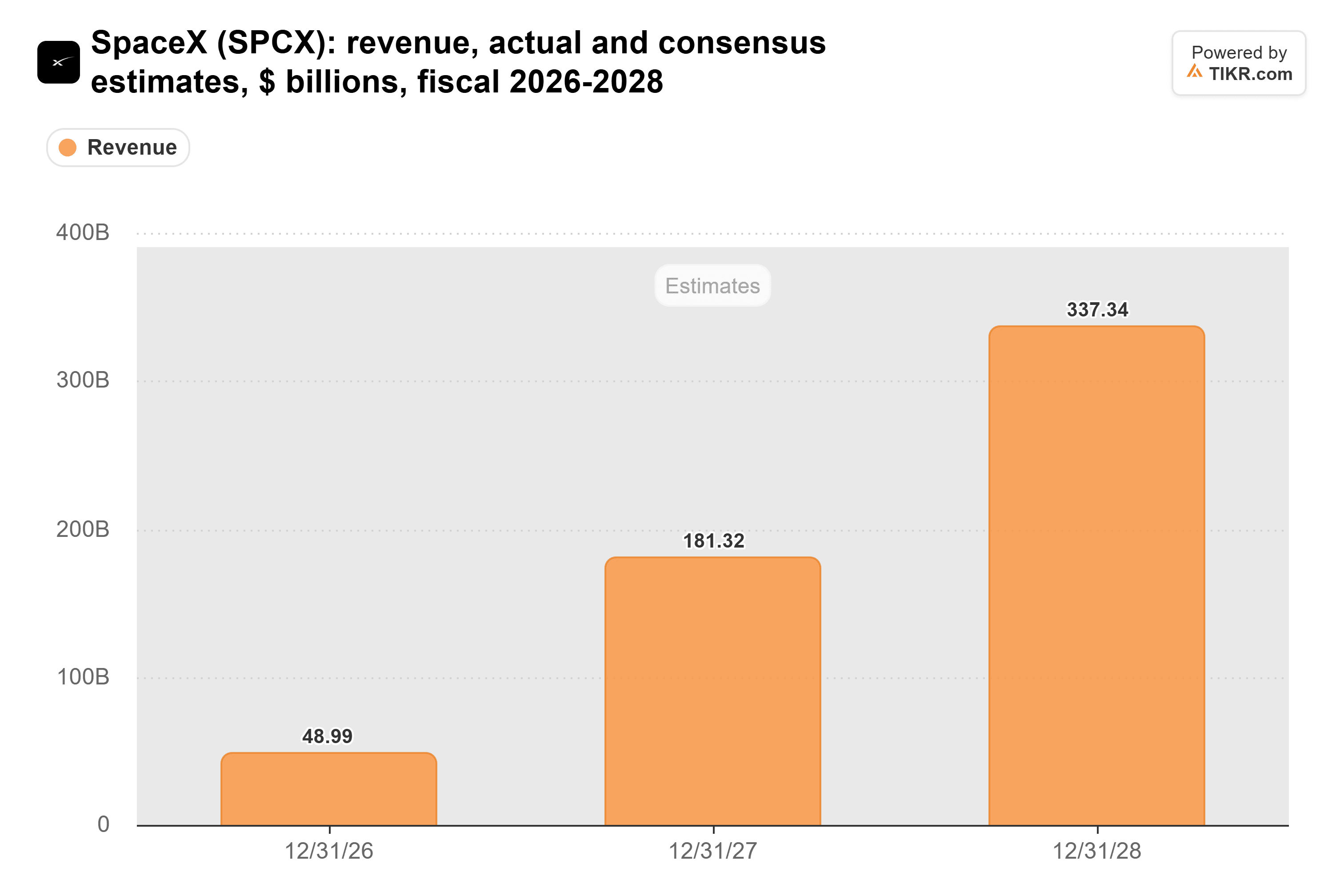
Much of SpaceX’s recent growth has come from its Super Intelligence segment, which contributed $6.75 billion of the company’s $9 billion year-over-year revenue increase in the third quarter.
Starlink, though, remains central to SpaceX’s profitability.
Its Connectivity segment generated $2.37 billion of the company’s $2.79 billion in third-quarter operating income, accounting for approximately 85% of the total.
SpaceX President Gwynne Shotwell said during the October 20 earnings call that deploying a few hundred next-generation Starlink V3 satellites by mid-2027 could noticeably improve the network.
That’s where Starship’s reusability could make a real financial difference. Lower launch costs would allow SpaceX to put more satellite capacity into orbit for every dollar spent.
Those profits matter even more given the size of SpaceX’s investment commitments. The company’s capital spending rose from $4.42 billion in 2023 to $20.9 billion in 2025.

Capital expenditures reached $55.1 billion over the trailing 12 months, with the Super Intelligence segment accounting for $40 billion of the company’s $48.1 billion in spending during the first nine months of 2026.
Most of that recent spending has gone toward AI infrastructure rather than Starship development.
Cheaper satellite launches could strengthen Starlink’s profitability while SpaceX continues funding its expensive AI expansion.
A breakthrough worth celebrating, but not buying
At its November 27 closing price of $133.59, SpaceX commands a market capitalization of approximately $1.81 trillion, equivalent to roughly 37x its projected 2026 revenue and 5.4x its estimated 2028 revenue.
I’m bullish on what Starship’s successful recovery means for Starlink. SpaceX doesn’t need airplane-style reusability to improve its satellite network, but it does need spacecraft that can reliably return and fly again.
Musk’s assessment suggests that a few weeks of refurbishment could be enough, but Ship 42’s likely retirement means that claim remains unproven.
The biggest investment risk is that SpaceX’s capital-intensive AI expansion fails to deliver the financial returns already embedded in its valuation.
At $133.59, I would avoid buying SpaceX stock for now. Starship’s successful recovery strengthens the company’s long-term competitive position, but cheaper satellite launches alone aren’t enough to justify a $1.81 trillion valuation.
I’d want to see repeatable Starship reuse and stronger evidence of returns on AI spending before buying at this price.
So what is SpaceX stock actually worth?
TIKR lets you forecast the future price of any stock in less than a minute. Just enter a few assumptions into TIKR’s valuation model and see what SpaceX could be worth. Start from Wall Street consensus estimates, or adjust the inputs to reflect your own view of the business. It’s free to use.
Disclaimer:
Please note that the articles on TIKR are not intended to serve as investment or financial advice from TIKR or our content team, nor are they recommendations to buy or sell any stocks. We create our content based on TIKR Terminal’s investment data and analysts’ estimates. Our analysis might not include recent company news or important updates. TIKR has no position in any of the stocks mentioned. Thank you for reading, and happy investing!


