Key Takeaways
- Nvidia has reportedly told partners to stop shipping its servers to four Southeast Asian countries after a new US export rule.
- Banks have paused billions in data center loans tied to Chinese tech giants.
- Stalled financing could slow orders even after licenses arrive.
- Nvidia trades at about 10x forward earnings; watch the 90-day license window closing in mid-February.
Nvidia (NVDA) has told partners such as Dell Technologies (DELL) and Super Micro Computer (SMCI) to stop shipping its servers to Malaysia, Singapore, Thailand and Indonesia, the Financial Times reported on Nov. 26.
Banks have also paused billions in data center loans tied to ByteDance, Alibaba (BABA) and Tencent pending clarity on the rules, Bloomberg reported.
A New Rule, and No Instructions for It
Since Nov. 19, a US rule has required a license to ship advanced AI chips to Singapore, Malaysia, Indonesia, Thailand and Brazil, unless the buyer is US-headquartered. Data centers already renting large amounts of compute to Chinese firms have 90 days to get licensed.
“There’s this new rule but no guidance on execution,” one cloud executive told the FT. “No one knows how to apply for this licence while the 90-day clock is ticking. It’s causing sheer chaos in the region.”
Nvidia’s Estimates Came Before the Halt
Nvidia’s outlook already assumes no China data center revenue, but not the Southeast Asian data centers that Chinese demand turned into a boom. Nvidia’s filings can’t size that: servers for the region often sell through US-based Dell and Super Micro or Taiwanese makers. Customers headquartered outside the US, Taiwan and China made up just $4.3 billion of revenue in the year ended January 2026.
Analysts expect revenue to nearly double to $424 billion in the year ending January 2027, then reach $726 billion the year after:

Unless licenses come quickly, I’d expect trims to the quarters around the 90-day window.
The Bigger Problem Is the Financing
The servers can probably find other buyers; Nvidia says demand exceeds supply. The loans are harder to replace: deals near the finish line are reportedly in doubt, and lenders are struggling to sell down their exposure. A data center that loses its loan won’t order servers once licenses come, so the real risk is a slower regional build that outlasts the halt.
TIKR Tracks 63 Analysts on Nvidia. How Many Say “Buy”?
See the full breakdown of Buy, Hold, and Sell ratings on Nvidia, along with Wall Street’s revenue and earnings estimates, all in one place. More than 500,000 investors use TIKR to research stocks like this one. See Nvidia’s Analyst Ratings
Dell, Super Micro and Alibaba Feel It First
Dell reported a record $132.3 billion AI backlog and raised full-year revenue guidance to $202 billion. Its third-quarter release said each order was “rigorously vetted for customer quality and access to capital, land and power.” Access to capital is exactly what some of the region’s buyers just lost.
A stalled region weighs more on the much smaller Super Micro. Its revenue reached $39.1 billion in the year ended June 2026, up from $5.2 billion four years earlier:

Alibaba, a tenant on some of the paused loans, has $72.8 billion of cash and liquid investments but still needs licenses.
Priced for Worse Than a Four-Country Pause
Nvidia’s forward P/E was 10x on Nov. 25, under half its one-year average of 22x and just above its Nov. 20 low of 8.7x:
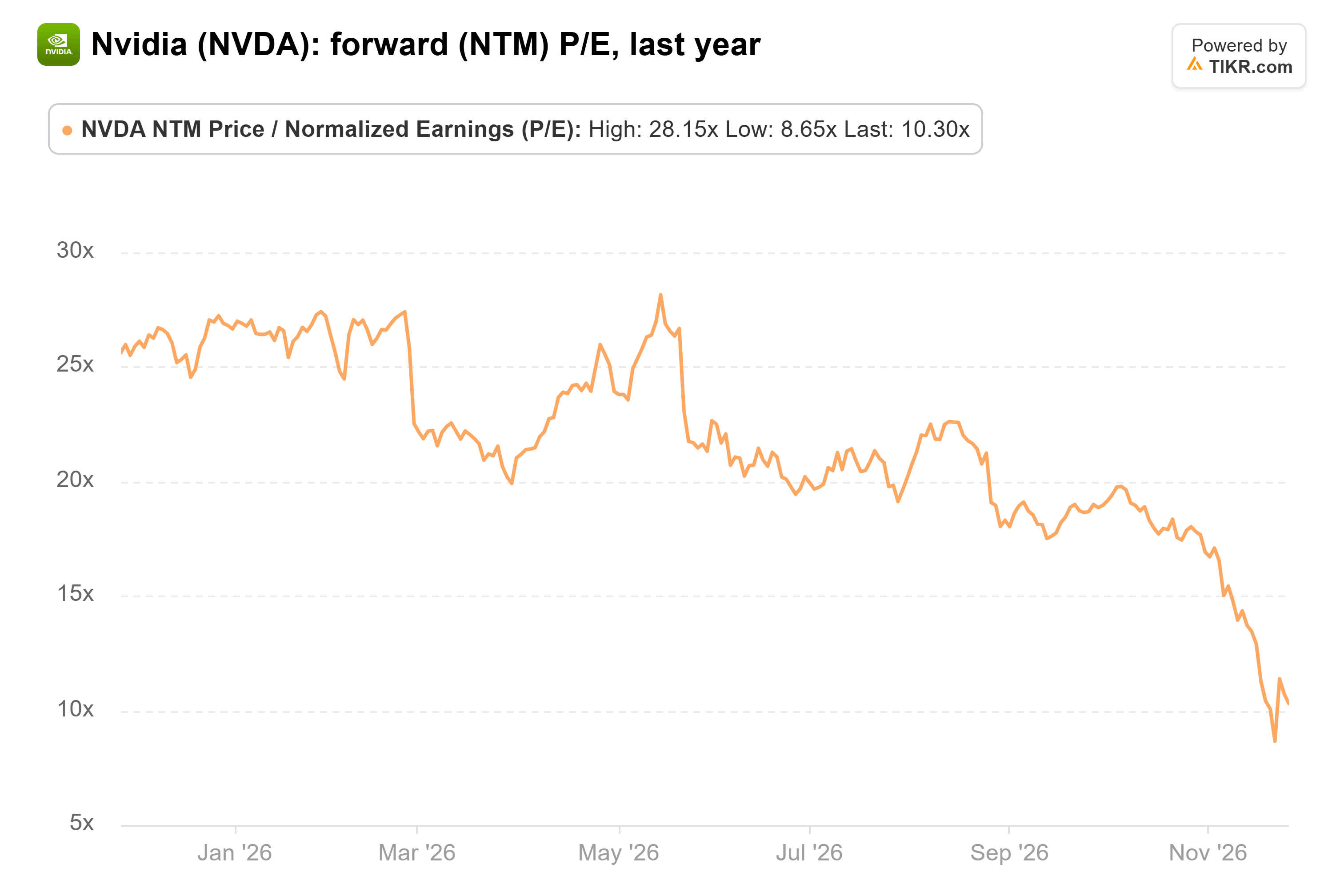
This is bad news for Nvidia’s next few months and worse for the region’s builders, but the stock already prices in far more than a four-country pause. The risk is Washington making it stick: CEO Jensen Huang has agreed to testify before the Senate, and senators in both parties want tougher chip export laws.
If licenses arrive by mid-February and the loans restart, analysts’ $726 billion estimate for the year ending January 2028 should hold. If not, watch for cuts to it before Nvidia reports in late February.
So What Is Nvidia Stock Actually Worth?
TIKR lets you forecast the future price of any stock in less than a minute. Just enter a few assumptions into TIKR’s valuation model and see what Nvidia could be worth. Start from Wall Street consensus estimates, or adjust the inputs to reflect your own view of the business. It’s free to use.
Disclaimer:
Please note that the articles on TIKR are not intended to serve as investment or financial advice from TIKR or our content team, nor are they recommendations to buy or sell any stocks. We create our content based on TIKR Terminal’s investment data and analysts’ estimates. Our analysis might not include recent company news or important updates. TIKR has no position in any of the stocks mentioned. Thank you for reading, and happy investing!