Key Takeaways
- At today’s prices, $1,000 a month in dividend checks takes about $329,400 of U.S. Bancorp stock, about $334,000 of PNC, or about $466,400 of SouthState Bank.
- PNC costs only slightly more than U.S. Bancorp, and its dividend is better covered and has grown faster.
- U.S. Bancorp’s dividend is the least covered of the three, at 44% of fiscal 2025 normalized earnings, which still leaves plenty of room.
- SouthState Bank’s dividend takes just 24% of normalized earnings, but its lower yield costs about $137,000 more than U.S. Bancorp for the same income.
Any retiree hunting for $1,000 a month in dividend checks is going to look hard at the banks. Three of them raised their dividends this summer: U.S. Bancorp (USB) by 3.6% in June, then PNC Financial Services Group (PNC) by 18% and SouthState Bank (SSB) by 10% in July.
Their yields run from 2.6% to 3.6%, though, so the money it takes to collect $12,000 a year from any one of them varies a lot. Since these are banks, each dividend is judged on its payout ratio of normalized EPS. Here’s what each would take on its own, at today’s prices:
| Stock | Shares | Cost | Yield | Income a year | Payout ratio of normalized EPS (fiscal 2025 / fiscal 2026 est.) |
|---|---|---|---|---|---|
| U.S. Bancorp | 5,556 | $329,415 | 3.6% | $12,001 | 44% / 40% |
| PNC | 1,500 | $334,050 | 3.6% | $12,000 | 40% / 38% |
| SouthState Bank | 4,546 | $466,420 | 2.6% | $12,001 | 24% / 27% |
Sources: TIKR, StockAnalysis. Today’s prices, each company’s current dividend rate, whole shares.
6 safe dividend stocks paying retirees 6%+ yields
There are over 100 stocks paying 6%+ annual dividends today.
But after an extensive investment review leveraging TIKR’s proprietary data, we now believe only six of them are truly safe for retirees.
They’re all yours as part of our new investment report. Learn more about how to get access right here.
U.S. Bancorp’s check costs the least
U.S. Bancorp’s third-quarter net revenue hit a record $7.97 billion, up from $7.33 billion a year earlier, and net income rose 10% to $2.20 billion. Management now expects 2026 net revenue to grow 8% to 9%, with about 300 basis points of positive operating leverage.
With revenue growing faster than costs, analysts see normalized EPS rising 16% in fiscal 2026, to $5.34 from $4.62. That would take the payout ratio to 40% from 44% in fiscal 2025. The dividend has stayed well under earnings for a decade:

The payout ratio peaked at 59% in fiscal 2023, when normalized EPS fell to $3.27, and the dividend still went up that year.
CFO John Stern said on the third-quarter call that the bank is “very much committed to the 70% to 75% payout from a capital distribution standpoint.” That’s dividends and buybacks together, so buybacks have plenty of room to flex before the dividend would.
PNC’s check is growing fastest
PNC’s check costs only about $6,700 more than U.S. Bancorp’s, and its business is growing faster. It expects 2026 revenue to rise about 13.7%, on average loans up about 13.5%, while noninterest expense rises about 9.5%. Analysts see normalized EPS rising 16% in fiscal 2026, to $19.33 from $16.59.
The dividend took a well-covered 40% of normalized EPS in fiscal 2025, and on fiscal 2026’s consensus it would take 38%, even after July’s 18% raise to $2.00 a quarter. PNC’s dividend grew 7.5% a year from fiscal 2020 to fiscal 2025, from $4.60 to $6.60 a share, and it kept growing through a rough year:

In fiscal 2020, normalized EPS fell to $6.21 and the payout ratio hit 74%, and PNC still raised its dividend to $4.60 from $4.20.
The risk is slower loan growth, and PNC itself names a pullback in AI-related capex as one thing that could cause it.
SouthState has the most room
SouthState Bank sits at the other end of the trade-off: its 2.6% yield makes its check the most expensive of the three, but its dividend has the most room. In the third quarter, loans grew 9% and deposits grew 7% from a year earlier, as SouthState added commercial bankers to a team now up about 13%.
Analysts see normalized EPS slipping 2% in fiscal 2026, to $9.35 from $9.50, so the payout ratio edges up to 27% from 24% after July’s 10% raise. The dividend has stayed far below earnings for a decade:
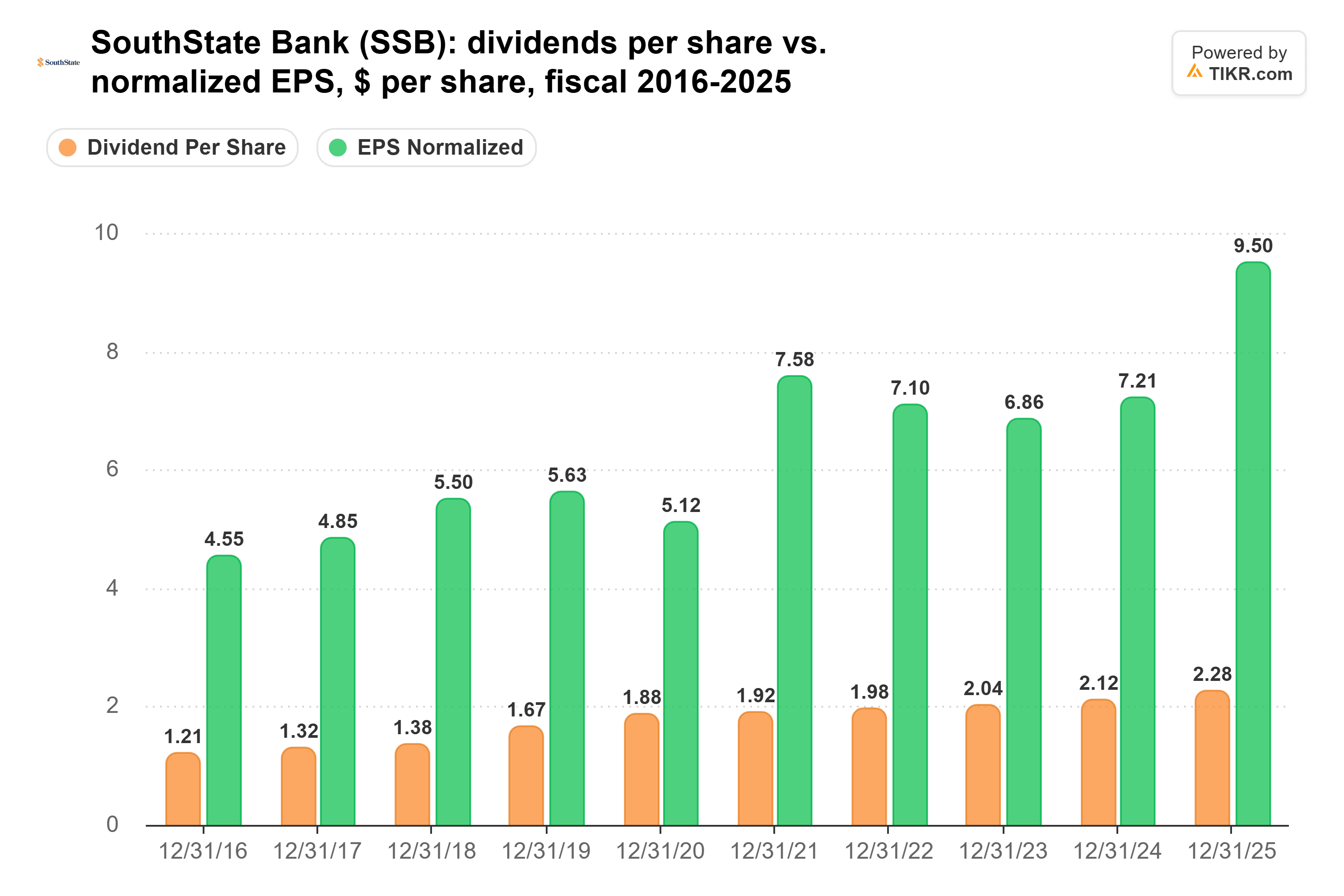
From fiscal 2016 to fiscal 2025, it never took more than 37% of normalized EPS.
CFO William Matthews said a total payout of 40% to 60%, buybacks included, “makes sense for a company that’s a growth company in growth markets like ours.” With the dividend taking about a quarter of earnings, the buybacks are what would give, and management calls growing the dividend alongside earnings its first capital priority.
I’d take PNC’s check
U.S. Bancorp’s dividend is the least covered of the three, so it’s the most at risk of a cut. That doesn’t make it risky: a 44% payout ratio leaves plenty of room.
Going cheap doesn’t save much, either. U.S. Bancorp’s position costs about $6,700 less than PNC’s, for a dividend that’s less covered and grew about half as fast from fiscal 2020 to fiscal 2025. SouthState’s dividend is the safest of the three, but it costs about $137,000 more than U.S. Bancorp’s for the same $1,000 a month. And at their 5-year growth rates, PNC’s 1,500 shares would pay about $23,000 a year by year 10, against about $17,000 for either of the others.
If I could collect my $1,000 a month from only one of these banks, I’d take PNC’s check. It costs barely more than the cheapest one, it’s well covered, and it’s growing the fastest.
PNC’s fourth-quarter report early next year is the next test. A net interest margin of 3% or better, from 2.94% in the third quarter, would keep its earnings growth on track.
Forget PNC Financial Services Group: 6 safe 6%+ dividend yields you can buy right now
Dividends can hold the key to enormous wealth. But only if you buy the right ones.
Picking the right high-yield dividend stock can be the difference between a dream retirement…and scraping by every month, waiting for the next Social Security check to clear.
We’ve identified six stocks yielding 6%+ that we believe every retiree should know about right now. (And PNC Financial Services Group isn’t one of them.)
Disclaimer:
Please note that the articles on TIKR are not intended to serve as investment or financial advice from TIKR or our content team, nor are they recommendations to buy or sell any stocks. We create our content based on TIKR Terminal’s investment data and analysts’ estimates. Our analysis might not include recent company news or important updates. TIKR has no position in any of the stocks mentioned. Thank you for reading, and happy investing!