Key Takeaways
- Hormel Foods yields 5.1% and TotalEnergies 4.7%, and their dividends grew 4.5% and 4.9% a year from fiscal 2020 to fiscal 2025.
- Hormel’s dividends took 82% of its free cash flow over the last twelve months, against 51% at TotalEnergies.
- Hormel just closed a $1.055 billion chicken acquisition, partly paid for with $700 million of new borrowing.
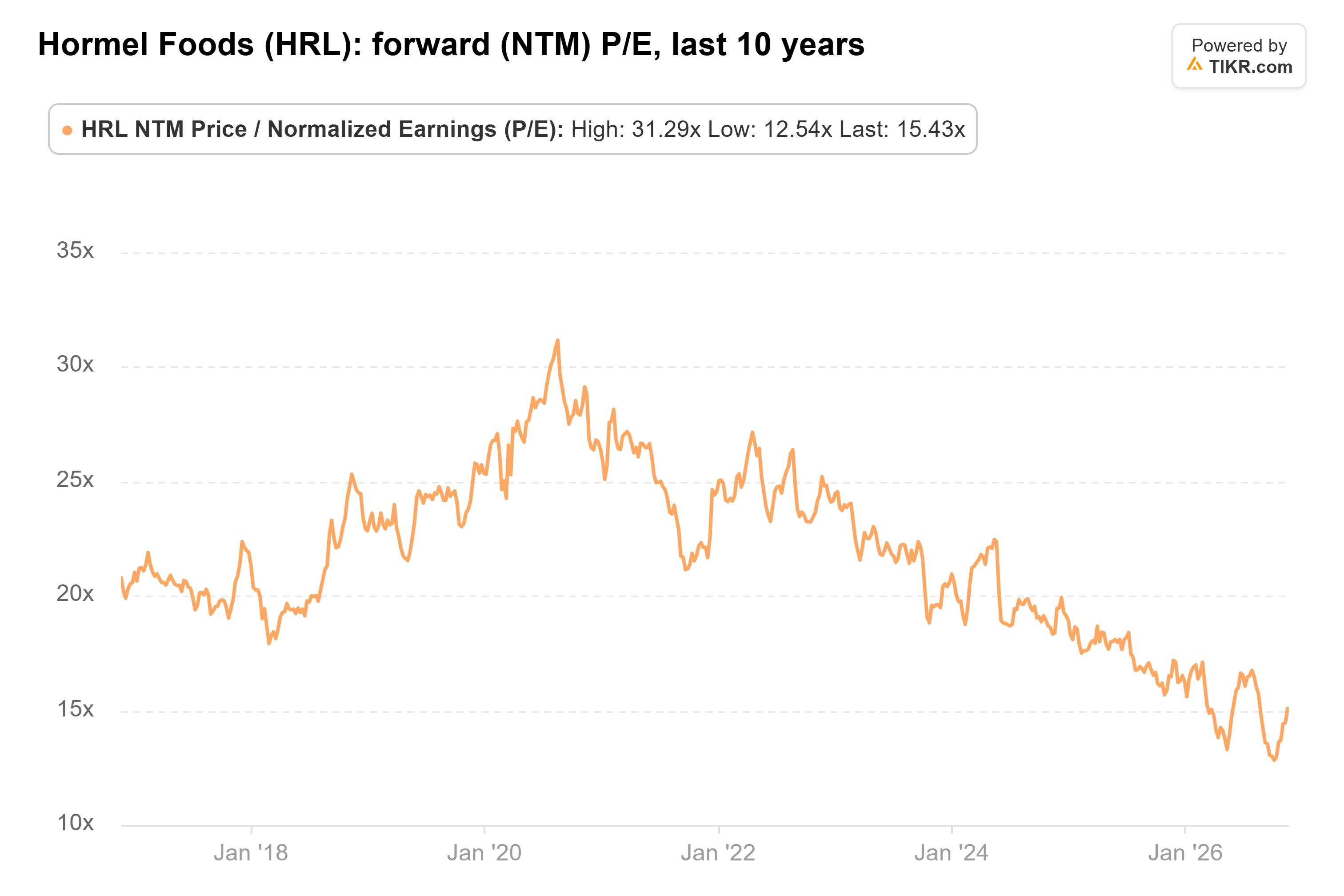
- Hormel trades at 15x forward earnings, well below its 10-year average of 22x.
If you’re buying a dividend stock to hold for 20 years, you’re betting on whether the company can keep paying, and raising, through the bad years in between.
That makes Hormel Foods (HRL) and TotalEnergies (TTE) a tougher choice than it looks. Hormel yields 5.1% and said on its third-quarter call that it had reached its “392nd consecutive quarterly payout.” TotalEnergies yields 4.7%, and on Oct. 29 it raised its 2026 cash flow outlook.
So if I can only hold one for the next 20 years, which is it?
| Metric | Hormel Foods (HRL) | TotalEnergies (TTE) |
|---|---|---|
| Dividend yield | 5.1% | 4.7% |
| Dividend growth, fiscal 2020 to fiscal 2025 | 4.5% a year | 4.9% a year |
| Cash dividend payout ratio (TTM) | 82% | 51% |
| Net debt/EBITDA | 1.2x | 0.5x |
| Interest coverage | 12.6x | 10.2x |
| Forward P/E | 15x | 8.3x |
Source: TIKR. Trailing twelve months to July 26, 2026 for Hormel and June 30, 2026 for TotalEnergies.
6 safe dividend stocks paying retirees 6%+ yields
There are over 100 stocks paying 6%+ annual dividends today.
But after an extensive investment review leveraging TIKR’s proprietary data, we now believe only six of them are truly safe for retirees.
They’re all yours as part of our new investment report. Learn more about how to get access right here.
Hormel is spending big on chicken
Hormel’s retail business is shrinking while its foodservice business grows. In the quarter ended July 26, organic sales fell 2%, while Foodservice grew for a 12th straight quarter. Management still raised its fiscal 2026 adjusted EPS guidance to $1.45-$1.51, up 6% to 10%. Then, on Nov. 16, it closed its $1.055 billion purchase of Brakebush Brothers, which it expects to roughly triple its chicken business by net sales, after borrowing $700 million on Nov. 13 to help pay for it.
What worries me over 20 years is that Hormel’s dividend has outgrown its cash. Free cash flow was $785 million in fiscal 2016 and $778 million in fiscal 2023, while dividends paid doubled from $296 million to $593 million:

In fiscal 2025, the year ended October 2025, $534 million of free cash flow didn’t cover $633 million of dividends. Coverage is back to a tight 82% over the twelve months to July. John Ghingo, who became CEO on Oct. 26, said on the third-quarter call, “Certainly, the dividend continues to be very important to us.” I believe him, but 82% leaves little room for new interest costs or another weak year for shoppers.
TotalEnergies has room to spare
TotalEnergies’ cash swings far more than Hormel’s, but it starts with a much bigger cushion. In the third quarter of 2026, production rose more than 3% from the second quarter and refining posted record results, lifting cash flow to $12.3 billion. Management now expects more than $42 billion for the year.
Its free cash flow has run from negative $1.59 billion in fiscal 2016 to $33.7 billion in fiscal 2022, while dividends paid rose from $2.79 billion to $8.42 billion in fiscal 2025:
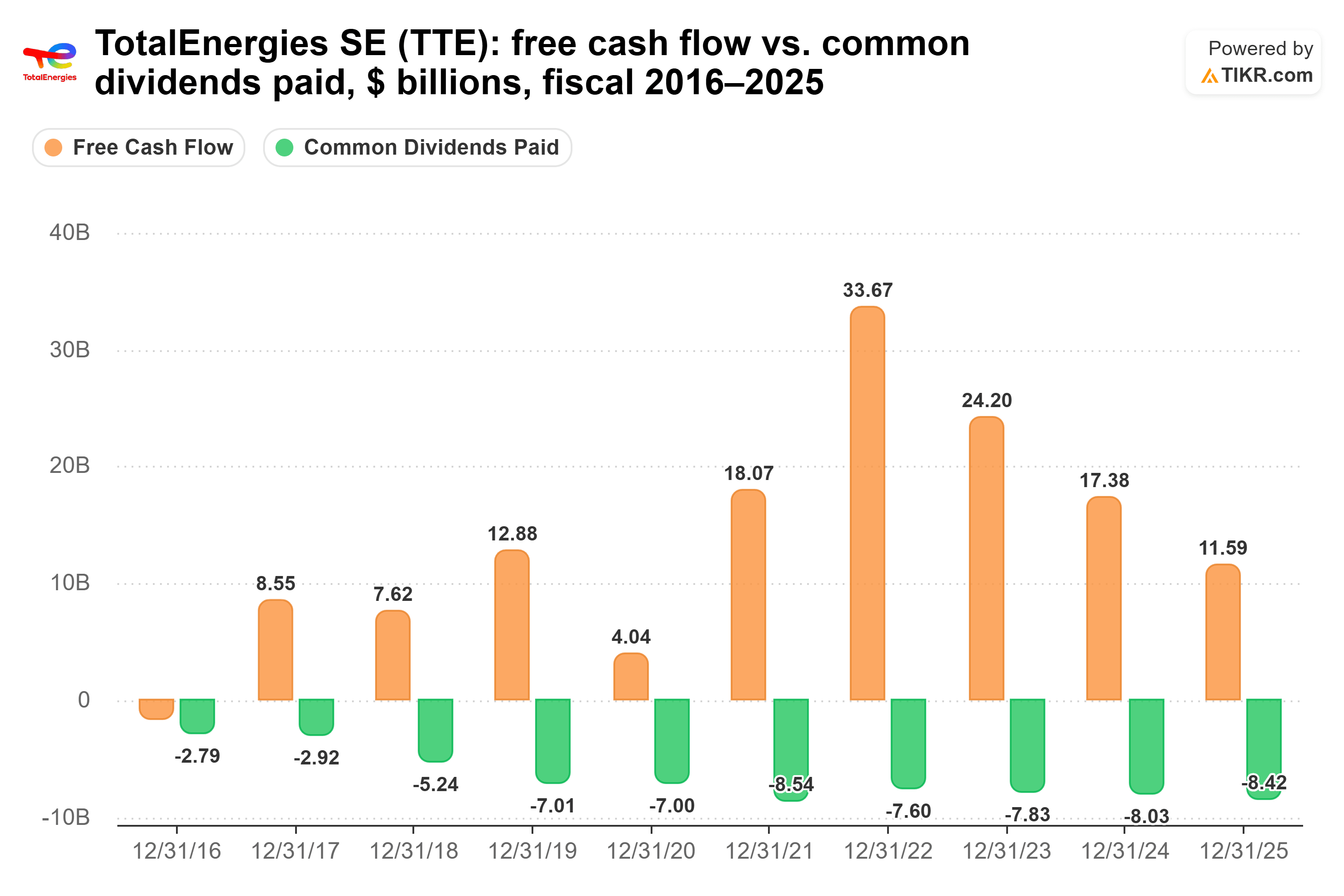
In fiscal 2020, free cash flow fell to $4.04 billion, and TotalEnergies still paid $7.00 billion in dividends, in line with fiscal 2019’s $7.01 billion. Dividends took 72.7% of free cash flow in fiscal 2025 and a comfortable 51% over the twelve months to June 30. It said on its Oct. 29 call that a strong year could add $400-500 million (about €0.20 a share) to the final 2026 dividend, which it decides in February.
The dividend is set in euros, so what US holders receive moves with the exchange rate, and France withholds tax on it. The main risk is the Middle East, where the conflict still limits its LNG exports through the Strait of Hormuz.
So which dividend wins?
If I can only pick one dividend stock for the next 20 years, I’m picking TotalEnergies. Its 51% payout ratio and 0.5x net debt to EBITDA give it far more room than Hormel’s 82% and fresh borrowing. And it has already paid through a year like fiscal 2020.
Hormel still makes a strong case. At their five-year growth rates, $10,000 in Hormel pays about $16,031 over 20 years against about $15,300 in TotalEnergies. Hormel’s check reaches about $1,181 a year by year 20, an 11.8% yield on the original $10,000, and TotalEnergies wouldn’t out-earn it until about 2052. And the stock is cheap against its own history, at 15x forward earnings against a 10-year average of 22x:
Hormel’s 5.1% yield only pays off over 20 years if the cash keeps up, and Hormel’s free cash flow hasn’t for years. Of course, Hormel gives its fiscal 2027 outlook and more on Brakebush on its Dec. 3 call, and a clear path to rebuilding free cash flow would make this a much closer call.
Forget TotalEnergies: 6 safe 6%+ dividend yields you can buy right now
Dividends can hold the key to enormous wealth. But only if you buy the right ones.
Picking the right high-yield dividend stock can be the difference between a dream retirement…and scraping by every month, waiting for the next Social Security check to clear.
We’ve identified six stocks yielding 6%+ that we believe every retiree should know about right now. (And TotalEnergies isn’t one of them.)
Disclaimer:
Please note that the articles on TIKR are not intended to serve as investment or financial advice from TIKR or our content team, nor are they recommendations to buy or sell any stocks. We create our content based on TIKR Terminal’s investment data and analysts’ estimates. Our analysis might not include recent company news or important updates. TIKR has no position in any of the stocks mentioned. Thank you for reading, and happy investing!