Key Takeaways
- Elon Musk said on X that cities on the Moon and Mars need about a megaton a year sent to orbit, or about 5,000 Starship flights a year at his 200-ton payload figure.
- That’s roughly 47x the twice-weekly pace Musk wants SpaceX (SPCX) to reach by the end of 2027, so how often Starship flies matters more to its value than reuse alone.
- Analysts expect SpaceX’s revenue to reach $338 billion in 2028, with nothing in it for cities on the Moon or Mars.
SpaceX caught a Starship from orbit for the first time on Nov. 14. Now Elon Musk says it will need to fly thousands of times a year.
This week, the X account ApoStructura pointed out that “If Starship were its own launch company, it would already be number 2 in the US by payload to orbit.”
Investor Shaun Maguire shared it, calling it an “Insane stat!”
Musk’s response? “About a megaton per year to orbit is needed to build self-sustaining cities on the Moon and Mars.”
That’s a million tons. Every year.
Do the math on a megaton
Earlier this week, Musk said on X that Starship’s “Propellant cost per flight will drop below $500k and payload will exceed 200 tons.”
At 200 tons per flight, a megaton takes 5,000 Starship launches a year, or about 14 a day.
For scale, Falcon 9 flew 165 times in 2025. Musk’s target is about 30x that, from a single rocket.
Starship isn’t close yet. On SpaceX’s Q3 call in October, Musk set the goal at weekly flights in the first half of 2027 and two a week by the end of the year.
Two a week is about 100 flights a year, so a megaton needs roughly 50x that pace.
TIKR tracks 42 analysts on SpaceX. How many say “Buy”?
See the full breakdown of Buy, Hold, and Sell ratings on SpaceX, along with Wall Street’s revenue and earnings estimates, all in one place. More than 500,000 investors use TIKR to research stocks like this one. See SpaceX’s Analyst Ratings.
Reuse is only the start
Fuel isn’t the obstacle. Even at Musk’s figure of under $500,000 a flight, 5,000 launches would burn about $2.5 billion of propellant a year.
The harder part is turning the rockets around. The Nov. 14 catch brought the ship home with its heat shield nearly intact.
But the booster catch failed because of a fuel-system problem, and SpaceX hasn’t set a date to fly the caught ship again.
The last two flights were about six weeks apart, one in late September and one in mid-November.
A rocket you can fly again once a month and one you can fly again every day are worth very different amounts. So for me, Starship’s value depends on how often it flies.
The cities don’t pay the bills
Of course, cities on the Moon and Mars won’t earn SpaceX anything for a long time, and analysts aren’t counting on them.
Consensus has SpaceX’s revenue climbing from $49.0 billion in 2026 to $338 billion in 2028:
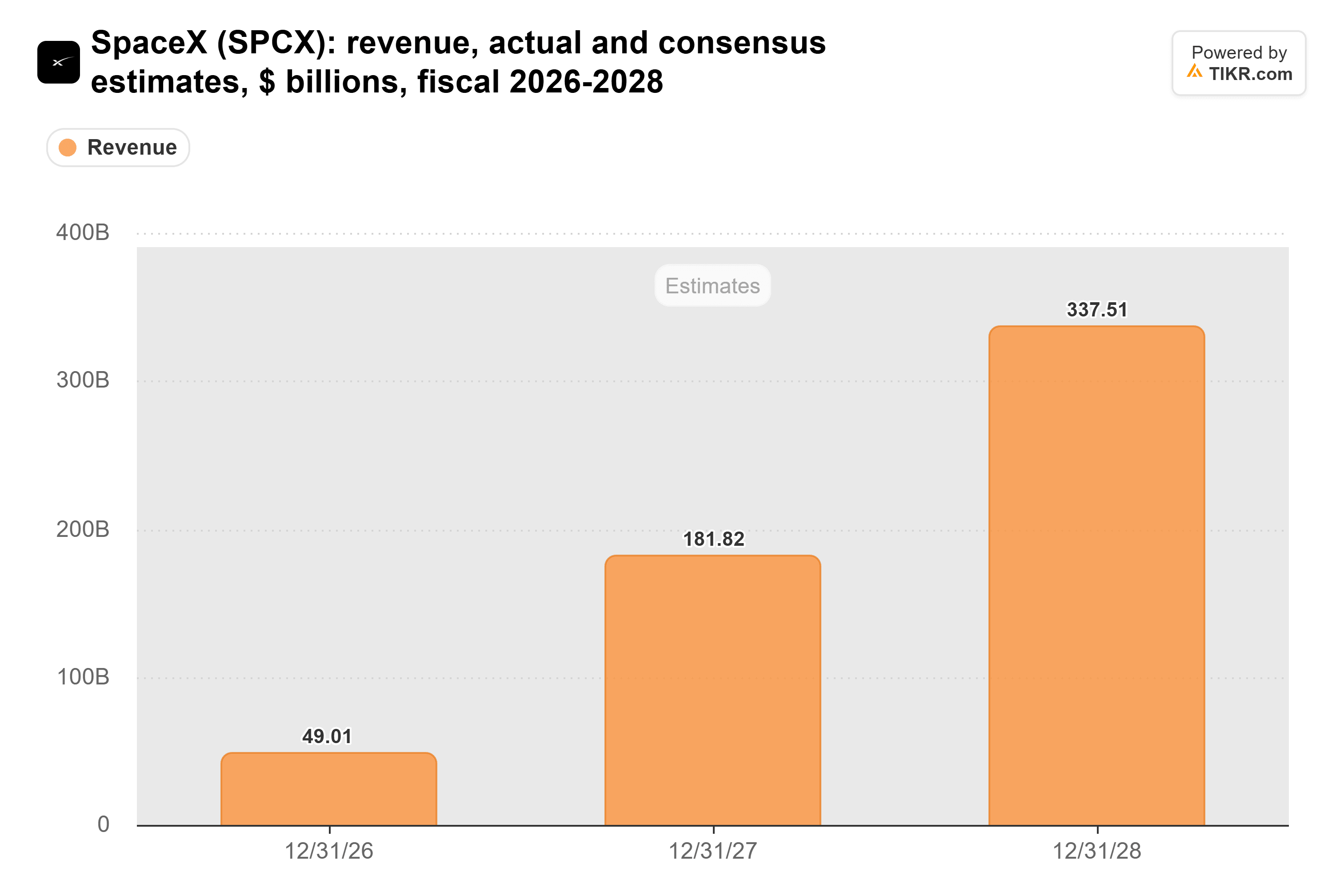
That growth comes from Starlink and from renting out AI compute.
But the flight rate a megaton needs would pay off on Earth first. SpaceX says one full Starship can carry up to 60 Starlink V3 satellites, 20x the capacity of a Falcon 9 launch.
Starlink is where the profit is today: it earned $5.2 billion of operating income in the first nine months of 2026. I read the megaton as a production target, and every step toward it makes Starlink cheaper to expand.
Rockets compete with data centers for cash
SpaceX’s capital spending nearly quintupled from 2023 to 2025:
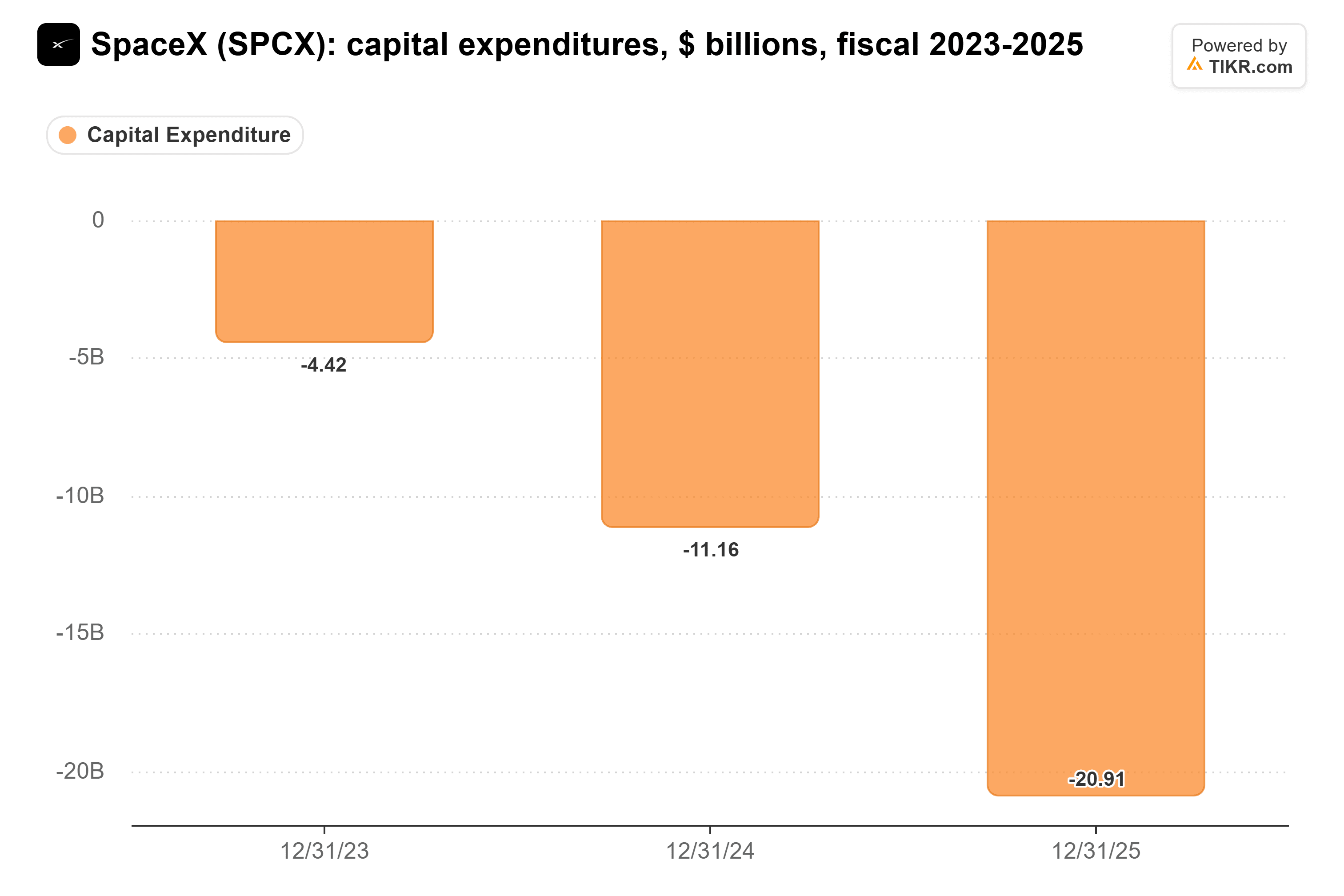
Most of today’s spending goes to data centers, though.
The Super Intelligence segment took $40.0 billion of SpaceX’s $48.1 billion of capex in the first nine months of 2026.
Analysts expect SpaceX’s free cash flow to be negative $150 billion in 2027. So a fleet built to fly thousands of times a year would compete with the AI buildout for every dollar.
Watch the flight count
A megaton a year really does mean about 5,000 Starship flights, so the number to watch is how often Starship flies.
Next up: a booster catch, a second flight for the ship caught on Nov. 14, and the weekly flights Musk wants in the first half of 2027.
If Starship is still flying about every six weeks by mid-2027, the megaton will stay a slogan for a long while.
So what is SpaceX stock actually worth?
TIKR lets you forecast the future price of any stock in less than a minute. Just enter a few assumptions into TIKR’s valuation model and see what SpaceX could be worth. Start from Wall Street consensus estimates, or adjust the inputs to reflect your own view of the business. It’s free to use.
Disclaimer:
Please note that the articles on TIKR are not intended to serve as investment or financial advice from TIKR or our content team, nor are they recommendations to buy or sell any stocks. We create our content based on TIKR Terminal’s investment data and analysts’ estimates. Our analysis might not include recent company news or important updates. TIKR has no position in any of the stocks mentioned. Thank you for reading, and happy investing!