


Key Takeaways
- Microsoft said it will scale its Maia chips to multi-gigawatt deployments starting next calendar year, and Elon Musk named scaling power as the hard part of AI.
- Chip companies and app companies are moving into each other’s businesses, and power is the one input none of them can copy quickly, which favors Vistra, Constellation Energy and GE Vernova.
- Analysts expect Constellation’s normalized EPS to reach $13.29 in fiscal 2027 and GE Vernova’s revenue to reach $60.7 billion in fiscal 2028.
- Vistra has lost nearly a fifth of its value over the past year even though its adjusted EBITDA rose in 2025, so these stocks can trade on the AI mood more than on their own results.
Microsoft (MSFT) just made what CEO Satya Nadella called “our biggest bet yet on our own silicon.”
In a post on X last week, Nadella said Microsoft will scale its Maia chips “to multi-gigawatt deployments” starting next calendar year. He added that the new Maia 300 delivers “40% more tokens per watt compared to leading GPU-based systems.”
Even Microsoft’s pitch for its own chip is measured in watts.
Venture capitalist Chamath Palihapitiya took it further: “In AI, it is increasingly true that everyone competes with everyone.” Then he asked what that leaves to build margins around: “Is it distribution? Is it a data moat? Is it a physical constraint like power?”
Elon Musk’s answer? “Scaling power harnessed, along with super fast construction, cooling, networking and batteries. This is hard.”
Power is the input nobody can copy fast
Microsoft can design its own chips. A chipmaker can build its own apps. Neither can conjure a power plant in a quarter.
Morgan Stanley (MS)‘s Ariana Salvatore made the same point on this week’s episode of Thoughts on the Market. For investors, she said, “the central question may be less about how much companies are willing to spend on AI, and more about how quickly and at what cost they can secure the power needed to support it.”
Three stocks stand out to me as built for that question.
Vistra’s business is holding up better than its stock
Vistra (VST) is the one the market likes least right now. The stock has lost nearly a fifth of its value over the past year, yet Jefferies (JEF) has a $298 price target on it, nearly 90% above where the stock traded on Oct. 13.
Its operating margin climbed from negative territory in fiscal 2021 and 2022 to 23.9% in fiscal 2024, then slipped to 12.5% in fiscal 2025.

Part of that 2025 dip comes from hedge accounting. Vistra’s $944 million of 2025 net income included an $808 million unrealized pre-tax loss on hedges that settle in future years, and its adjusted EBITDA from ongoing operations rose to $5.91 billion.
Plus, it has signed long-term nuclear power deals with Meta Platforms (META) and Amazon (AMZN), two of the very companies Chamath says will soon compete with everyone.
Constellation’s earnings keep climbing
Constellation Energy (CEG) shows how lasting analysts think this is. Its normalized EPS rose from $5.34 in fiscal 2023 to $9.39 in fiscal 2025, and the 20 analysts covering it expect $12.13 this year and $13.29 in fiscal 2027.
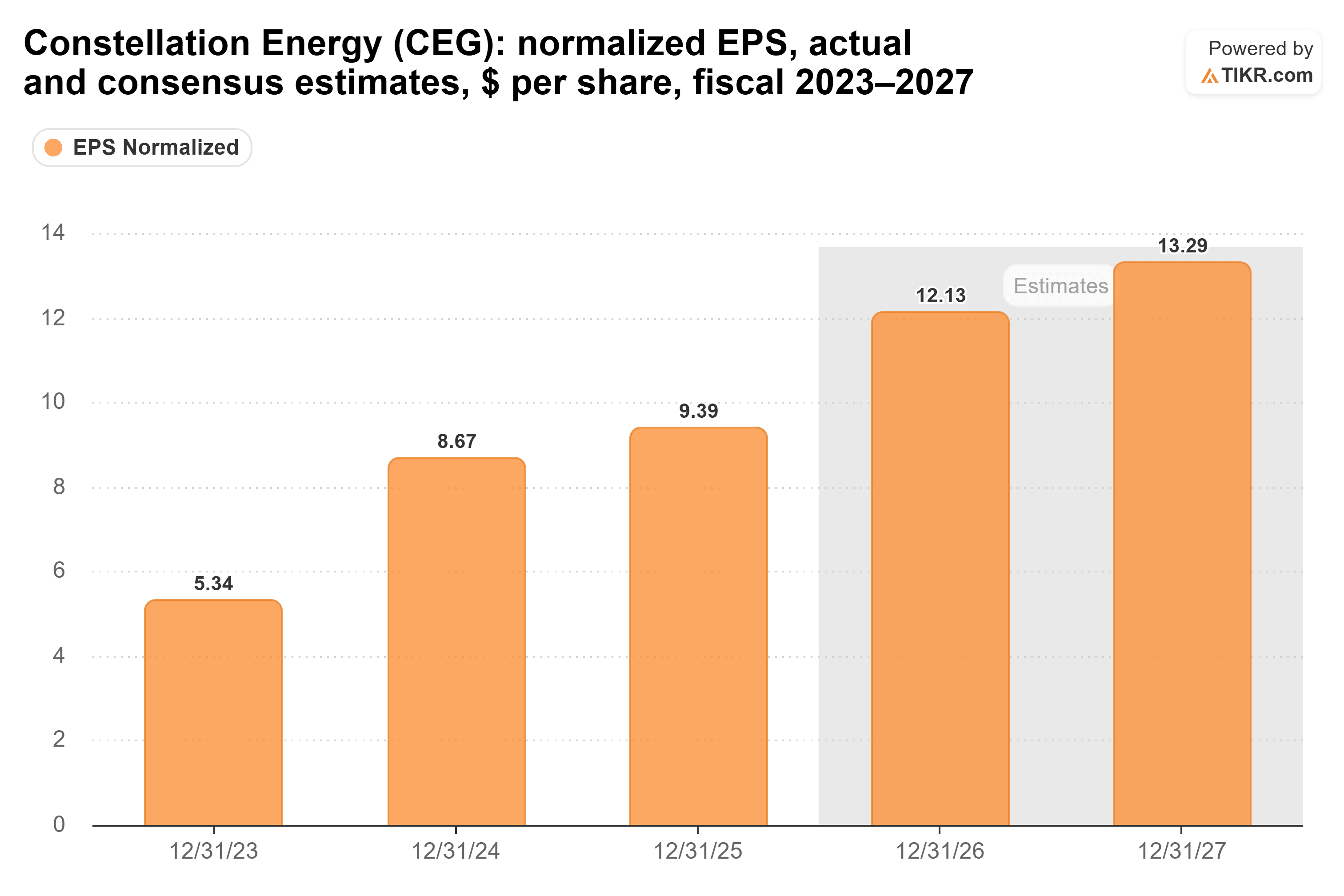
That would be about 2.5x its fiscal 2023 earnings. And with Microsoft now planning for multi-gigawatt deployments, nothing in last week’s news argues for cutting those estimates.
GE Vernova doesn’t have to pick a winner
Then there’s the company that gets paid whoever wins the fight over chips and apps. Every new plant and grid hookup needs turbines and grid equipment, and GE Vernova (GEV) supplies both.
It’s the oldest play in the gold-rush playbook: sell the picks and shovels. Same deal here.
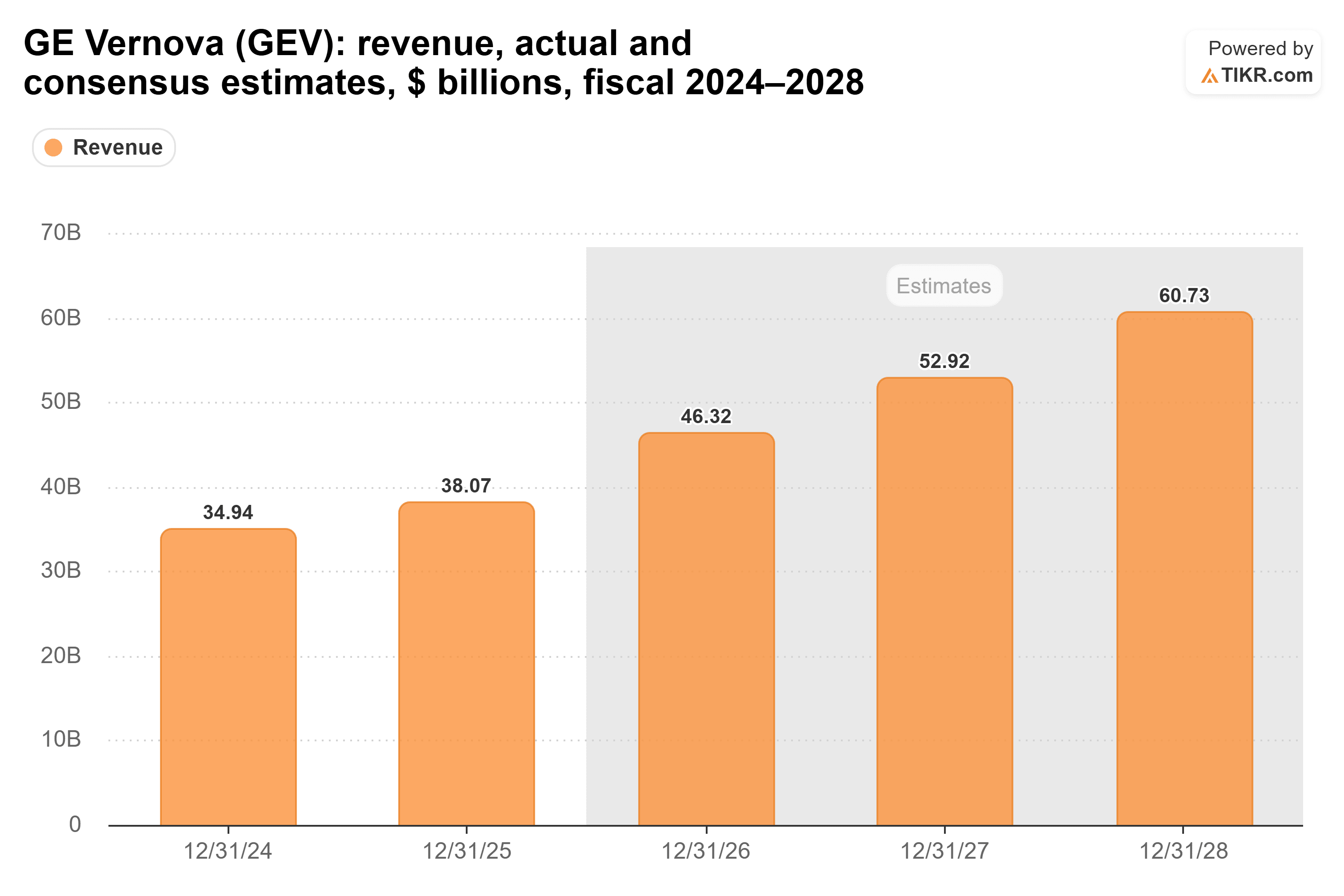
Revenue grew from $34.9 billion in fiscal 2024 to $38.1 billion in fiscal 2025, and consensus has it reaching $60.7 billion by fiscal 2028, nearly 60% above last year’s.
Power is the slowest fix on Musk’s list
To be fair, Musk didn’t name power alone. He listed construction, cooling, networking and batteries in the same breath, and each of those is a big market too.
But cooling gear, network switches and battery packs come out of factories, and companies can build more factories. Power needs plants, permits and grid connections, and Salvatore says Washington now has a big say in how fast those come. Decisions on “electricity infrastructure, permitting, and affordability,” she said, “could become just as important in determining how quickly that investment translates into operational capacity.”
The risk is that these stocks move with the mood around AI. Vistra fell nearly a fifth in a year while its adjusted EBITDA grew, so a scare over AI spending can drag all three down whatever their results say.
The upshot
All three make money from the input that the AI build can’t route around. Vistra and Constellation sell the power, and GE Vernova sells the gear to make and move it.
If I had to pick one today, it’s Vistra. Its business grew last year while its stock went the other way, and that gap is the opportunity.
Of course, the permitting bill Salvatore discussed is “far from guaranteed,” and the elections will shape what comes out of it.
So what is Vistra stock actually worth?
TIKR lets you forecast the future price of any stock in less than a minute. Just enter a few assumptions into TIKR’s valuation model and see what Vistra could be worth. Start from Wall Street consensus estimates, or adjust the inputs to reflect your own view of the business. It’s free to use.
Disclaimer:
Please note that the articles on TIKR are not intended to serve as investment or financial advice from TIKR or our content team, nor are they recommendations to buy or sell any stocks. We create our content based on TIKR Terminal’s investment data and analysts’ estimates. Our analysis might not include recent company news or important updates. TIKR has no position in any of the stocks mentioned. Thank you for reading, and happy investing!


