
Key Stats for Microsoft Stock
- Current Price: $530.14
- Target Price (Mid): ~$1,290
- Street Target: ~$606
- Potential Total Return: ~143%
- Annualized IRR: ~21% / year
What Happened?
Microsoft (MSFT) CFO Amy Hood told analysts on October 28 that the company has access to the debt markets but “we haven’t yet, I would say, tapped that.” Bloomberg reported a deal in the works on October 29, and that evening Microsoft priced $25 billion of senior unsecured notes in ten tranches maturing from 2028 to 2066, its first U.S. investment-grade bond sale since 2017, per Bloomberg. Shares closed down 0.16% that day, giving back an after-hours jump of about 4% on 48% Azure growth, as Alphabet tumbled after its own report.
What the $25 Billion Costs and What It Can Pay For
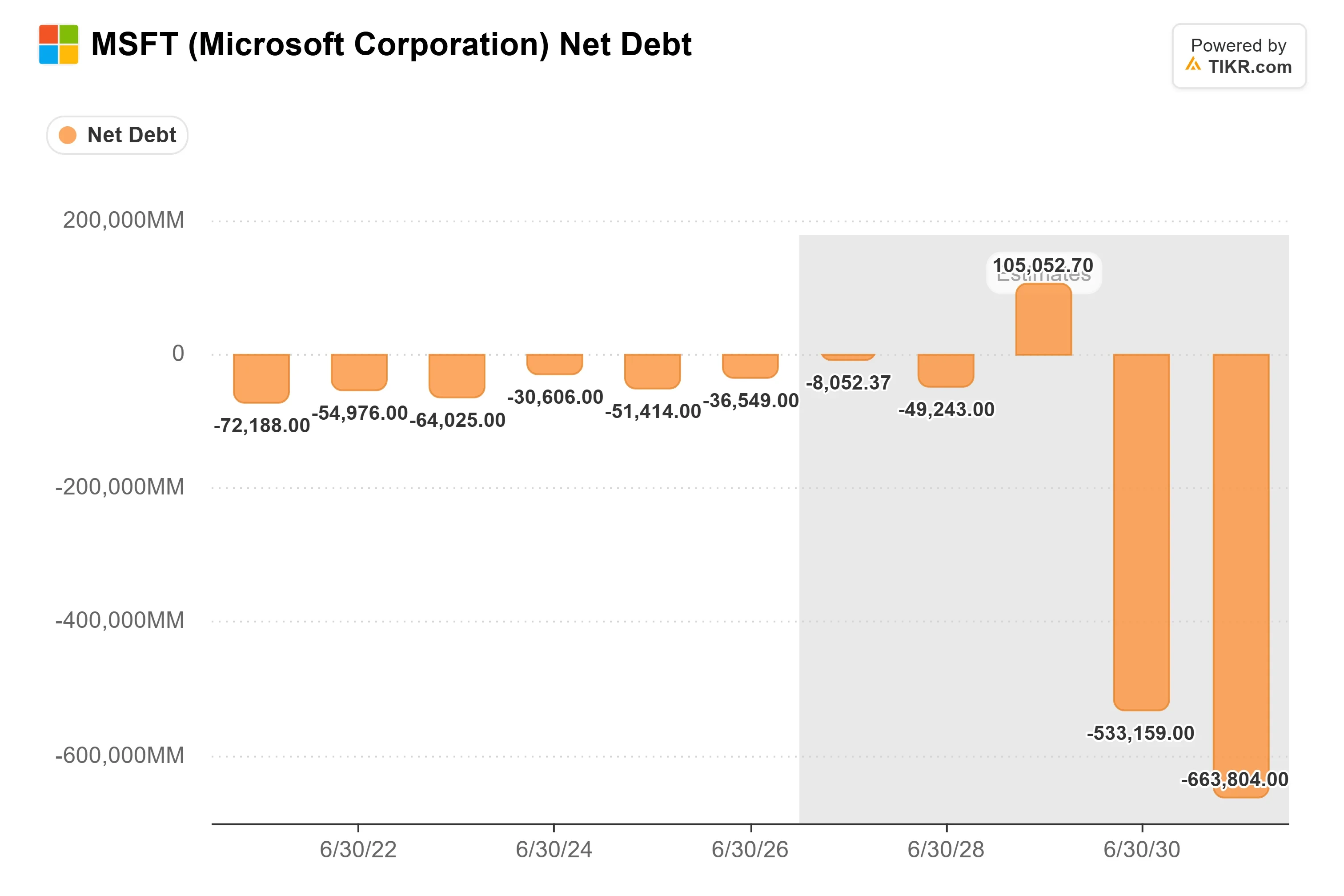
The fixed-rate notes carry coupons from 4.85% to 6.35%. Before the deal priced, Hood had guided fiscal Q2 other income to about negative $300 million, excluding OpenAI, because interest expense, including data center finance lease interest, would more than offset interest income. Hood said Microsoft has been using leasing as a financing “vehicle,” and the notes add a second source. Microsoft says the proceeds are for general corporate purposes, which may include capex, buybacks, acquisitions and debt repayment. It had $46.14 billion of long-term debt at June 30, with $9.25 billion due in fiscal 2027, and $36.55 billion of net cash per TIKR.
Fiscal Q1 operating cash flow rose 29% to $58 billion, but $39.4 billion of cash paid for property and equipment left free cash flow at $18.6 billion, down from $25.66 billion a year earlier. Hood guided Q2 capex above $50 billion and expects spending to accelerate in the second half, mainly on CPUs and GPUs plus third-party capacity deliveries that slipped into that period. Those delays cut her calendar 2026 capex estimate to about $170 billion. CoreWeave and Nebius, which supply Microsoft with outside capacity, fell 4.99% and 5.68% on October 29 after Microsoft and Alphabet both reported lighter capex.
Hood’s case is that, as Microsoft improves its infrastructure efficiency, each dollar of capex “has the potential to support more revenue and higher returns over time.
TIKR tracks 56 analysts on Microsoft. How many say “Buy”? See the full breakdown of Buy, Hold, and Sell ratings on Microsoft, along with Wall Street’s revenue and earnings estimates, all in one place. More than 500,000 investors use TIKR to research stocks like this one. See Microsoft’s Analyst Ratings
The Azure Guide Leans on Efficiency Microsoft Still Has to Find
Hood guided Azure growth of 49% to 50% in constant currency for fiscal Q2, with fleet efficiency gains helping offset some third-party GPU contracts delayed to the second half. She said the guide needs more of those gains: “We need to find some more, which we’re counting on.” She also flagged token pricing as a swing factor after higher-than-expected pricing helped Q1.
Two signals were softer. Commercial bookings fell 12% against large Azure commitments signed a year earlier, and TIKR shows Hold ratings rising to five from two at the end of September, while Buy ratings edged up to 40 from 39. Several banks raised targets, including Citi to $680 and Wells Fargo to $750, both above TIKR’s Street mean of about $606.
TIKR Advanced Model Analysis
- Current Price: $530.14
- Target Price (Mid): ~$1,290
- Potential Total Return: ~143%
- Annualized IRR: ~21% / year

The mid case assumes revenue compounds around 19% a year and net margins move toward around 40%, with the P/E multiple drifting down about 1% a year. Azure demand and higher revenue per user from Copilot and E7 seats drive sales. Fleet efficiency only partly offsets Azure’s lower margins, which is why Hood guided Microsoft Cloud gross margin to roughly 65% in Q2, down from a year earlier. The key risk is the one Hood named: the Azure guide depends on efficiency gains not yet found and on token pricing she described as uncertain. If those gains keep coming, revenue can outpace spending. If they stall while third-party delays persist, depreciation and interest costs rise before the revenue arrives.
Conclusion
The fiscal Q2 report early next year settles it. Azure growth of 49% or better with capex above $50 billion would show the buildout is meeting demand Microsoft can already see. A miss while capex keeps climbing would make the $25 billion look like a bridge to a slower payoff.
So what is Microsoft stock actually worth?
TIKR lets you forecast the future price of any stock in less than a minute. Just enter a few assumptions into TIKR’s valuation model and see what Microsoft could be worth. Start from Wall Street consensus estimates, or adjust the inputs to reflect your own view of the business. It’s free to use.
Analyze Microsoft on TIKR Free →
Disclaimer:
Please note that the articles on TIKR are not intended to serve as investment or financial advice from TIKR or our content team, nor are they recommendations to buy or sell any stocks. We create our content based on TIKR Terminal’s investment data and analysts’ estimates. Our analysis might not include recent company news or important updates. TIKR has no position in any stocks mentioned. Thank you for reading, and happy investing!