Key Takeaways
- Riot Platforms fell approximately 33% over the past month through October 28, as investors reassessed the financing risks facing bitcoin miners expanding into AI data centers.
- Rising borrowing costs and concerns about funding AI infrastructure have pressured the sector, with CoreWeave’s debt-market troubles adding to investor uncertainty.
- Riot faces a major financing deadline on December 31, when its up-to-$573 million Morgan Stanley bridge facility matures. The company also previously expected to close a roughly $180 million AMD-related term loan.
- ATB Cormark’s $30 price target implies approximately 108% upside from Riot’s October 28 closing price, but reaching that target likely depends on securing financing without substantial shareholder dilution.
Riot Platforms (RIOT) has fallen approximately 33% over the past month through October 28, as investors reassess the financial risks facing bitcoin miners expanding into artificial intelligence infrastructure.
The weakness has extended to competitors, including MARA Holdings (MARA), as enthusiasm for AI data center development meets concerns about rising borrowing costs.
Despite the decline, Wall Street continues to see substantial potential in Riot’s long-term strategy.
On October 22, ATB Cormark Capital Markets lowered its price target on Riot from $36 to $30 while maintaining its Buy rating.
Based on Riot’s October 28 closing price of $14.45, that target represents approximately 108% upside.
The opportunity is significant, but investors now want evidence that Riot can finance its ambitious AI infrastructure expansion.
Why Riot Platforms Stock Has Fallen
The pressure on Riot reflects broader weakness among companies funding large AI infrastructure projects.
CoreWeave (CRWV) became a prominent example on October 14, when its shares declined more than 15% and some of its bonds briefly yielded more than 15%.
Those developments intensified concerns about the cost of financing AI data centers, particularly as higher interest rates make debt-funded construction projects more expensive.
On October 16, Cantor Fitzgerald reduced price targets across seven AI data center stocks, lowering its Riot target from $30 to $24.
The firm cited rising financing costs, pressure on property valuations, potential capital expenditure overruns, and execution risks.
Morgan Stanley and Piper Sandler also reduced their Riot price targets during October while maintaining favorable ratings.
The selloff therefore reflects concerns extending beyond Riot’s individual operations.
Companies developing AI infrastructure must commit substantial capital before their facilities begin generating contracted revenue. Higher borrowing costs can reduce the returns those projects ultimately deliver.
For Riot, that issue is especially important because the company is transitioning from bitcoin mining toward a more diversified data center business.
Riot’s AI Data Center Business Could Drive Long-Term Growth
Riot’s expansion into AI data centers has significantly changed its potential revenue profile.
Bitcoin mining accounted for approximately 92% of Riot’s segment revenue in the second quarter of 2025, compared with about 65% a year later.
The company has also secured approximately $9.8 billion in contracted data center revenue through agreements involving AMD and a leading frontier AI laboratory.
Once the contracted facilities are fully operational, management expects these agreements to generate approximately $520 million in average annual revenue.
The larger AI laboratory project is expected to require between $2.1 billion and $2.3 billion in construction spending.
Based on management’s projections, the project could generate between $365 million and $411 million in average annual net operating income, representing approximately 16% to 20% of estimated development costs.
These economics suggest Riot’s data center business could eventually become an important contributor to profitability.
The comparison with MARA also highlights how Riot’s business is changing. Riot reported $174 million in second-quarter 2026 revenue, including $23 million from data centers, while MARA generated approximately $175 million in total revenue during the same quarter.
Although their quarterly revenues were similar, Riot’s growing data center contribution and long-term AI agreements provide another potential source of revenue beyond bitcoin mining.
However, attractive projected returns do not eliminate the challenges associated with financing construction.
Riot’s existing Morgan Stanley bridge facility carries a floating interest rate of SOFR plus 2.75%, while the terms of its anticipated permanent financing remain uncertain.
That makes financing execution one of the most important factors affecting Riot’s valuation over the next 12 months.
Riot Faces a Critical December 31 Financing Deadline
Riot’s historical cash flows demonstrate why additional financing is necessary.
In fiscal 2025, operating activities consumed approximately $573 million in cash, while capital expenditures totaled another $422 million.
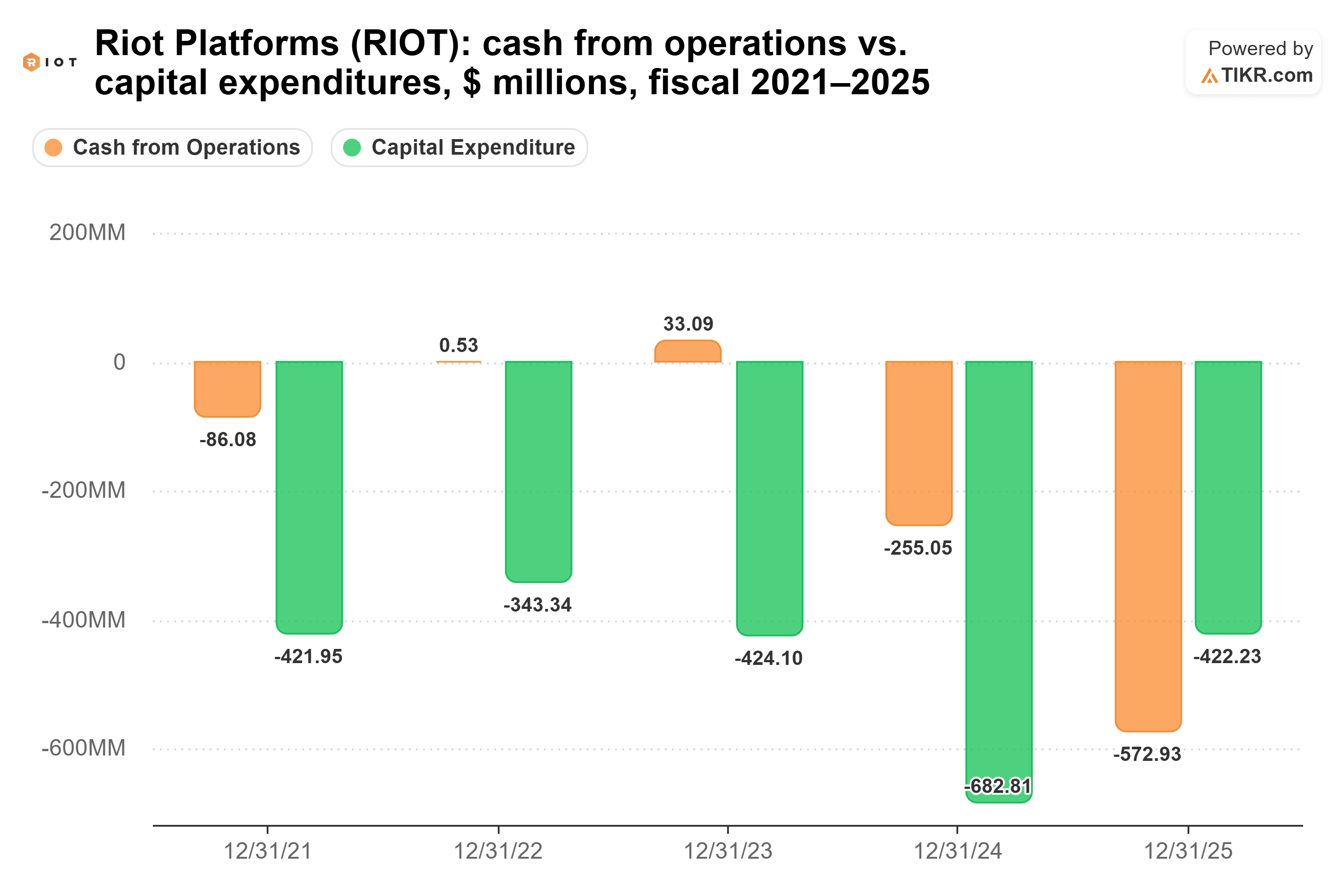
The chart illustrates Riot’s substantial historical cash requirements and the importance of external funding.
Its immediate challenge involves an up-to-$573 million interim financing facility provided by Morgan Stanley, which matures on December 31, 2026.
The facility supports development expenses associated with Riot’s AI data center expansion, but the maturity date arrives before the company expects to receive substantial revenue from its larger AI laboratory project.
The first 96 MW of that deployment is expected to begin generating rental revenue in December 2027.
During Riot’s second-quarter earnings call, Chief Financial Officer Jason Chung said management planned to “execute the takeout financing of this interim facility in the coming months.”
Management also previously expected to close a roughly $180 million term loan associated with AMD’s initial 25 MW deployment by September 30.
A confirmed refinancing arrangement would help reduce concerns about the company’s ability to complete development without issuing additional shares.
An equity offering at depressed stock prices could dilute existing shareholders, potentially reducing the benefits of future growth.
Riot’s financing strategy therefore remains central to its investment outlook.
Is Riot Platforms Stock Undervalued or Overvalued?
Riot appears undervalued based on the potential earnings contribution from its contracted AI data center projects, although its financing risks justify a meaningful discount.
Wall Street’s average price target declined from approximately $33 in late September to around $30 in the original TIKR data, reflecting greater caution about the company’s near-term outlook.
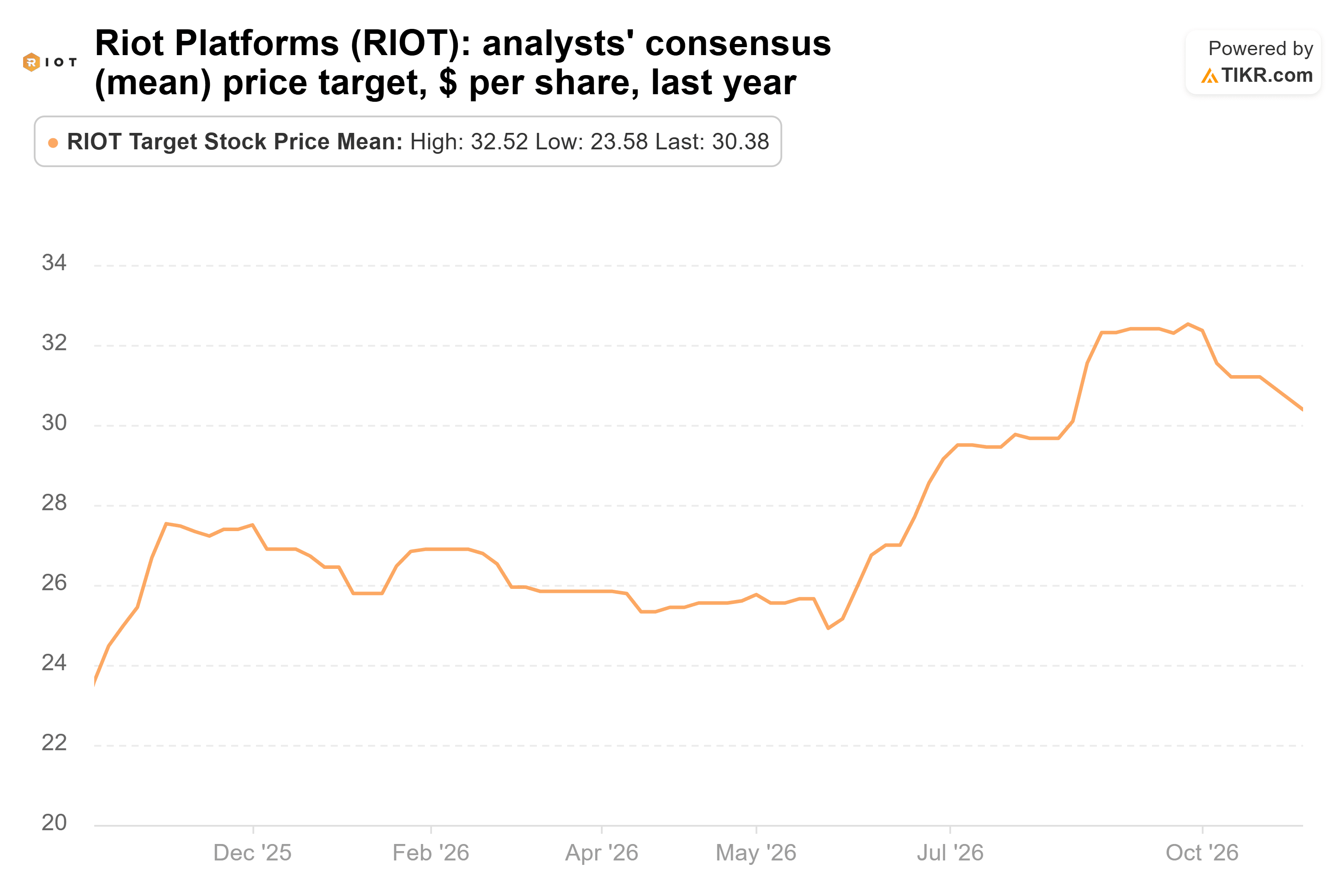
Even after those reductions, analyst targets remain substantially above Riot’s October 28 closing price.
The company’s valuation also provides context.
The original TIKR valuation snapshot placed Riot at approximately 6.7x forward sales, compared with a five-year average of 6.2x and a peak near 16x earlier in 2026.
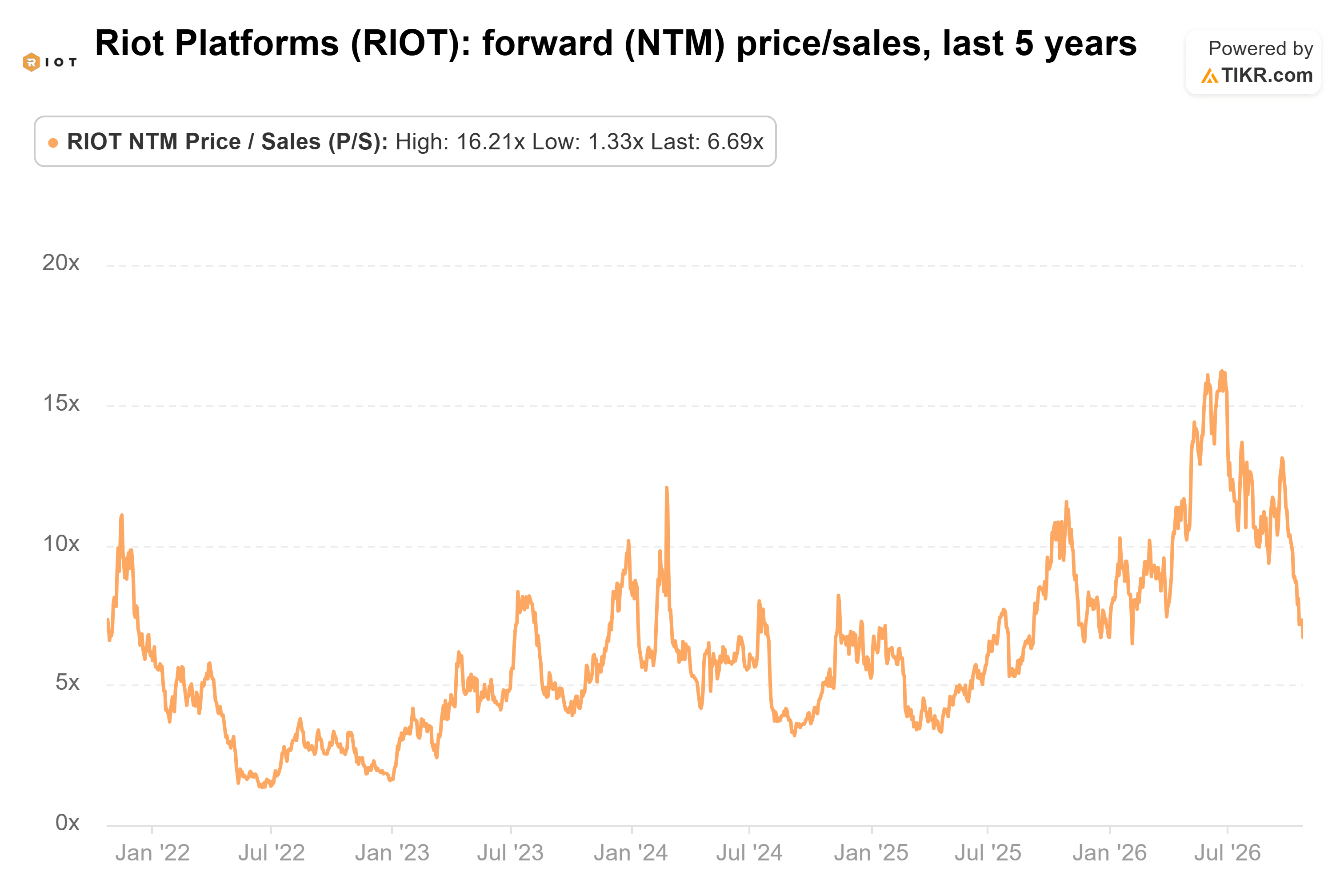
That valuation was considerably below the recent peak but still close to Riot’s historical average, suggesting a recovery toward $30 would require meaningful progress rather than simply a return to normal valuation levels.
Riot’s contracted AI data center agreements provide greater visibility into potential future revenue, while its substantial construction commitments create financing risks that investors cannot ignore.
Over the next 12 months, Riot’s stock performance will likely depend on securing permanent financing, advancing its AMD deployment, and demonstrating progress toward contracted rental revenue.
The company’s third-quarter earnings conference call is scheduled for November 4, 2026, at 8:00 a.m. ET, giving management an opportunity to update investors on its financing progress.
If Riot secures the AMD-related loan and completes refinancing of its Morgan Stanley facility without substantial dilution, ATB Cormark’s $30 target could become achievable.
If financing remains unresolved as December 31 approaches, the stock could face additional pressure despite the value of its contracted AI agreements.
Riot therefore looks undervalued based on its longer-term AI infrastructure potential, but the financing deadline remains the biggest obstacle to realizing that upside.
So what is Riot Platforms stock actually worth?
TIKR lets you forecast the future price of any stock in less than a minute. Just enter a few assumptions into TIKR’s valuation model and see what Riot Platforms could be worth. Start from Wall Street consensus estimates, or adjust the inputs to reflect your own view of the business. It’s free to use.
Disclaimer:
Please note that the articles on TIKR are not intended to serve as investment or financial advice from TIKR or our content team, nor are they recommendations to buy or sell any stocks. We create our content based on TIKR Terminal’s investment data and analysts’ estimates. Our analysis might not include recent company news or important updates. TIKR has no position in any of the stocks mentioned. Thank you for reading, and happy investing!