Key Stats for MU Stock
- Past week’s performance: 10.7%
- 52-week range: $114 to $1,255
- Valuation model target price: $1457
- Implied upside: 49.5% over 2.0 years
Value your favorite stocks like Micron with 5 years of analysts’ forecasts using TIKR (It’s free) >>>
A Sold-Out AI Memory Machine
Micron Technology (MU) climbed about 10.7% this week, and shares closed near $974 on Thursday. The jump came after Micron unveiled a new $10 billion AI memory research lab in Boise, Idaho. But that announcement only tells part of the story, because the real driver is how tight Micron’s chip supply has become.
Micron makes DRAM and NAND, which are the memory and storage chips used in phones, laptops, and AI data centers. Right now, its most important product is high bandwidth memory, or HBM, since this chip design feeds data to AI processors at very high speeds. Nvidia picked Micron’s HBM3E for its H200 and Blackwell GPUs, and Micron says it has already sold out its entire 2026 HBM supply, including upcoming HBM4 chips.

That sold out backdrop helps explain Micron’s blowout June quarter. Revenue surged 346% year over year to $41 billion, and it beat estimates easily. Adjusted EPS came in at $25.11, while analysts had expected $20.60. Gross margin jumped to about 85% from roughly 38% a year earlier, so profitability has changed dramatically in a short window.
The new lab adds a longer term angle to this story. Micron says the facility will focus on next generation memory, packaging, and compute architecture over the next decade. Because AI supply chains face growing political scrutiny, this move reinforces Micron’s commitment to U.S. manufacturing.
CEO Sanjay Mehrotra summed up the shift simply, saying, “Today there is no AI without memory.” That comment captures why investors now treat Micron less like a cyclical chipmaker and more like core AI infrastructure.
If MU stock keeps climbing toward $1,000, the next real test is whether AI demand can outrun the industry’s history of overbuilding supply. Going forward, the fiscal Q4 report on September 30 will show whether Micron’s own guidance holds up.
See analysts’ growth forecasts and price targets for MU (It’s free) >>>
Betting on the AI Memory Supercycle
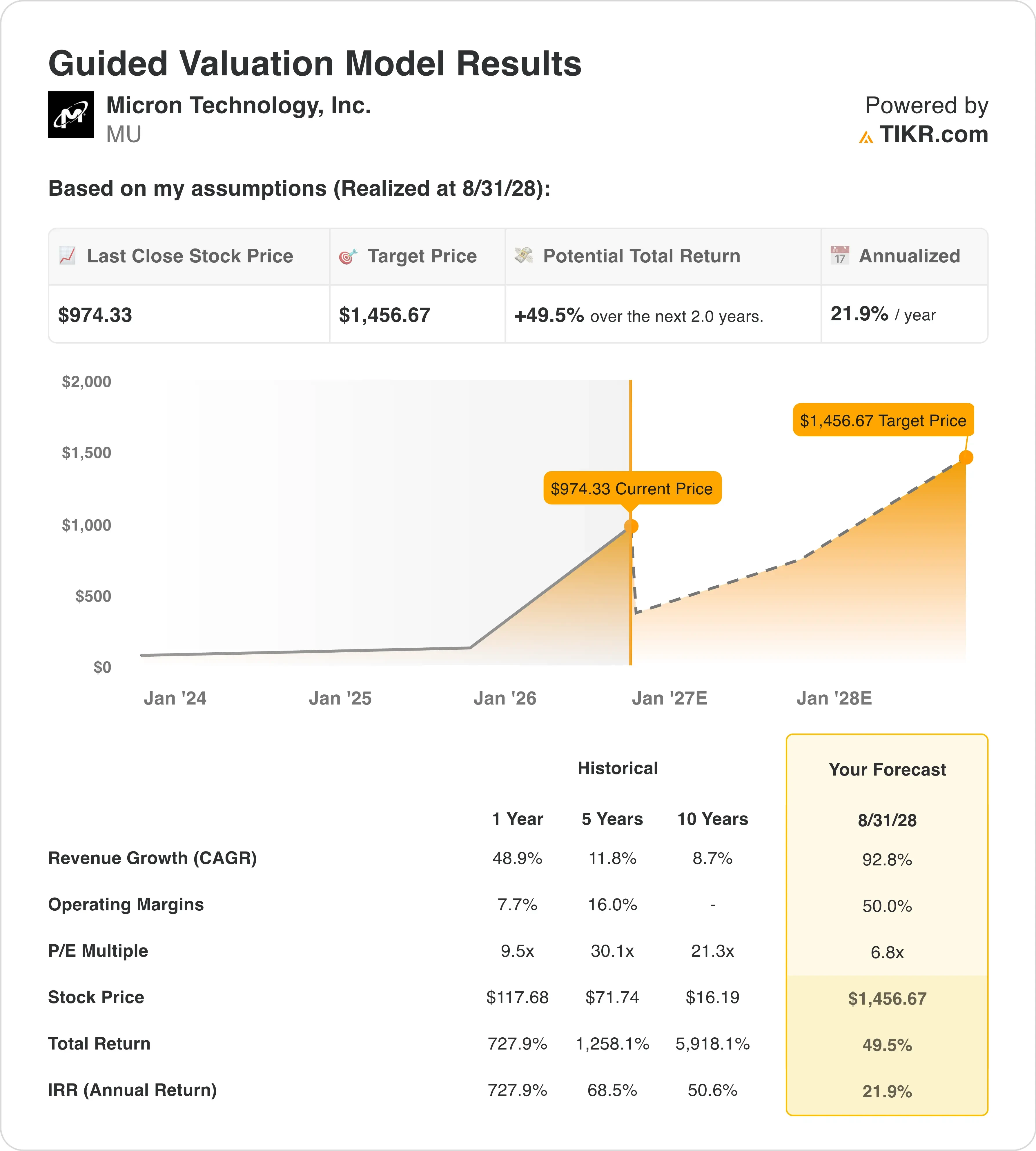
Under valuation model assumptions realized through 8/31/28, the stock is modeled using:
- Revenue Growth (CAGR): 92.8%
- Operating Margins: 50.0%
- Exit P/E Multiple: 6.8x
Based on these inputs, the model estimates a $1,457 target price, implying 49.5% upside over the next 2.0 years and a 21.9% annualized return.
Micron’s valuation looks unusual at first, because a $974 stock rarely trades at such a low forward multiple. But the low 6.8x multiple reflects how fast earnings have already grown this cycle. Since profits jumped so quickly, the model assumes some multiple compression even while the business keeps expanding.
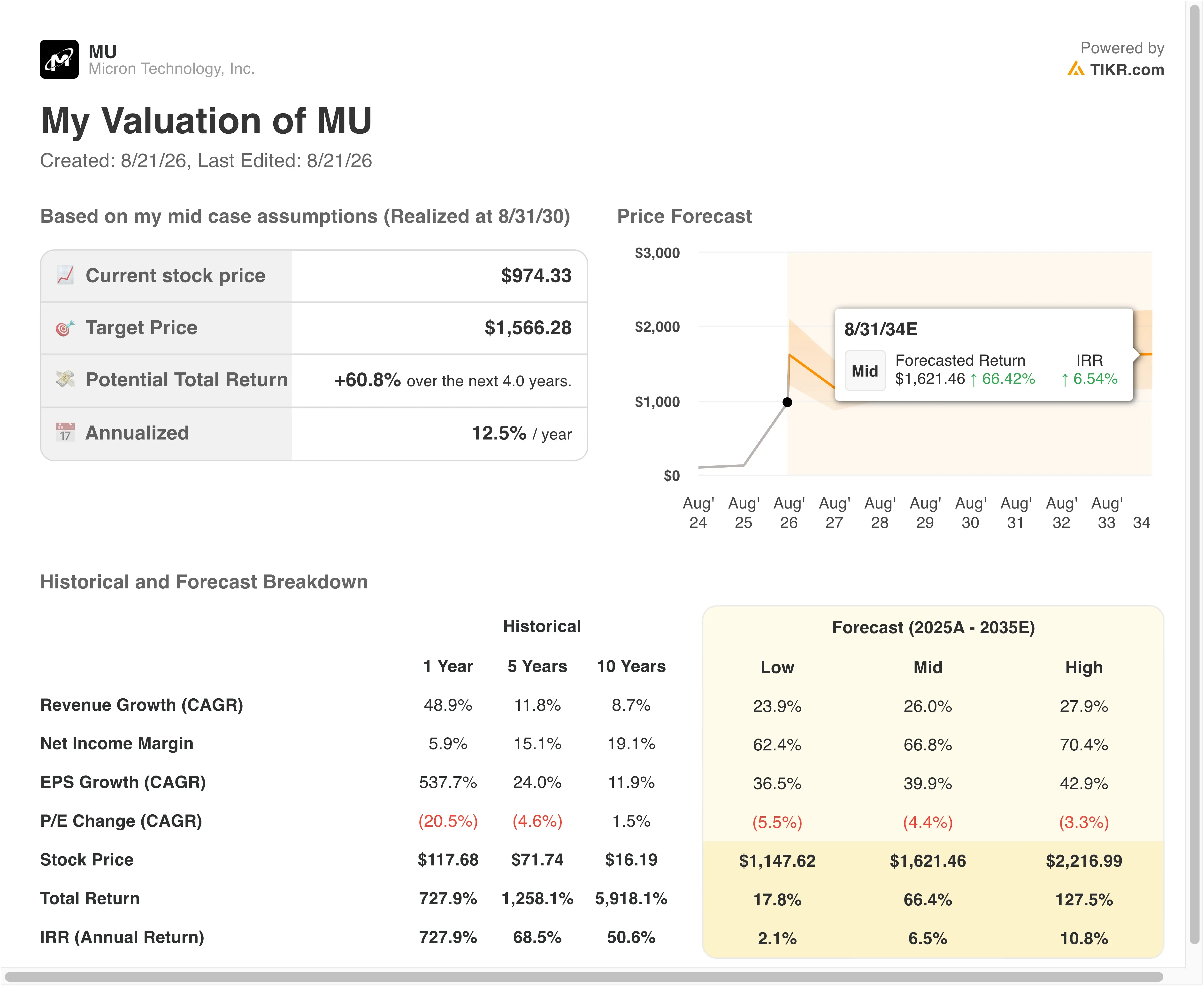
Whether that math works out depends almost entirely on how long AI memory demand lasts. Micron already has 2026 HBM supply sold out, so near term revenue growth looks secure. Margins are trickier, though, because memory pricing has historically snapped back once supply caught up with demand.
Product mix offers some protection here. Micron’s data center business, built around HBM and high capacity DRAM, carries structurally higher margins than its older consumer memory lines. As that mix keeps shifting toward AI customers, average profitability should hold up better than in past cycles, even if unit pricing eventually softens.
Compared with its own history, Micron’s current forward P/E sits well below its five and ten year averages. That gap shows investors still doubt how long this AI upcycle can run, and this skepticism becomes clearer once you compare Micron with its closest rivals.
Grab your own price target for Micron in under a minute (Free with TIKR) >>>
Where Micron Stands Against Its Memory Rivals
Micron’s two closest global rivals are Samsung Electronics (005930) and SK Hynix (000660), and both are racing to expand HBM capacity for the same AI customers. SK Hynix has become Micron’s most direct HBM rival, and it remains Nvidia’s largest HBM supplier by volume. Its stock has also rallied hard this year, since renewed AI enthusiasm lifted South Korean chip names broadly.
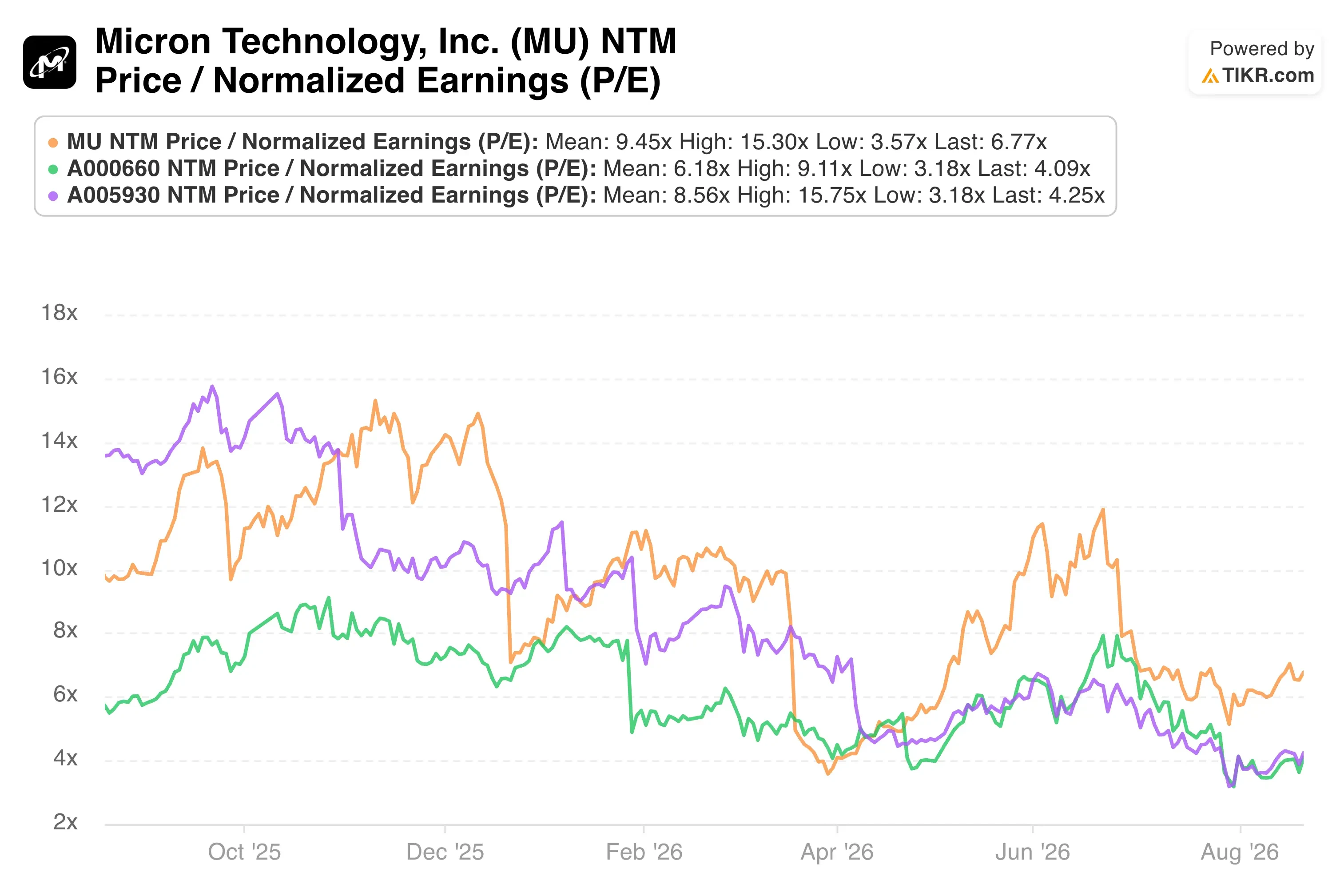
On valuation, Micron’s roughly 6.8x forward multiple sits well below the double digit multiples that SK Hynix and Samsung typically command. That gap exists largely because Micron’s earnings growth has been so extreme that its stock price has not fully caught up yet. This could close two ways: either Micron’s stock keeps climbing, or its growth slows and the multiple normalizes on a smaller earnings base.
Samsung remains the largest memory maker by total revenue, but Micron has carved out a real edge in HBM3E power efficiency. That matters a lot for AI data centers, since power and cooling budgets are tightly constrained. This efficiency advantage, combined with Nvidia’s design wins, has become Micron’s clearest competitive moat this cycle.
What’s Driving MU Stock Going Forward?
The most immediate catalyst is Micron’s fiscal Q4 report, expected around September 30. Investors will watch closely whether the company’s roughly $50 billion revenue guidance holds, because that figure implies continued sequential acceleration.
Beyond that single print, the new Boise lab signals Micron’s intent to stay at the technology frontier for the next decade. This matters because it could help Micron win future HBM4 and HBM5 design slots with Nvidia and other AI chipmakers.
Broader industry dynamics matter too. Competing HBM investments from SK Hynix and Samsung, along with any slowdown in hyperscaler AI spending, could pressure the tight supply and demand balance driving Micron’s margins. So far, though, management says tight conditions should persist beyond calendar 2027.
Regulatory and geopolitical factors round out the picture, since U.S. semiconductor policy and China trade dynamics keep shifting. Micron has leaned hard into domestic manufacturing, so it could benefit if policy continues favoring U.S. based chip production.
Track Micron’s next earnings catalyst before it hits the tape (Free with TIKR) >>>
Should You Invest in Micron Technology?
The only way to really know is to look at the numbers yourself. TIKR gives you free access to the same institutional-quality financial data that professional analysts use to answer exactly that question.
Pull up MU, and you’ll see years of historical financials, what Wall Street analysts expect for revenue and earnings in the quarters ahead, how valuation multiples have moved over time, and whether price targets are trending up or down.
You can build a free watchlist to track MU alongside every other stock on your radar. No credit card required. Just the data you need to decide for yourself.
Analyze MU stock on TIKR Free→
Disclaimer:
Please note that the articles on TIKR are not intended to serve as investment or financial advice from TIKR or our content team, nor are they recommendations to buy or sell any stocks. We create our content based on TIKR Terminal’s investment data and analysts’ estimates. Our analysis might not include recent company news or important updates. TIKR has no position in any stocks mentioned. Thank you for reading, and happy investing!