
Key Takeaways
- MercadoLibre fell 9% last week after a third-quarter profit miss. Revenue rose 45%, but its operating margin fell to 6.3% from 9.8% a year earlier.
- Most of the squeeze comes from loan-loss provisions and free shipping that management chose to pay for, so the margin should recover as growth slows.
- Analysts expect earnings per share to dip to $37.45 in 2026 and then climb to $75.87 by 2028. The hosts of We Study Billionaires see a 13% to 14% operating margin by the end of the decade.
- The main risk is a loan book that grew 75% in a year, because up-front provisions will keep weighing on the margin until that growth slows.
MercadoLibre (MELI) sank 9% on a profit miss last week. Days later, the latest episode of the We Study Billionaires podcast came out under the title “We Doubled Down on Meli.”
Growth wasn’t the issue. Third-quarter revenue rose 45% to $10.75 billion, while the operating margin fell to 6.3% from 9.8% a year earlier.
Shawn O’Malley was defending the growth forecasts in Daniel Mahncke’s model on the episode when he reminded listeners that “Meli is the only company ever at significant size that was able to grow 30% or more for 30 consecutive quarters straight.”
That’s quite a streak. But the hosts’ real bet is on where the margin goes from here.
TIKR tracks 26 analysts on MercadoLibre. How many say “Buy”?
See the full breakdown of Buy, Hold, and Sell ratings on MercadoLibre, along with Wall Street’s revenue and earnings estimates, all in one place. More than 500,000 investors use TIKR to research stocks like this one. See MercadoLibre’s Analyst Ratings
The squeeze was on purpose
MercadoLibre’s management hasn’t been shy about why profits are down. On the third-quarter call, CEO Ariel Szarfsztejn said the company is investing because the opportunity is large and deeper engagement builds a lasting lead. Then he added: “We have accepted a lower margin to do that, and I think we’ve been open on that regard.”
On the podcast, Mahncke broke down where that margin went. He called the provisions MercadoLibre books for its loans “actually the biggest part of the margin compression.” He said that “in Q1, that alone cost four percentage points of operating margin,” and two points in the second quarter. Next on his list was free shipping, which he called a response to Shopee in Brazil, and which he said has helped MercadoLibre outgrow its rival from a bigger base.
Then MercadoLibre added a logistics bill in the third quarter. CFO Martin de los Santos said on the call that the company grew its logistics capacity 20% from the second quarter ahead of the holiday peak, against 10% a year earlier. He expects part of that cost to come back in the fourth quarter.
Wall Street already expects the rebound
If the squeeze is a choice, earnings should bounce back once the spending eases, and analysts are counting on that. Their estimates have earnings per share dipping this year, then climbing fast:
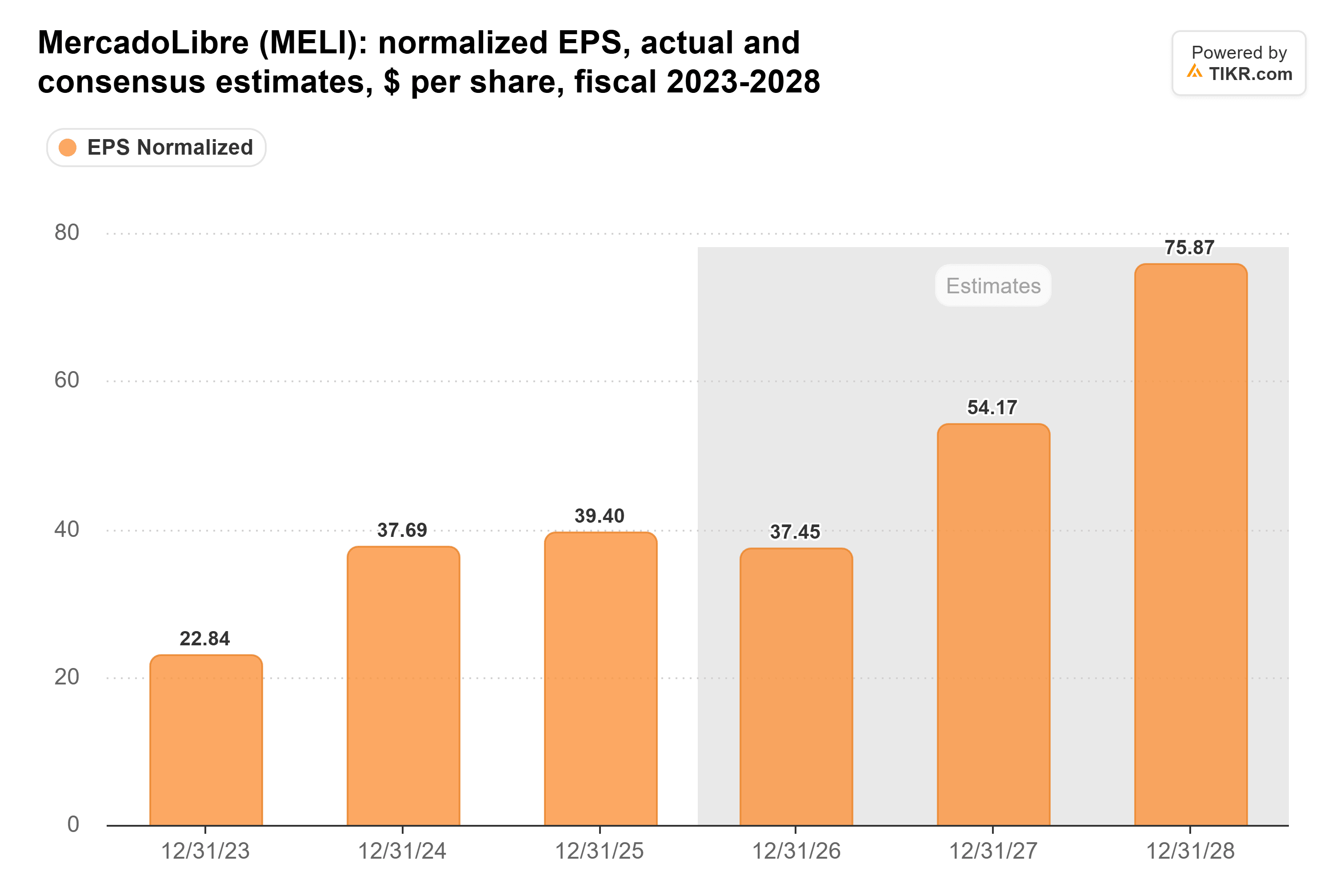
Analysts trimmed their numbers after the miss. They still have earnings per share rising 45% to $54.17 in 2027, then 40% to $75.87 in 2028.
The hosts go further. Mahncke’s model puts 2030 earnings per share at about $177, against $39.40 last year. To get there, analysts’ 2028 figure would have to more than double in two years.
A slower 2027 would help
Mahncke’s model also ends the streak. MercadoLibre’s revenue has grown more than 30% in every year since 2019, reaching $28.9 billion in 2025:
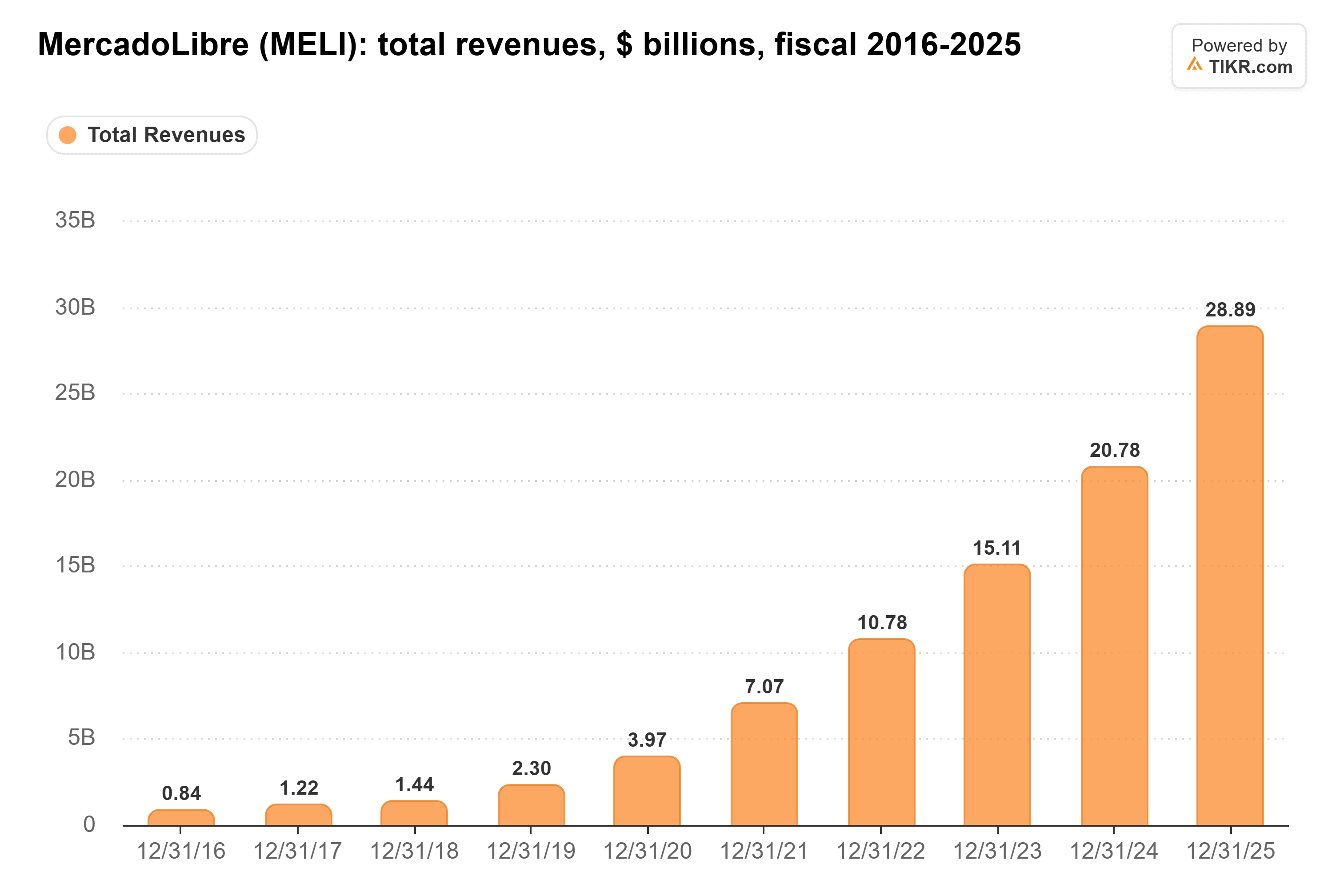
In 2027, Mahncke has commerce growing 25% and fintech 32%, which would end the 30% run sometime next year. From there, both slow a couple of points a year as MercadoLibre scales back its investments. As a result, he said, “the operating margin that currently stands at only 7% will creep higher again, reaching 13 to 14% by the end of the decade.”
That’s less of a stretch than it sounds, since MercadoLibre has climbed out of a deeper hole before:
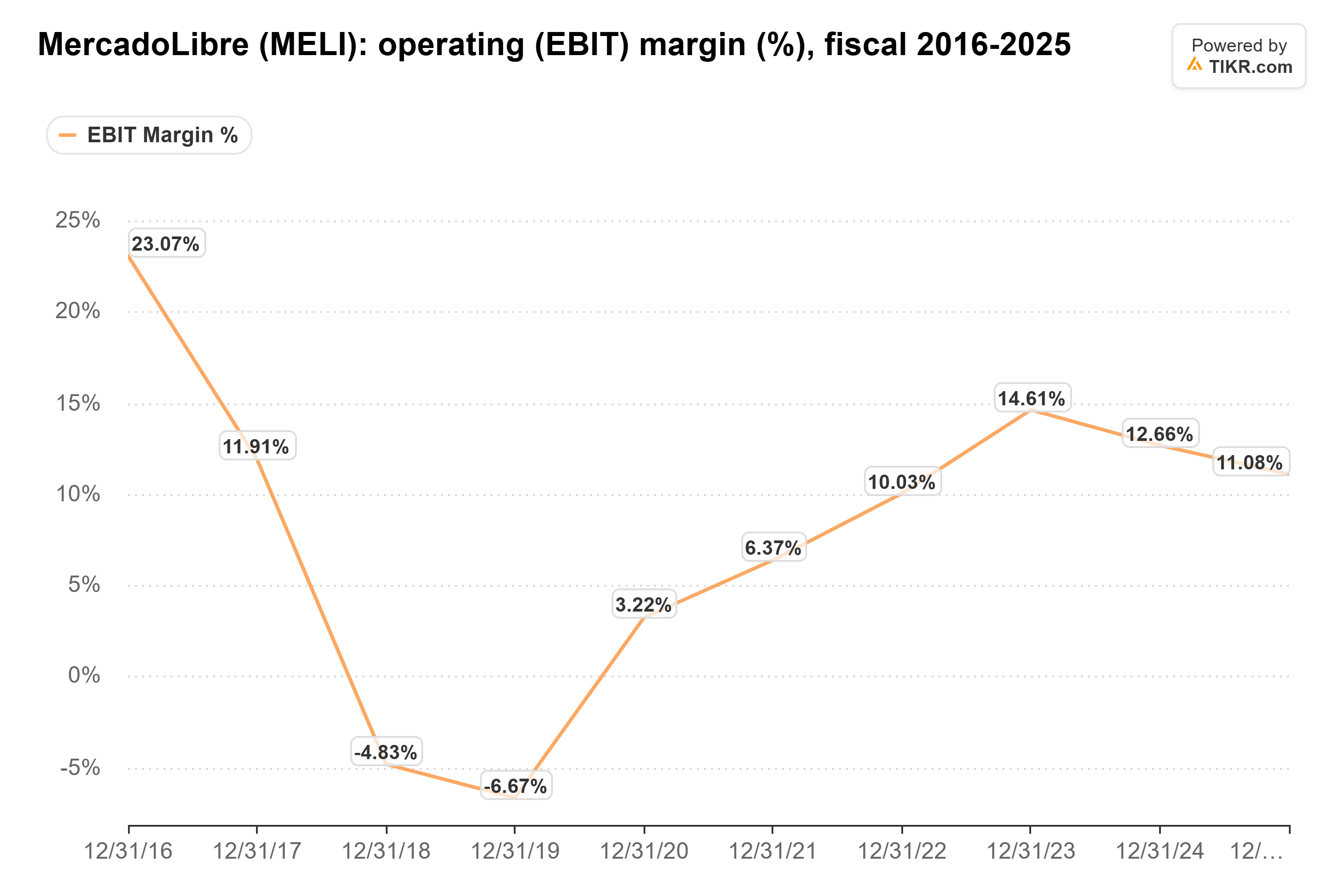
The margin went from -6.7% in 2019 to 14.6% in 2023, so 13% to 14% would only take it back to where it was three years ago.
The loan book has to slow down first
O’Malley called the up-front provisions on MercadoLibre’s credit cards “really an accounting timing issue more than anything.” But MercadoLibre only gets that margin back once its loan book grows more slowly. The credit portfolio grew 75% over the year to $16.4 billion at June 30. Over the same stretch, provisions rose to 12.5% of revenue in the second quarter from 10.2% a year earlier. As long as the book keeps growing that fast, the up-front charges will keep coming.
So far the loans look healthy. Loans 15 to 90 days late held around 7.0% of the book in the third quarter, near historic lows. Loans 91 to 360 days late did rise, to 18.7% of the book at June 30 from 16.8% six months earlier.
Growth slows, the margin climbs
I expect MercadoLibre’s growth to slow and its margin to turn around at the same time. Once it stops pushing its loan book and its logistics network quite so hard, it’ll grow more slowly and spend less to do it. Bottom line: last week’s miss looks like the cost of a choice MercadoLibre keeps making on purpose. I’d rather own the stock before that choice starts paying off than after.
Of course, management doesn’t give guidance, and Szarfsztejn said it has delivered the same message about investing on every call for the last 18 months. Fourth-quarter results early next year will show whether the logistics costs de los Santos expects back actually return, and how fast the loan book is still growing.
So what is MercadoLibre stock actually worth?
TIKR lets you forecast the future price of any stock in less than a minute. Just enter a few assumptions into TIKR’s valuation model and see what MercadoLibre could be worth. Start from Wall Street consensus estimates, or adjust the inputs to reflect your own view of the business. It’s free to use.
Disclaimer:
Please note that the articles on TIKR are not intended to serve as investment or financial advice from TIKR or our content team, nor are they recommendations to buy or sell any stocks. We create our content based on TIKR Terminal’s investment data and analysts’ estimates. Our analysis might not include recent company news or important updates. TIKR has no position in any of the stocks mentioned. Thank you for reading, and happy investing!