Key Takeaways
- Of the 460 big funds that have filed 13Fs for the quarter ended Sept. 30, 15 bought Palo Alto Networks and 22 sold it. Ken Fisher’s Fisher Investments was the biggest buyer, adding about $948 million of stock.
- Stanley Druckenmiller’s Duquesne Family Office cut its Palo Alto stake by 74%, and the stock is down 22% since the quarter ended.
- Analysts expect normalized EPS to rise from $3.84 in fiscal 2026 to $4.88 in fiscal 2028, and the stock trades at 74x forward earnings against a five-year average of 57x.
- The sellers have the better case for now, and Palo Alto’s fiscal first-quarter report this week is the next test.
Big money split on Palo Alto Networks (PANW) last quarter. Ken Fisher’s Fisher Investments added 41% to its stake, according to its 13F for the quarter ended Sept. 30, filed Nov. 6. Stanley Druckenmiller’s Duquesne Family Office cut 74% of its shares, according to its own 13F, filed Nov. 16.
Fisher and Druckenmiller are part of a wider split. Of the 460 big funds that have filed 13Fs for the quarter, 15 bought Palo Alto, either opening a position or adding 20% or more, and 22 sold out or cut by 20% or more. That group is funds readers know plus funds with $1 billion or more of US stocks, with quant and index funds left out. In all, 45 of them held shares at the quarter’s end.
Fisher’s buy dwarfs everyone else’s
Fisher Investments manages $387 billion in all. In the quarter it went from 5.76 million Palo Alto shares to 8.14 million, adding about $948 million of stock at quarter-end prices. Its stake was worth $3.24 billion on Sept. 30, but that’s still only 0.9% of its 13F stocks and its 31st-largest holding. GQG Partners, which manages $164 billion, came next with a new position of 1.26 million shares worth $502 million. After those two, no buyer added more than $39 million.
TIKR tracks 56 analysts on Palo Alto Networks. How many say “Buy”?
See the full breakdown of Buy, Hold, and Sell ratings on Palo Alto Networks, along with Wall Street’s revenue and earnings estimates, all in one place. More than 500,000 investors use TIKR to research stocks like this one. See Palo Alto Networks’ Analyst Ratings
The biggest sellers still own plenty
The biggest sale came from Mirova US, a $14 billion firm. It cut its stake 34% to 864,841 shares, selling about $175 million of stock at quarter-end prices. Atreides Management, an $11 billion fund, also cut 34%, down to 578,905 shares, which comes to about $118 million. Neither sold out. Palo Alto was still Mirova’s seventh-largest holding at 3.8% of its 13F stocks, and it made up 2.1% of Atreides’, a bigger share than it is of Fisher’s.
Druckenmiller sold less in dollars, about $34 million. That still left Duquesne, whose 13F holds $4.15 billion of US stocks, with just 30,000 shares worth $12 million. A 13F only shows what a fund held on Sept. 30, so it can’t tell us what any of them paid or why they moved. Since that date, the stock has fallen 22%, including a drop of nearly 10% in a single day.
Earnings keep growing, but slower per share
The business backs the buyers. Palo Alto guides revenue up 23% to 24% in fiscal 2027, which runs to July. It also turned 38.4% of fiscal 2026 revenue into adjusted free cash flow. Analysts expect earnings per share to keep rising through fiscal 2028:
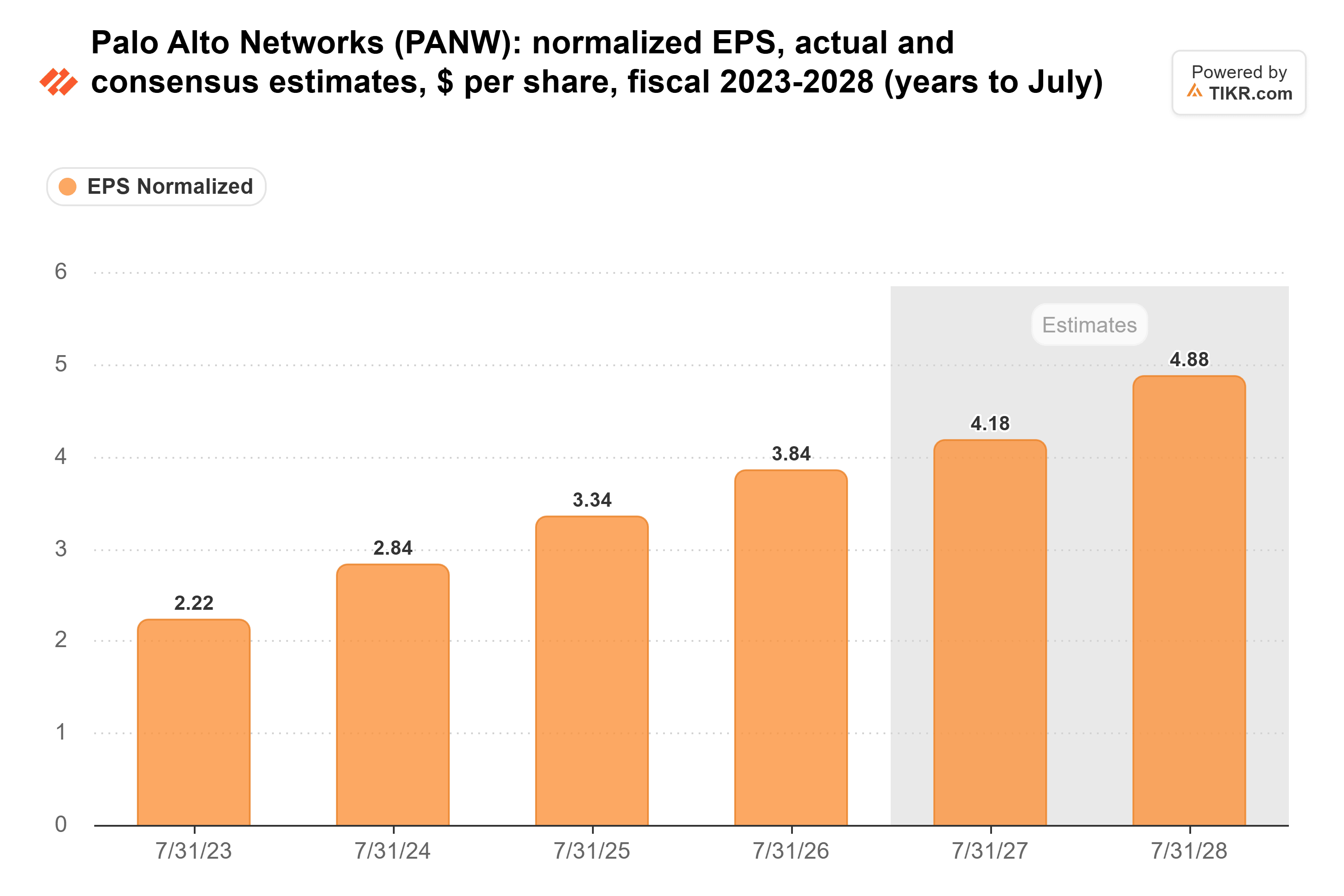
Normalized EPS rose from $2.22 in fiscal 2023 to $3.84 in fiscal 2026. Consensus has $4.18 for fiscal 2027 and $4.88 for fiscal 2028.
The problem is the share count. Palo Alto paid for CyberArk mostly in stock, and shares outstanding rose 22% in about 15 months, to 818 million from 668 million in July 2025. In fiscal 2026, non-GAAP net income rose 25% but non-GAAP EPS rose only 15%. Management guides EPS up just 8% to 9% this fiscal year.
74x is still a lot to pay
Even after the drop, the stock is expensive against its own history:
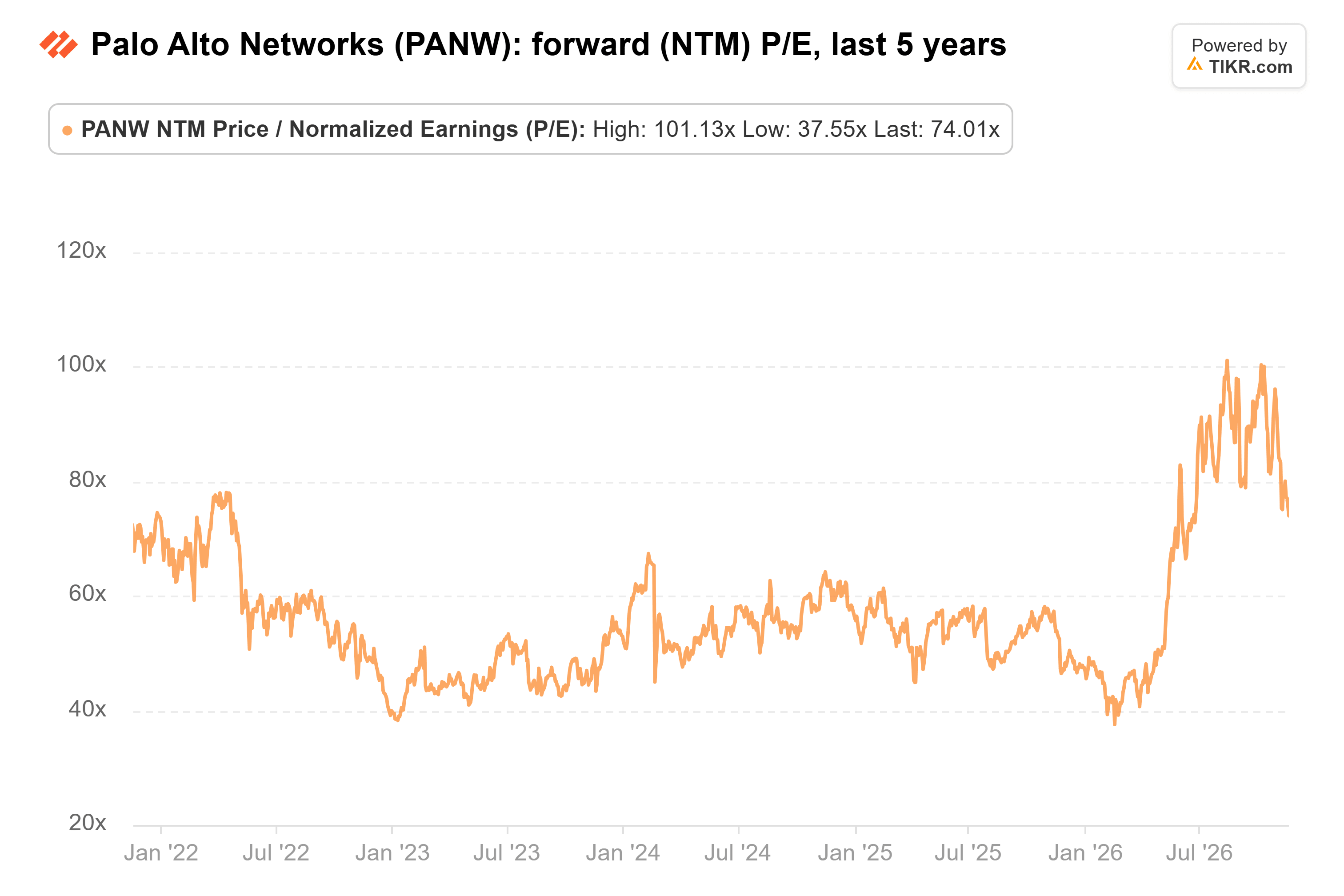
At 74x forward earnings, Palo Alto trades well above its five-year average of 57x, though it’s below the 101x it reached in August.
Analysts’ consensus price target has climbed sharply since its April low:
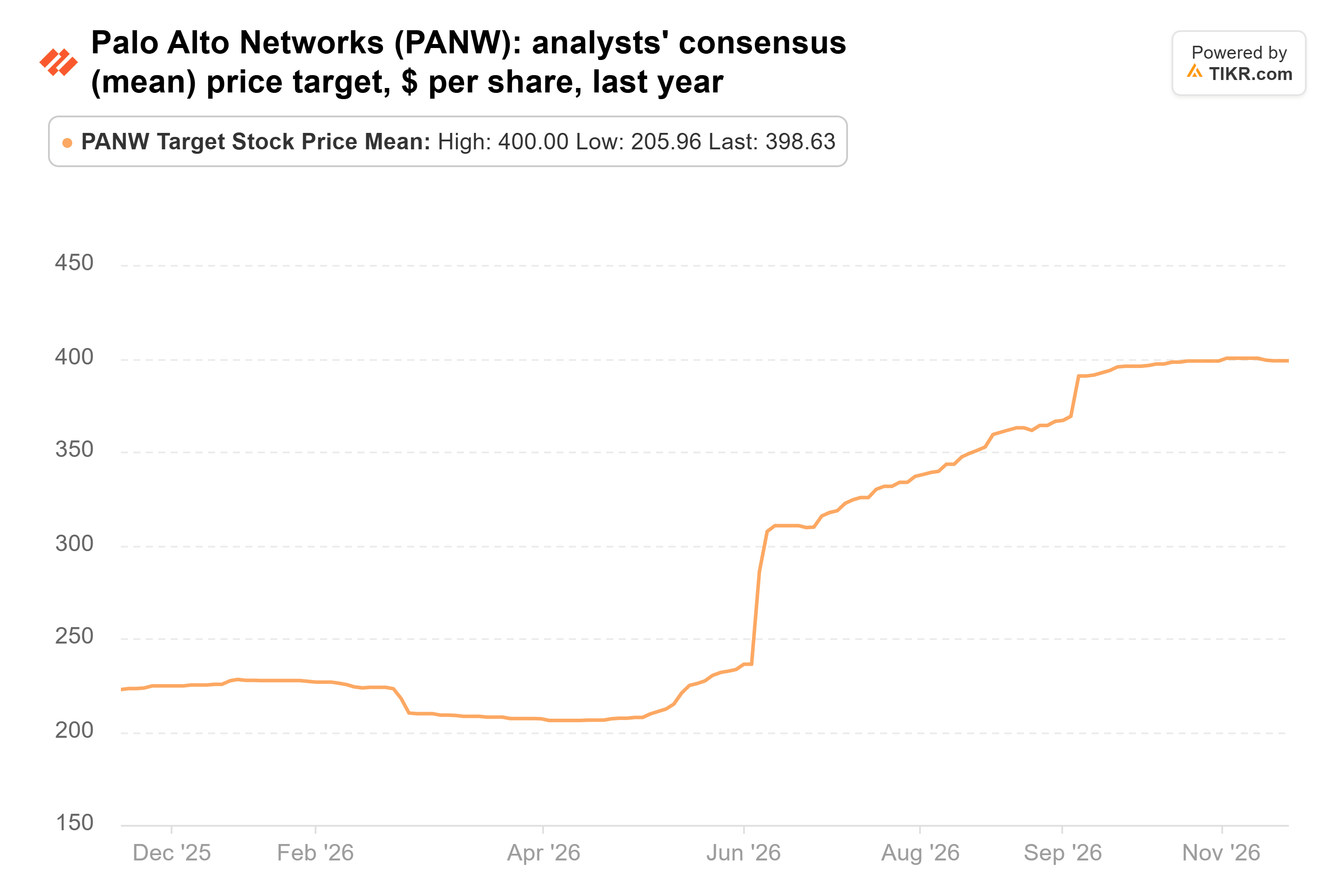
The $399 consensus target, from 55 analysts, is 29% above the last close and up from $223 a year ago. By our math, $399 is about 82x the fiscal 2028 EPS estimate. Earnings growth from here covers a bit more than half of that 29% upside. The rest would need investors to pay a higher multiple than today’s 74x.
I’m with the sellers, for now
Palo Alto is a strong business. But at 74x forward earnings, with per-share growth held back by the share count, investors are already paying for a lot of growth. Reaching the consensus target would take an even higher multiple. Fisher’s bet is huge in dollars, but it’s under 1% of its 13F stocks, while the two biggest sellers still hold more of the stock as a share of theirs.
Of course, the deals could pay off faster than that. Management says CyberArk’s margins rose 1,000 basis points or more within about nine months.
The first test comes with Palo Alto’s fiscal first-quarter report this week. Management guides Next-Generation Security ARR of $9.54 billion to $9.56 billion and non-GAAP EPS of $0.96 to $0.98. Its full-year guide assumes 844 million to 847 million diluted shares. ARR above the top of that range, with the share count in line, would strengthen the buyers’ case. The funds’ next 13Fs, due in mid-February, will show who stayed.
So what is Palo Alto Networks stock actually worth?
TIKR lets you forecast the future price of any stock in less than a minute. Just enter a few assumptions into TIKR’s valuation model and see what Palo Alto Networks could be worth. Start from Wall Street consensus estimates, or adjust the inputs to reflect your own view of the business. It’s free to use.
Value Palo Alto Networks for free
Disclaimer:
Please note that the articles on TIKR are not intended to serve as investment or financial advice from TIKR or our content team, nor are they recommendations to buy or sell any stocks. We create our content based on TIKR Terminal’s investment data and analysts’ estimates. Our analysis might not include recent company news or important updates. TIKR has no position in any of the stocks mentioned. Thank you for reading, and happy investing!