Key Takeaways
- On Prof G Markets, Josh Brown said Anthropic could become “a cash spigot” priced to make Nvidia and Palantir look expensive. He listed Meta’s push into AI agents as one of its threats.
- Brown also named Meta and Alphabet as his two public examples of a company with a premier AI model and its own compute, which makes Meta a better fit for his case than the AI lab he was describing.
- Analysts expect Meta’s normalized EPS to rise from $29.68 in 2025 to $42.30 in 2028, and the stock trades at 19x forward earnings, below its five-year average of 21x.
- The catch is cash: analysts don’t expect Meta’s free cash flow to recover until 2029, and the 2027 capex plan due in late January is the next test.
Josh Brown sees “a cash spigot” coming in AI. He was talking about Anthropic, but the company that fits his description best is Meta Platforms (META).
On the Oct. 30 episode of Prof G Markets, Brown, who co-hosts The Compound and Friends, walked through Anthropic’s IPO filing. He said Anthropic is priced below Palantir and about in line with Nvidia (NVDA), while growing much faster than both. (Nvidia, for its part, agreed last week to put $3 billion into Meta’s stock sale.)
Then he listed what could go wrong. One threat on his list: “if Facebook takes advantage of the agentic layer and connects the 500 million businesses they already have a relationship with, with the 3 billion consumers.”
If Anthropic gets past all of that, he said, “this thing becomes a cash spigot trading at a multiple that makes Nvidia” look expensive, “and especially Palantir.”
So why not just own the threat?
Brown got there himself later in the episode: “I have two examples in the publicly traded market of a company that has a premier model and its own source of compute to run that model. We have obviously Alphabet and Google Gemini and now we have Meta and Muse.”
Anthropic, he pointed out, has to pay someone else for its compute. Meta builds most of its own, though not all: Susan Li said higher third-party cloud spend helped drive its third-quarter cost growth.
Brown’s Numbers Hold Up
Based on a user survey, Meta estimates that at least 500 million self-identified small businesses use its apps, a figure it repeated in its Oct. 26 offering document. Those apps averaged 3.64 billion daily users in September.
Muse, its new agent, is already putting the two together. More than 10 million people in the U.S. and Canada set it up in its first six weeks. Management said on the third-quarter call that over a quarter of active users shop with it, spending more than $200 per purchase on average (travel bookings included).
Meta doesn’t report any revenue from Muse yet. Even so, analysts expect Meta’s normalized EPS to keep climbing through 2028:

That’s $42.30 a share in 2028, about 43% above 2025’s $29.68. Muse is the piece that could push those estimates higher.
And investors aren’t paying much for that path. Meta trades at 19x forward earnings, below its five-year average of 21x:
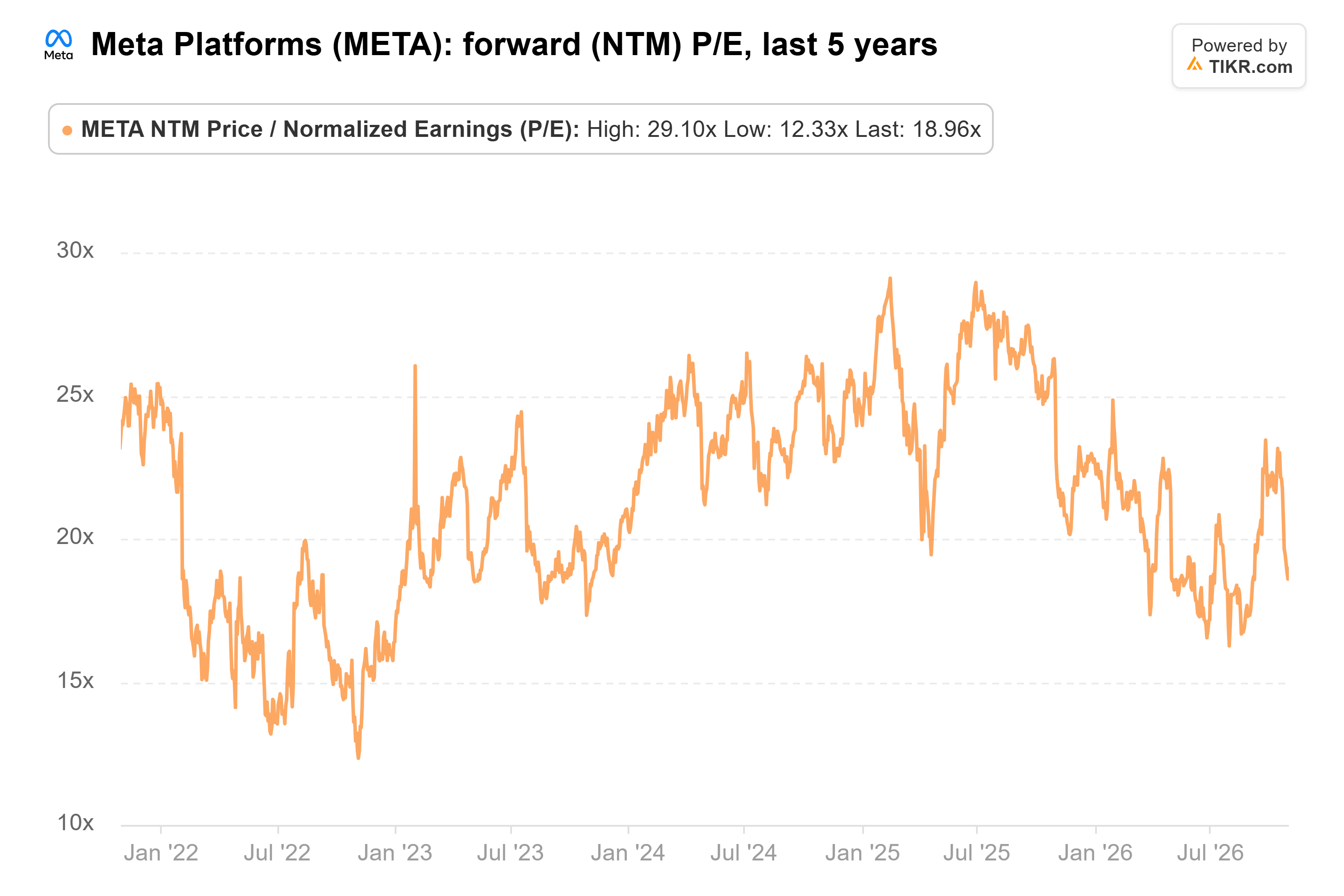
(It was at 29x as recently as February 2025.)
TIKR Tracks 63 Analysts on Meta Platforms. How Many Say “Buy”?
See the full breakdown of Buy, Hold, and Sell ratings on Meta Platforms, along with Wall Street’s revenue and earnings estimates, all in one place. More than 500,000 investors use TIKR to research stocks like this one. See Meta Platforms’ Analyst Ratings
The Spigot Is Still Shut
But Meta is putting all of that cash back into the build, and then some. On The Compound and Friends the same day, Brown put Meta’s spending at 70% of revenue. The reported figures are lower but heading his way. Capex, including finance-lease principal, was 54% of revenue in the third quarter, and analysts’ 2027 estimates put it near 65%.
Meta’s capital spending nearly doubled in 2025, to $69.7 billion:

And management guides 2026 to $135 billion to $145 billion.
In the third quarter, capex of $34.9 billion topped operating cash flow of $32.8 billion. Analysts expect free cash flow of negative $35.1 billion in 2027 and roughly breakeven in 2028, before it jumps to $80.5 billion in 2029.
So Meta is raising money. It priced $37.5 billion of stock sales on Oct. 26 and plans up to $60 billion more in new Class C shares starting in 2027. That’s real dilution for today’s shareholders.
Nvidia’s $3 billion comes with expanded work on Muse, the two companies said. A chipmaker funding a big customer can look circular, but when the company Brown used as his yardstick buys in, I read that as a vote of confidence.
Why Meta Is Worth the Wait
Brown’s cash spigot fits Meta better than the company he pinned it on. Meta already owns the model, the compute and the 3.64 billion users, and at 19x forward earnings, investors aren’t paying up for any of it. That multiple sits on a share count that’s about to grow, though, and that’s the part of the bull case I’d watch most closely.
The wait is the risk. The first real read comes on Meta’s fourth-quarter call in late January, when management typically gives next year’s guidance, 2027 capex included. Susan Li said Meta’s new AI businesses could begin contributing revenue in 2027, and Zuckerberg said Muse will move to monetization sooner than Meta’s usual playbook. That call is where I’d look for the first sign of Muse paying its way.
So What Is Meta Stock Actually Worth?
TIKR lets you forecast the future price of any stock in less than a minute. Just enter a few assumptions into TIKR’s valuation model and see what Meta could be worth. Start from Wall Street consensus estimates, or adjust the inputs to reflect your own view of the business. It’s free to use.
Disclaimer:
Please note that the articles on TIKR are not intended to serve as investment or financial advice from TIKR or our content team, nor are they recommendations to buy or sell any stocks. We create our content based on TIKR Terminal’s investment data and analysts’ estimates. Our analysis might not include recent company news or important updates. TIKR has no position in any of the stocks mentioned. Thank you for reading, and happy investing!