Key Takeaways
- Jim Cramer told a Mad Money caller on Friday to sell AT&T. He did it two days after Qualcomm said SpaceX picked it to power Starlink Mobile’s nationwide 5G network.
- AT&T and T-Mobile are reportedly ready to cut Boost Mobile off their networks if SpaceX buys it, a sign the carriers see a fourth network as a threat to their pricing.
- Wireless made 96.9% of AT&T’s segment operating income in 2025, and analysts expect its revenue to grow under 2% a year through 2028.
- Verizon trades at 8.8x forward earnings, near its three-year average, so the big three have little cushion if SpaceX pushes wireless prices down, and AT&T is one to avoid for now.
Jim Cramer has a simple message for AT&T (T) shareholders worried about SpaceX (SPCX): Sell.
On Friday’s episode of Mad Money, a caller asked for his take on AT&T “with the emergence of SpaceX and all the new technology out there.” Cramer’s answer:
“I think that Elon Musk is a vicious competitor. I think AT&T represents old and he represents new. So I am going to say you should not own AT&T.”
He said he has Starlink in Europe, where he swapped a $150 system for a $50 one that he called much better and much faster. He also called his answer a “tough call.” This week’s news makes it a little easier.
TIKR tracks 24 analysts on AT&T. How many say “Buy”?
See the full breakdown of Buy, Hold, and Sell ratings on AT&T, along with Wall Street’s revenue and earnings estimates, all in one place. More than 500,000 investors use TIKR to research stocks like this one. See AT&T’s Analyst Ratings
The carriers are already playing defense
SpaceX’s interest in Boost Mobile looked like a shortcut into wireless when The Washington Post reported the talks. SpaceX would buy Boost or get access to its network, which Boost leases from AT&T and T-Mobile.
On Wednesday, the push got more concrete. On Qualcomm (QCOM)‘s fiscal fourth-quarter call, CEO Cristiano Amon said “SpaceX selected Qualcomm to power Starlink Mobile’s nationwide terrestrial 5G network in the U.S.” Deployment begins in 2027 under a multiyear agreement, and Amon expects it to be one of the largest 5G rollouts in the country. That gives SpaceX the equipment for a credible fourth national network. It also gives Qualcomm what Amon called “a significant win for our infrastructure business.”
A day later, Semafor’s Rohan Goswami reported, citing sources, that AT&T and T-Mobile will kick Boost off their spectrum if Musk goes ahead with a takeover.
You don’t threaten to cut off a customer over a rival you aren’t worried about.
Wireless pays for nearly everything at AT&T
That threat hits AT&T right where it makes money. Its Mobility segment made $27.2 billion of operating income in 2025, 96.9% of the segment total. AT&T has also been raising prices: postpaid phone revenue per user rose 4% in the third quarter, which management credits to new rate plans and higher prices for existing customers. A low-cost fourth carrier makes increases like that much harder to push through.
AT&T doesn’t have much other growth to fall back on. Analysts expect its revenue to go from $126 billion in 2025 to $132 billion in 2028.
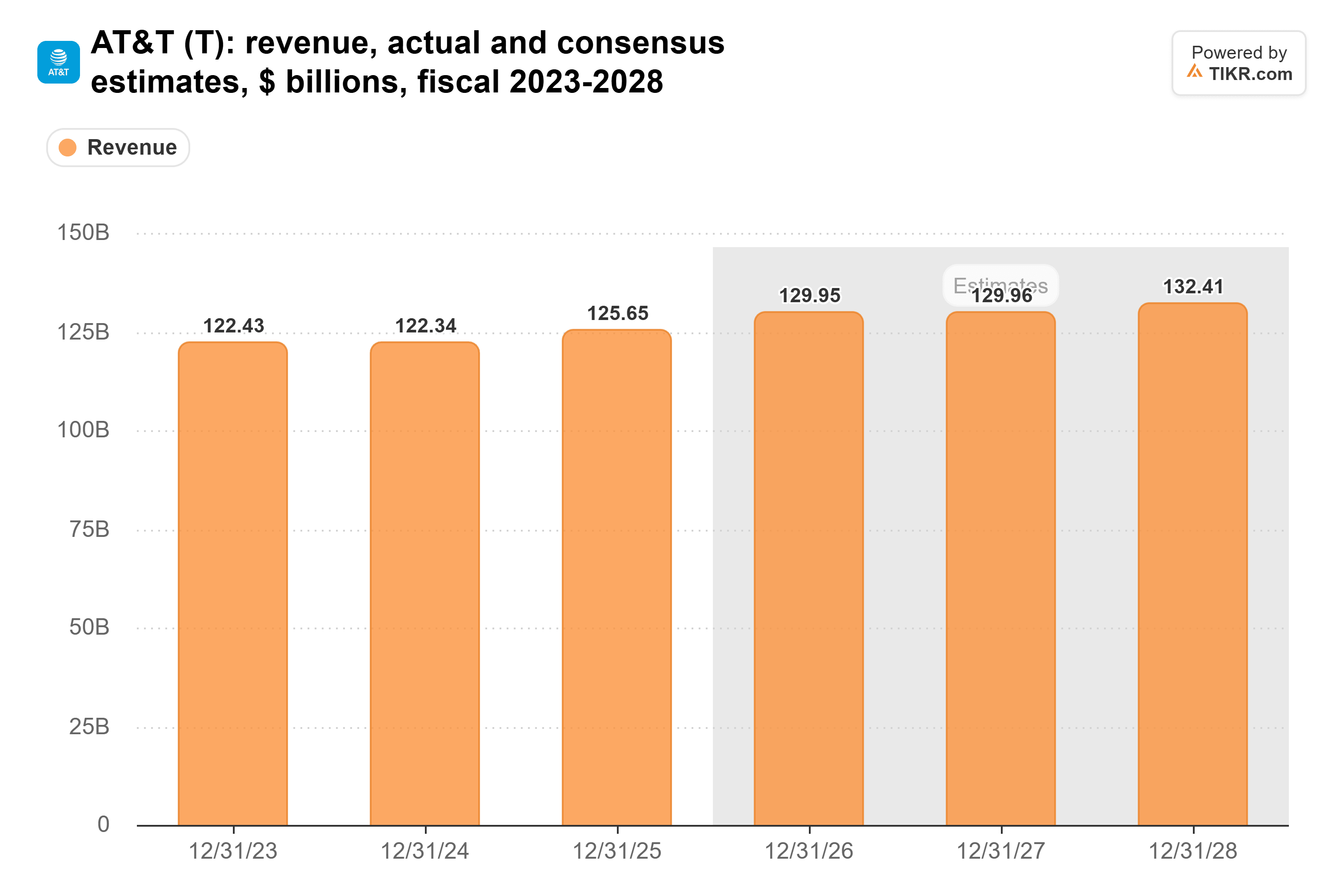
That’s under 2% a year, and nothing in this week’s news gives analysts a reason to raise it.
The cash has been steadier. AT&T’s free cash flow has landed between $18.5 billion and $20.5 billion in each of the last three years.
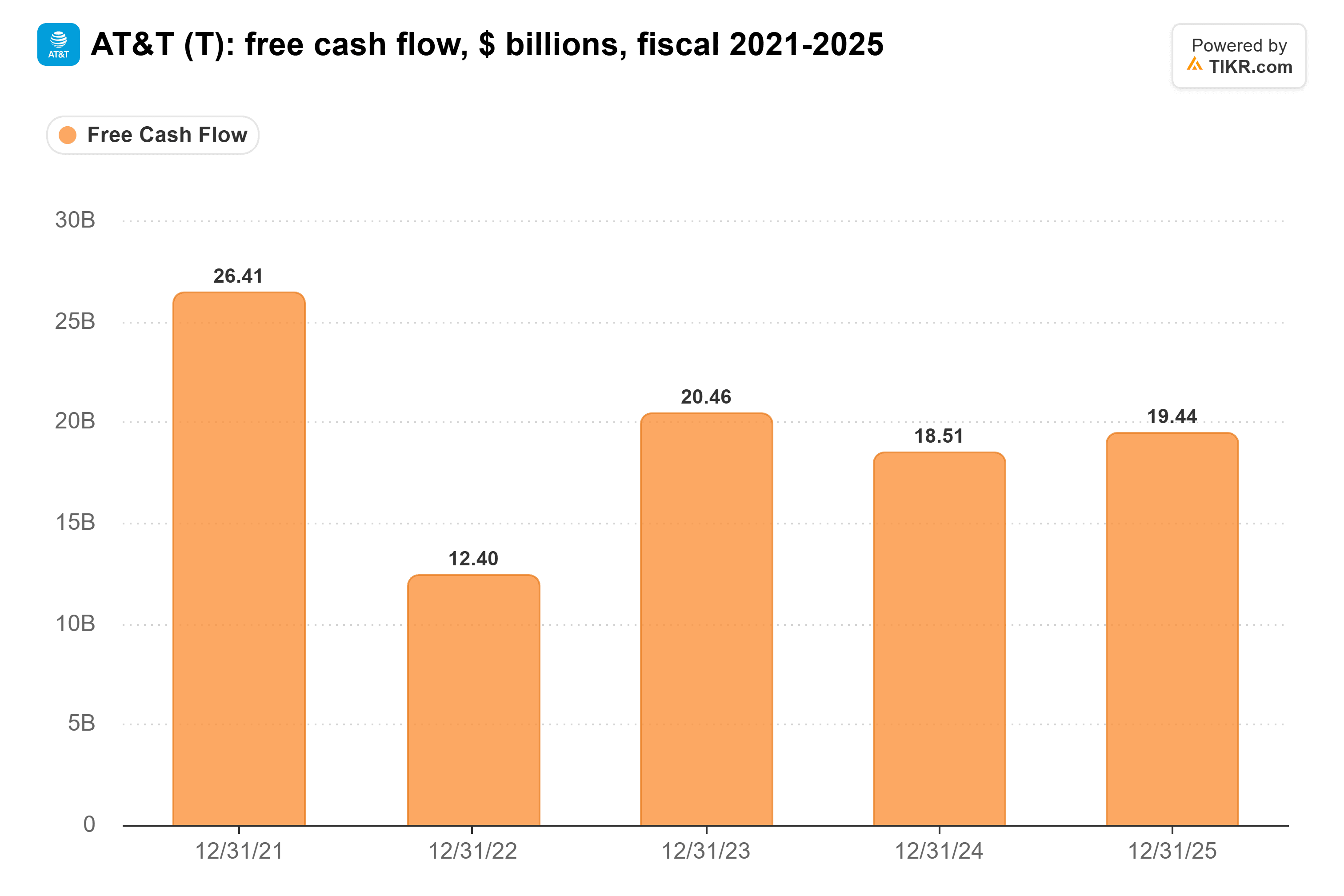
But AT&T is asking a lot of that cash. It pays a dividend of $1.11 a share and is buying back stock. It also spent $28.4 billion this year on EchoStar spectrum and Lumen fiber, which pushed net debt to 3.1x adjusted EBITDA at the end of September.
SpaceX doesn’t need a finished network to hurt
None of this happens overnight. TD Cowen puts the cost of a nationwide land network at over $80 billion. SpaceX’s roughly $8 billion purchase of Grain Management’s spectrum still needs FCC approval, and Qualcomm’s rollout doesn’t begin until 2027. AT&T’s customers aren’t leaving yet, either: postpaid phone churn held at 0.92% in the third quarter, flat from a year earlier.
But SpaceX can put pressure on prices long before its last tower goes up. With Starlink Mobile on its way, I suspect AT&T will think twice about its next round of rate increases. That alone would cut into the one business funding everything else.
Steve Eisman, the investor made famous by The Big Short, went further on Friday’s episode of The Real Eisman Playbook. He pointed to the Qualcomm deal and said Musk looks to be going all in against T-Mobile, AT&T and Verizon (VZ). Then he added: “I think the big three are just uninvestable.”
Investors haven’t gone that far with Verizon. Its forward P/E is 8.8x, a bit below its three-year average of 9.0x and down from 10.5x in March.
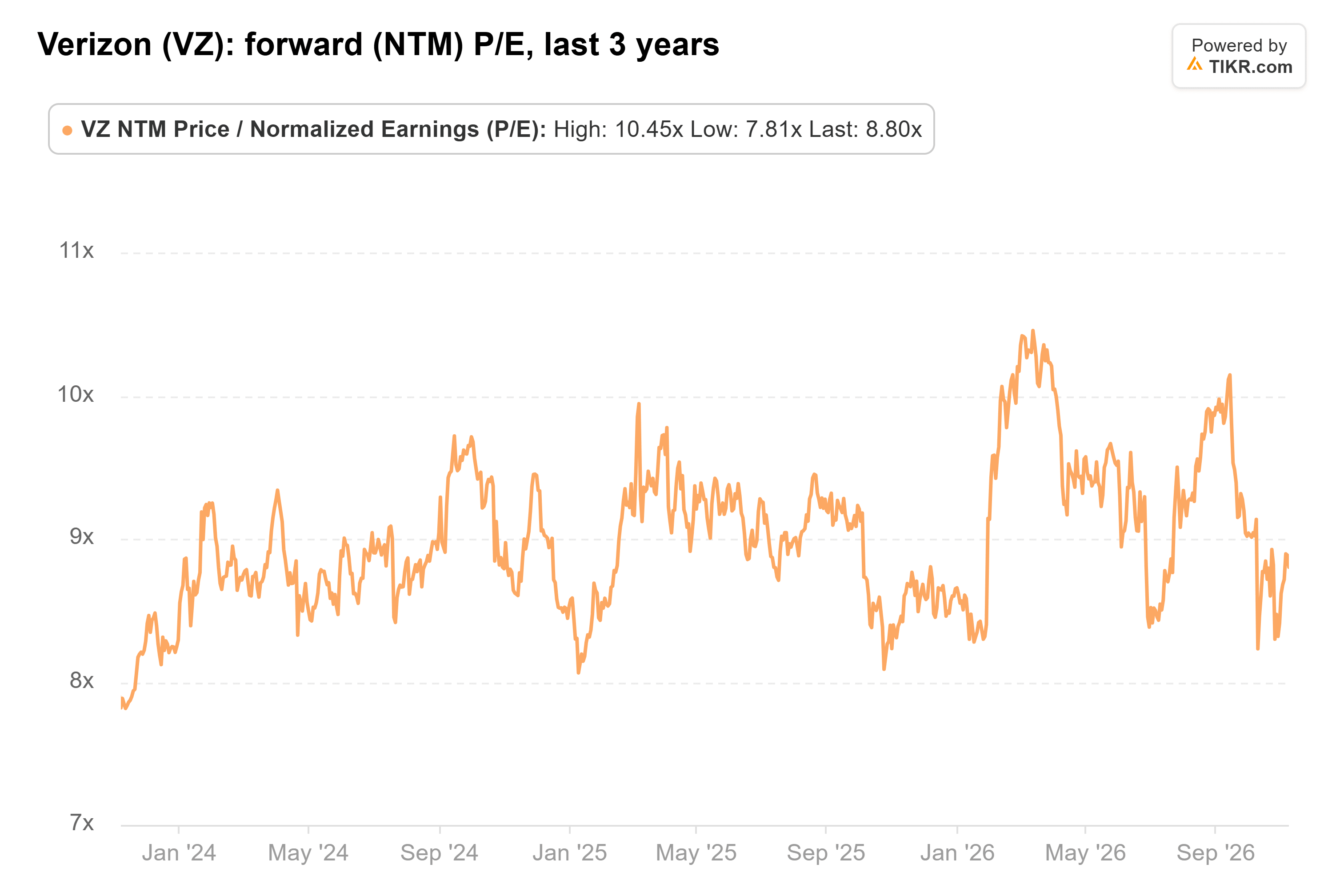
That’s a low multiple, but it’s normal for Verizon, so I don’t think these stocks are priced for a fight over wireless prices yet.
Cramer’s call holds up
I agree with Cramer. AT&T gets nearly all its profit from wireless, analysts expect little revenue growth, and its debt load jumped this year. That leaves AT&T little room to absorb a fight over prices. And judging by their threat to cut off Boost, AT&T and T-Mobile see the same risk.
Of course, SpaceX still has to win FCC approval for its spectrum and actually build the network. AT&T’s fourth-quarter report, expected in late January, will show whether customers keep staying now that Starlink Mobile has an equipment partner and a 2027 start date.
So what is AT&T stock actually worth?
TIKR lets you forecast the future price of any stock in less than a minute. Just enter a few assumptions into TIKR’s valuation model and see what AT&T could be worth. Start from Wall Street consensus estimates, or adjust the inputs to reflect your own view of the business. It’s free to use.
Disclaimer:
Please note that the articles on TIKR are not intended to serve as investment or financial advice from TIKR or our content team, nor are they recommendations to buy or sell any stocks. We create our content based on TIKR Terminal’s investment data and analysts’ estimates. Our analysis might not include recent company news or important updates. TIKR has no position in any of the stocks mentioned. Thank you for reading, and happy investing!