Key Takeaways
- Jim Chanos says CoreWeave will end 2026 with more than $80 billion of capital employed, about $4 for every $1 of revenue.
- Nvidia says Hopper GPUs are recontracting at up to twice their original price, but little of CoreWeave’s fleet has come up for renewal.
- The 2027 renewals will show whether higher rents bring the ratio down.
CoreWeave (CRWV) is down more than 70% from its May high, and its bulls have one big answer: GPU rents are going up.
On the Nov. 17 earnings call from Nvidia (NVDA), interim CEO Colette Kress said “Hopper GPUs have recontracted at up to twice their original price under the multi-year agreements.” IREN (IREN) reported on Nov. 5 that it contracted H100 GPUs at double previous pricing, and Nebius (NBIS) says its newest deals pay back in under two years.
Famed short seller Jim Chanos isn’t buying it. On Nov. 19, he wrote on X:
“And $CRWV will have >$80B of capital employed at YE 2026. Still that $4 of capital for every $1 of revenue ratio. If realized economic rents were improving that ratio should be dropping. It’s not. Why?”
For now, the numbers are on his side.
The $4 Checks Out
On its third-quarter call on Nov. 10, CoreWeave said it expects to exit 2026 at $20 billion to $21 billion of annualized revenue. That puts Chanos’s $80 billion at $3.80 to $4.00 of capital per $1 of revenue.
Analysts expect revenue to reach $45.1 billion in 2028, up from $5.1 billion in 2025:

Capital spending went from $70 million in 2022 to $10.3 billion in 2025:

On CoreWeave’s own measure, which counts leased equipment, third-quarter capex was $14.5 billion against $3.7 billion of revenue. Cash spent on equipment was $9.4 billion.
TIKR Tracks 41 Analysts on CoreWeave. How Many Say “Buy”?
See the full breakdown of Buy, Hold, and Sell ratings on CoreWeave, along with Wall Street’s revenue and earnings estimates, all in one place. More than 500,000 investors use TIKR to research stocks like this one. See CoreWeave’s Analyst Ratings
Most of CoreWeave’s Build Is Borrowed
Total debt, leases included, rose from $2.0 billion at the end of 2023 to $29.8 billion at the end of 2025:
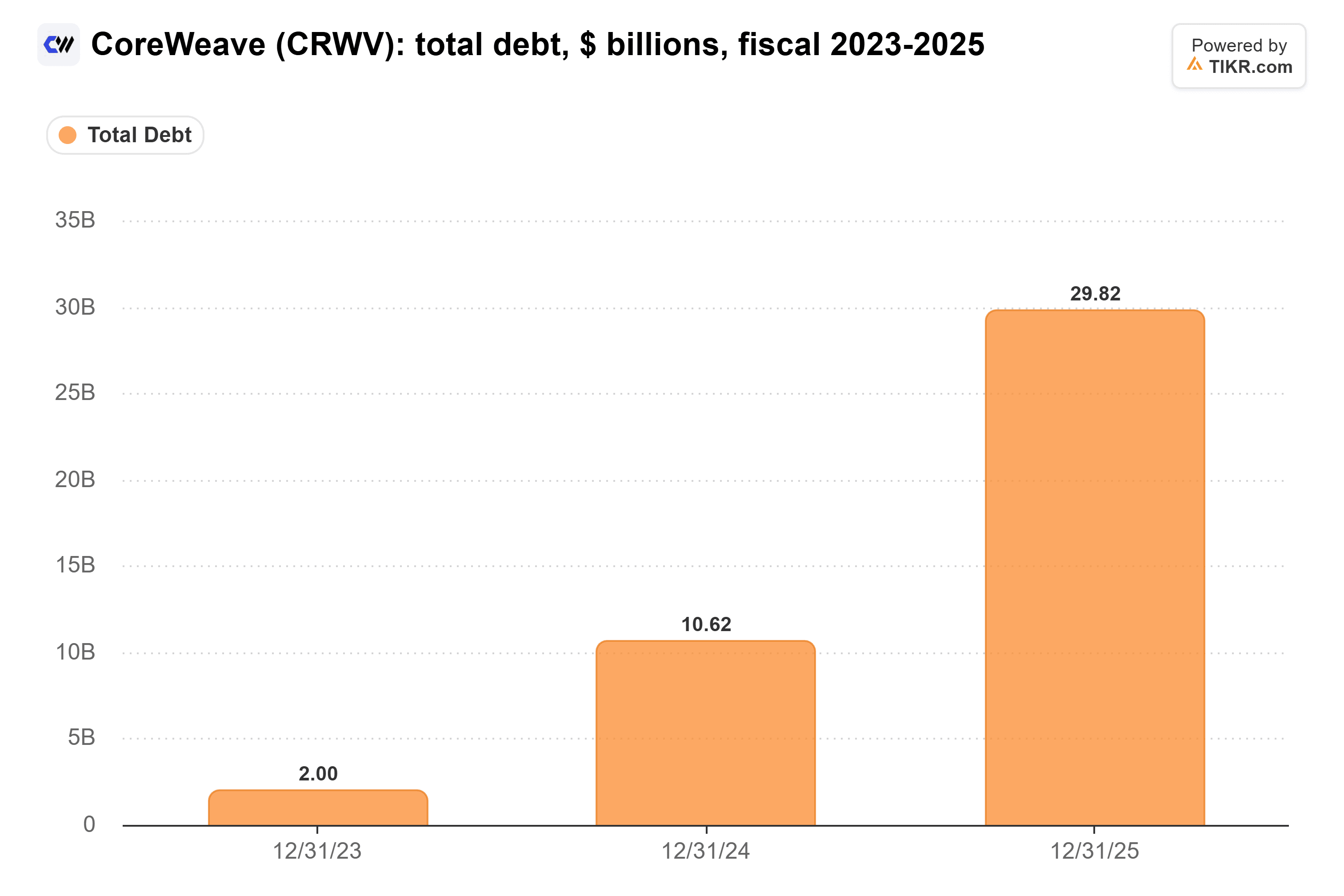
Borrowings alone, leases excluded, reached $46.9 billion against $4.0 billion of shareholders’ equity by Sept. 30.
Higher Rents Haven’t Reached CoreWeave’s Fleet Yet
The bull case is timing. CoreWeave pays for capacity months before it earns, against about $133 billion of signed backlog. CEO Michael Intrator said Ampere and Hopper pricing rose 30% to 50% last quarter, above original contract rates.
But only a sliver of the fleet reprices at a time. In August, CFO Nitin Agrawal called the capacity up for renewal “a very limited part of our fleet.” More than 130,000 GPUs come off contract in 2027 and about 170,000 in 2028. Intrator says re-letting the 2027 batch alone would add approaching $4 billion of annualized revenue.
Chanos Doubts the Neocloud Paybacks
On Nov. 17, Chanos also wrote that “these neocloud managements define ‘payback’ using gross revenues,” tagging CoreWeave, Nebius and IREN.
IREN’s math shows the gap: it measures GPU cost against contracted revenue less direct costs, leaving out interest and data centers. Nebius, meanwhile, plans about $27 billion of 2026 capex against $1.96 billion of revenue in the first nine months.
Chanos Wins on CoreWeave’s Current Numbers
Higher GPU rents are real. They just haven’t reached enough of CoreWeave’s fleet to move the capital math. The first check is the fourth-quarter report in early 2027: if rents are flowing through, capital employed should slip below $4 for every $1 of annualized revenue. If the 130,000 GPUs renewing in 2027 recontract anywhere near Kress’s “twice,” Chanos’s ratio should finally drop.
So What Is CoreWeave Stock Actually Worth?
TIKR lets you forecast the future price of any stock in less than a minute. Just enter a few assumptions into TIKR’s valuation model and see what CoreWeave could be worth. Start from Wall Street consensus estimates, or adjust the inputs to reflect your own view of the business. It’s free to use.
Disclaimer:
Please note that the articles on TIKR are not intended to serve as investment or financial advice from TIKR or our content team, nor are they recommendations to buy or sell any stocks. We create our content based on TIKR Terminal’s investment data and analysts’ estimates. Our analysis might not include recent company news or important updates. TIKR has no position in any of the stocks mentioned. Thank you for reading, and happy investing!