
Key Takeaways
- NVIDIA stock fell nearly 9% at Monday’s low after its board opened an investigation into CEO Jensen Huang, while most other chipmakers rose.
- Gary Black doubts Huang can stay on as CEO and sees no natural successor inside the company.
- At Friday’s close, NVIDIA traded at about 15x forward earnings, under half its five-year average of 36x.
- The succession risk is real, but much of the fear was already in the price.
NVIDIA (NVDA) stock fell as much as 8.8% on Monday, touching $170.24 against Friday’s $186.64 close, while most other chipmakers rose. On Sunday, its board opened an independent investigation into CEO Jensen Huang’s relationship with Alice Huang, a former Megaspeed executive whom US intelligence officials reportedly believe China’s Ministry of State Security recruited. (Beijing calls the spy story unsubstantiated.)
In a Sunday email to staff, Huang admitted to an affair and said he would cooperate fully. The board said it has no reason to believe NVIDIA’s secrets or national security were compromised, and that it still has confidence in Huang.
Gary Black, managing partner of The Future Fund, doubts Huang can stay on as CEO at all, and he named the bigger problem: “He has no natural successor within the company.”
For a company worth about $4.5 trillion going into Monday, that’s a scary sentence. Huang co-founded NVIDIA in 1993 and has run it ever since. Black sees no lasting damage to NVIDIA’s value, but he expects many portfolio managers to trim their stakes anyway.
The Market Was Already Braced for Bad News
Mohamed El-Erian, the former CEO of PIMCO, thinks markets haven’t caught up: “The so-called ‘key-man risk’ looms large here, and it’s doubtful markets have adequately priced it in.”
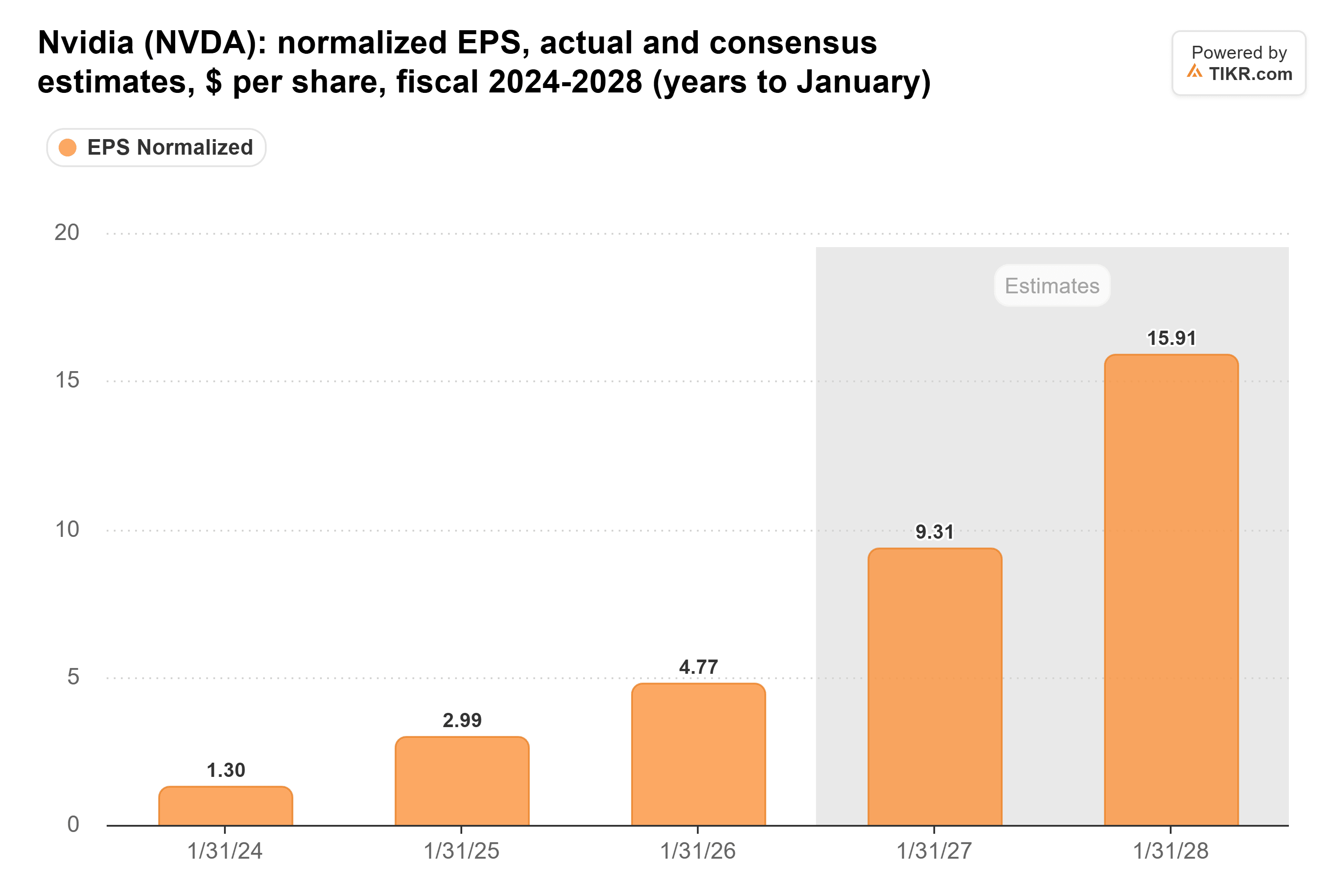
I’m not so sure. Analysts expect NVIDIA’s normalized EPS to more than double in two years, from $9.31 in the fiscal year ending January 2027 to $21.34 in the one ending January 2029. Nothing in the board’s probe changes how many chips customers ordered last week.
Yet at Friday’s close, investors were paying about 15x forward earnings, near the stock’s five-year low and less than half its five-year average of 36x. At Monday’s low, that slipped to about 14x.
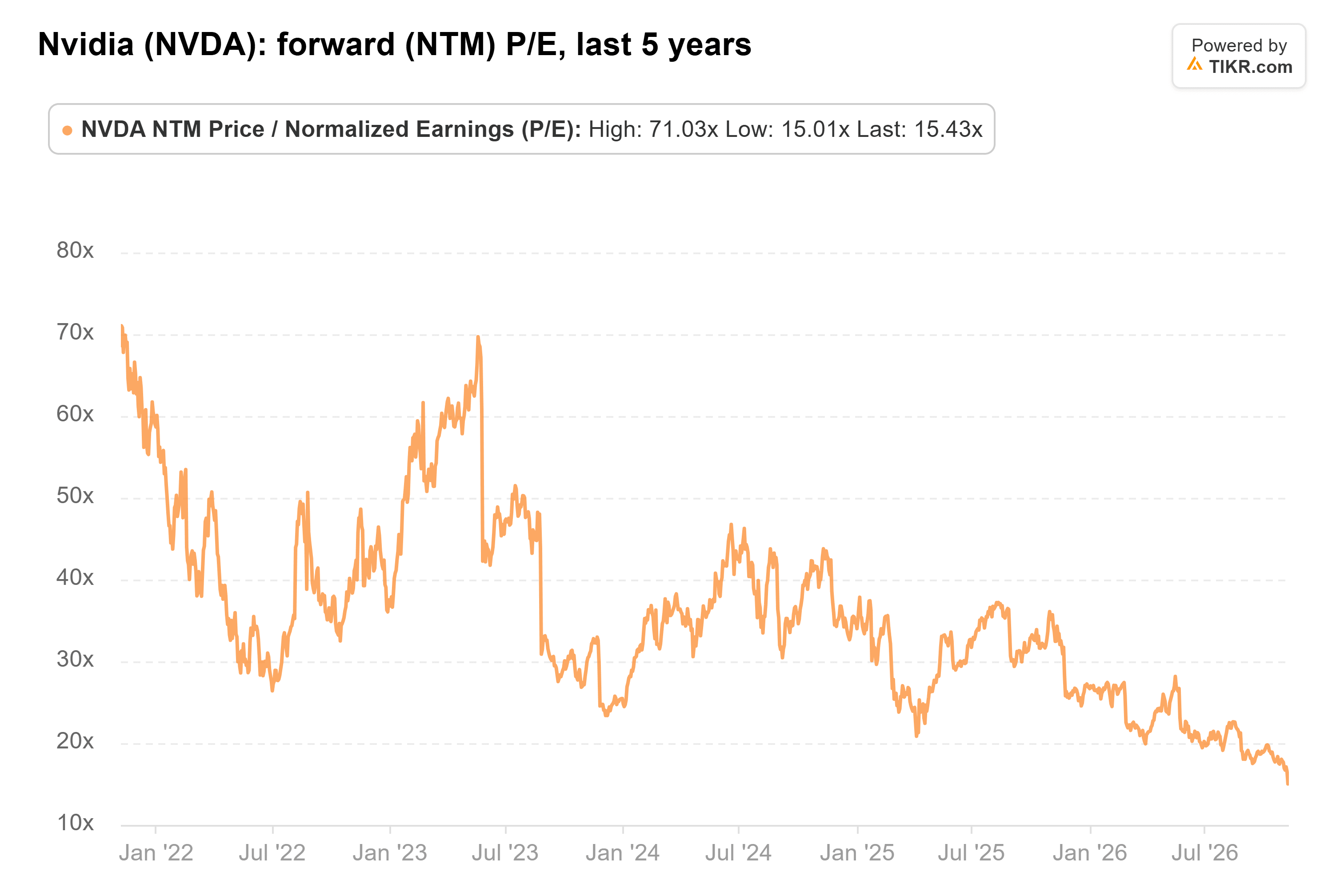
The multiple had already shrunk in a post-midterm selloff on fears of a slower US data center build-out. Any discount for losing Huang comes on top of one that’s already there.
TIKR Tracks 62 Analysts on NVIDIA. How Many Say “Buy”?
See the full breakdown of Buy, Hold, and Sell ratings on NVIDIA, along with Wall Street’s revenue and earnings estimates, all in one place. More than 500,000 investors use TIKR to research stocks like this one. See NVIDIA’s Analyst Ratings
Huang Built a Moat That Should Outlast Him
Lyn Alden, the macro investment strategist, put the bear case bluntly: “Realistically, if a mega cap company has too much single-man risk, it’s not really worth what it is.” In the same post, she named the alternative: “Either the tech and scale/structure are the moat, or it’s flimsy.”
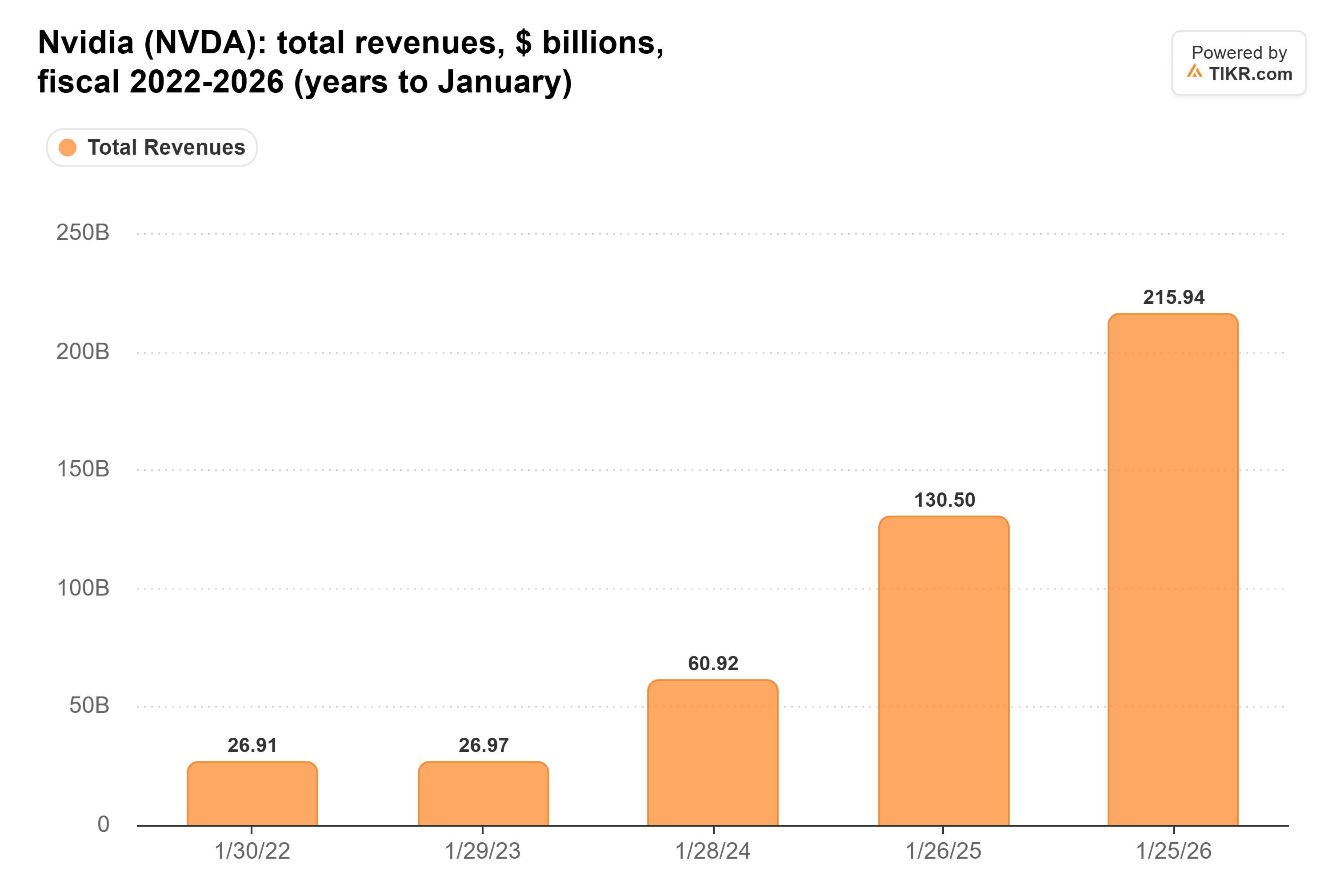
I’m in the tech-and-scale camp. Revenue grew roughly eightfold in four years, to $216 billion in the fiscal year ended January 2026, and NVIDIA’s annual report counts more than 7.5 million developers building on its CUDA software. They aren’t going anywhere if the CEO does.
What a Huang Exit Would Cost NVIDIA Stock
Politico’s Brendan Bordelon pointed to Huang’s “intense deal-making capabilities” on The Decoded Podcast, and management said on the August earnings call that NVIDIA has put nearly $50 billion into frontier AI labs. A successor would have to hold those relationships without the founder who built them.
Losing Huang with no one ready would hurt. But at about 14x forward earnings with estimates that strong, a succession selloff looks like a chance to buy, as long as the board’s findings stay away from the chip business.
NVIDIA reports on November 17, against guidance of $108 billion in quarterly revenue, and House committee chairs have asked Huang to a closed-door briefing the next day. The board hasn’t set a date for its findings. If it forces Huang out without naming a successor, the stock is in for a rough few weeks.
So what is NVIDIA stock actually worth?
TIKR lets you forecast the future price of any stock in less than a minute. Just enter a few assumptions into TIKR’s valuation model and see what NVIDIA could be worth. Start from Wall Street consensus estimates, or adjust the inputs to reflect your own view of the business. It’s free to use.
Disclaimer:
Please note that the articles on TIKR are not intended to serve as investment or financial advice from TIKR or our content team, nor are they recommendations to buy or sell any stocks. We create our content based on TIKR Terminal’s investment data and analysts’ estimates. Our analysis might not include recent company news or important updates. TIKR has no position in any of the stocks mentioned. Thank you for reading, and happy investing!