Telstra (TLS) has quietly delivered a strong year, with the stock up more than 20% year to date as investors warmed to the company’s steady execution and the completion of its multi-year T25 strategy. The market has responded well to Telstra’s push to simplify its portfolio, sharpen its core business, and lift network investment across mobile and fixed services. That momentum has helped the stock outperform both the broader Australian telecom sector and many income-focused peers.
Find out what a stock’s really worth in under 60 seconds with TIKR’s new Valuation Model (It’s free)>>>
Telstra remains one of Australia’s most important infrastructure companies, with a footprint that touches consumer mobility, enterprise networks, broadband, data centers, and emerging digital services. Its scale provides stability, while its retail and enterprise divisions balance recurring revenue and long-term customer relationships.
What investors want now is clarity on the next phase of growth. The company has begun outlining its post-T25 priorities, focusing on mobile pricing discipline, cost control, and returns on capital investment. The outlook for 2026 hinges on how well Telstra converts those strategic moves into earnings growth and stronger free cash flow.
Quickly value any stock with TIKR’s powerful new Valuation Model (It’s free!) >>>
Financial Story
Telstra posted stable financial performance for FY25, with group revenue rising modestly on the back of stronger mobile service revenue and improved postpaid subscriber trends. Mobile ARPU held firm despite competitive pressure, and Telstra maintained its leadership position across 5G coverage and network quality. Enterprise demand softened during the year, but fixed services and network applications remain central to long-term earnings stability.
| Metric | FY2025 | FY2024 |
|---|---|---|
| Revenue | A$23.2B | A$23.1B |
| EBITDA | A$8.4B | A$7.9B |
| Net Income | A$1.95B | A$1.80B |
| Free Cash Flow | A$4.3B | A$4.0B |
| CapEx | A$3.1B | A$3.0B |
| Net Debt | A$14.2B | A$14.4B |
| Mobile Service Revenue Growth | 6.5% | 4.0% |
| Fixed-Line Revenue Change | (2.3%) | (3.1%) |
| Dividend Per Share | A$0.18 | A$0.18 |
EBIT grew at a moderate pace as the company benefited from cost discipline and productivity gains tied to the end of the T25 transformation program. Management highlighted that improved mix, reduced legacy costs, and ongoing digitization efforts should support operating leverage into 2026. The company also kept capital expenditure in check, with investment tied closely to network upgrades and IT modernization.
Free cash flow strengthened as Telstra balanced investment with a focus on shareholder returns. Operating cash flow improved from better mobile economics, and working capital remained stable. With a well-covered dividend, modest leverage, and a clearer capital allocation framework, Telstra enters the next fiscal year with a more resilient foundation than in previous cycles.
Look up Telstra’s full financial results & estimates (It’s free)>>>
Broader Market Context
The Australian telecommunications sector has seen modest growth this year, supported by resilient consumer spending and lower-than-expected churn. While competition remains intense, disciplined pricing in mobile and stabilization in fixed-line services have helped major carriers protect margins. Investors continue to prioritize cash flow, dividend sustainability, and network reliability.
Inflationary pressures, energy costs, and wage increases remain challenges, but Telstra’s scale and cost reduction roadmap help offset these headwinds. As data usage expands and 5G coverage matures, the sector is positioned for steady mid-single-digit earnings growth across the next few years, provided pricing discipline holds.
1. Mobile Momentum and Pricing Power
Telstra’s mobile division continues to be the engine of the business, delivering steady ARPU growth and industry-leading network performance. Postpaid subscriber additions remained healthy during FY25, supported by strong demand for premium plans and expanded 5G device penetration. Customer churn stayed low, reflecting the value customers place on reliability and broad coverage. This stability helped offset competitive intensity from smaller operators and rising promotional activity.
Looking ahead, Telstra expects mobile growth to remain supported by population trends, migration, and enterprise mobility needs. Management continues to emphasize disciplined pricing, especially as data consumption expands and network usage intensifies. These mobile fundamentals remain central to Telstra’s confidence that it can deliver consistent, incremental operating income through FY26 and beyond.
2. Cost Discipline and Operating Efficiency
The completion of the T25 program marked a major operational reset for Telstra. The company exited several legacy cost structures, simplified organizational layers, and invested heavily in automation and digital workflows. These efforts supported a measurable improvement in EBIT margins and created a clearer path toward sustainable cost savings. Management highlighted that many of these efficiencies should continue to contribute through FY26 as new systems scale.
Even with inflationary pressure across labor and energy costs, Telstra’s productivity gains helped stabilize expenses. The company expects a similar focus in its next phase of strategy, with more targeted investment in digital infrastructure and fewer large-scale transformation costs. Investors will be watching whether these structural improvements translate into stronger operating leverage, particularly if revenue growth accelerates.
Value stocks like Telstra in less than 60 seconds with TIKR (It’s free) >>>
3. Cash Flow Stability and Capital Allocation
Free cash flow improved during the year, driven by better operating earnings and tight capital management. Telstra managed to balance investment in critical network upgrades with a conservative balance sheet and a healthy liquidity position. The company reiterated its commitment to dividends, supported by predictable cash generation and limited exposure to high-risk growth projects.
Looking ahead, capital allocation will likely remain focused on maintaining network leadership while exploring selective growth opportunities in enterprise, data services, and digital platforms. Management has emphasized that return on invested capital remains a central priority, with each investment reviewed against long-term cash generation. This approach should help maintain discipline as Telstra navigates the next stage of its strategy.
The TIKR Takeaway

Telstra enters FY26 from a position of stability, supported by steady mobile growth, disciplined execution, and improving free cash flow. With transformation costs winding down and capital spending more targeted, the company has room to strengthen its financial profile. The next year will be defined by how well Telstra balances pricing, cost control, and selective investment across key business segments.
Should You Buy, Sell, or Hold Telstra Stock in 2025?
Telstra sits in a steady position with balanced risks and opportunities, and while mobile remains the anchor, cost control is improving, and cash flow is stable. The path to stronger earnings is clearer, but confirmation through FY26 results will matter. Investors may want to watch upcoming reports to see how execution tracks.
How Much Upside Does Telstra Stock Have From Here?
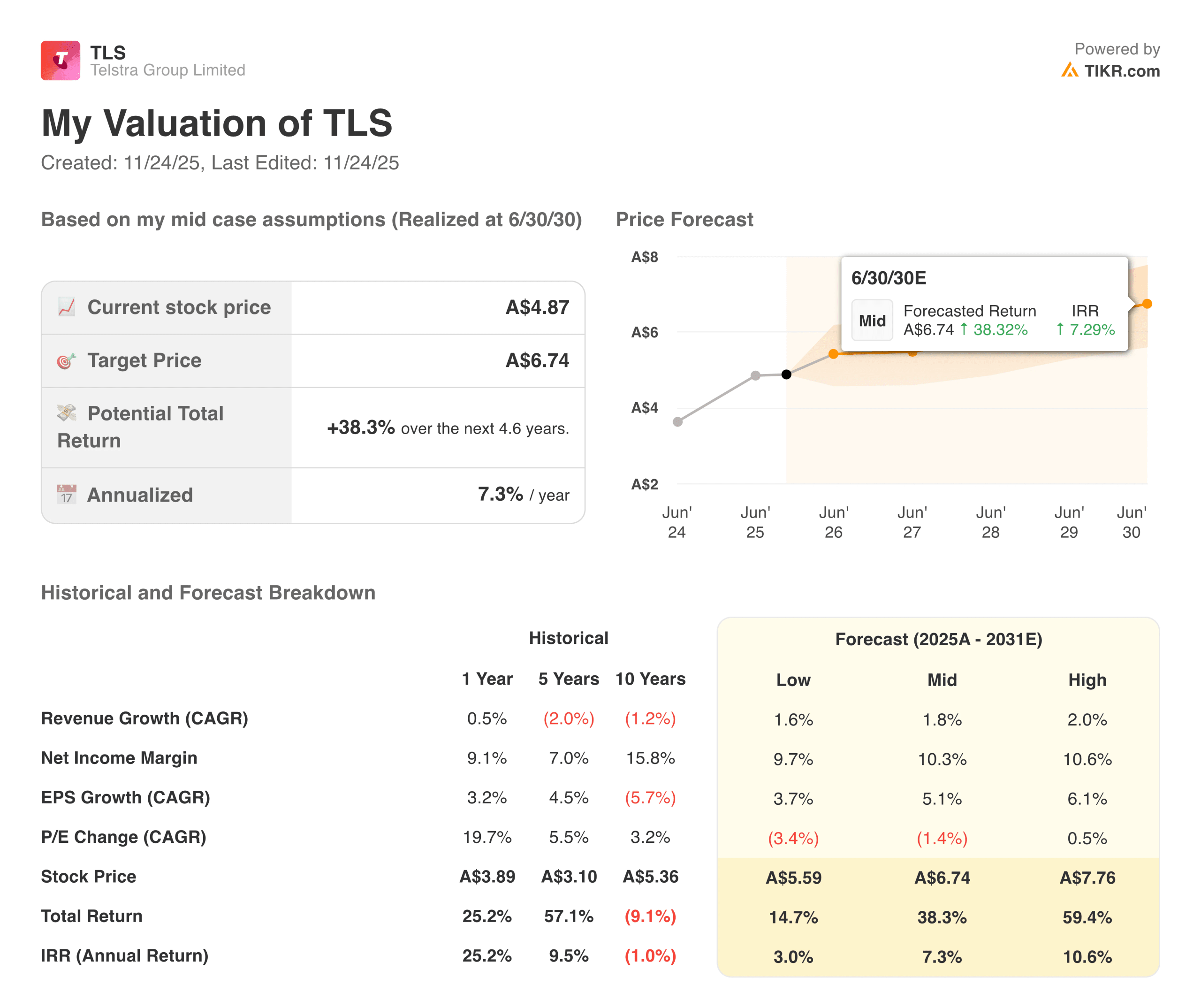
With TIKR’s new Valuation Model tool, you can estimate a stock’s potential share price in under a minute.
All it takes is three simple inputs:
- Revenue Growth
- Operating Margins
- Exit P/E Multiple
If you’re not sure what to enter, TIKR automatically fills in each input using analysts’ consensus estimates, giving you a quick, reliable starting point.
From there, TIKR calculates the potential share price and total returns under Bull, Base, and Bear scenarios so you can quickly see whether a stock looks undervalued or overvalued.
Find out what your favorite stocks are really worth (Free with TIKR) >>>
Looking for New Opportunities?
- See what stocks billionaire investors are buying so you can follow the smart money.
- Analyze stocks in as little as 5 minutes with TIKR’s all-in-one, easy-to-use platform.
- The more rocks you overturn… the more opportunities you’ll uncover. Search 100K+ global stocks, global top investor holdings, and more with TIKR.
Disclaimer:
Please note that the articles on TIKR are not intended to serve as investment or financial advice from TIKR or our content team, nor are they recommendations to buy or sell any stocks. We create our content based on TIKR Terminal’s investment data and analysts’ estimates. Our analysis might not include recent company news or important updates. TIKR has no position in any stocks mentioned. Thank you for reading, and happy investing!