Key Takeaways
- Intuitive Machines (LUNR) booked $920 million in awards in Q2 and pushed its backlog to a record $1.8 billion, yet the stock is down 45% this year.
- Most of its revenue has come from fixed-price contracts, so cost overruns come out of its own profit.
- Gross margin was 4.3% in fiscal 2025 and operating margin was -41.5%, so the business still loses money on the work it wins.
- Analysts don’t expect a profit until 2028, and gross margin in the Nov. 12 report is the number to watch.
Intuitive Machines has had no trouble winning work in 2026. It booked $920 million of awards in Q2, and its backlog hit a record $1.8 billion at the end of June, up from $1.1 billion at the end of March.
Shareholders haven’t been rewarded for it. The stock is down 43% in the past month and 52% so far this year.
For a company like this, the backlog is the easy part. The question is whether all that contract work can earn a margin.
TIKR tracks 10 analysts on Intuitive Machines. How many say “Buy”?
See the full breakdown of Buy, Hold, and Sell ratings on Intuitive Machines, along with Wall Street’s revenue and earnings estimates, all in one place. More than 500,000 investors use TIKR to research stocks like this one. See Intuitive Machines’ Analyst Ratings
Winning isn’t the problem
This year’s wins cover the Moon, missile defense and commercial satellites:
- $180.4 million from NASA in March to deliver seven payloads to the lunar south pole, the first job for its larger Nova-D lander
- A sixth NASA lander mission in June, on a firm-fixed-price contract worth up to $148.3 million
- More than $600 million to build three commercial geostationary communications satellites over 30 months
- A July award for 18 satellites for the Space Development Agency’s Golden Dome missile-tracking constellation
The satellite work depends on Lanteris Space Systems, formerly Maxar Space Systems, which Intuitive Machines bought for $800 million in Q1.
Q2 revenue was more than four times what it was a year earlier, and the company booked another $300 million of awards in Q3 through Aug. 13.
Still, analysts don’t see a profit coming soon. Their estimates show the per-share loss getting bigger this year before it shrinks:
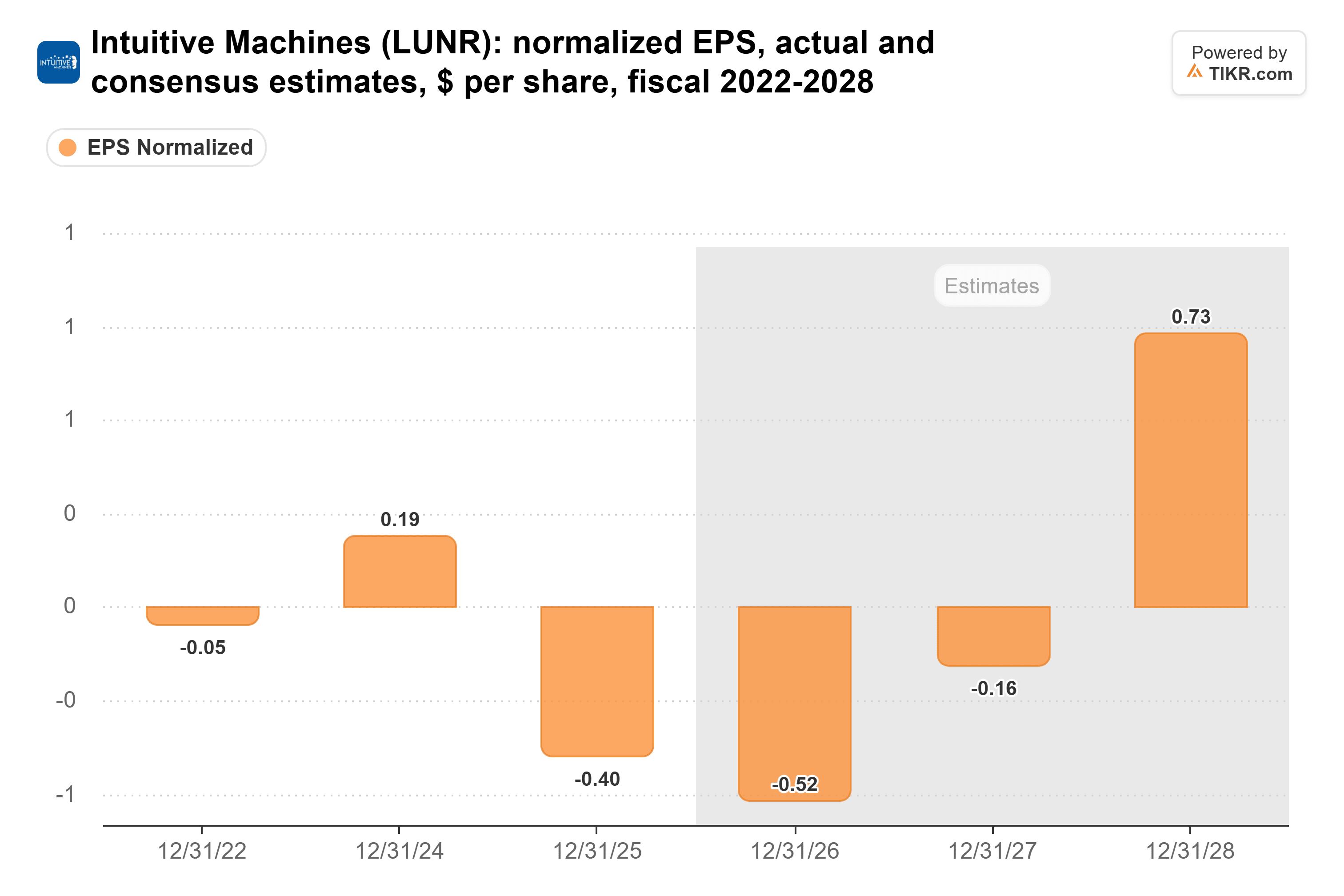
The first profit, $0.73 a share in 2028, comes from a single analyst’s estimate.
Even the bulls are trimming.
This week, B. Riley Securities cut its target to $34 from $43, and KeyBanc cut its target to $30 from $38, though both kept Buy ratings.
Intuitive Machines eats its own overruns
The margin matters more than the backlog because of how Intuitive Machines gets paid.
Its annual report says most of its revenue has come from fixed-price, long-term contracts, and the June lander award is fixed-price too.
So when a mission costs more than planned, Intuitive Machines pays the difference out of its gross profit. The same report lists manufacturing and production cost overruns among the risks to its margins.
Since late 2023, it has taken on more cost-reimbursable work, where the customer carries more of the risk. Even so, gross margin was negative in fiscal 2021 and fiscal 2023 and has been thin since.
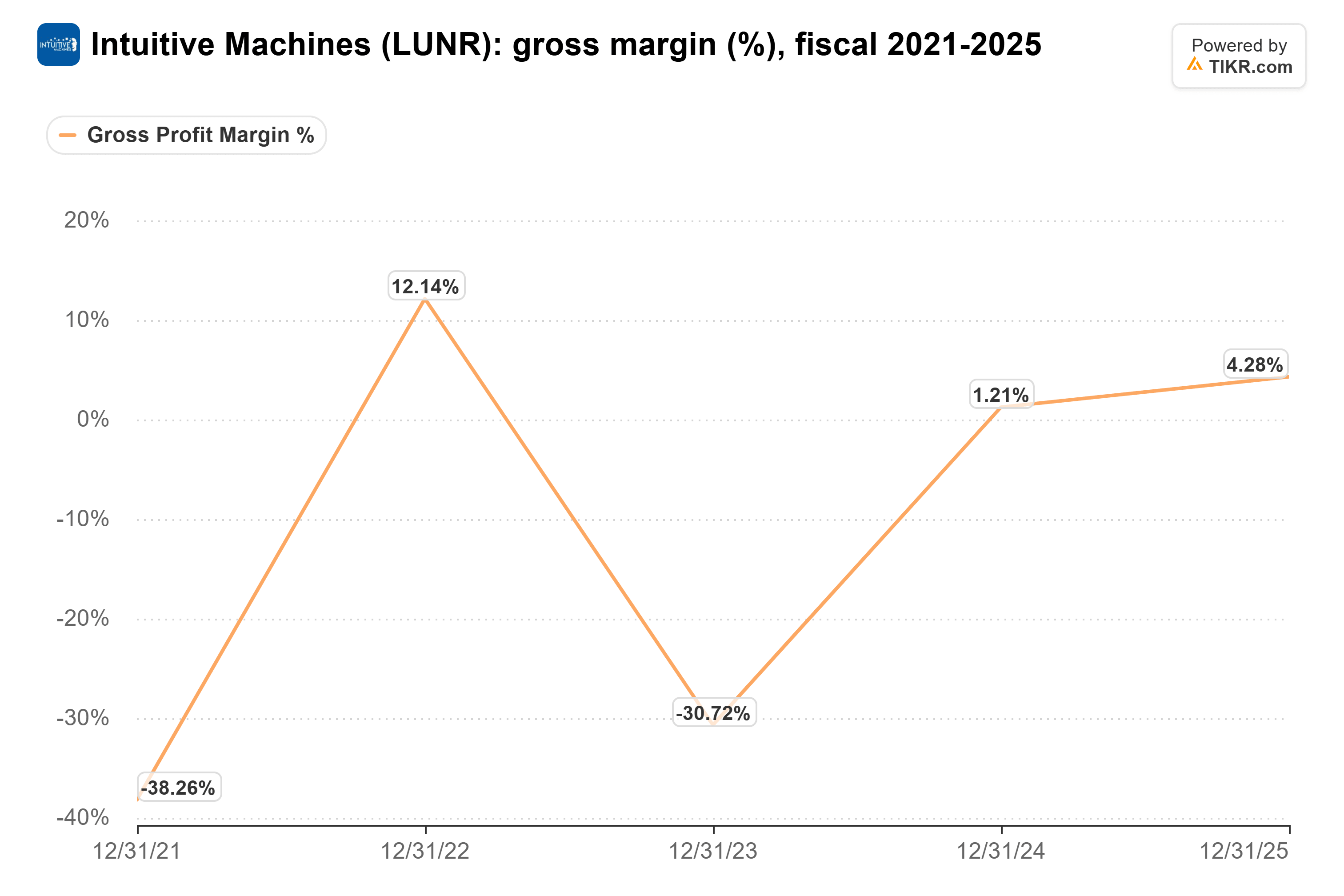
A 4.3% gross margin in fiscal 2025 left little to cover overhead. Operating margin was negative in every year on the chart, and it got worse in 2025 even though gross margin improved:

My guess is that deal costs explain part of that. In 2025, Intuitive Machines bought KinetX and agreed to buy Lanteris.
The bull case is scale
Thin margins are common for a contractor that’s still building out, and more volume could lift them. The company describes its sixth lander as a standard production-line Nova-C, built alongside other landers. Building the same lander over and over is how a fixed-price contractor earns a margin.
There’s early evidence, too. For Q1 2026, its first with Landers, Intuitive Machines reported record quarterly revenue and gross margin, plus positive adjusted EBITDA.
But the backlog is now much bigger than it was during the early lunar missions. The more of that work that’s fixed-price, the more a cost slip on any of it would hurt gross profit, as it did on those missions.
Watch the margin on Nov. 12
Intuitive Machines reports Q3 results before the market opens on Thursday, Nov. 12.
Revenue will get the headlines, and TIKR has already looked at whether the revenue ramp Wall Street models is real.
I’d watch two things: gross margin with a full quarter of Lantris in it, and whether any fixed-price mission booked higher costs.
Bottom line: the contract wins show there’s demand for what Intuitive Machines builds. Until gross margin stays in the double digits for a few quarters, I’d treat the backlog as a revenue story and wait.
With analysts not expecting a profit until 2028, there’s no rush. Of course, a couple of clean quarters on the new satellite work would change that picture fast.
So what is Intuitive Machines stock actually worth?
TIKR lets you forecast the future price of any stock in less than a minute. Just enter a few assumptions into TIKR’s valuation model and see what Intuitive Machines could be worth. Start from Wall Street consensus estimates, or adjust the inputs to reflect your own view of the business. It’s free to use.
Value Intuitive Machines for free
Disclaimer:
Please note that the articles on TIKR are not intended to serve as investment or financial advice from TIKR or our content team, nor are they recommendations to buy or sell any stocks. We create our content based on TIKR Terminal’s investment data and analysts’ estimates. Our analysis might not include recent company news or important updates. TIKR has no position in any of the stocks mentioned. Thank you for reading, and happy investing!