


Key Takeaways
- Intel stock closed at $113 on October 7, ~212% above its late-December close of $36, after Q2 revenue of $16.1B beat the midpoint of guidance by $1.8B.
- Analysts list 14 Buys, 1 Outperform, 32 Holds, 4 No Opinions, 1 Underperform, and 1 Sell, with the $118 mean target 4% above the price.
- My mid-case inputs on TIKR’s model value Intel stock at $459 by December 2030, implying a 305.4% total return, or 39.2% a year.
- CEO Lip-Bu Tan said on October 7 that Intel stays in Terafab.
Intel Stock Has Tripled Since December, Then Lost 6% in Four Sessions
Intel Corporation (INTC) stock closed at $113 on October 7, 2026, up about 212% from its late-December close of $36, by my math. The steepest leg came between late March and late June, when Intel stock climbed from $43 to $128.
On June 8, Reuters, citing The Information, reported that Google had placed an order with Intel to manufacture more than three million tensor processing units in 2028. Reuters said it could not independently verify the report. Intel reported second-quarter results on July 23, with revenue of $16.1 billion landing $1.8 billion above the midpoint of its guidance. CEO Lip-Bu Tan opened the Q2 earnings call with Intel’s core message: “strong demand for our products continue to outpace our growing supply.” The company guided third-quarter revenue to $15.8 billion to $16.8 billion and raised 2026 capital spending to more than $20 billion.
Intel raised equity in August, in an offering Deutsche Bank analyst Melissa Weathers put at about $23 billion. Reuters reported that Intel stock gained about 34% in September, and the shares closed at $120 on September 30.
October opened lower. Elon Musk said on October 3 that TSMC and his Terafab chip venture had held discussions, and Intel stock dipped 2.35% to about $117 on October 5. Reuters counted a 6.4% loss over the four sessions through October 6. On October 7, Tan told Bloomberg that Intel will remain involved in Terafab, while Musk said his companies would build and run the fab themselves.
Across the stretch, Intel stock ran from $36 to $128 by late June, finished September at $120, and traded near $109 on the morning of October 8.
Analysts Raised Intel Stock Targets Nearly as Fast as the Price
Intel stock carries 14 Buys, 1 Outperform, 32 Holds, 4 No Opinions, 1 Underperform, and 1 Sell, up from 4 Buys in late December.

The mean target climbed from $38 to $118 over the same stretch, a 210% rise against the price’s 212%. That mean now sits 4% above the $113 close. The lowest of 43 price targets is $80.
My Inputs Put Intel Stock at $459 by 2030
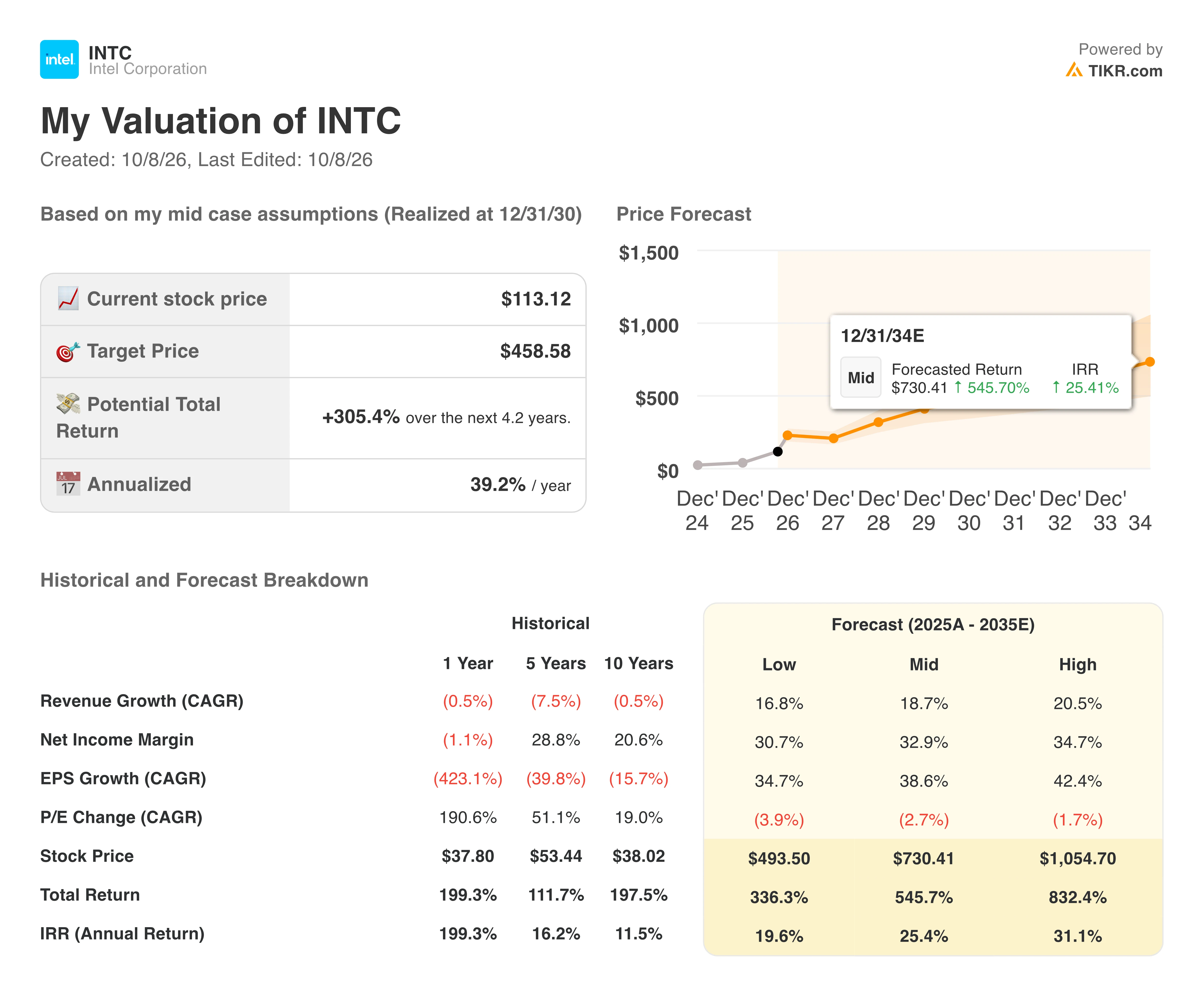
I ran a mid case with revenue growing 18.7% a year, a net income margin of 32.9%, EPS growing 38.6% a year, and the P/E shrinking 2.7% a year. Over the last year, revenue slipped 0.5% and the net margin was negative 1.1%, so this case assumes a full turnaround. I set growth there because CFO David Zinsner told analysts on July 23 he expects server growth “well north of a double-digit CAGR” for the next few years.
The model lands at $459 by December 31, 2030. That is a 305.4% total return from the $113 close over 4.2 years, or 39.2% a year.
By my math, $459 is about four times today’s base price. The test is the margin: Intel Foundry lost $2.1 billion in Q2, and Zinsner has set an internal breakeven target for the end of 2027. However, he cautioned in August that investment to support additional customers could push breakeven into 2028, potentially as late as year-end.
My inputs on TIKR’s model put Intel stock at $459 by 2030, a 305% total return from $113. Think I’m too high or too low? Run your own INTC numbers on TIKR for free →
So what is Intel stock actually worth?
TIKR lets you forecast the future price of any stock in less than a minute. Just enter a few assumptions into TIKR’s valuation model and see what INTC stock could be worth. Start from Wall Street consensus estimates, or adjust the inputs to reflect your own view of the business. It’s free to use.
Value Intel Corporation for free→
Disclaimer:
Please note that the articles on TIKR are not intended to serve as investment or financial advice from TIKR or our content team, nor are they recommendations to buy or sell any stocks. We create our content based on TIKR Terminal’s investment data and analysts’ estimates. Our analysis might not include recent company news or important updates. TIKR has no position in any of the stocks mentioned. Thank you for reading, and happy investing!


