Key Takeaways
- Intel (INTC) shares rose 5% today after CEO Lip-Bu Tan said Intel signed its first outside customer for 18A, the same day Microsoft (MSFT) became the first named customer for its EMIB packaging.
- It’s the first real outside proof for Intel’s foundry, but the 18A customer is unnamed.
- Intel’s foundry lost $10.3 billion in 2025, with just $307 million of revenue from outside customers.
- Tan’s goal of matching TSMC (TSM) needs 14A customers, and at about 40x forward earnings the stock already prices in a turnaround.
Intel shares rose 5% today after CEO Lip-Bu Tan said Intel has signed its first outside customer for 18A, its most advanced manufacturing process.
It’s welcome news for a stock that lost more than a third of its value in a month after a $1.6 billion guidance miss and a shareholder lawsuit.
On the same day, Microsoft became the first company to announce it will use Intel’s EMIB packaging for its Azure chips. And Tan put a date on catching TSMC.
What Tan said
At the TomorrowX Summit in Austin on Wednesday, Tan said Intel “just signed our first outside customer on 18A” and put 18A yield “now at 70%,” according to Wall St Engine’s post on X.
The post also has him expecting parity with TSMC for Intel’s own chips by late 2027 or 2028, with volume production on 14A, Intel’s next process, in 2028.
He didn’t name the customer or say which measure of yield he meant. Intel’s chief technology officer, Pushkar Ranade, later said on X that the customer signed for 18A-P, a version of 18A.
TIKR tracks 55 analysts on Intel. How many say “Buy”?
See the full breakdown of Buy, Hold, and Sell ratings on Intel, along with Wall Street’s revenue and earnings estimates, all in one place. More than 500,000 investors use TIKR to research stocks like this one. See Intel’s Analyst Ratings
Why one customer matters this much
Intel’s annual report shows the foundry lost $10.3 billion in 2025 on $17.8 billion of revenue, only $307 million of it from outside customers.
Last year, Intel said it could pause 14A if it didn’t land a significant outside customer for it, so a paying 18A customer is the first sign that outside demand can show up.
Analysts already expect a lot. Consensus has Intel’s revenue rising to $83.8 billion in 2028 from $52.9 billion in 2025, with the biggest step in 2028, the year Tan wants 14A in volume:
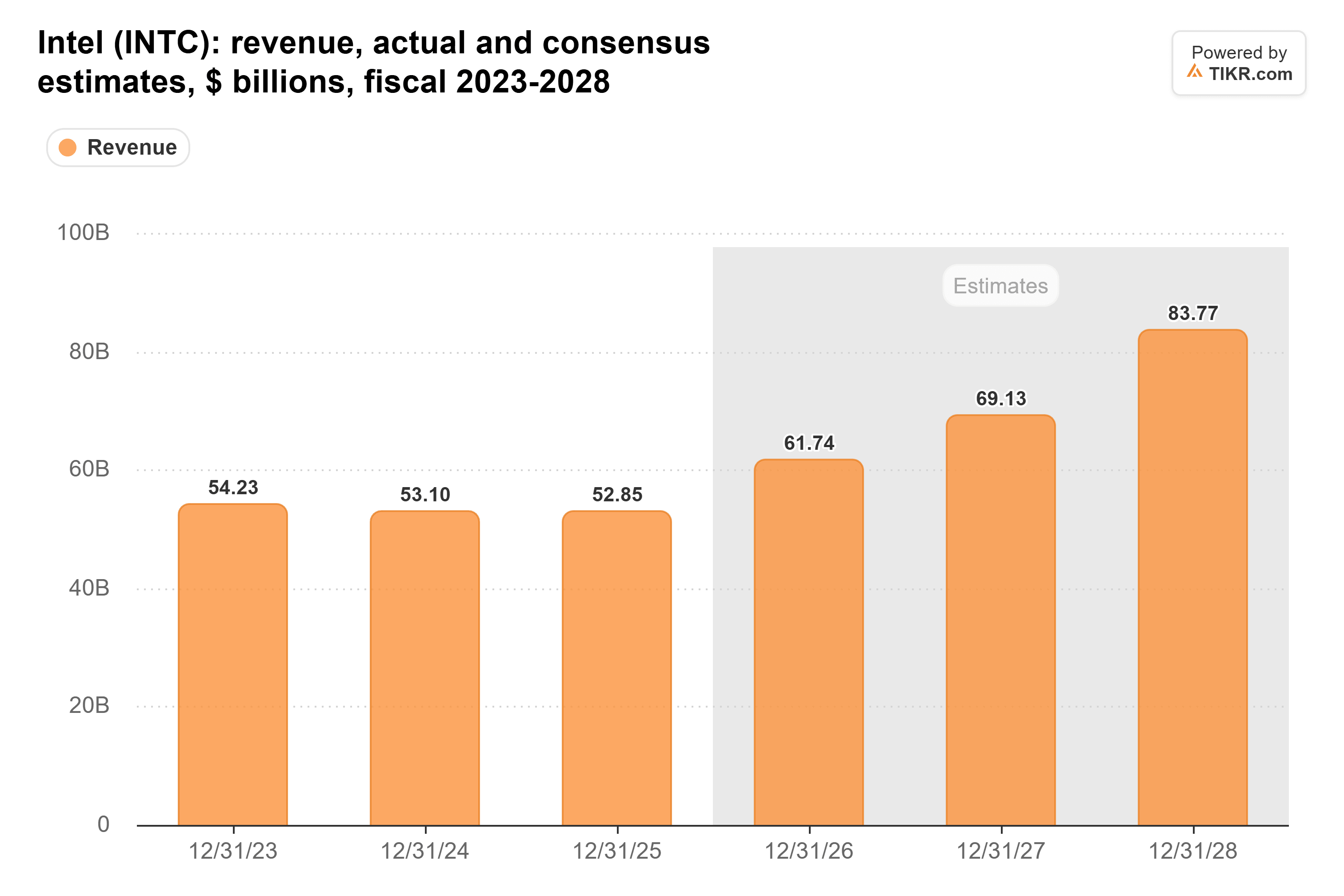
Those estimates came before Wednesday’s news. One unnamed customer on 18A-P isn’t enough for me to expect them to rise yet.
Filling the fabs is also how Intel gets its margin back. Its gross margin fell from 55.5% in 2021 to 36.6% in 2025:
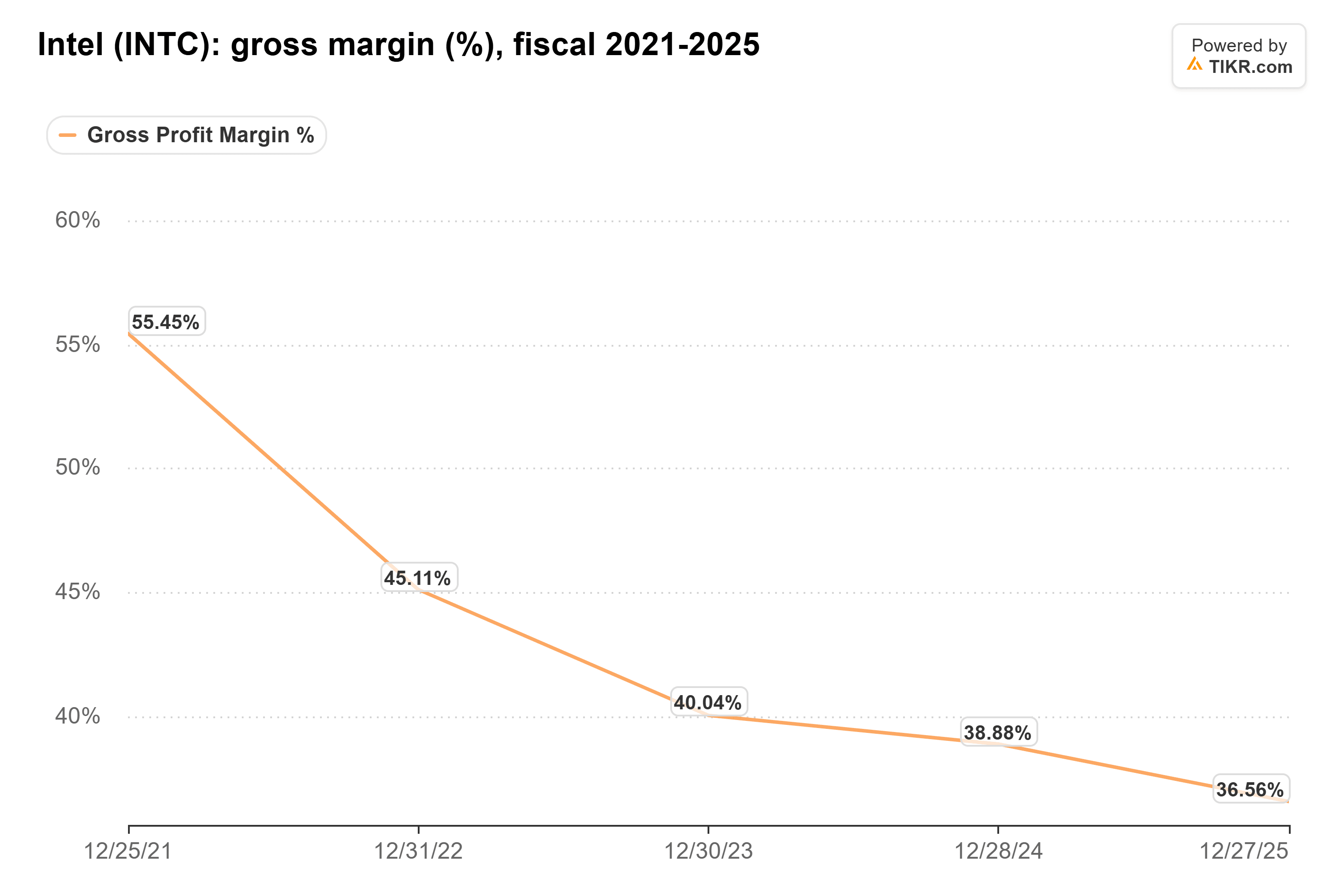
Getting it back takes outside wafers, sold at prices that cover the cost of the fabs.
Microsoft’s deal has a name on it
Microsoft will use EMIB, Intel’s technology for connecting several chips inside one package, for Azure’s own silicon. The companies’ joint release says the deal also covers Xeon supply, including next-generation Diamond Rapids chips, but neither disclosed its value or said Microsoft is the 18A customer.
Tan said at the summit that “Amazon, Microsoft and Google are struggling to get capacity for their CPU ambitions at TSMC.”
That’s a jab at TSMC, whose CEO offered in October to help customers that couldn’t get enough of Intel’s EMIB-T packaging. Microsoft went to Intel anyway.
My read: matching TSMC would let Intel bring home the tiles it buys from TSMC for some of its own products, the part of TSMC’s business most exposed to Tan’s timeline.
Good news, at a full price
Even after the slide, Intel isn’t cheap. At the last close, the stock traded at about 40x forward earnings. That’s under its five-year average of 50x, but years of thin earnings pushed that average up:
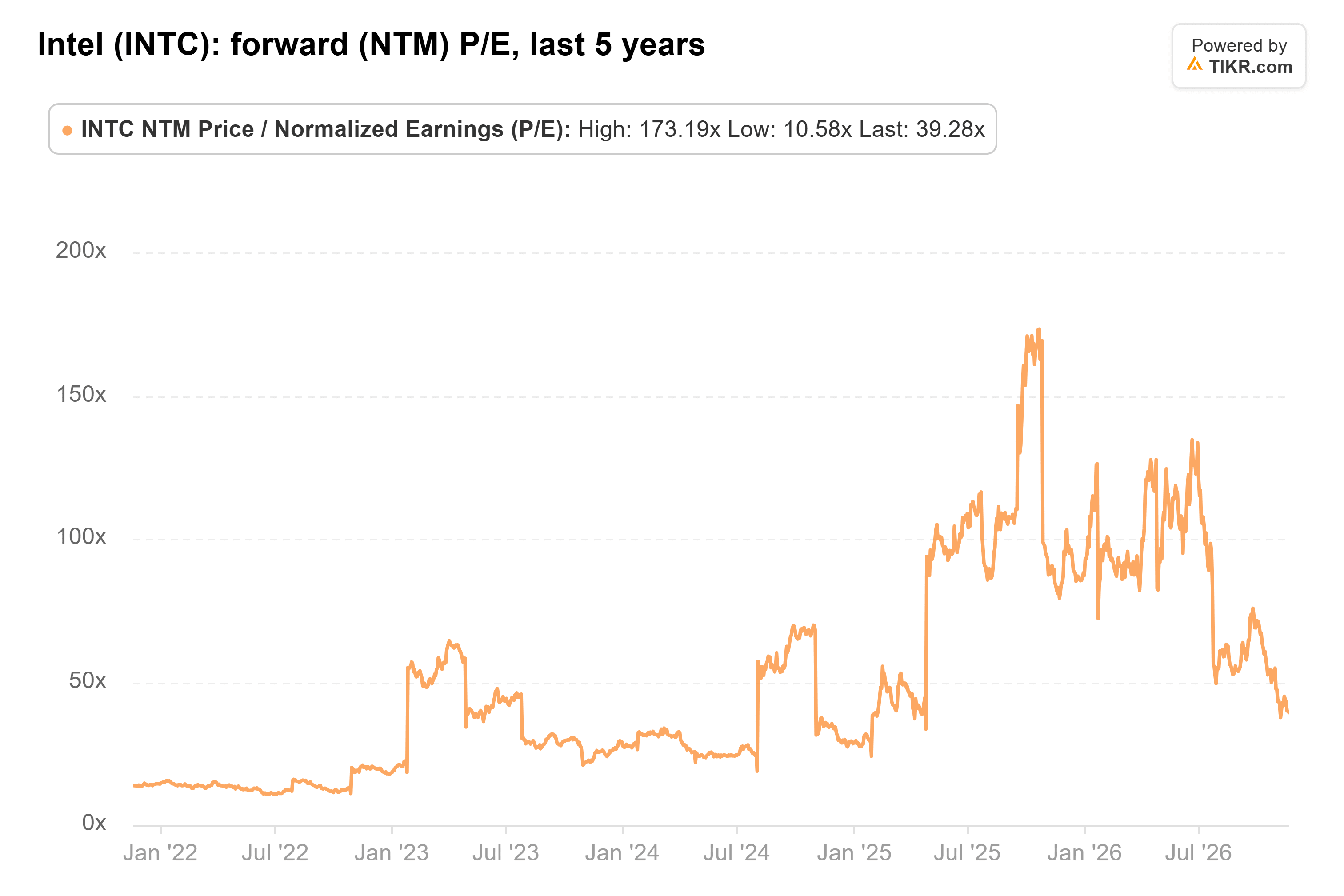
From 2014 to 2022, when Intel was a mature, profitable chipmaker, it traded between 10x and 18x. Today’s jump pushes the multiple higher still.
Bottom line: this is the first real proof that an outside company will pay for Intel’s most advanced process, and Microsoft’s name on the packaging deal adds to it.
Still, at that price, I’d want the 18A customer’s name and the size of its order before buying into the turnaround.
The next test is 14A, where management expects customers to commit designs between the second half of 2026 and the first half of 2027.
A named 14A customer with volume attached would confirm the turnaround. Outside foundry revenue stuck near 2025’s $307 million would leave Intel’s fabs relying on Intel’s own chips.
So what is Intel stock actually worth?
TIKR lets you forecast the future price of any stock in less than a minute. Just enter a few assumptions into TIKR’s valuation model and see what Intel could be worth. Start from Wall Street consensus estimates, or adjust the inputs to reflect your own view of the business. It’s free to use.
Disclaimer:
Please note that the articles on TIKR are not intended to serve as investment or financial advice from TIKR or our content team, nor are they recommendations to buy or sell any stocks. We create our content based on TIKR Terminal’s investment data and analysts’ estimates. Our analysis might not include recent company news or important updates. TIKR has no position in any of the stocks mentioned. Thank you for reading, and happy investing!