Key Takeaways
- A hypothetical $850,000 portfolio split evenly across Molson Coors, Clorox and Prudential Financial pays $40,301 a year in dividends, about $3,360 a month.
- Clorox’s dividend is the least covered, at 133% of free cash flow over the twelve months to Sept. 30, 2026, though analysts expect 74% in fiscal 2027.
- If Clorox halved its dividend, the income would fall to about $33,600 a year, and if it stopped paying, to about $26,800.
- Prudential’s check looks the safest, while Molson Coors’ is well covered but rests on a shrinking beer business.
If you’re retired and living off your portfolio, a dividend check you can count on matters more than a big one.
So take a hypothetical retiree who splits $850,000 evenly across Molson Coors (TAP), Clorox (CLX) and Prudential Financial (PRU). At today’s prices, that’s about 7,090 shares of Molson Coors, about 2,700 of Clorox and about 2,355 of Prudential, paying $40,301 a year, or about $3,360 a month.
That’s a 4.7% yield on this part of the portfolio. (Of course, no one should ever own just three stocks.) But the three checks aren’t equally safe.
| Stock | Shares | Cost | Income a year | Share of income | Coverage (latest / forward) |
|---|---|---|---|---|---|
| Molson Coors (TAP) | 7,090 | $283,316 | $13,613 | 34% | 31% / 36% of free cash flow |
| Clorox (CLX) | 2,700 | $283,289 | $13,500 | 34% | 133% / 74% of free cash flow |
| Prudential Financial (PRU) | 2,355 | $283,306 | $13,188 | 33% | 37% / 41% of normalized EPS |
| Total | $40,301 |
Source: TIKR, today’s prices. Latest coverage is the twelve months to Sept. 30, 2026 (Prudential: fiscal 2025); forward is the next fiscal year’s consensus.
6 safe dividend stocks paying retirees 6%+ yields
There are over 100 stocks paying 6%+ annual dividends today.
But after an extensive investment review leveraging TIKR’s proprietary data, we now believe only six of them are truly safe for retirees.
They’re all yours as part of our new investment report. Learn more about how to get access right here.
Molson Coors has room to spare, but beer is a tough sell
Molson Coors’ dividend has the most cushion of the three. It took just 31% of free cash flow over the twelve months to Sept. 30, 2026, and analysts expect 36% for fiscal 2026. Free cash flow has covered dividends paid in every year since fiscal 2016:
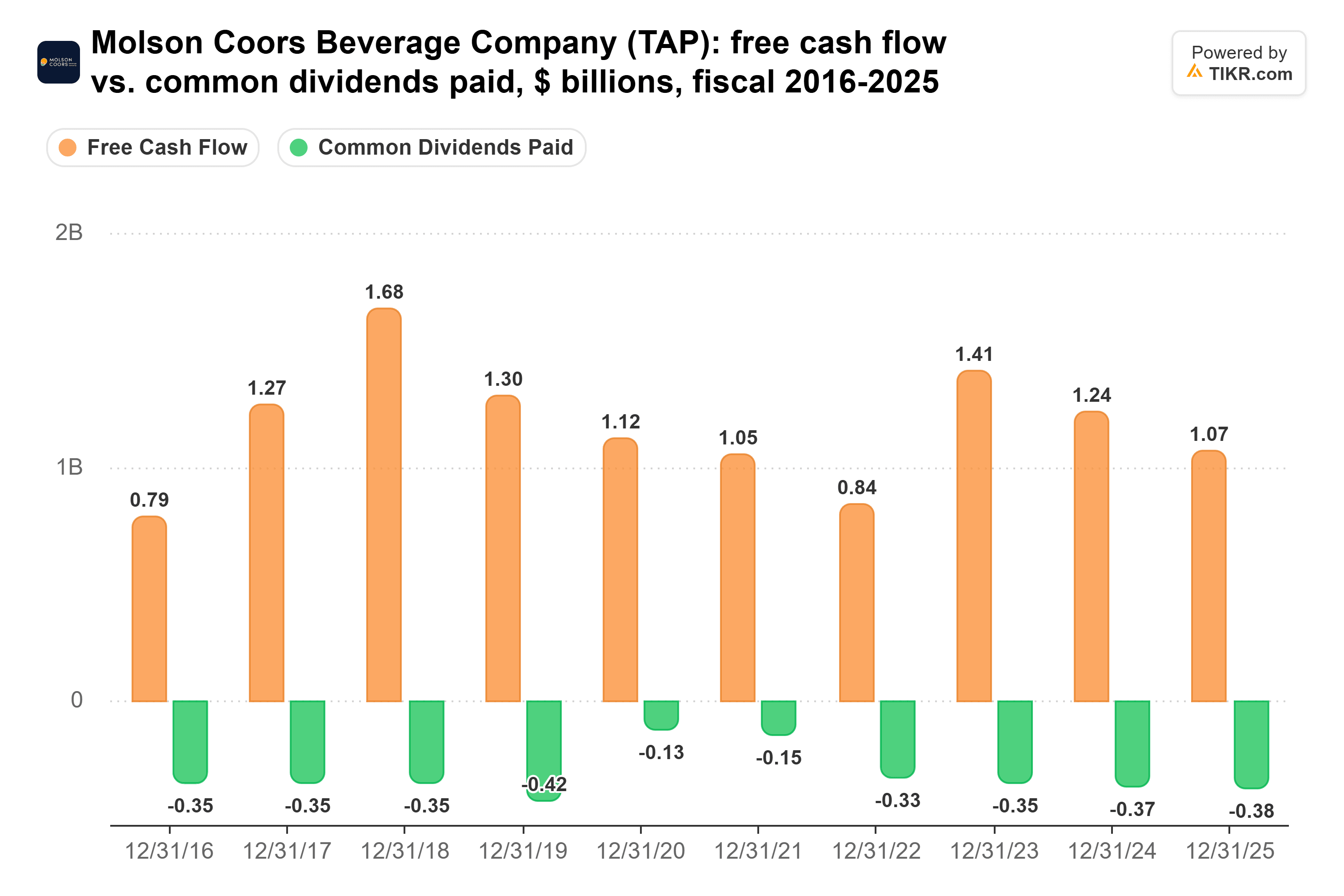
The business is going the wrong way, though. On Nov. 5, Molson Coors cut its 2026 outlook to a 16% to 19% drop in underlying EPS, from 11% to 15%, and to underlying free cash flow of $1.0 billion, give or take 10%, from $1.1 billion. U.S. beer industry volume fell more than 4% in the third quarter by the company’s own estimate.
“We cannot cost cut our way to sustainable growth,” CEO Rahul Goyal said on the third-quarter call. Still, CFO Tracey Joubert says the company has “the balance sheet capacity to manage through periods of cost pressure,” and with 31% coverage, I believe her on the dividend.
Clorox’s check is running ahead of its cash
Clorox is paying out more than its business brings in. Over the twelve months to Sept. 30, 2026, it paid $602 million in dividends against $453 million of free cash flow, a stretched 133%. Free cash flow also fell short of dividends in fiscal 2022, 2024 and 2026 (Clorox’s years end in June):
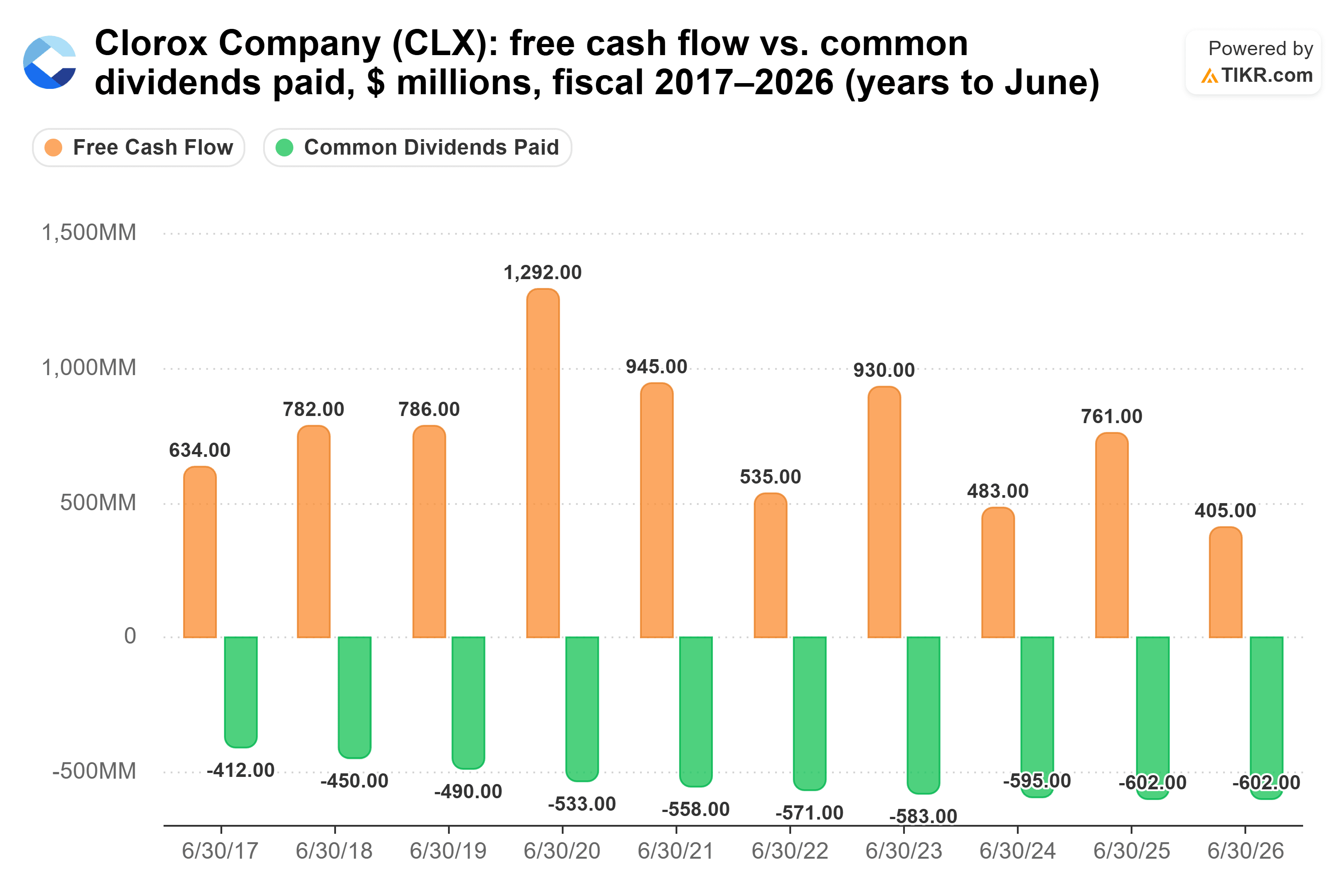
Costs are the culprit. Higher commodity, manufacturing and logistics costs cut gross margin by 130 basis points to 40.4% in the quarter ended Sept. 30, 2026. On Nov. 2, Clorox lowered its fiscal 2027 gross margin outlook to about 41.5% and said adjusted EPS should land near the low end of its $5.70-$6.00 range.
Management told investors on its August call that “the current payout is a bit elevated, but we see this as something more transitory as we rebuild our gross margin.” The fiscal 2027 consensus agrees, at a 74% payout. But that takes free cash flow of $828 million, roughly double fiscal 2026’s $405 million. And Clorox will be chasing it under a new CEO: Fabian Garcia, from Unilever, takes over from Linda Rendle on Jan. 5, 2027.
Prudential’s check looks the sturdiest
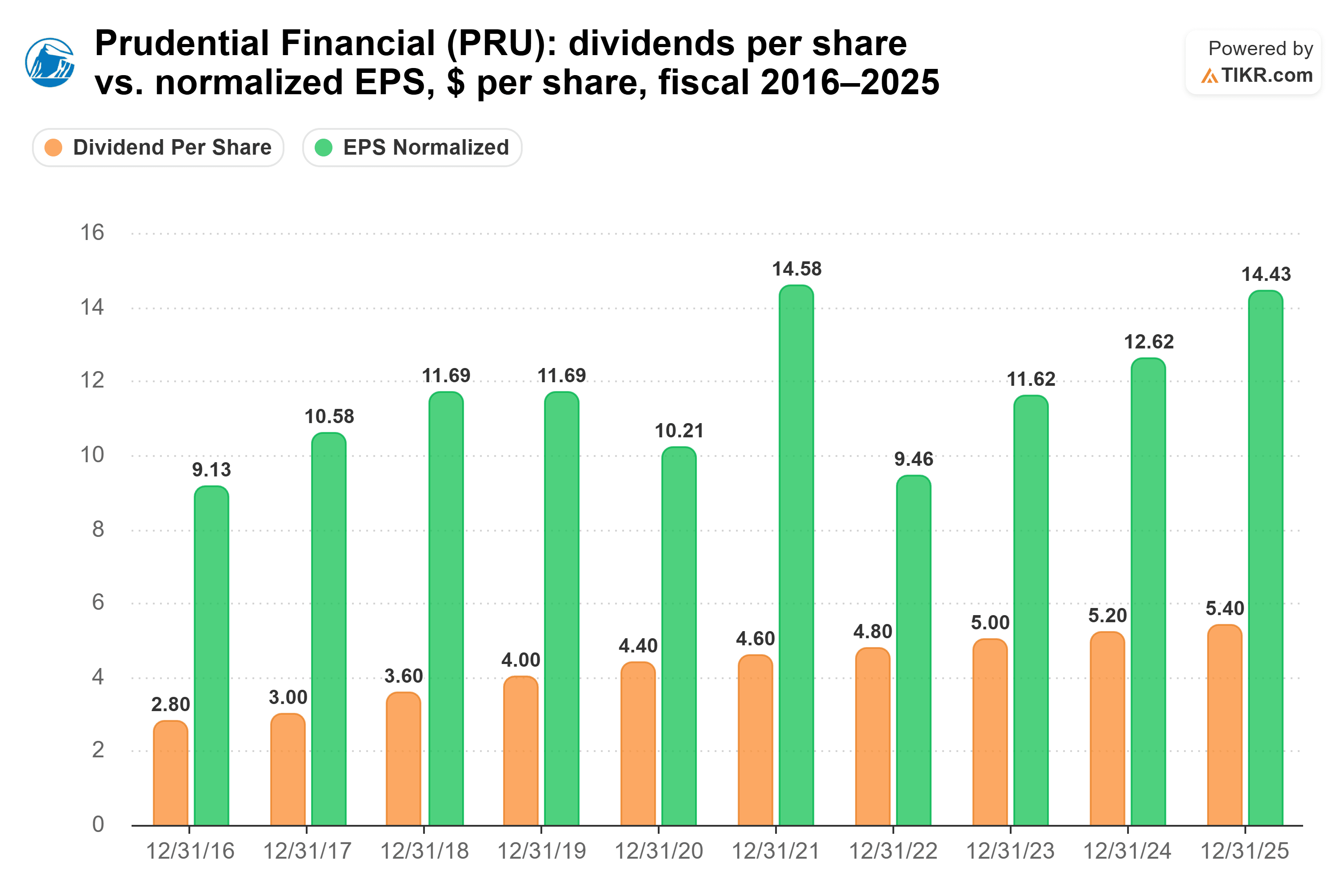
As an insurer, Prudential is judged on earnings, and its dividend took just 37% of fiscal 2025’s normalized EPS of $14.43 a share. Analysts expect 41% for fiscal 2026. Its dividend rose every year from $2.80 a share in fiscal 2016 to $5.40 in fiscal 2025, with earnings well above it the whole way:
Japan is the sore spot. Employees at Prudential of Japan improperly received ¥3.1 billion from customers, and on Oct. 9, Japan’s Financial Services Agency extended a halt on new sales there through Jan. 31, 2027. The suspension cost about $140 million in the third quarter.
Prudential is also raising cash. On Oct. 20, it agreed to sell its Brazil and Mexico businesses for about $4 billion, which should net about $3.1 billion.
Two steady checks and one to watch
I’d be comfortable collecting two of these checks. Prudential’s looks safe and growing: it’s well covered, and the Brazil and Mexico sale brings in cash. Molson Coors’ looks safe but slow, with plenty of coverage and a shrinking beer business behind it.
Clorox’s is stretched, and it’s the most at risk. If it halved its dividend, this portfolio’s income would fall to about $33,600 a year, and if it stopped paying, to about $26,800. I don’t expect either anytime soon, since management said in August that “for now, you should expect this to continue.” (I’d note the “for now.”)
Clorox’s free cash flow needs to climb back above the roughly $600 million it pays in dividends each year. Garcia’s first earnings report, early next year, should show whether the margins are on their way back.
Enjoy your retirement in style with these safe 6%+ dividend yields
Dividends can hold the key to enormous wealth. But only if you buy the right ones.
Picking the right high-yield dividend stock can be the difference between a dream retirement…and scraping by every month, waiting for the next Social Security check to clear.
We’ve identified six stocks yielding 6%+ that we believe every retiree should know about right now.
Disclaimer:
Please note that the articles on TIKR are not intended to serve as investment or financial advice from TIKR or our content team, nor are they recommendations to buy or sell any stocks. We create our content based on TIKR Terminal’s investment data and analysts’ estimates. Our analysis might not include recent company news or important updates. TIKR has no position in any of the stocks mentioned. Thank you for reading, and happy investing!