Key Takeaways
- At today’s prices, $1,000 a month in dividends takes 6,977 Pfizer shares (about $201,600), 4,762 Bristol Myers Squibb shares (about $302,100) or 3,530 Merck shares (about $521,600).
- Pfizer’s 6.0% yield makes it the cheapest of the three by about $320,000 against Merck, but its dividend takes 89% of its free cash flow, the thinnest coverage of the group.
- Bristol Myers Squibb’s dividend takes 55% of its free cash flow, and it grew 6.2% a year from fiscal 2020 to fiscal 2025, the fastest of the three.
- Bristol Myers Squibb’s check is the one I’d want, and its expected 2027 drop in Eliquis revenue is the risk to watch.
If you want $1,000 a month in dividend checks from one drug stock, the cost ranges from about $201,600 to about $521,600 at today’s prices.
That’s the spread across Pfizer (PFE), Merck (MRK) and Bristol Myers Squibb (BMY) for a hypothetical retiree who wants $12,000 a year from just one of them. (Of course, no retiree should lean on a single stock for income.)
The higher the yield, the fewer dollars it takes. But a cheaper check only helps if it keeps coming:
| Stock | Yield | Shares for $1,000 a month | Cost | Cash dividend payout ratio (TTM) | Dividend growth, fiscal 2020-2025 |
|---|---|---|---|---|---|
| Pfizer (PFE) | 6.0% | 6,977 | $201,566 | 89% | 2.5% a year |
| Merck (MRK) | 2.3% | 3,530 | $522,616 | 66% | 5.8% a year |
| Bristol Myers Squibb (BMY) | 4.0% | 4,762 | $302,054 | 55% | 6.2% a year |
Source: TIKR, at today’s prices. Dividends at each company’s current annual rate. Payout ratios over each company’s last reported twelve months.
6 safe dividend stocks paying retirees 6%+ yields
There are over 100 stocks paying 6%+ annual dividends today.
But after an extensive investment review leveraging TIKR’s proprietary data, we now believe only six of them are truly safe for retirees.
They’re all yours for free as part of our new investment report, which you can access right here.
Pfizer’s check is the cheapest, and the most stretched
Pfizer is in the middle of a handoff. Third-quarter revenue of $16.6 billion was about flat from a year earlier operationally, as Paxlovid fell 63% and Comirnaty fell 29% while launched and acquired products grew 32%. Pfizer raised its 2026 revenue guidance to $62.0-$64.0 billion on Nov. 3. But Cecile Guegan, made permanent CFO this month, said 2027’s guidance will reflect two of its drugs entering Medicare’s negotiated prices that year.
That squeeze shows in the dividend’s coverage. The dividend took 89% of free cash flow over the twelve months to June 28, 2026, and it was more than free cash flow outright in fiscal 2023 and fiscal 2025:
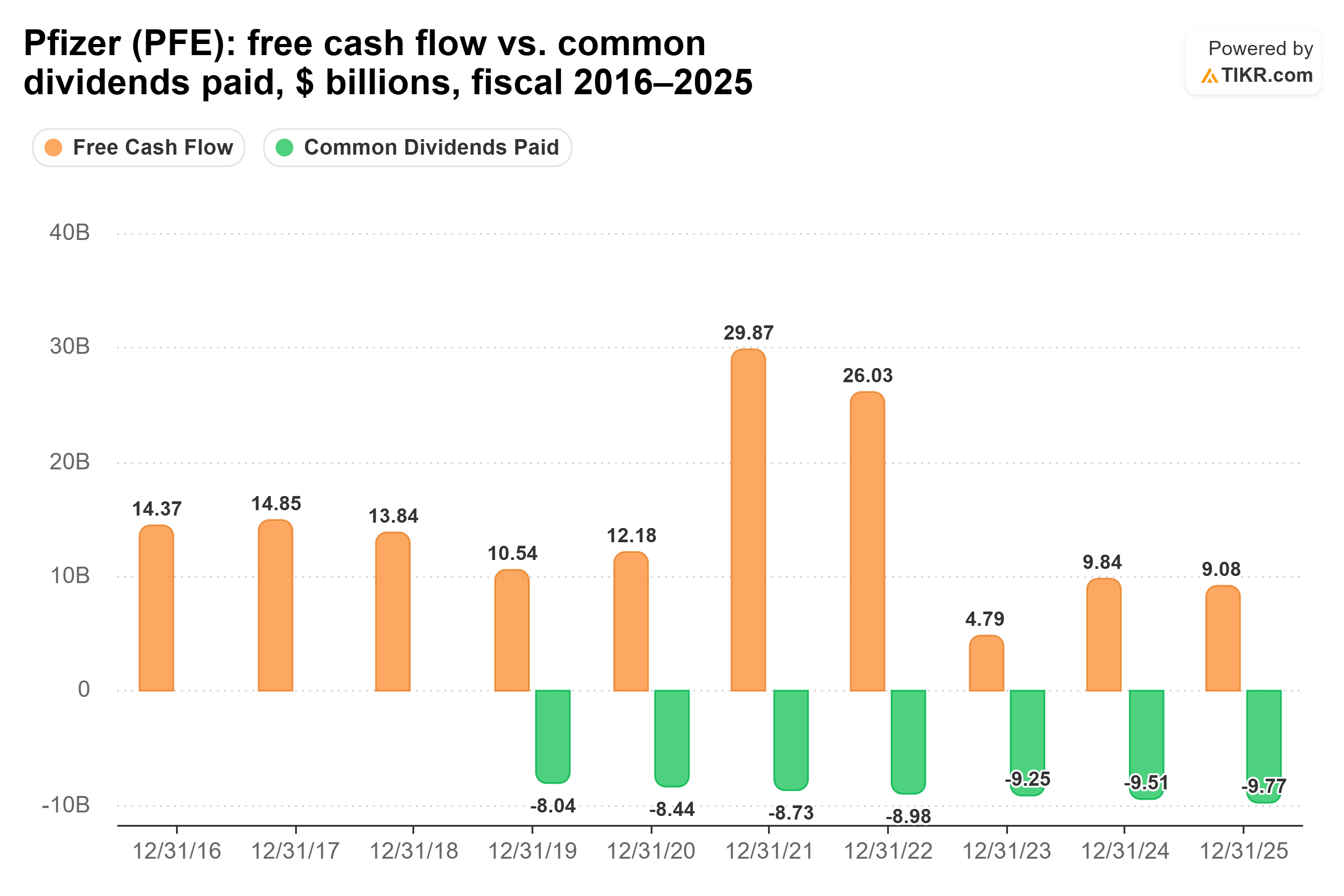
On Oct. 6, the board declared a $0.43 fourth-quarter dividend, Pfizer’s 352nd consecutive quarterly payment and the same rate it has paid all year. The dividend had grown 2.5% a year from fiscal 2020, when it was $1.52.
Merck costs the most, and the market’s paying for its growth
Merck’s 2.3% yield means the same $1,000 a month takes about $521,600. Part of that is the price investors put on the business: Merck trades at 18x forward earnings, against 10x for Pfizer and 9.6x for Bristol Myers.
Third-quarter sales rose 5% to $18.1 billion, with Keytruda up 6% to $8.6 billion and Winrevair up 93% to $694 million. Merck raised its 2026 sales guidance to $66.8-$67.3 billion on Oct. 29. The worry is Keytruda’s loss of exclusivity. CFO Caroline Litchfield called it “really more of a hill on the overall revenues of our company,” with strong growth returning soon after.
Coverage leaves room. Dividends took 66% of free cash flow over the twelve months to Sept. 30, 2026. From fiscal 2023 to fiscal 2025, the ratio ran between 43% and 81%:
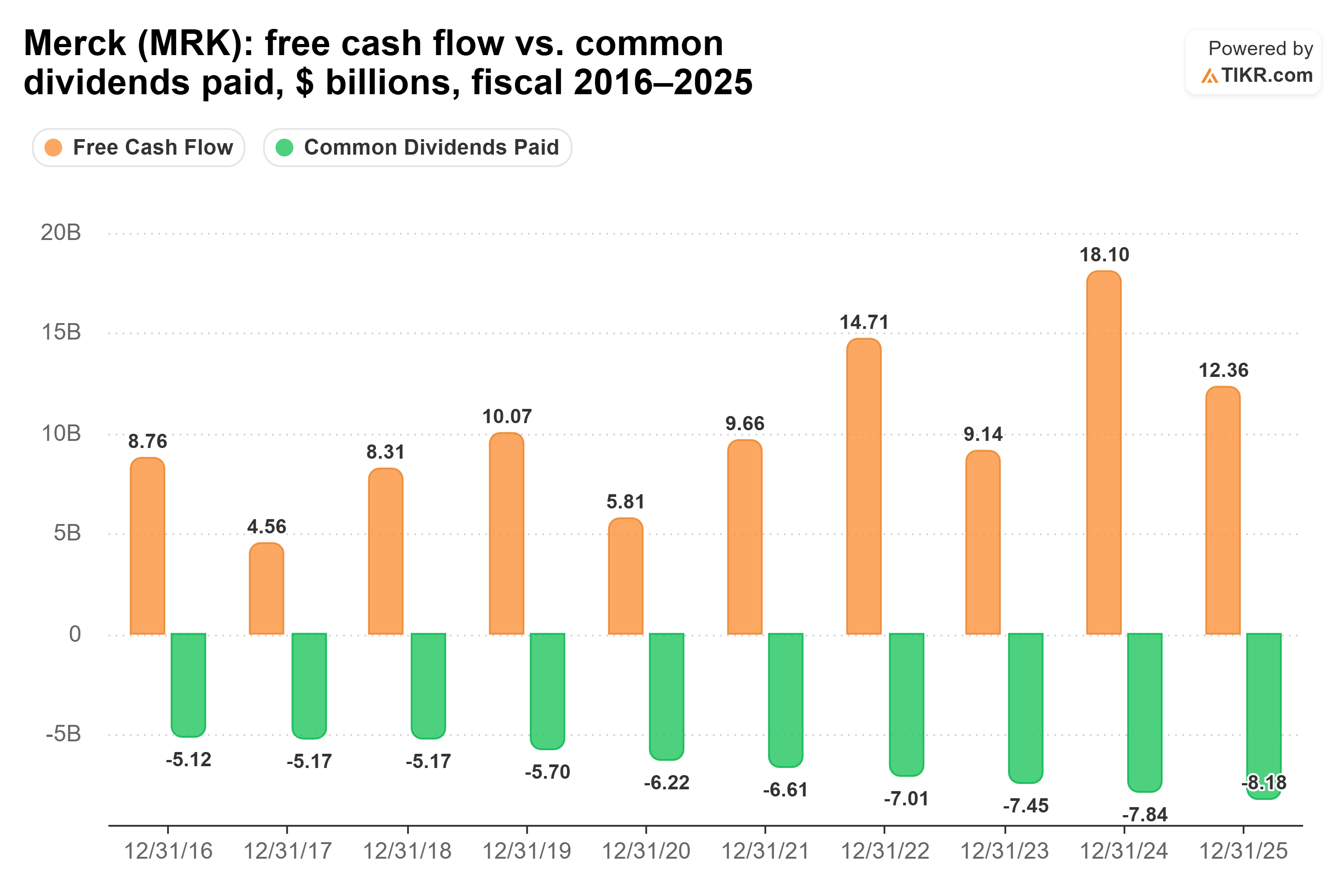
“We remain committed to the dividend with the goal of increasing it over time,” Litchfield said on Merck’s third-quarter call. Its record backs that up: the dividend grew 5.8% a year from fiscal 2020 to fiscal 2025.
Bristol Myers covers its check with the most room
Bristol Myers is the best covered of the three. Its dividend took 55% of free cash flow over the twelve months to Sept. 30, 2026, and no more than 39% in any year from fiscal 2021 to fiscal 2025:
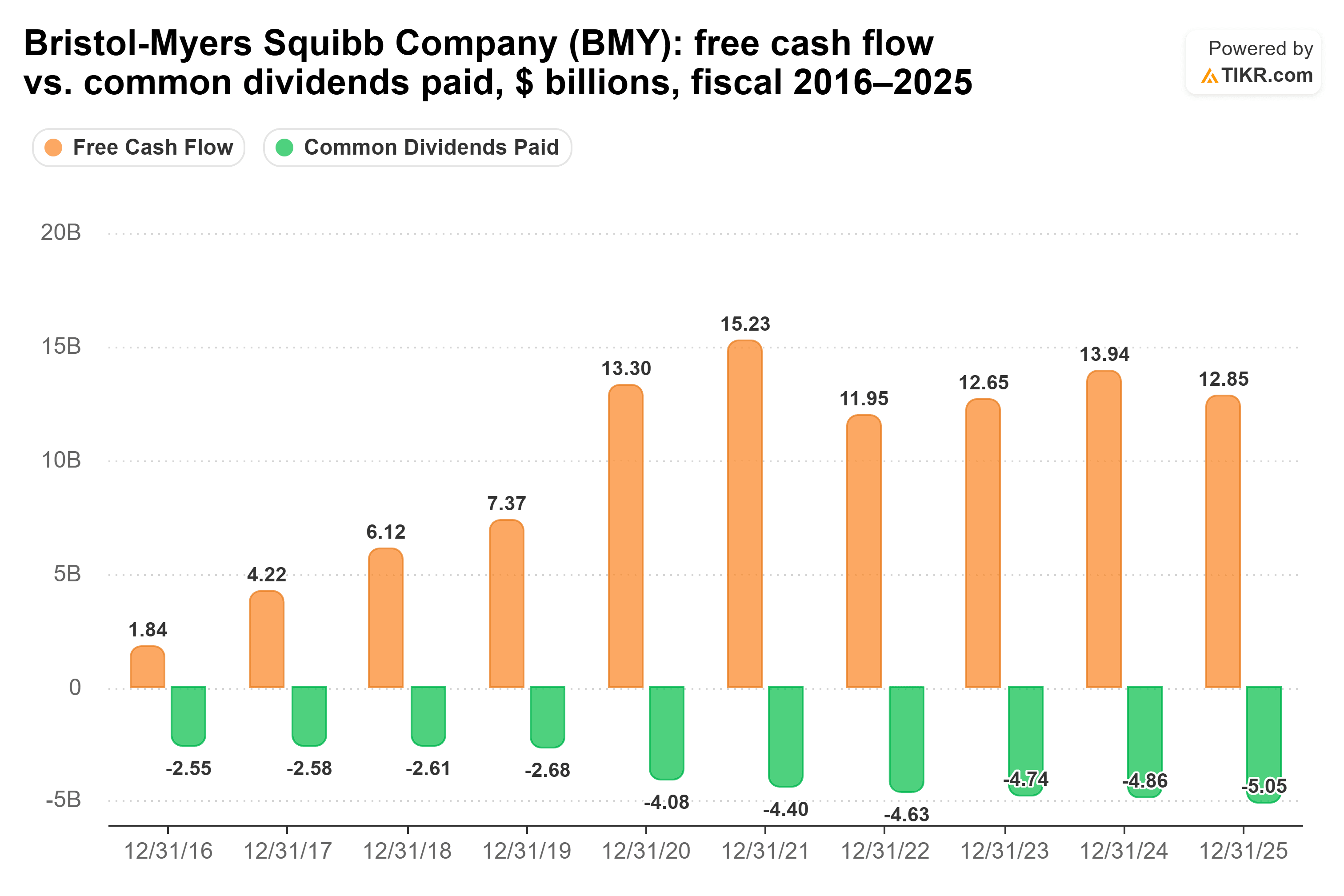
The ratio rose from 39% in fiscal 2025 to 55% because trailing free cash flow of $9.29 billion came in below fiscal 2025’s $12.9 billion.
The business is shifting, too. Third-quarter revenue rose 7% to $13.1 billion. The Growth Portfolio climbed 12% to $7.7 billion and Eliquis grew 26%, more than making up for a 47% drop in Revlimid sales to generic competition. The biggest risk is Eliquis itself: management expects Eliquis revenue to fall $1.5 billion to $2 billion in 2027.
The check I’d want in retirement
Pfizer’s check is the most at risk of the three, though that’s a long way from saying it’s in danger. On Pfizer’s second-quarter call in August, CEO Albert Bourla said, “We feel extremely confident that we will — even the most stretched scenarios that we are running, we will be able to maintain our dividend.” But “maintain” is the key word. With 89% of free cash flow going out the door, I wouldn’t count on much growth, and that’s the trade-off for the $320,000 you’d save against Merck.
Merck’s sales are growing and its dividend has room, but you pay up for both.
Bottom line: Bristol Myers is the check I’d want. It costs far less than Merck and has the widest cushion. At its 6.2% pace, the same 4,762 shares would pay about $20,700 a year in year 10. And at 9.6x forward earnings, I’m not paying much for any of it.
Of course, the drop in Eliquis revenue will test that cushion in 2027. Milvexian’s atrial fibrillation readout, expected early next year, will be the next big look at what could follow Eliquis.
Forget Bristol Myers Squibb: 6 safe 6%+ dividend yields you can buy right now
Dividends can hold the key to enormous wealth. But only if you buy the right ones.
Picking the right high-yield dividend stock can be the difference between a dream retirement…and scraping by every month, waiting for the next Social Security check to clear.
We’ve identified six stocks yielding 6%+ that we believe every retiree should know about right now. (And Bristol Myers Squibb isn’t one of them.)
Disclaimer:
Please note that the articles on TIKR are not intended to serve as investment or financial advice from TIKR or our content team, nor are they recommendations to buy or sell any stocks. We create our content based on TIKR Terminal’s investment data and analysts’ estimates. Our analysis might not include recent company news or important updates. TIKR has no position in any of the stocks mentioned. Thank you for reading, and happy investing!