Key Takeaways
- At today’s prices, $1,000 a month in dividends takes 3,659 shares of Gilead Sciences, 3,410 shares of Merck or 2,239 shares of Johnson & Johnson.
- Merck is the cheapest route at about $481,900, but its dividend is the least covered, at 66% of free cash flow over the last twelve months.
- Gilead’s dividend is the best covered, at 30%, but it costs the most and has grown the slowest.
- Johnson & Johnson’s check looks like the one to want, with a decade of steady free cash flow behind it and talc litigation as the risk to watch.
Drugmakers like Gilead Sciences (GILD), Merck & Co. (MRK) and Johnson & Johnson (JNJ) end up on just about every retiree’s dividend shortlist.
So let’s take a hypothetical retiree who wants $1,000 a month, or $12,000 a year, in dividend checks from just one of them. At today’s prices, Merck gets there for about $165,700 less than Gilead. This is what each one takes:
| Stock | Yield | Shares for $1,000 a month | Cost | Cash dividend payout ratio (TTM) |
|---|---|---|---|---|
| Gilead Sciences | 1.9% | 3,659 | $647,643 | 30% |
| Merck & Co. | 2.5% | 3,410 | $481,901 | 66% |
| Johnson & Johnson | 1.9% | 2,239 | $616,867 | 62% |
Source: TIKR and StockAnalysis, at today’s prices. Dividends at each company’s current yearly rate; payout ratios for the twelve months to late September 2026.
6 safe dividend stocks paying retirees 6%+ yields
There are over 100 stocks paying 6%+ annual dividends today.
But after an extensive investment review leveraging TIKR’s proprietary data, we now believe only six of them are truly safe for retirees.
They’re all yours as part of our new investment report. Learn more about how to get access right here.
Gilead: the most cushion, the slowest raises
Third-quarter product sales rose 13% to $8.3 billion from the same quarter of 2025, with HIV sales up 18%. On Oct. 29, Gilead raised its 2026 product sales guide to $31.0 billion-$31.3 billion from $30.1 billion-$30.4 billion.
The dividend took a well-covered 30% of free cash flow over the twelve months to Sept. 30, down from 42.3% in fiscal 2025. Free cash flow has also topped the dividend in every year of the last decade:

The catch is Biktarvy, which brought in $4.1 billion of the quarter’s sales. CMS set its Medicare price at $2,600 for a 30-day supply starting Jan. 1, 2028, and Gilead expects that to cost the drug about $1.5 billion of revenue that year. CFO Andrew Dickinson still expects “very strong margins, not only in ’27, but for the foreseeable future.” Meanwhile, the dividend grew just 3.0% a year from fiscal 2020 to fiscal 2025 ($2.72 to $3.16 a share).
Merck: the cheapest check, with Keytruda’s hill ahead
Merck’s check costs the least, and its business is still growing. Third-quarter sales rose 5% to $18.1 billion, with Keytruda up 6% to $8.6 billion, and Merck raised its 2026 adjusted earnings guide on Oct. 29. Keytruda’s coming loss of exclusivity is the big question. CFO Caroline Litchfield said, “we see the KEYTRUDA LOE as really more of a hill on the overall revenues of our company as we will, in short order, then return to strong growth.”
The dividend took 66% of free cash flow over the twelve months to Sept. 30. That ratio ran from 43.3% (fiscal 2024) to 81.4% (fiscal 2023) over the last five fiscal years, and free cash flow fell short of the dividend in fiscal 2017 and fiscal 2020:
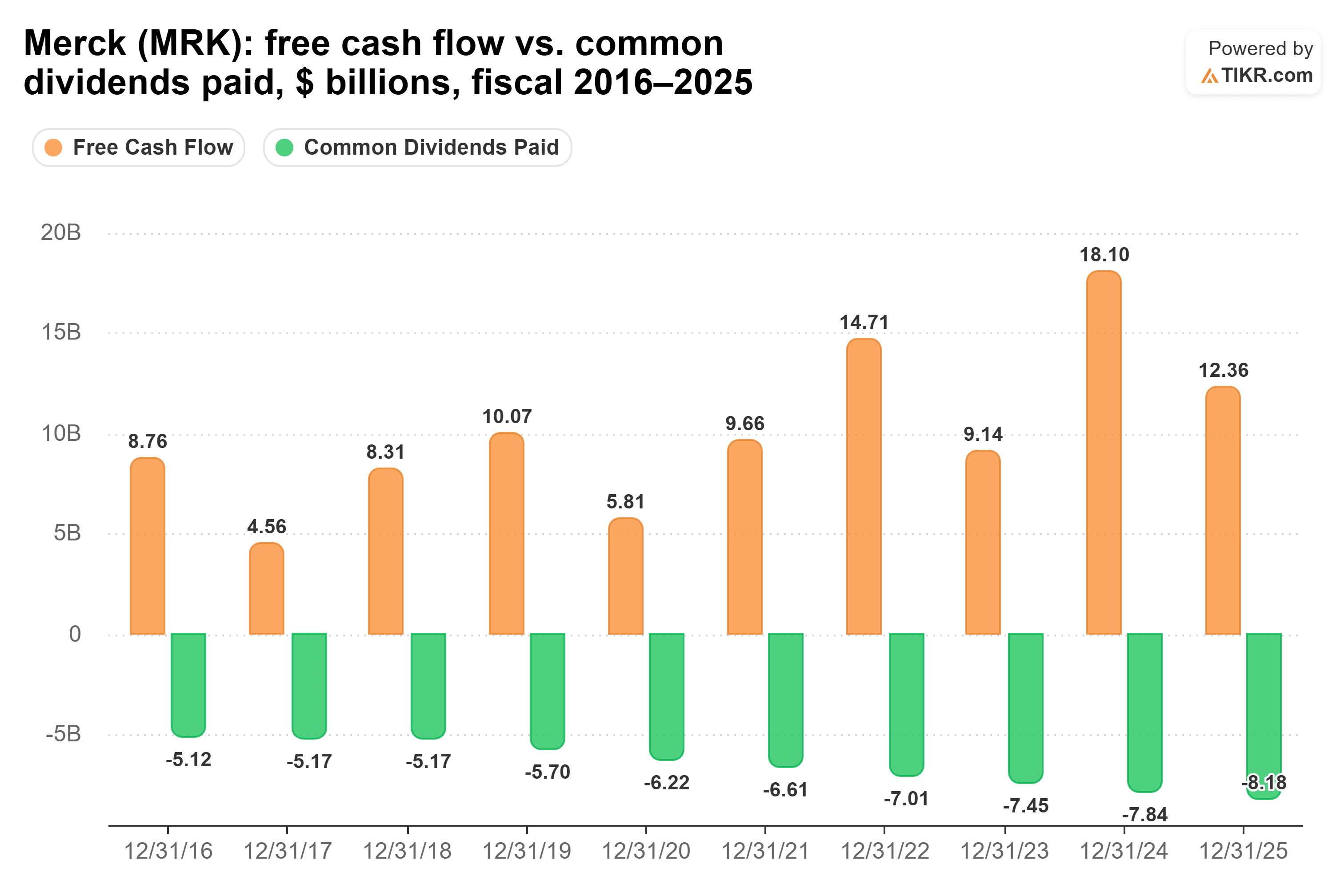
“We remain committed to the dividend with the goal of increasing it over time,” Litchfield said. On Nov. 17, Merck raised its quarterly dividend 3.5% to $0.88 from $0.85. That’s well below the 5.8% a year it averaged from fiscal 2020 to fiscal 2025 ($2.48 to $3.28 a share).
Johnson & Johnson: steady cash, with a talc overhang
Johnson & Johnson’s check has the steadiest cash of the three behind it. Third-quarter sales rose 5.9% to $25.4 billion. On Oct. 13, J&J raised its 2026 adjusted EPS guide to $11.05-$11.15 and stood by its free cash flow guide of about $21 billion.
The dividend took 62% of free cash flow over the twelve months to Sept. 27. That ratio has stayed between 51.9% and 66.8% since fiscal 2020, and free cash flow has held between $15.5 billion and $20.2 billion in every year of the last decade:

Analysts’ fiscal 2026 consensus puts the ratio at 55%, though that assumes $23.15 billion of free cash flow, more than J&J’s own guide. The dividend grew 5.2% a year from fiscal 2020 to fiscal 2025 ($3.98 to $5.14 a share). The risk is talc. J&J’s Oct. 21 quarterly report says trials have restarted in state courts since its talc unit’s third bankruptcy was dismissed. CFO Joseph Wolk said the proposed ovarian settlement is “trending to meet the 95% threshold” of claimant participation it needs.
The check I’d want
Merck’s dividend is the least covered of the three, so it’s the most at risk, though I wouldn’t call it truly risky. Free cash flow covered it in each of the last five fiscal years, and the roughly $165,700 it saves against Gilead is real money. But I suspect raises stay small until Merck gets over Keytruda’s hill.
Gilead’s check has the most cushion but grows the slowest. At its 3.0% pace, Gilead’s shares would pay about $15,720 a year by year 10. At its 5.2% pace, Johnson & Johnson’s would pay about $19,018, and Gilead’s figure doesn’t account for Biktarvy’s 2028 price cut.
So if I could only pick one of these checks, it’d be Johnson & Johnson’s. Its check costs less than Gilead’s and has grown faster. The next tests are whether the ovarian settlement clears that 95% threshold and whether J&J’s 2026 free cash flow comes in near its roughly $21 billion guide.
Forget Johnson & Johnson: 6 safe 6%+ dividend yields you can buy right now
Dividends can hold the key to enormous wealth. But only if you buy the right ones.
Picking the right high-yield dividend stock can be the difference between a dream retirement…and scraping by every month, waiting for the next Social Security check to clear.
We’ve identified six stocks yielding 6%+ that we believe every retiree should know about right now. (And Johnson & Johnson isn’t one of them.)
Disclaimer:
Please note that the articles on TIKR are not intended to serve as investment or financial advice from TIKR or our content team, nor are they recommendations to buy or sell any stocks. We create our content based on TIKR Terminal’s investment data and analysts’ estimates. Our analysis might not include recent company news or important updates. TIKR has no position in any of the stocks mentioned. Thank you for reading, and happy investing!