Key Takeaways
- Bloom Energy shares rose 6.63% on Nov. 27 as AI stocks rebounded, two days after Oracle’s stock hit a 52-week low on fears about how it will pay for its AI data-center build.
- Bloom had deducted just $17.3 million of its Oracle warrant asset from revenue by Sept. 30, with $306.5 million still to go, which suggests most of its Oracle deliveries are still ahead.
- Oracle’s spending also reaches AMD, while Vertiv’s orders show the AI buildout goes well beyond Oracle.
- Bloom’s fourth-quarter report early next year will show how far that $17.3 million has climbed.
Bloom Energy (BE) shares rose 6.63% to $163.02 on Nov. 27 as beaten-down AI stocks rebounded in the shortened session after Thanksgiving. Oracle (ORCL), Bloom’s best-known customer, gained 3.13% after touching a 52-week low on Nov. 25, the day the cost of insuring its debt hit a record. Oracle’s funding matters more to Bloom than it might seem, because most of Bloom’s Oracle business hasn’t shipped yet.
Bloom isn’t the only supplier with a lot riding on Oracle’s build. Advanced Micro Devices (AMD) said in its third-quarter release that Oracle’s cloud is among the customers running workloads on its first Helios racks. And the orders at Vertiv (VRT) show how far the buildout reaches beyond Oracle.
The number that matters: $17.3 million
Oracle received about 2.15 million Bloom shares on May 1, when it exercised a warrant Bloom issued in April, and Bloom booked the value of those shares as a customer consideration asset. Bloom’s third-quarter 10-Q says that asset comes off revenue as systems sold under the Oracle arrangement are delivered. By Sept. 30, just $17.3 million had come off.
That’s barely 5% of the total, which suggests most of Bloom’s Oracle deliveries are still to come. Oracle has contracted for 1.2 gigawatts of Bloom fuel cells under a master agreement that allows up to 2.8 gigawatts.
The remaining $306.5 million will also come off revenue as those systems ship. But that’s small next to the revenue analysts expect from Bloom, which more than doubles from 2026 to 2028:
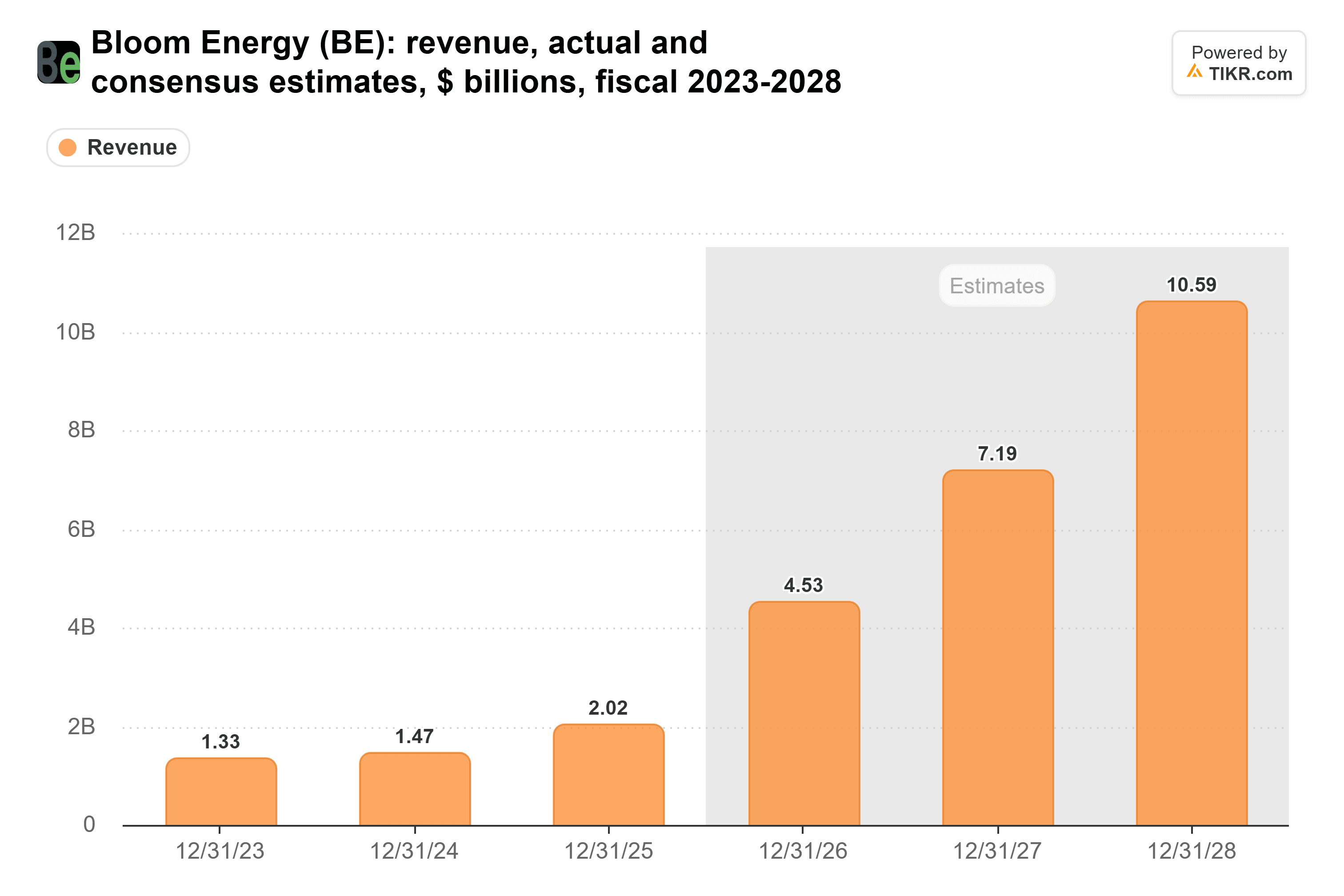
Those estimates assume Oracle’s build keeps moving, which is why doubts about Oracle’s funding show up in Bloom’s stock.
TIKR tracks 29 analysts on Bloom Energy. How many say “Buy”?
See the full breakdown of Buy, Hold, and Sell ratings on Bloom Energy, along with Wall Street’s revenue and earnings estimates, all in one place. More than 500,000 investors use TIKR to research stocks like this one. See Bloom Energy’s Analyst Ratings
Oracle’s checkbook is still open
Oracle’s capital spending rose more than sevenfold in less than two years, from $3.97 billion in the quarter to Nov. 30, 2024, to $28.5 billion in the quarter to Aug. 31, 2026:
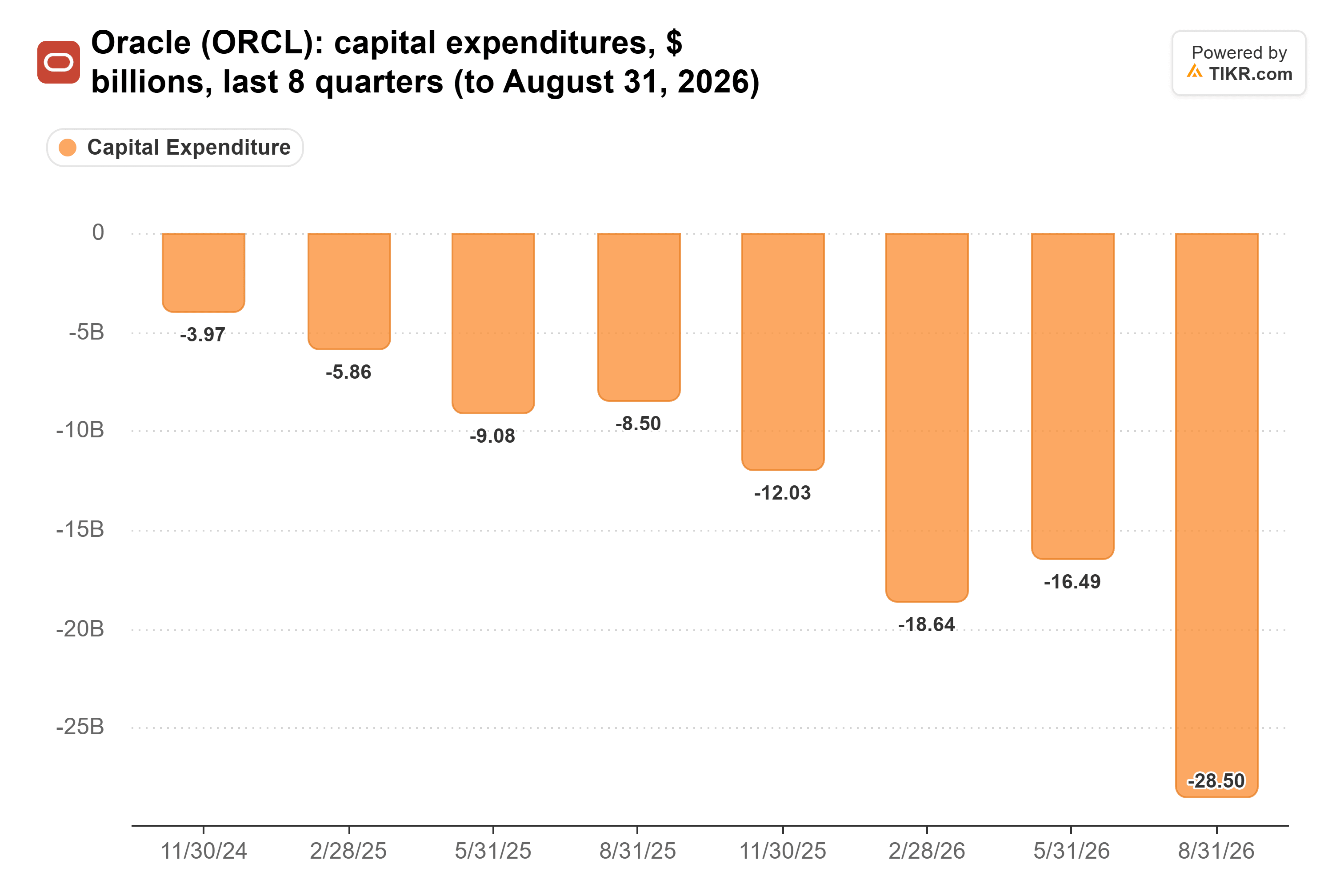
Spending at that pace made the credit market nervous. On Nov. 25, the cost of insuring Oracle’s debt hit a record, per S&P Global Market Intelligence, and Oracle’s free cash flow was negative $28.7 billion over the four quarters to Aug. 31. Oracle said on Nov. 20 that its OpenAI contract is fully funded after a $20 billion stock and debt raise, but its shares still sank to a 52-week low before the Nov. 27 bounce. Its fiscal second-quarter report in December is the next real test.
AMD’s Data Center segment revenue hit a record $8.5 billion in the third quarter, up 97%, and the company is scaling up Helios production. Whether Oracle can pay for its build affects how many of those racks ship on time, the same question behind Bloom’s deliveries.
Oracle isn’t the whole story
Bloom doesn’t say how much of its revenue or backlog comes from Oracle. Its two biggest customers made up 43% and 26% of third-quarter revenue, and the second is a related party. The 2.15 million shares Oracle received are less than 1% of Bloom’s 295.54 million shares.
Vertiv’s organic orders more than doubled from a year earlier in the third quarter, and it raised its full-year sales guidance by $650 million, to $14.65 billion at the midpoint. Bloom is riding the same demand: it has raised its 2026 revenue guidance three times this year, to a range of $4.4 billion to $4.6 billion. Unlike Vertiv, it also has a number that shows how much of Oracle’s work is left.
Watch the deduction
The Nov. 27 move looks more like the AI rebound than a verdict on Oracle, and Bloom’s valuation leaves room for it. At the Nov. 25 close, Bloom traded at about 31x forward earnings, near the bottom of its range since 2023, when its quarter-end readings ran from 29x to 145x. The Nov. 27 gain only takes it a little higher.
Bloom’s fourth-quarter report, due early next year, will show how far the $17.3 million has climbed. A big step up would confirm that Oracle’s systems are shipping, especially if fourth-quarter revenue lands near the top of the $1.35 billion to $1.55 billion its guidance implies. If the deduction barely moves, that would suggest Oracle’s deliveries are running late, however well Oracle funds its build.
So what is Bloom Energy stock actually worth?
TIKR lets you forecast the future price of any stock in less than a minute. Just enter a few assumptions into TIKR’s valuation model and see what Bloom Energy could be worth. Start from Wall Street consensus estimates, or adjust the inputs to reflect your own view of the business. It’s free to use.
Disclaimer:
Please note that the articles on TIKR are not intended to serve as investment or financial advice from TIKR or our content team, nor are they recommendations to buy or sell any stocks. We create our content based on TIKR Terminal’s investment data and analysts’ estimates. Our analysis might not include recent company news or important updates. TIKR has no position in any of the stocks mentioned. Thank you for reading, and happy investing!