Key Takeaways
- Intel stock is up 56% in a year but sits 59% below its June 30 closing high, after a fourth-quarter outlook that came in about $1.6 billion under consensus.
- Intel’s server business is booming, but it can’t make enough chips, and AMD is selling the ones Intel can’t.
- Jensen Huang’s return as NVIDIA’s CEO could help the chip partnership he struck with Intel, but Intel still trades at about 39x forward earnings, against about 27x for AMD.
- Intel’s fourth-quarter report, expected in late January, has to show more Xeon supply and a gross margin near the 38% guide before the stock looks like a buy.
Intel (INTC) stock closed at $57.40 on Nov. 27, up 5.38% in a holiday-shortened session as chip stocks rebounded. That leaves it up 56% over the past year but 59% below its June 30 closing high of $139.63. Server demand and foundry hopes helped the stock nearly quadruple from late December to that peak. Investors then gave most of it back after an October outlook showed how much Intel still leans on PCs.
AMD (AMD) rose 4.56% the same day and is up 98% over the past year, selling server chips Intel can’t make fast enough. And Jensen Huang, who championed the $5 billion investment NVIDIA (NVDA) made in Intel, is back as NVIDIA’s CEO after its board reinstated him on Nov. 23.
Data centers made the first half
Intel’s second quarter showed why investors piled in: revenue rose 25% to $16.1 billion, and data center and AI sales jumped 59%. CFO David Zinsner also said Intel was “meaningfully increasing our investments in equipment, clean room space, and substrates.” To help pay for it, Intel sold $23 billion of stock at $95 a share in August.
Then the PC slump hit
Intel’s third quarter, reported Oct. 29, beat its own guidance, with data center and AI revenue up 78% to $7.3 billion. But the PC group, still Intel’s biggest, slipped 5% to $8.1 billion. Intel then guided fourth-quarter revenue to $15.0-$16.0 billion, against a $17.07 billion LSEG consensus, and non-GAAP gross margin to 38%, from 44.1%.
An October explosion at Fab 28 in Israel will cost about $300 million of that revenue and roughly 2 points of margin, and Intel expects a similar revenue hit in the first quarter. The rest is PCs, as memory shortages push up laptop prices. “We see the PC slowdown continuing at least through the first half of next year,” Zinsner said.
TIKR tracks 49 analysts on Intel. How many say “Buy”?
See the full breakdown of Buy, Hold, and Sell ratings on Intel, along with Wall Street’s revenue and earnings estimates, all in one place. More than 500,000 investors use TIKR to research stocks like this one. See Intel’s Analyst Ratings
AMD is selling the chips Intel can’t make
“Our immediate priority is to unlock additional supply to meet extraordinary demand for our Xeon family,” CEO Lip-Bu Tan said in the October release. AMD has stepped into that gap: its data center revenue hit a record $8.5 billion in the third quarter, up 97%, on EPYC server CPUs and new Instinct GPUs. Intel is moving some PC capacity to server chips, but Tan has conceded it can’t shift supply as freely as AMD can.
November brought some relief. Tan said on Nov. 18 that Intel had signed its first outside 18A customer, without naming it, and Microsoft became the first named customer for its EMIB packaging. Huang’s return puts the champion of the joint x86 chips back in charge at NVIDIA, though NVIDIA’s 13F filing shows it held 161.1 million Intel shares on Sept. 30, down from 214.8 million.
39x is still a lot to pay
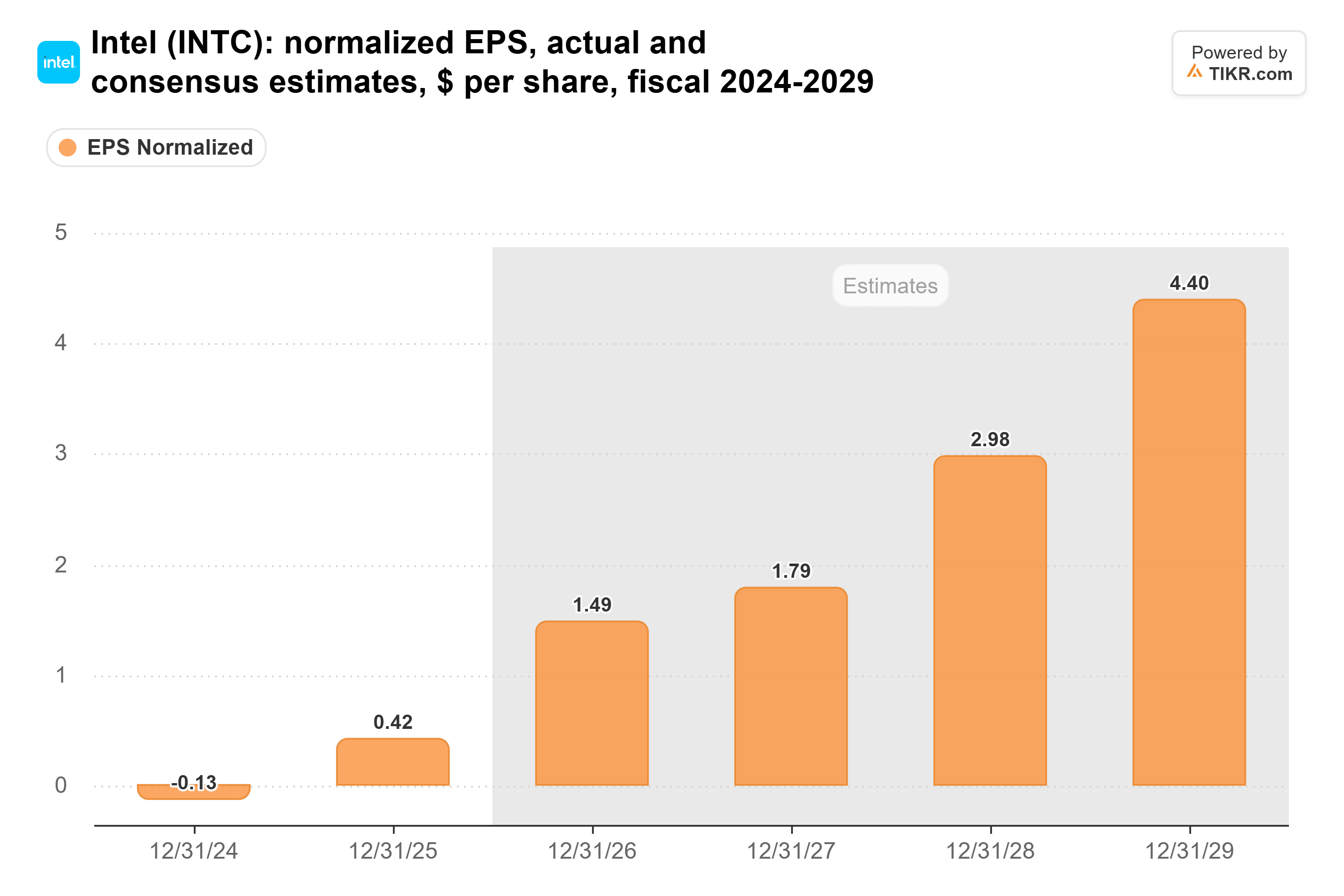
Analysts expect normalized EPS to climb from $1.49 this year to $1.79 in 2027 (down from $2.11 before the October report) and $2.98 in 2028:
On Nov. 25, before Friday’s rebound, Intel traded at about 39x forward earnings, below its five-year average of 51x:
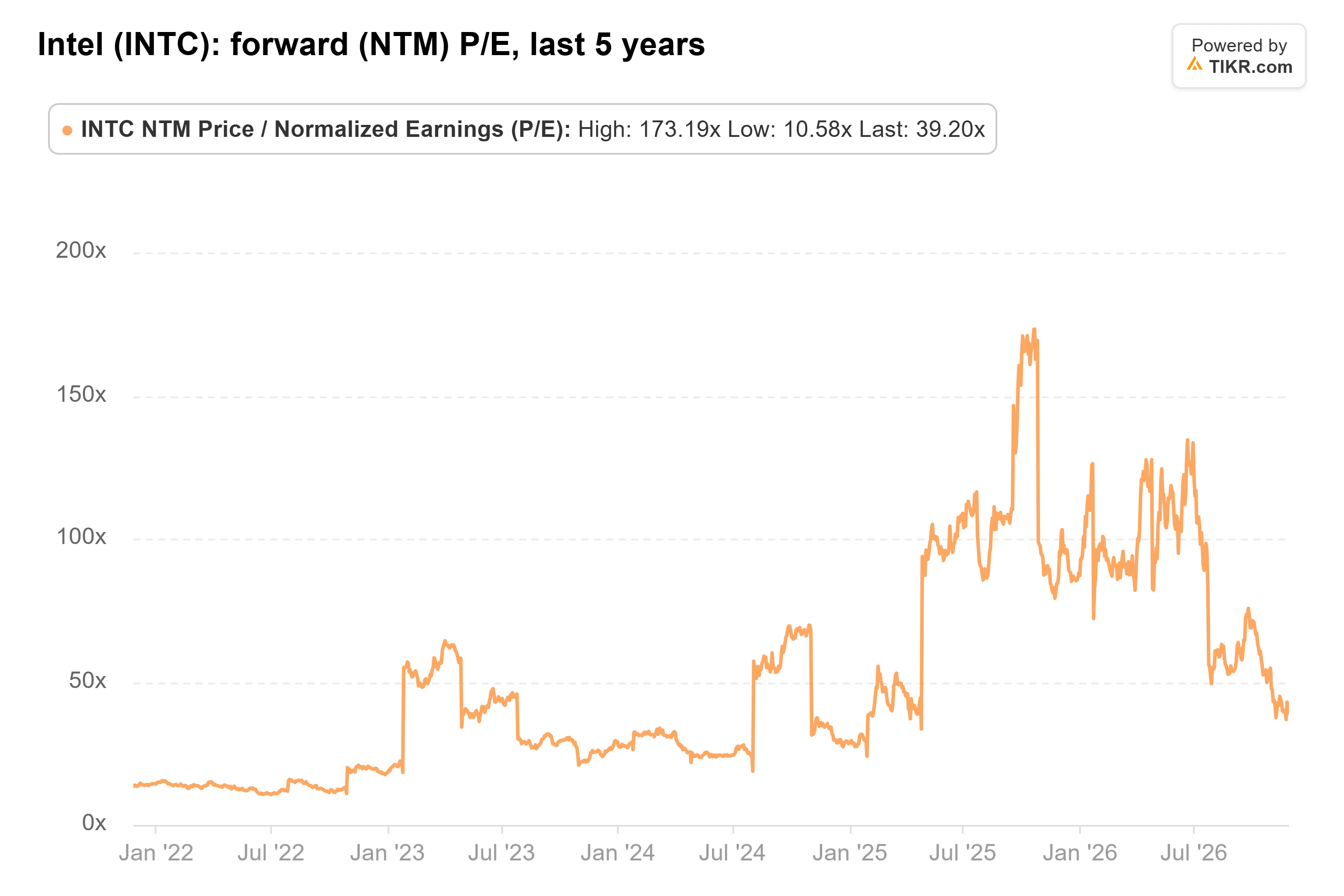
But that average comes from years when Intel earned almost nothing. As a steady earner from 2014 to 2022, it traded at about 10x to 18x. Citi’s $100 target (cut from $130 on Nov. 2) and Bank of America’s $80 (cut from $100 on Nov. 12) work out to about 34x and 27x Intel’s 2028 estimate. AMD trades at about 27x forward earnings, with its EPS expected to more than double to $17.61 in 2027.
January has to earn the 39x
At about 39x, Intel is priced for a recovery its biggest business hasn’t started. Its server chips sell as fast as it can make them, but the PC group is shrinking, and AMD offers more of the server-CPU shortage at a lower multiple. Intel’s fourth-quarter report, expected in late January, needs revenue inside the $15.0-$16.0 billion guide, a non-GAAP gross margin near 38%, and a clear read on the Fab 28 hit to the first quarter before that multiple looks earned. If Tan unlocks Xeon supply faster than expected, though, those 2027 estimates could climb quickly.
So what is Intel stock actually worth?
TIKR lets you forecast the future price of any stock in less than a minute. Just enter a few assumptions into TIKR’s valuation model and see what Intel could be worth. Start from Wall Street consensus estimates, or adjust the inputs to reflect your own view of the business. It’s free to use.
Disclaimer:
Please note that the articles on TIKR are not intended to serve as investment or financial advice from TIKR or our content team, nor are they recommendations to buy or sell any stocks. We create our content based on TIKR Terminal’s investment data and analysts’ estimates. Our analysis might not include recent company news or important updates. TIKR has no position in any of the stocks mentioned. Thank you for reading, and happy investing!