Key Takeaways
- At today’s prices, $1,000 a month in dividends takes 2,765 shares of Duke Energy, 3,093 shares of American Electric Power or 3,381 shares of Consolidated Edison.
- Duke Energy costs the least, about $358,800, which is about $44,700 less than Consolidated Edison, but it pays out the most of its earnings: 67% of fiscal 2025 normalized EPS.
- American Electric Power expects 9% to 11% annual earnings growth from 2027 through 2031, but its management expects dividend raises of roughly 2% a year.
- Consolidated Edison’s 60% payout ratio, lower debt and 52 straight years of raises make it the safest check of the three.
Any retiree hunting for a dividend check they can count on is going to look at utilities like Duke Energy (DUK), Consolidated Edison (ED) and American Electric Power (AEP). So let’s take a hypothetical retiree who wants $1,000 a month from just one of them.
At today’s prices, that takes 2,765 shares of Duke Energy, about $358,800 at a 3.3% yield. AEP takes 3,093 shares, about $387,100 at a 3.1% yield. Con Edison takes 3,381 shares, about $403,600 at a 3.0% yield.
So Duke’s check costs about $44,700 less than Con Edison’s. But is it as safe?
| Stock | Shares | Cost | Yield | Income a month | Payout ratio of normalized EPS, fiscal 2025 | Fiscal 2026 (consensus) |
|---|---|---|---|---|---|---|
| Duke Energy | 2,765 | $358,842 | 3.3% | $1,000 | 67% | 65% |
| Consolidated Edison | 3,381 | $403,556 | 3.0% | $1,000 | 60% | 58% |
| American Electric Power | 3,093 | $387,058 | 3.1% | $1,000 | 63% | 60% |
Source: TIKR, at today’s prices, with each dividend at its current rate.
6 safe dividend stocks paying retirees 6%+ yields
There are over 100 stocks paying 6%+ annual dividends today.
But after an extensive investment review leveraging TIKR’s proprietary data, we now believe only six of them are truly safe for retirees.
They’re all yours as part of our new investment report. Learn more about how to get access right here.
Duke Energy’s coverage keeps improving
Duke Energy’s earnings are growing on rate increases and new demand from data centers. Adjusted EPS rose to $1.99 in the third quarter of 2026 from $1.81 a year before, and management narrowed its 2026 guidance to $6.70-$6.80, around the $6.75 analysts expect. On Nov. 17, North Carolina regulators approved its two rate-case settlements there at a 9.8% return on equity, with new rates starting Jan. 1, 2027.
Duke’s dividend took 67% of fiscal 2025 normalized EPS ($4.22 a share against $6.31), and analysts expect 65% for fiscal 2026. That’s the most of the three, but it’s down from 77% in fiscal 2018:
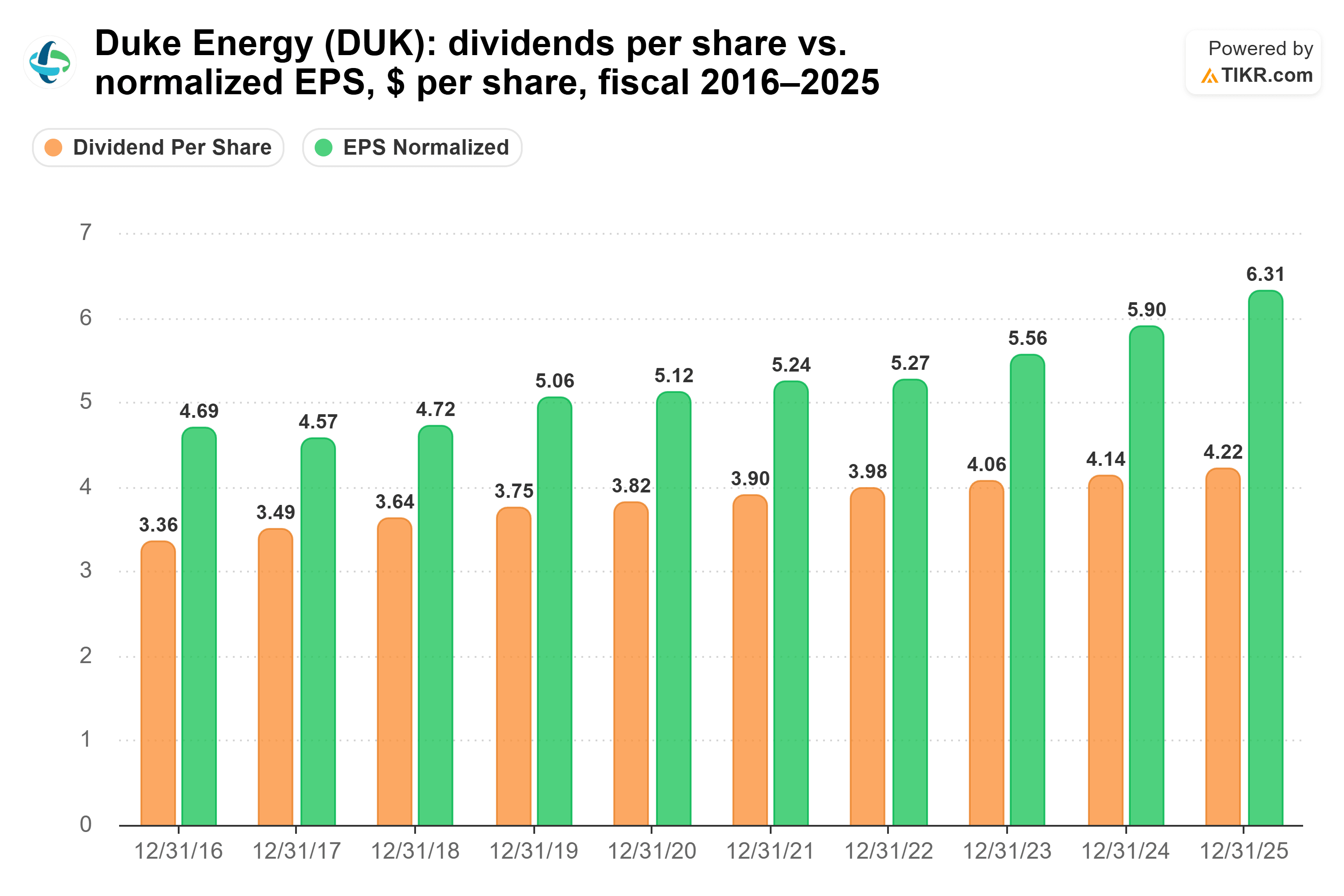
Duke says July’s 2% raise marked over 20 years of annual increases in a row. Management expects earnings to grow 5% to 7% a year through 2030, faster than the dividend, so the payout ratio has room to keep falling.
Con Edison costs more for a reason
Con Edison asks the most for the same check, but it has the strongest balance sheet here. Its net debt is 4.4x EBITDA, against 5.5x at Duke and 5.7x at AEP. And Con Edison says its 4.4% raise for 2026 made 52 straight years of dividend increases.
Earnings are holding up, too, as electrification drives its spending. Adjusted EPS rose to $2.07 in the third quarter of 2026 from $1.90 a year before, and management narrowed its 2026 guidance to $6.05-$6.15, near the $6.11 analysts expect.
Its dividend took 60% of fiscal 2025 normalized EPS ($3.40 a share against $5.70), and analysts expect 58% for fiscal 2026. That’s the best coverage of the three, and down from 73% in fiscal 2020:

The catch is the new stock it sells to pay for that spending. On Nov. 16, Con Edison announced an offering of 6 million shares through a forward sale. More shares spread future earnings thinner, which can slow dividend growth per share.
AEP’s earnings will outrun its dividend
AEP has the fastest growth of the three, fed by data centers and other big customers. Operating EPS jumped to $2.23 in the third quarter from $1.80 a year before, and management expects 9% to 11% annual growth from 2027 through 2031 on a $100 billion five-year capital plan.
The dividend won’t keep that pace. AEP raised its quarterly payment to $0.97 from $0.95 on Oct. 20, a 2.1% raise, after growing it 5.7% a year from fiscal 2020 to fiscal 2025. As CFO Trevor Mihalik put it on the third-quarter call: “We have moderated the growth of the dividend over the last year, and we are forecasting a similar type of modest growth to the dividend at roughly 2% over the 4- or 5-year period.”
That leaves plenty of earnings behind the check. The dividend took 63% of fiscal 2025 normalized EPS ($3.74 a share against $5.97), and analysts expect 60% for fiscal 2026:

The cost is debt: at 5.7x EBITDA, AEP carries the most of the three, and it’s sitting on over $5 billion of equity forwards to help fund its plan.
I’d pay up for Con Edison
Duke Energy pays out the most of its earnings, so it’s the one most at risk of a cut, though I don’t see it as truly risky since its payout ratio keeps falling. The bigger watch item is funding: management plans $10 billion of new stock for a $103 billion capital plan, on top of 5.5x net debt to EBITDA.
But I want the check I’d worry about least, and that’s Con Edison’s. It has the most earnings behind its dividend and the least debt, and its 4.4% raise this year beat the roughly 2% at Duke and AEP. AEP grows fastest, but its own CFO expects raises of roughly 2% a year.
Of course, all three are leaning on new shares to fund their build-outs. I’ll be watching Con Edison’s fourth-quarter results early next year to see whether 2026 adjusted EPS lands in its $6.05-$6.15 range, new shares and all.
Forget Consolidated Edison: 6 safe 6%+ dividend yields you can buy right now
Dividends can hold the key to enormous wealth. But only if you buy the right ones.
Picking the right high-yield dividend stock can be the difference between a dream retirement…and scraping by every month, waiting for the next Social Security check to clear.
We’ve identified six stocks yielding 6%+ that we believe every retiree should know about right now. (And Consolidated Edison isn’t one of them.)
Disclaimer:
Please note that the articles on TIKR are not intended to serve as investment or financial advice from TIKR or our content team, nor are they recommendations to buy or sell any stocks. We create our content based on TIKR Terminal’s investment data and analysts’ estimates. Our analysis might not include recent company news or important updates. TIKR has no position in any of the stocks mentioned. Thank you for reading, and happy investing!