Key Takeaways
- Kimberly-Clark yields 4.8% and has raised its dividend for 54 straight years, while GSK yields 3.8%.
- GSK’s dividend took 39% of its free cash flow over the twelve months to June 30, 2026, against 87% at Kimberly-Clark over the twelve months to Sept. 30.
- Kimberly-Clark closed its Kenvue acquisition on Nov. 2, 2026, after issuing $4.9 billion of new notes to help pay for it.
- At each dividend’s current pace of growth, $10,000 in either stock pays similar income over the next 20 years.
Kimberly-Clark (KMB) closed its Kenvue acquisition on Nov. 2. On Nov. 11, its board declared a quarterly dividend of $1.28 a share, its first since the deal. The company says it “is considered a Dividend Aristocrat, having paid a dividend for 92 consecutive years and increasing its dividend in each of the past 54 consecutive years.”
GSK (GSK) can’t match that record, and its 3.8% yield is smaller than Kimberly-Clark’s 4.8%. But GSK’s dividend has plenty of free cash flow to spare. Someone holding a dividend for 20 years has to choose between the longer record and bigger check, or the wider cushion.
So which one would I hold?
| Metric | GSK (GSK) | Kimberly-Clark (KMB) |
|---|---|---|
| Dividend yield | 3.8% | 4.8% |
| Dividend growth, fiscal 2020-2025 | -12.0% a year | 3.3% a year |
| Cash dividend payout ratio (TTM) | 39% | 87% |
| Net debt/EBITDA (LTM) | 1.78x | 1.22x |
| Interest coverage (LTM) | 14.7x | 13.1x |
| Forward P/E (NTM) | 10x | 16x |
6 safe dividend stocks paying retirees 6%+ yields
There are over 100 stocks paying 6%+ annual dividends today.
But after an extensive investment review leveraging TIKR’s proprietary data, we now believe only six of them are truly safe for retirees.
They’re all yours as part of our new investment report. Learn more about how to get access right here.
GSK has room to spare
Over the twelve months to June 30, 2026, GSK paid £2.67 billion in dividends out of £6.90 billion of free cash flow, a comfortable 39%.
Part of that cushion comes from a cut. The chart shows dividends paid falling from £4.00 billion in fiscal 2021 to £2.25 billion in fiscal 2023, while free cash flow stayed between £5.16 billion and £7.45 billion every year from fiscal 2018 on.
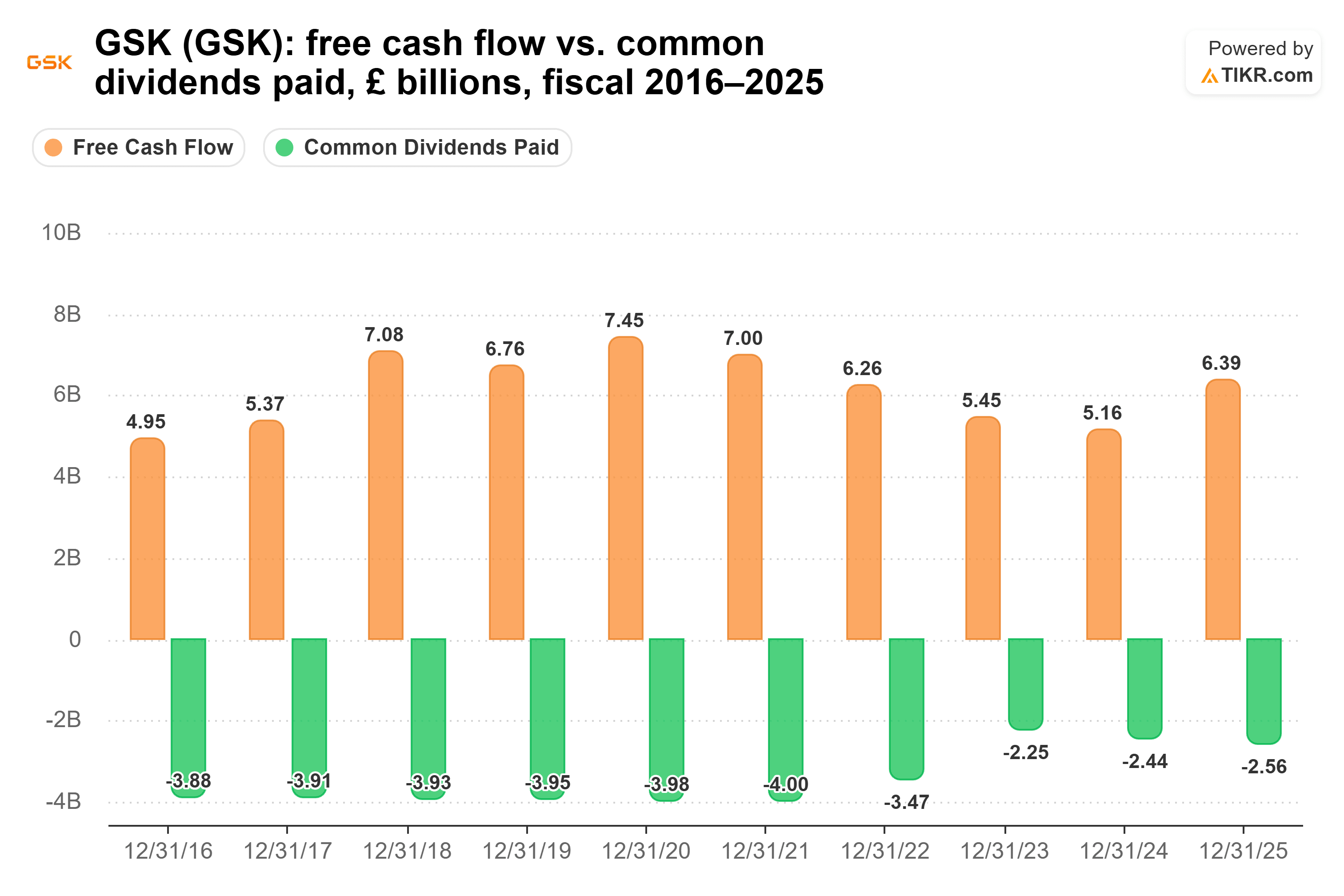
That cut is why GSK’s 5-year rate is -12.0% a year from fiscal 2020 to fiscal 2025. Since then, the dividend has been growing: cash dividends rose 4.9% in fiscal 2025, from £2.44 billion to £2.56 billion, and GSK expects 70p a share for 2026. It sets its dividend in pounds, so the dollar amount a US holder collects moves with the exchange rate.
The business is growing too. GSK said third-quarter sales rose 5% to £8.9 billion and kept its 2026 guidance. The main risk is Zantac: GSK reportedly faces a $2.2 billion settlement. That’s a real cost, but a small one next to a year’s free cash flow.
Kimberly-Clark’s cushion is thin
GSK’s cushion has widened, and Kimberly-Clark’s has shrunk. Its dividend took 87% of free cash flow over the twelve months to Sept. 30, 2026: $1.69 billion of dividends against $1.94 billion of free cash flow. The chart shows dividends paid rising every year, from $1.31 billion in fiscal 2016 to $1.66 billion in fiscal 2025. Over the same stretch, free cash flow fell from $2.78 billion in fiscal 2023 to $1.64 billion.
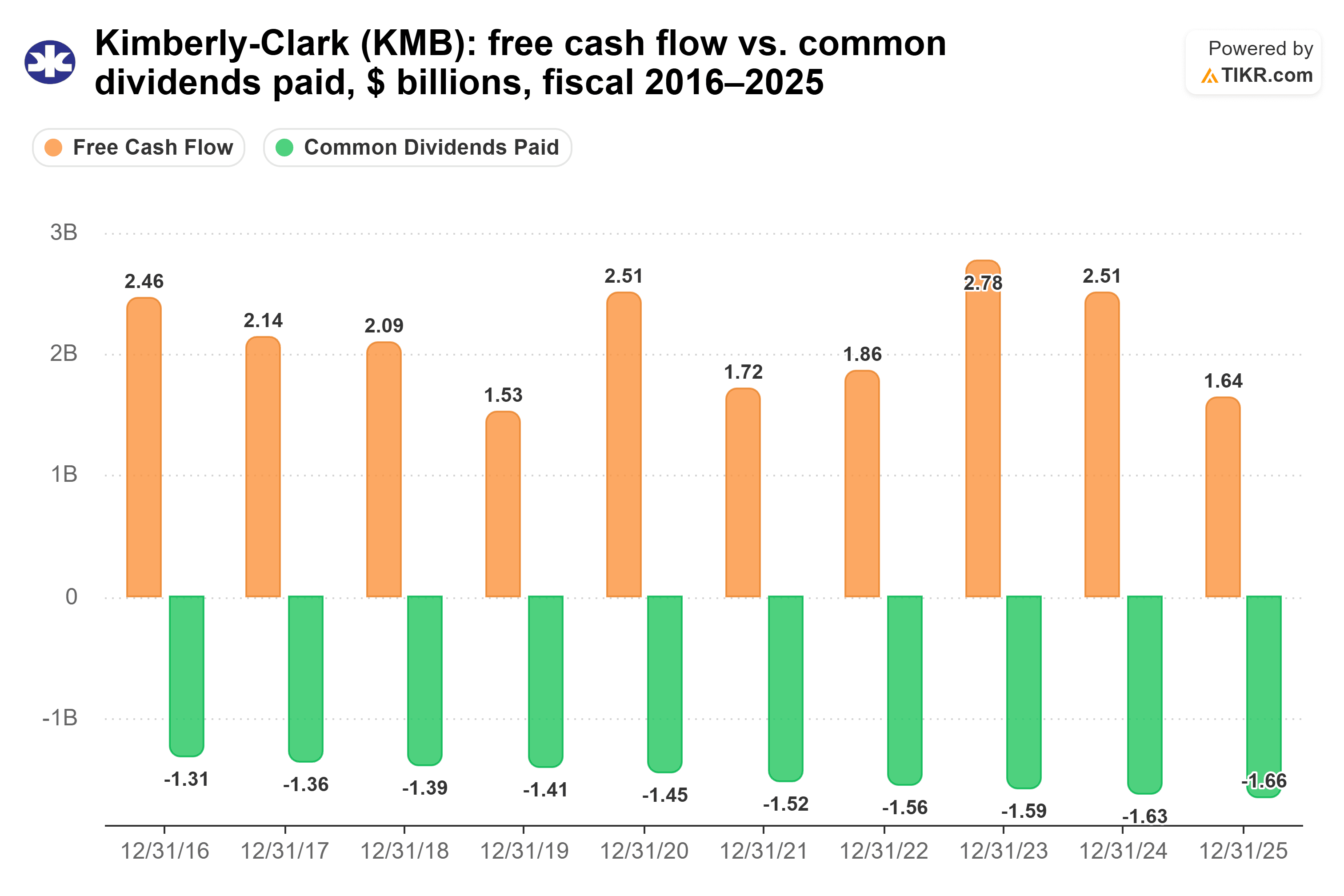
That took its cash dividend payout ratio from 57.2% in fiscal 2023 to a risky 101.3% in fiscal 2025.
The core business is soft. Third-quarter organic sales fell 1.3%, though adjusted EPS rose 17.2% to $1.70 and the company stood by its 2026 outlook.
Kenvue brings $2.1 billion of expected run-rate synergies, and also debt: $4.9 billion of new notes in October, plus about $6.4 billion of Kenvue’s bonds exchanged for Kimberly-Clark notes. The 1.22x net debt/EBITDA in the table is from before the deal closed, and management is aiming for leverage of about 2x by the end of the deal’s second year.
So which dividend wins?
If I could hold only one of these for the next 20 years, it’d be GSK. GSK pays out 39% of its free cash flow. Kimberly-Clark pays out 87% and now has a deal’s worth of new debt to service.
I’m not giving up much income to get that safety. At each dividend’s current pace of growth (the 4.9% rise in fiscal 2025 for GSK, figured in pounds, and 3.3% for Kimberly-Clark), $10,000 in Kimberly-Clark pays about $13,270 over 20 years, and $10,000 in GSK pays about $12,446. GSK’s yearly income would pass Kimberly-Clark’s around 2041.
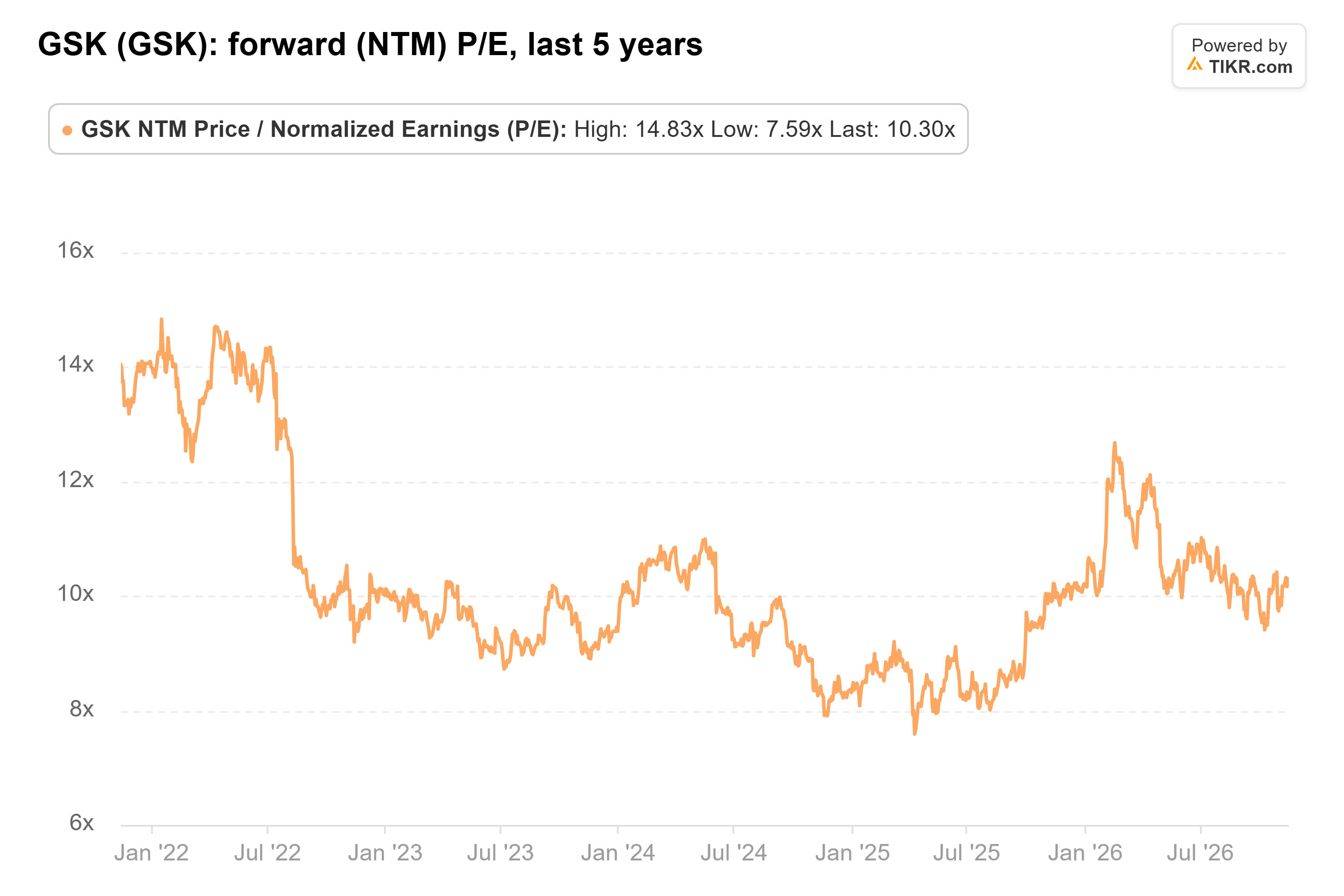
And GSK trades at 10x forward earnings, against 16x for Kimberly-Clark, and the chart shows that’s right at its five-year average.
That doesn’t mean Kimberly-Clark’s dividend is in trouble. It pays the bigger check today, and management will work very hard to keep a 54-year streak alive. If the synergies come through, the cushion could rebuild quickly. Still, GSK gets me similar income with far more room for error.
Of course, the answer could change. Kimberly-Clark expects mid-single-digit EPS dilution in 2027 and a snap back toward its usual growth by 2028. If it gets there, its case looks a lot stronger.
Forget GSK: 6 safe 6%+ dividend yields you can buy right now
Dividends can hold the key to enormous wealth. But only if you buy the right ones.
Picking the right high-yield dividend stock can be the difference between a dream retirement…and scraping by every month, waiting for the next Social Security check to clear.
We’ve identified six stocks yielding 6%+ that we believe every retiree should know about right now. (And GSK isn’t one of them.)
Disclaimer:
Please note that the articles on TIKR are not intended to serve as investment or financial advice from TIKR or our content team, nor are they recommendations to buy or sell any stocks. We create our content based on TIKR Terminal’s investment data and analysts’ estimates. Our analysis might not include recent company news or important updates. TIKR has no position in any of the stocks mentioned. Thank you for reading, and happy investing!