Key Takeaways
- Grab shares jumped 28% this week after third-quarter revenue rose 27% and adjusted EBITDA rose 73% to a record $237 million.
- CFO Peter Oey told Bloomberg that Grab’s AI interactions rose 60% while it delivered its margins, and the quarter’s results support him.
- Analysts expect Grab’s normalized EPS to double to $0.14 in 2026, hold there in 2027 and reach $0.20 in 2028.
- The stock is still down 30% in 2026, which looks like too much doubt for a company growing profits this fast, and the next test is whether margins hold as AI spending grows.
Grab Holdings (GRAB) stock jumped 28% this week through the Nov. 5 close. The third-quarter report it released after the U.S. close on Nov. 2 came with a raised full-year outlook.
The next day, Bloomberg’s Ed Ludlow asked CFO Peter Oey on Bloomberg Tech what Grab’s AI push will cost from here. Oey said, “the AI interaction was up 60% for us and yet we delivered those margins and the profitability in the business.”
TIKR tracks 24 analysts on Grab Holdings. How many say “Buy”?
See the full breakdown of Buy, Hold, and Sell ratings on Grab Holdings, along with Wall Street’s revenue and earnings estimates, all in one place. More than 500,000 investors use TIKR to research stocks like this one. See Grab Holdings’ Analyst Ratings
A quarter worth the jump
Grab’s third-quarter release had plenty to like:
- Revenue rose 27% to $1.11 billion.
- Adjusted EBITDA rose 73% to a record $237 million, a 21.3% margin against 15.6% a year earlier, with all three core segments profitable on a segment adjusted EBITDA basis for the first time.
- Full-year guidance went up, to 4.15-4.20 billion of revenue and 790-800 million of adjusted EBITDA.
- Grab bought back $400 million of stock in September and October, and has $500 million left on its program.
How AI pays Grab
Grab says drivers who use its AI assistant earn more than 10% more per hour, and merchants who rely on it earn about 20% more. Oey explained how that comes back to Grab: “we benefit also as we take a commission for all those rides that we do.”
The costs are moving the right way too. Ludlow noted that Grab’s AI cost per interaction fell 42% in the quarter, and Oey said it took three or four quarters of matching each model to the right job to get there.
Analysts expect Grab’s normalized EPS to double this year and keep climbing through 2028.
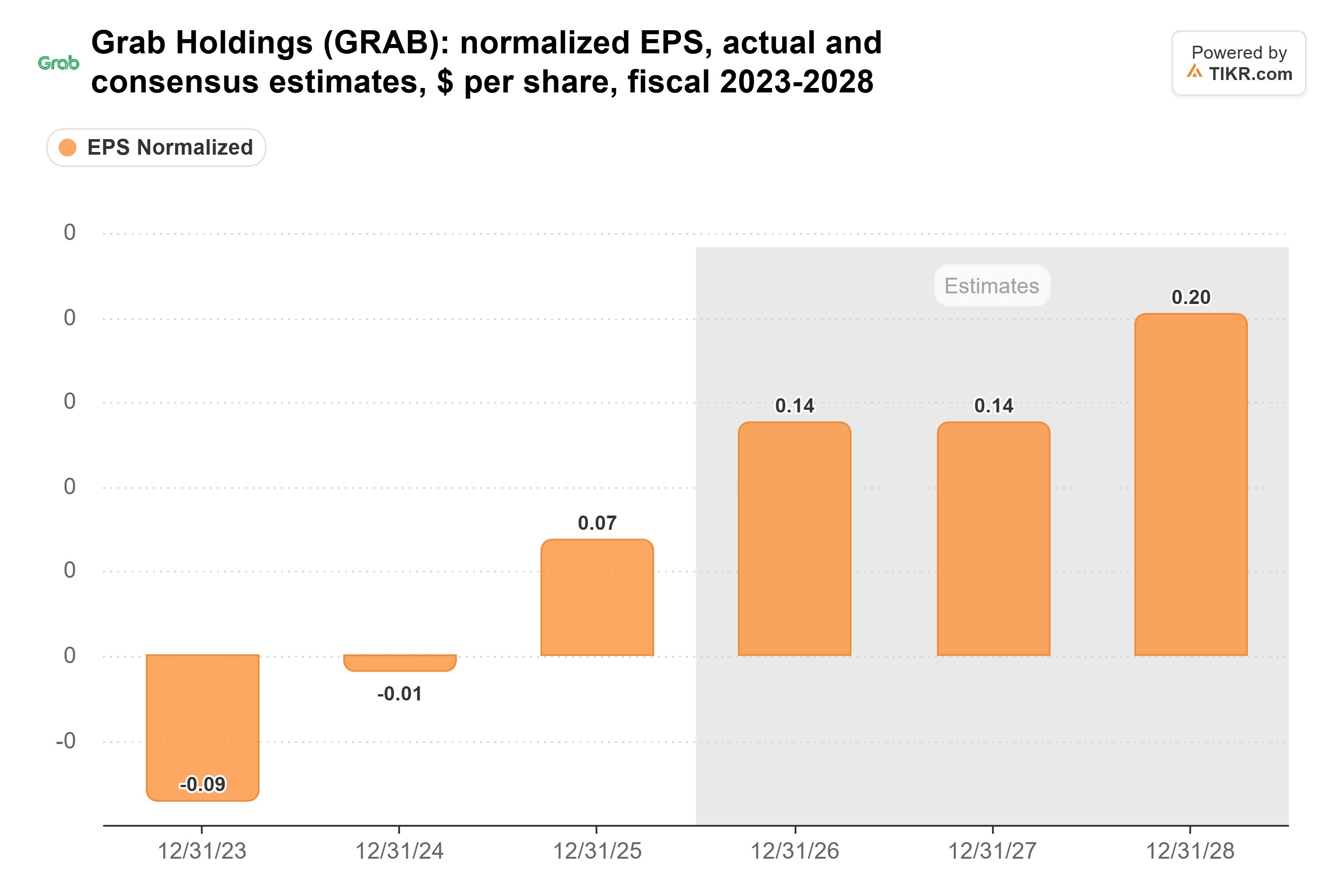
The flat 2027, at $0.14 for the second year running, stands out. Those estimates date from Oct. 29, before the report and the raised outlook, so 2027 is the number to watch for revisions. A quarter that lifted full-year guidance gives analysts more reason to raise it than cut it.
Margins are moving up
TIKR’s EBITDA margin, which runs below Grab’s adjusted figure, was higher than a year earlier in each of the first two quarters of 2026.
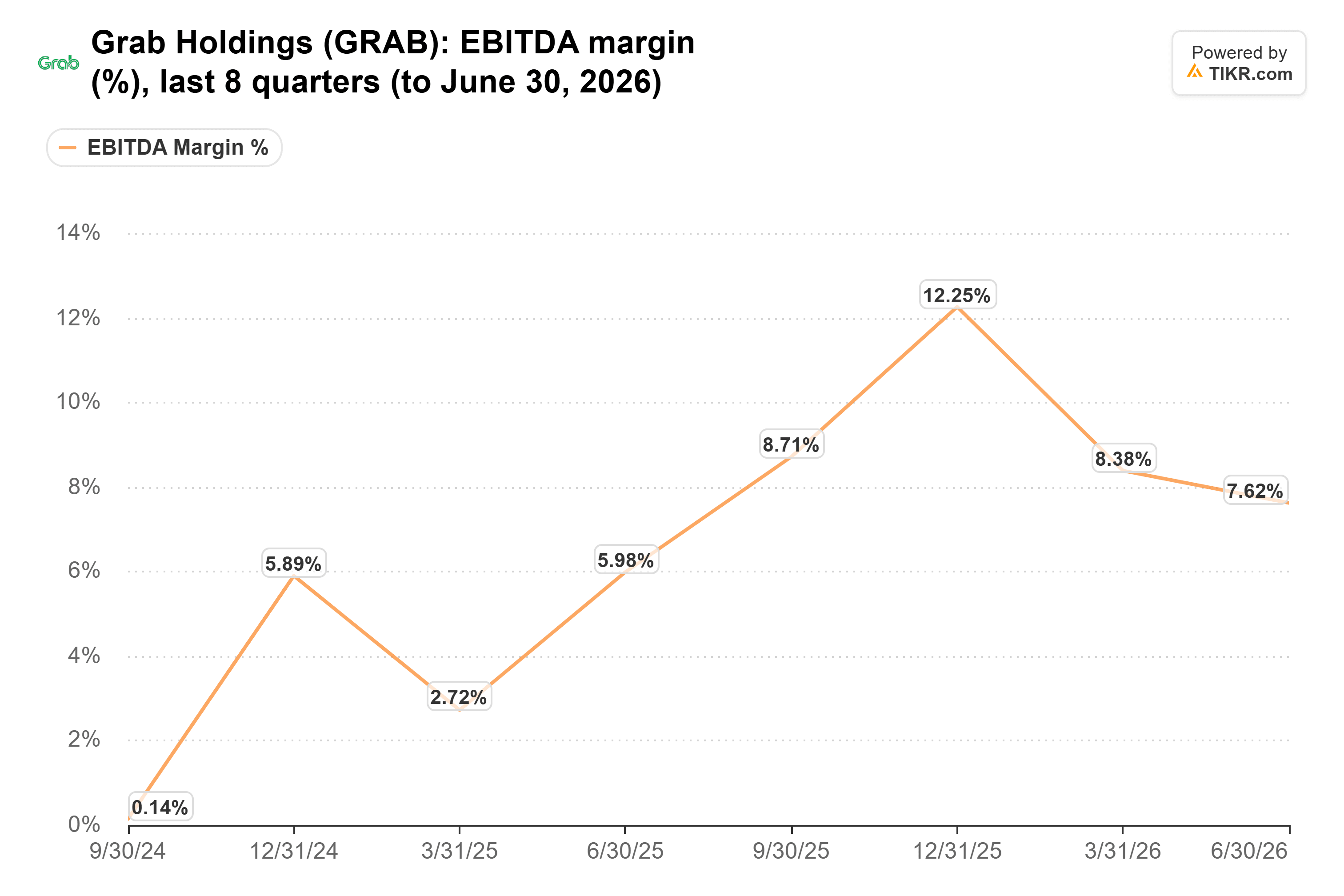
The March quarter came in at 8.4%, against 2.7% a year earlier, and the June quarter at 7.6%, against 6.0%. The December quarter’s 12.3% is still the high, so the climb is lumpy. Add the September quarter’s jump in the adjusted margin to 21.3%, and Oey has the figures to back his claim.
Still priced for doubt
Grab traded at about 21x forward earnings on Nov. 2, the day of its report, and this week’s jump has pushed that higher. Against analysts’ $0.20 for 2028, though, it trades at about 17x as of the Nov. 5 close. That’s a modest price for profits expected to nearly triple from 2025 to 2028.
Wall Street is still on board. J.P. Morgan raised its target to $5.10 from $4.80 on Nov. 3, and DBS kept its Buy rating and $5 target the same day. Barclays kept its Buy rating and $4 target on Nov. 4, after cutting it from $5 in October. Those targets sit 15% to 47% above the Nov. 5 close.
The bottom line still lags, though. Profit for the period was $18 million, against $17 million a year earlier, and Grab will book a $60 million break fee in the fourth quarter after its foodpanda Taiwan deal fell through, a cost it says won’t affect guidance.
The bigger risk is that Grab keeps leaning into AI and into driver supply, since management expects high fuel prices to keep pressing on driver costs in the fourth quarter. If the spending grows faster than the savings, the margin gains could stall.
Bottom line: Grab just showed it can add AI and widen its margins in the same quarter, and a stock still down this much in 2026 doesn’t give it credit for that. Of course, one quarter is still just one quarter. The fourth-quarter report, likely in February, will show whether margins hold up as the AI spending grows.
So what is Grab stock actually worth?
TIKR lets you forecast the future price of any stock in less than a minute. Just enter a few assumptions into TIKR’s valuation model and see what Grab could be worth. Start from Wall Street consensus estimates, or adjust the inputs to reflect your own view of the business. It’s free to use.
Disclaimer:
Please note that the articles on TIKR are not intended to serve as investment or financial advice from TIKR or our content team, nor are they recommendations to buy or sell any stocks. We create our content based on TIKR Terminal’s investment data and analysts’ estimates. Our analysis might not include recent company news or important updates. TIKR has no position in any of the stocks mentioned. Thank you for reading, and happy investing!