Key Takeaways
- Intel is the largest holding in Soros Fund Management’s 13F for the quarter ended Sept. 30: 2.83 million shares worth $340 million, or 5.3% of the US stocks it reported.
- Intel stock has fallen 54% since Sept. 30 after a weak outlook, and analysts have cut their earnings estimates.
- Even after those cuts, Intel trades at about 40x forward earnings, below its five-year average, and analysts’ average target is 63% above the last close.
- The bet makes more sense at today’s price than it did at the end of September, though it depends on Intel’s earnings doubling from this year to 2028.
Intel (INTC) is now the biggest stock in George Soros’ fund, and it got there fast.
Soros Fund Management’s 13F for the quarter ended Sept. 30, filed Nov. 13, shows 2.83 million Intel shares worth $340 million at quarter-end prices. That’s more than 28 times as many shares as the fund held at June 30.
Since then, Intel stock has fallen 54%.
Intel is now the fund’s No. 1 position
The stake is 5.3% of the $6.48 billion of US stocks the fund’s 13F reports across 234 positions, which makes Intel its largest holding. A 13F only shows what a fund held on the last day of the quarter. It doesn’t say when in the quarter Soros’ fund added the shares, what it paid or whether it still owns them. It also leaves out any short positions or hedges the fund may hold against the stake.
TIKR tracks 50 analysts on Intel. How many say “Buy”?
See the full breakdown of Buy, Hold, and Sell ratings on Intel, along with Wall Street’s revenue and earnings estimates, all in one place. More than 500,000 investors use TIKR to research stocks like this one. See Intel’s Analyst Ratings
The stock has been cut in half since
Most of the damage came with Intel’s third-quarter report on Oct. 29, when a weak outlook sent the stock sharply lower. Supply is part of the problem. A deadly Oct. 14 explosion at Intel’s Kiryat Gat fab in Israel halted production there for about two weeks. That shutdown and a shortage of substrates are both limiting shipments of Intel’s Xeon server chips.
Then on Nov. 12, Jensen Huang resigned as NVIDIA’s CEO. Huang championed the 2025 deal that paired Intel CPUs with NVIDIA graphics chips and came with NVIDIA’s $5 billion investment in Intel. So the partnership’s future now rests on NVIDIA’s next leader.
Intel’s own CEO is buying, though. Lip-Bu Tan bought 150,000 shares for $9.7 million on Nov. 2, at about $64.73 a share. That’s on top of about $10 million of stock he bought at $95 in August’s offering.
Does the bet add up at today’s price?
Analysts have cut their numbers, but they still expect Intel’s earnings to double from this year to 2028. The chart shows consensus normalized EPS rising from $0.42 in 2025 to $1.49 in 2026 and $2.99 in 2028:
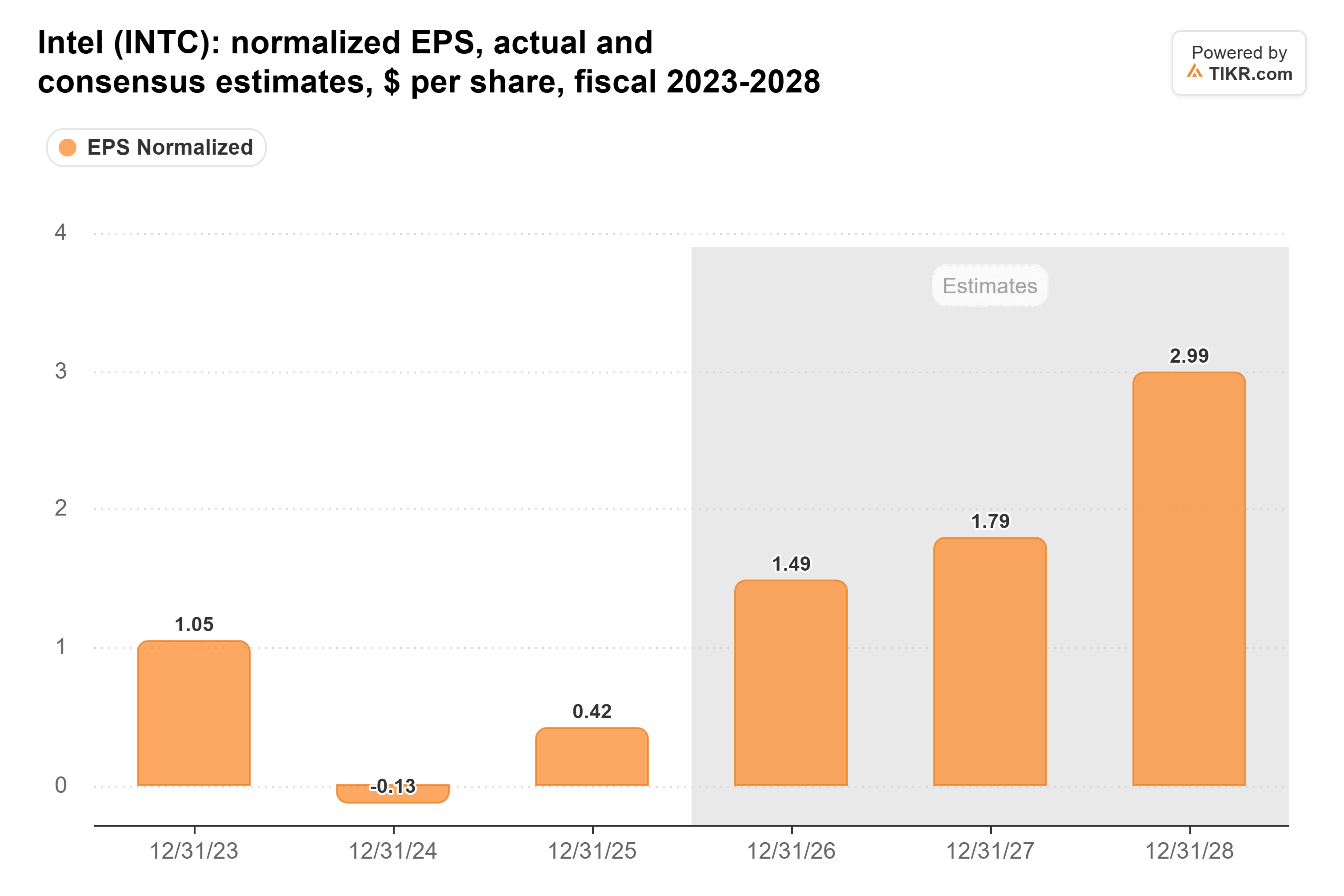
The 2027 estimate is now $1.79, down from $2.11 before the third-quarter report.
The selloff has made the valuation much cheaper. Intel trades at 40x forward earnings, down from 71x at the end of September and below its five-year average of 50x:
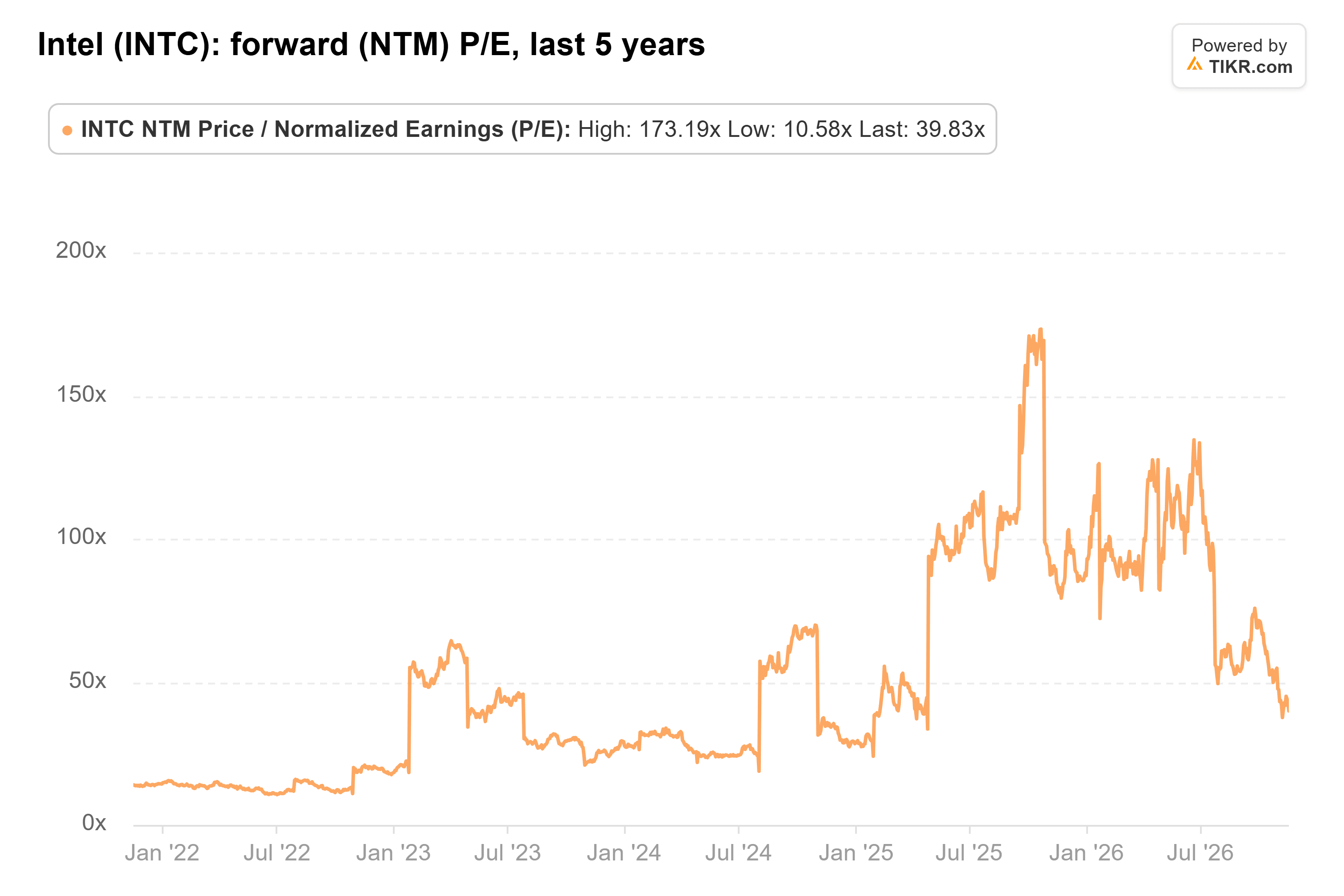
That average includes years when Intel barely earned anything, and the multiple peaked at 173x in October 2025. In mid-2022, it was 11x. A fairer check uses the 2028 estimate: at the last close of $55.47, Intel trades at about 19x 2028 earnings.
Wall Street still sees plenty of upside. The 49 analysts who cover Intel have an average target of $91, which is 63% above the last close. The chart shows that target falling from its early-October peak of $118 while staying well above the $37 where it stood a year ago:
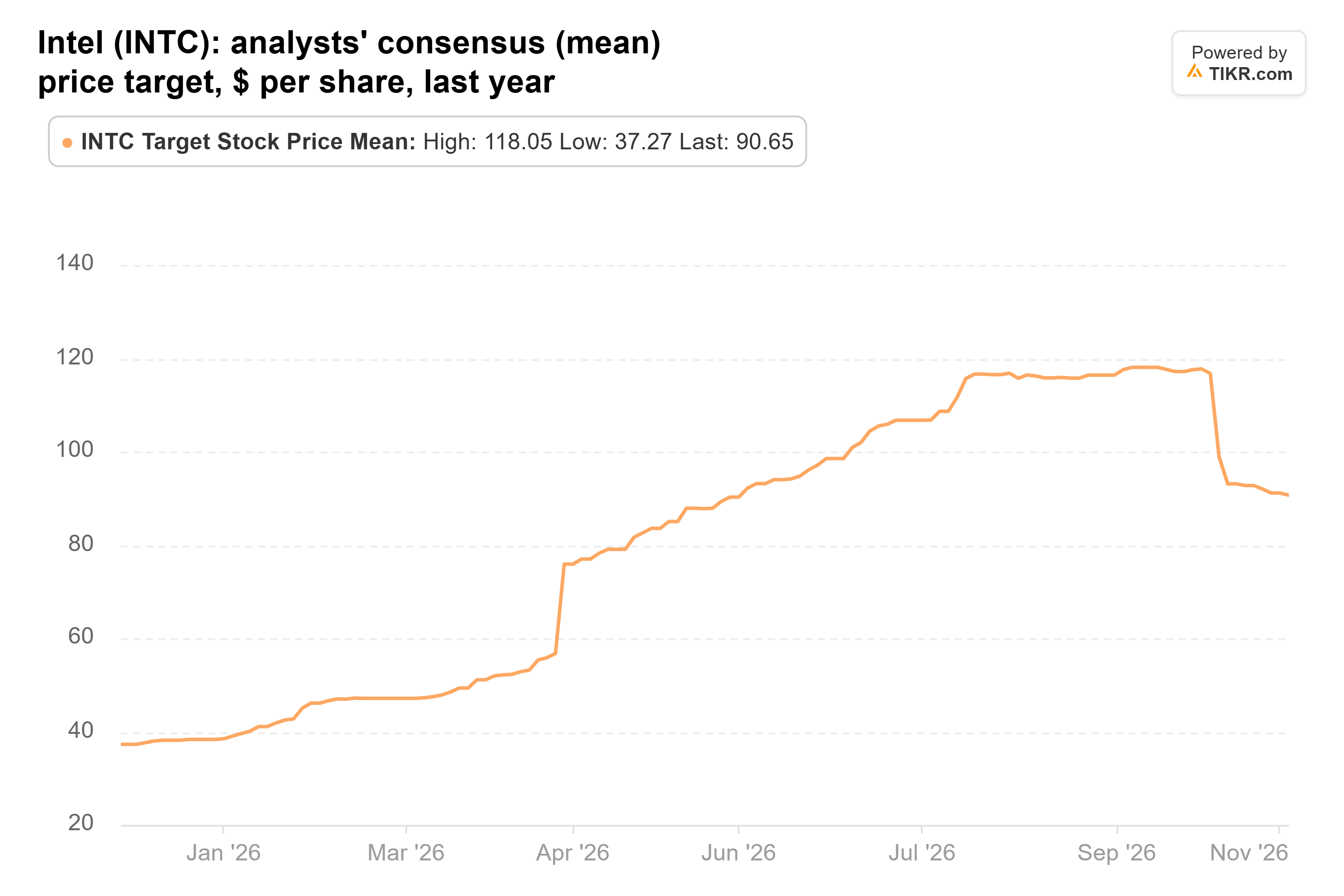
Even the lowest target, $63, is above the last close.
A better bet today than in September
The risk is that Intel needs outside customers to fill the factories it’s building. Outside foundry revenue was $293 million in the second quarter, against a $2.1 billion operating loss for Intel Foundry, and Intel plans to spend more than $20 billion on capex this year and significantly more in 2027.
Here’s where I land: Intel looks far more reasonable at about 19x 2028 earnings, with every Street target above the last close, than it did at 71x at the end of September. Soros’ fund has the better side of this one, as long as you’re willing to wait for 2028 while analysts keep trimming the path there.
We won’t know whether the fund held on until its next 13F, due by mid-February. Before then, Intel’s 2027 capex plan, expected early next year, could change the math, especially if it comes with another share sale.
So what is Intel stock actually worth?
TIKR lets you forecast the future price of any stock in less than a minute. Just enter a few assumptions into TIKR’s valuation model and see what Intel could be worth. Start from Wall Street consensus estimates, or adjust the inputs to reflect your own view of the business. It’s free to use.
Disclaimer:
Please note that the articles on TIKR are not intended to serve as investment or financial advice from TIKR or our content team, nor are they recommendations to buy or sell any stocks. We create our content based on TIKR Terminal’s investment data and analysts’ estimates. Our analysis might not include recent company news or important updates. TIKR has no position in any of the stocks mentioned. Thank you for reading, and happy investing!