Key Takeaways
- Ford yields 4.8% and Pfizer 5.7%, and both kept their quarterly dividends flat in their latest declarations.
- Ford’s dividend used just 35% of its free cash flow over the last twelve months, but it has been $0.15 a quarter since mid-2022.
- Pfizer’s dividend used 89% of its free cash flow over the last twelve months, with patent expiries still ahead.
- Pfizer’s 2027 guidance, the first to reflect Medicare’s negotiated prices on two of its drugs, is the next thing to watch.
Ford Motor Company (F) and Pfizer (PFE) each held their quarterly dividends flat this fall: 15 cents a share at Ford on Oct. 28, and $0.43 at Pfizer on Oct. 6.
That gives an income investor two household names yielding 4.8% and 5.7%, each with its own catch.
If I could hold only one of them for the next 10 years, which would it be?
| Metric | Ford (F) | Pfizer (PFE) |
|---|---|---|
| Dividend yield | 4.8% | 5.7% |
| Annual dividend | $0.60 | $1.72 |
| Regular dividend growth | None: $0.15 a quarter since mid-2022 | 2.5% a year, fiscal 2020-2025 |
| Record | Suspended in 2020, restarted late 2021 | 352 consecutive quarterly dividends |
| Cash dividend payout ratio (TTM) | 35% (to Sept. 30, 2026) | 89% (to June 28, 2026) |
| Net debt/EBITDA (LTM) | 16.0x | 2.0x |
| Interest coverage (LTM) | 1.2x | 7.0x |
Source: TIKR, Nov. 5, 2026; Pfizer’s record from its Oct. 6 dividend declaration.
6 safe dividend stocks paying retirees 6%+ yields
There are over 100 stocks paying 6%+ annual dividends today.
But after an extensive investment review leveraging TIKR’s proprietary data, we now believe only six of them are truly safe for retirees.
They’re all yours for free as part of our new investment report, which you can access right here.
Ford has plenty of cushion and no raises
Ford pays its dividend from free cash flow, and it has room to spare. Over the twelve months to Sept. 30, 2026, dividends of $1.81 billion used a well-covered 35% of its $5.14 billion of free cash flow. Since fiscal 2023, its first full year at today’s rate, free cash flow has run well ahead of the $2.4 billion a year Ford pays out:
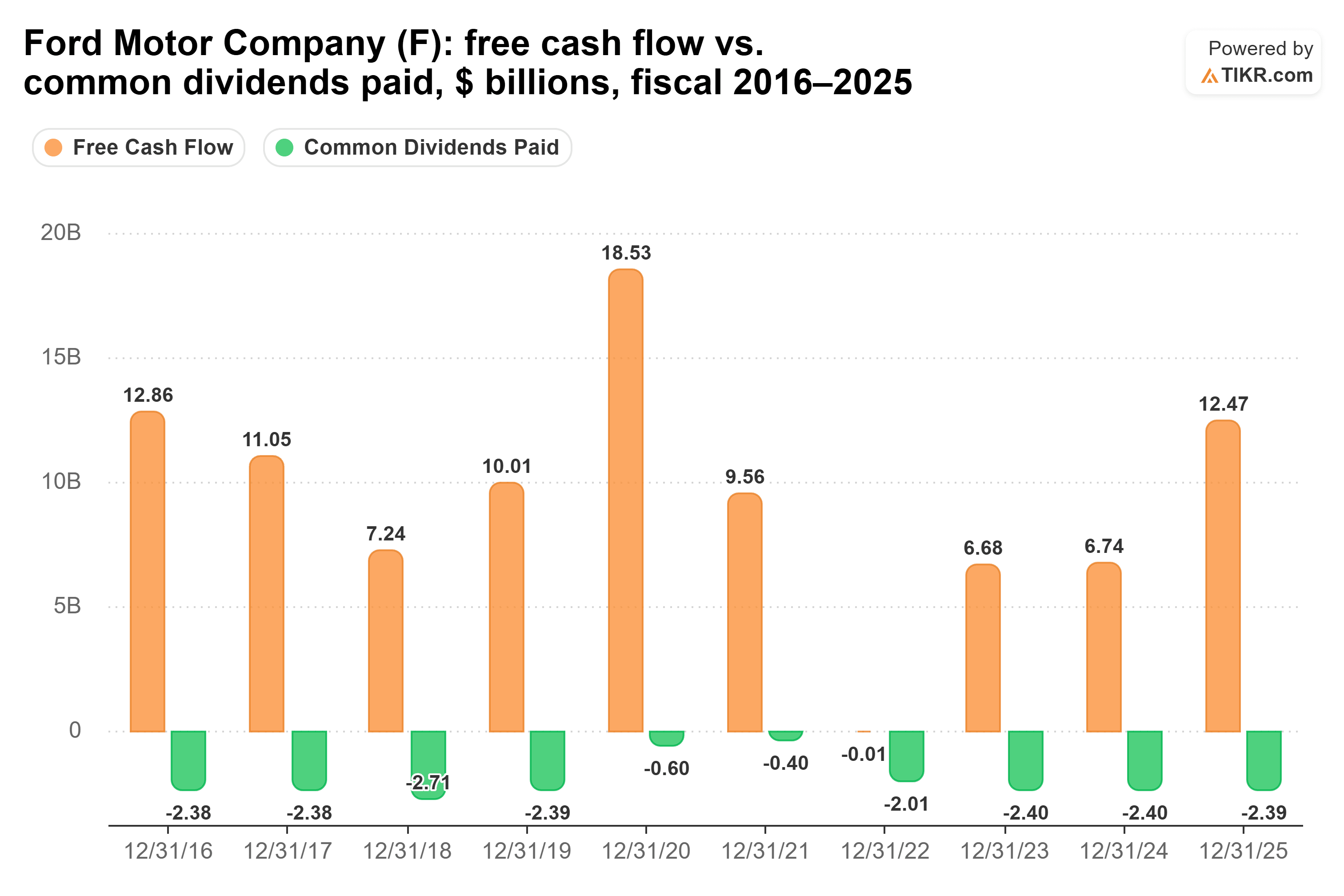
The same chart shows fiscal 2022, though, when free cash flow came in at negative $0.01 billion and Ford still paid $2.01 billion.
The business is holding up. Third-quarter revenue slipped 2% to $49.5 billion, but adjusted EBIT rose to $2.7 billion from $2.6 billion. Ford raised the low end of its full-year adjusted EBIT guidance to $10.5 billion and kept $6 billion to $7 billion of adjusted free cash flow in its outlook. On its third-quarter call, Ford said it expects 2027 earnings roughly in line with 2026’s.
The risk is the debt. Net of cash, it comes to 16.0x EBITDA, and EBIT covered interest just 1.2x over the last twelve months. Ford’s supplemental dividends, $0.18 a share in February 2024 and $0.15 in February 2025, are a bonus I’m not counting.
Pfizer pays a bigger check with less cushion
Pfizer has the opposite setup: more income and a longer record, with little cash left over. Over the twelve months to June 28, 2026, dividends of $9.79 billion used a risky 89% of its $10.98 billion of free cash flow. Free cash flow fell from $26.0 billion in fiscal 2022 to $9.08 billion in fiscal 2025, below the $9.77 billion Pfizer paid out that year:
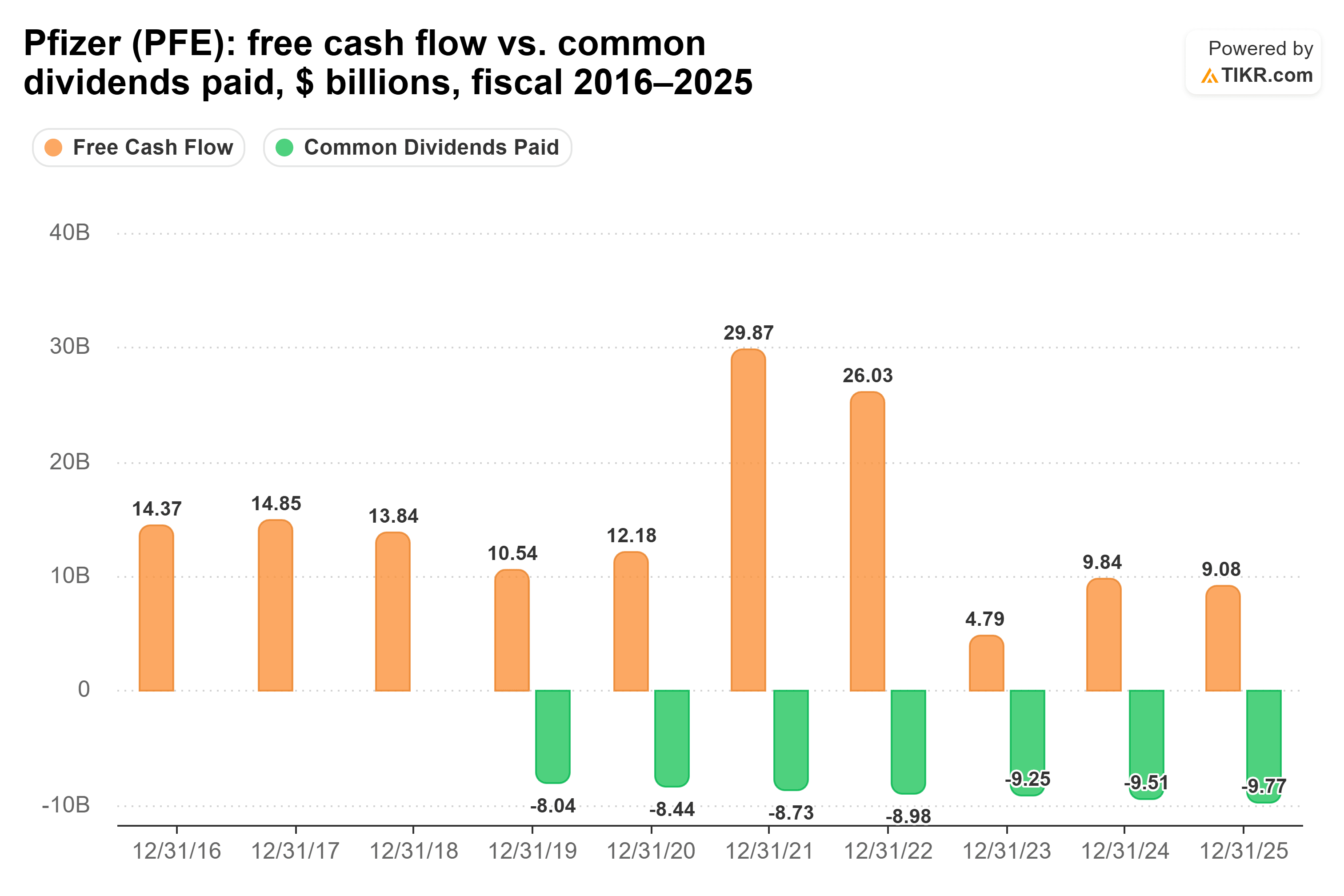
The business is mid-transition. Third-quarter revenue of $16.6 billion was relatively flat operationally: launched and acquired products grew 32% operationally, while Paxlovid fell 63%. Pfizer raised its 2026 revenue guidance to $62.0 billion to $64.0 billion. When it named Cecile Guegan its permanent CFO on Nov. 3, its priorities stayed the same: reinvest in the business, maintain and over time grow the dividend, and leave buybacks for later.
CEO Albert Bourla said on the second-quarter call: “We feel extremely confident that we will — even the most stretched scenarios that we are running, we will be able to maintain our dividend.” With coverage this thin, “maintain” is the honest promise.
The main risk is Ibrance, Xtandi and Eliquis outside the US, which all face loss of exclusivity.
So which dividend wins?
If I can only hold one for the next 10 years, I’m picking Pfizer.
Income is the big reason. At its 5-year growth rate of 2.5% a year, $10,000 in Pfizer pays about $6,387 over the decade, against about $4,800 from Ford with no raises. Given Pfizer’s coverage, that growth rate is the shaky part. But even if Pfizer never raises again, $570 a year for 10 years is $5,700, still $900 more than Ford.
The record counts too. Pfizer has paid 352 straight quarterly dividends. Ford suspended its dividend in 2020, a year its chart shows $18.5 billion of free cash flow.
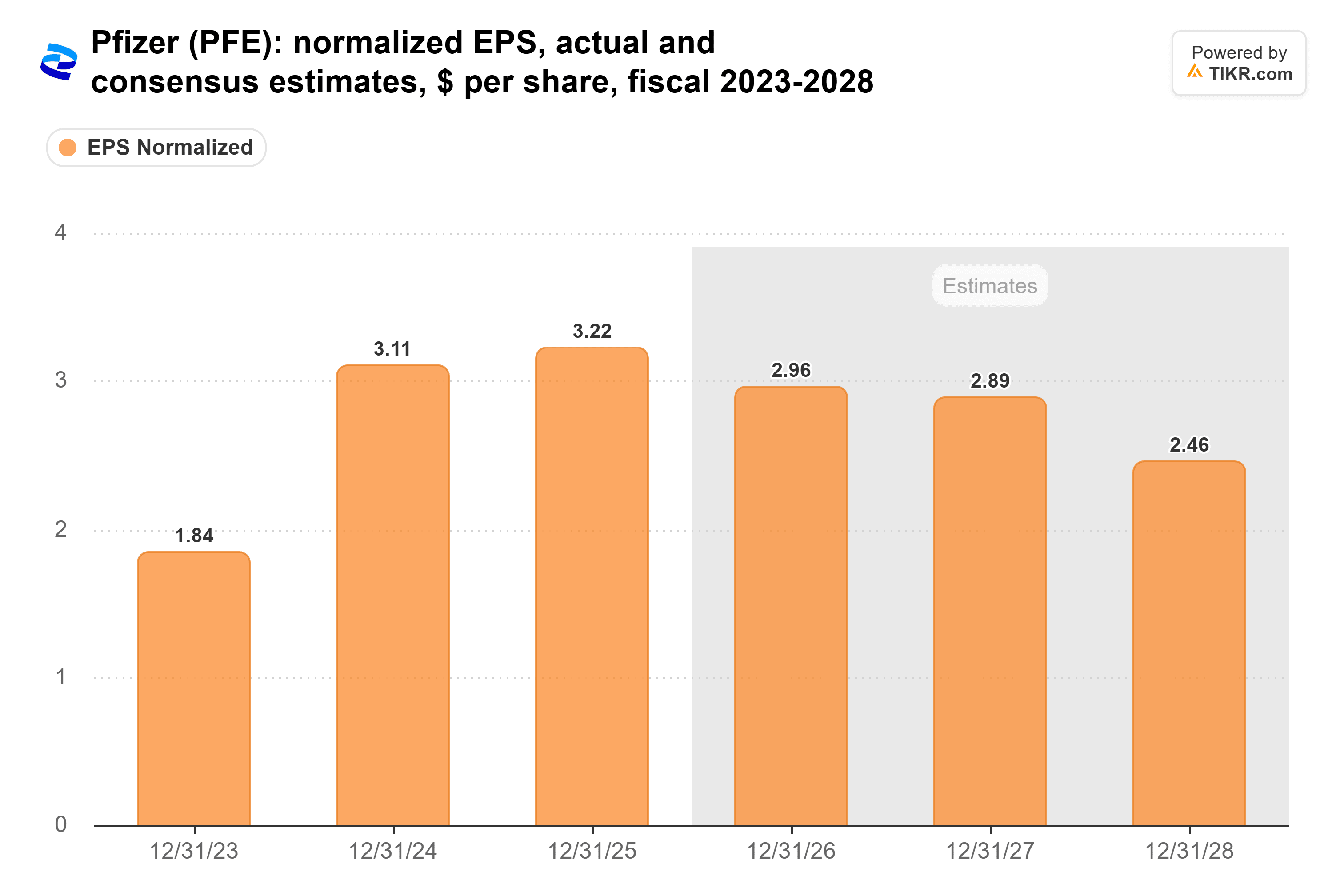
Analysts do expect Pfizer’s normalized EPS to shrink as patents expire, from $3.22 in fiscal 2025 to $2.46 in fiscal 2028. That still leaves a smaller but solid base under a $1.72 dividend:
This isn’t to say Ford’s dividend isn’t safe. It uses just 35% of free cash flow, and Ford ended the quarter with $25.3 billion of cash. Over 10 years, though, I’d rather own the bigger check from the company that has paid it 352 quarters running.
Of course, Pfizer’s 2027 guidance will be the first to reflect Medicare’s negotiated prices on two of its drugs. If that pushes free cash flow further below the dividend, I’d revisit the pick.
Forget Pfizer: 6 safe 6%+ dividend yields you can buy right now
Dividends can hold the key to enormous wealth. But only if you buy the right ones.
Picking the right high-yield dividend stock can be the difference between a dream retirement…and scraping by every month, waiting for the next Social Security check to clear.
We’ve identified six stocks yielding 6%+ that we believe every retiree should know about right now. (And Pfizer isn’t one of them.)
Disclaimer:
Please note that the articles on TIKR are not intended to serve as investment or financial advice from TIKR or our content team, nor are they recommendations to buy or sell any stocks. We create our content based on TIKR Terminal’s investment data and analysts’ estimates. Our analysis might not include recent company news or important updates. TIKR has no position in any of the stocks mentioned. Thank you for reading, and happy investing!