Key Takeaways
- The Fed warns big tech’s exposure to an AI downturn “may be substantially larger” than its balance sheets show.
- For Nvidia, the bigger risk is its earnings estimates, since the AI firms it backs are also its customers.
- With $96.7 billion of free cash flow last fiscal year, Nvidia can carry its guarantees.
- CoreWeave and Oracle are more exposed, and Nvidia’s forward P/E of about 10x prices in much of the risk.
The Federal Reserve just put a name to a pattern Nvidia (NVDA) sits at the center of: “circular financing.”
In its Nov. 13 Financial Stability Report, the Fed describes big tech lending to, investing in and guaranteeing smaller, riskier AI firms that then buy its products. In a downturn, the Fed warns, those companies’ exposure “may be substantially larger than suggested by their on-balance-sheet liabilities.”
Take Nvidia: it owns a stake in CoreWeave (CRWV), sells it the GPUs it rents out, and buys reserved capacity from it. Oracle (ORCL) shows the off-balance-sheet side, in its data center leases.
AI computing debt issuance topped $680 billion by October, up from $130 billion in all of 2023. The Financial Times puts Nvidia’s vendor financing at just under $700 billion, a much wider tally than the guarantees in its own filings.
The Borrowers Feel It First
CoreWeave is about as circular as it gets. In the third quarter, it booked $846 million of net interest expense on $3.66 billion of revenue and posted a GAAP net loss of $709 million. With $37 billion to $39 billion of capex planned this year, it has to keep borrowing, and I’d expect that to get pricier if lenders heed the Fed.
Oracle has $288 billion of data center leases that haven’t started and aren’t on its balance sheet. Its free cash flow was negative $5 billion in the quarter ended Aug. 31, and in July S&P estimated OpenAI was about half of its backlog, then $638 billion ($664 billion by Aug. 31).
Nvidia’s Estimates Lean on the Same Buyers
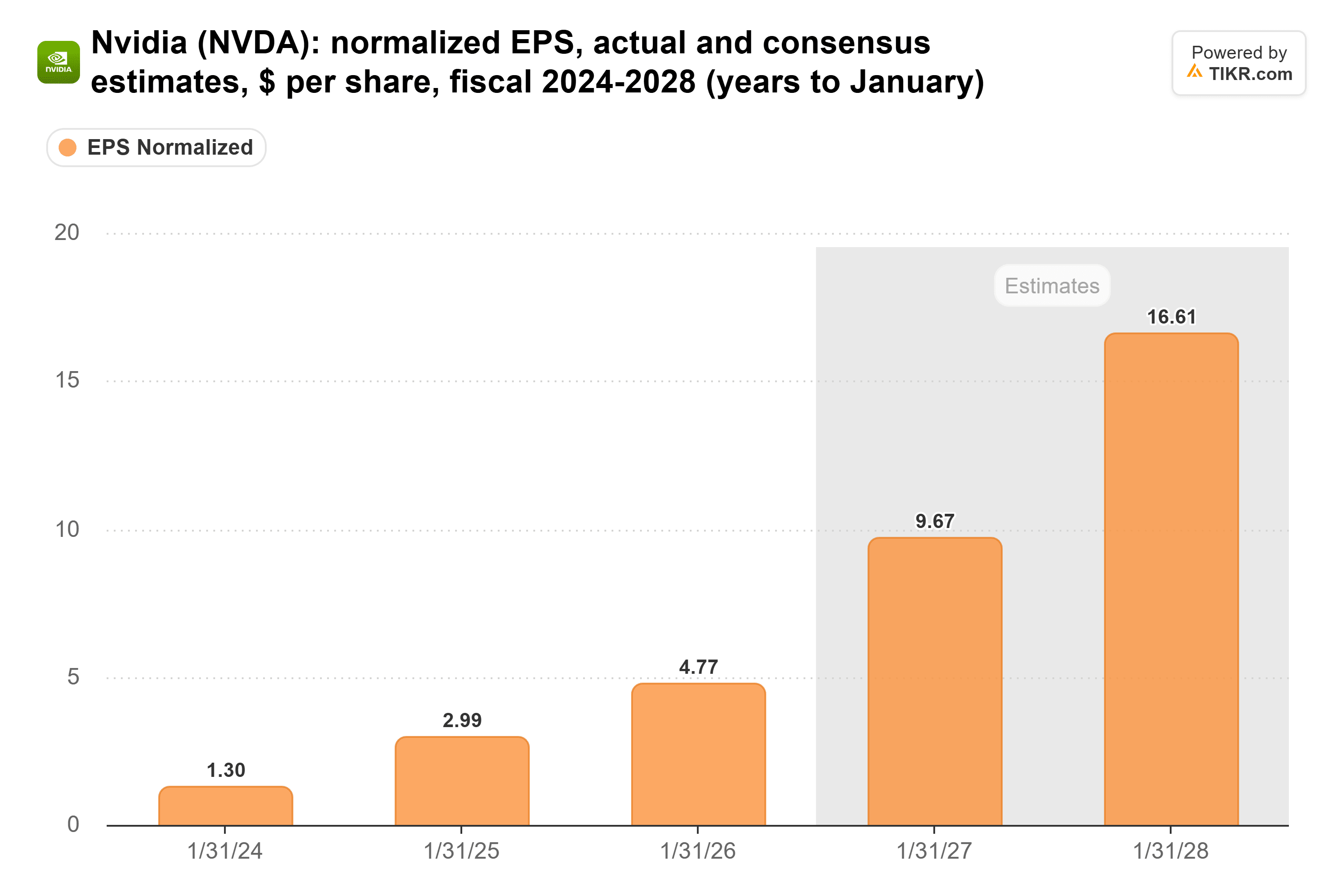
Analysts expect Nvidia’s normalized EPS to roughly double to $9.67 in the year ending January 2027, from $4.77, and to reach $21.65 two years later:
On its August call, management said it expects the labs it backs to make up roughly a quarter of next year’s business. In a downturn, Nvidia would lose those orders and take on their obligations at once.
TIKR Tracks 63 Analysts on Nvidia. How Many Say “Buy”?
See the full breakdown of Buy, Hold, and Sell ratings on Nvidia, along with Wall Street’s revenue and earnings estimates, all in one place. More than 500,000 investors use TIKR to research stocks like this one. See Nvidia’s Analyst Ratings
Nvidia Can Afford the Guarantees
Nvidia’s free cash flow reached $96.7 billion in the year ended January 2026, up from $8.13 billion four years earlier:

Its biggest guarantee, capped at $105 billion, backs OpenAI’s Ohio data center leases, pays out only on certain tenant defaults and shrinks as OpenAI pays rent. It phases in from fiscal 2029, but it would come due in exactly the downturn that shrinks Nvidia’s cash flow.
Wall Street Is Already Nervous
Nvidia trades at about 10x forward earnings, against a five-year average of 35x and a low of 8.7x set on Nov. 20, during Jensen Huang’s 11 days out as CEO:
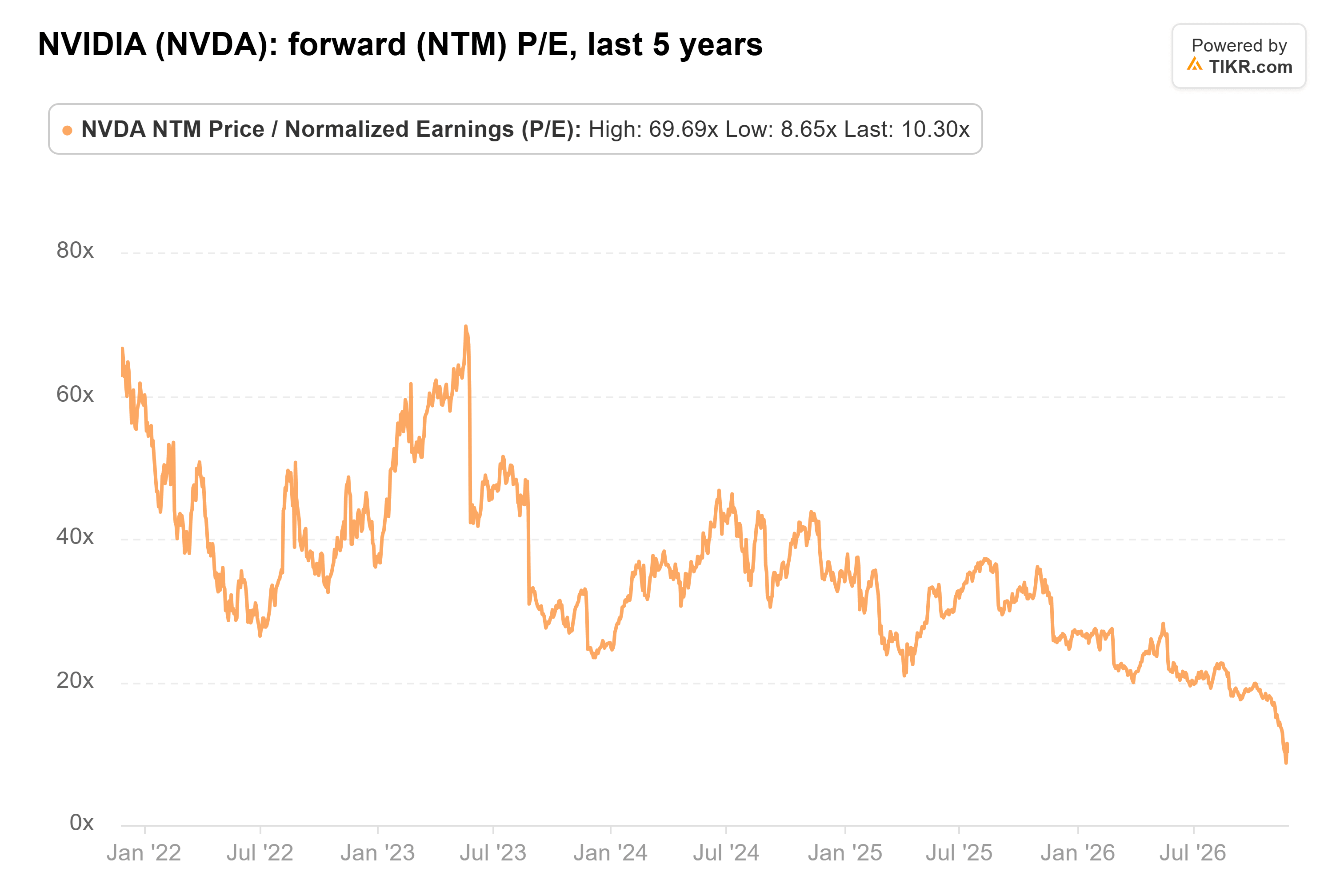
The way I see it, the Fed’s warning hits Nvidia’s estimates more than its balance sheet, and at about 10x, the stock already prices in far less growth than those estimates assume. CoreWeave and Oracle, whose funding costs would move first, carry the sharper risk.
Oracle reports in mid-December. Nvidia’s next report, likely in late February, has to show its labs still ordering at the pace behind the $16.61 EPS consensus for the year ending January 2028.
So What Is Nvidia Stock Actually Worth?
TIKR lets you forecast the future price of any stock in less than a minute. Just enter a few assumptions into TIKR’s valuation model and see what Nvidia could be worth. Start from Wall Street consensus estimates, or adjust the inputs to reflect your own view of the business. It’s free to use.
Disclaimer:
Please note that the articles on TIKR are not intended to serve as investment or financial advice from TIKR or our content team, nor are they recommendations to buy or sell any stocks. We create our content based on TIKR Terminal’s investment data and analysts’ estimates. Our analysis might not include recent company news or important updates. TIKR has no position in any of the stocks mentioned. Thank you for reading, and happy investing!