Key Takeaways
- Arista Networks (ANET) emerged as a potential winner following NVIDIA’s (NVDA) CEO shakeup, with Evercore highlighting an opportunity for Arista in AI networking.
- NVIDIA held 20.4% of the data center Ethernet switching market in the second quarter of 2026, compared with Arista’s 18.7%, leaving a 1.7-percentage-point gap.
- Cisco Systems (CSCO) held another 18.2% of the data center market and 28.7% of the broader Ethernet switching market, making it a major competitor for networking contracts.
- Arista’s third-quarter revenue surged 58.5% to $3.66 billion, while analysts expect annual revenue to reach approximately $18.8 billion in 2027.
What Happened?
Arista Networks (ANET) has emerged as a potential winner following Jensen Huang’s unexpected departure as CEO of NVIDIA (NVDA), raising a new question for investors: can Arista take advantage of the disruption to close the gap in AI networking?
NVIDIA announced on November 12 that Huang had resigned, with CFO Colette Kress taking over as interim CEO.
During CNBC’s November 13 Halftime Report, Frank Holland highlighted Evercore’s favorable view of Arista amid NVIDIA’s leadership disruption, identifying the networking company as a potential beneficiary.
The opportunity is easy to understand. NVIDIA only recently overtook Arista in data center Ethernet switching, a market both companies are competing to dominate as AI infrastructure spending expands.
According to IDC’s second-quarter market report, NVIDIA held 20.4% of the market, compared with Arista’s 18.7% and Cisco Systems (CSCO) at 18.2%.
That puts Arista just 1.7 percentage points behind NVIDIA.
But a leadership change alone won’t close that gap. Arista still needs to win networking contracts against two established competitors with significant resources.
Can Arista Close NVIDIA’s 1.7-Point Networking Lead?
NVIDIA’s networking advantage isn’t entirely dependent on who runs the company.
Its Spectrum-X platform combines Ethernet switches, networking components, and software with its broader AI infrastructure offering, giving customers an integrated solution for large GPU clusters.
That strategy has worked.
IDC reported that NVIDIA’s data center Ethernet switching revenue surged 181.1% year over year in the second quarter, compared with 37.6% growth in Arista’s overall Ethernet switching revenue.
Even after Huang’s departure, NVIDIA expects its operations, customer commitments, and product roadmap to continue without interruption.
For Arista, the bigger opportunity may come from customers looking to build AI networks around different accelerators rather than depending on one supplier’s ecosystem.
Arista has been expanding its open networking architecture to address that demand, including rack-scale systems designed for increasingly complex AI infrastructure.
Cisco remains another obstacle. Its 18.2% share of data center Ethernet switching puts it close behind Arista, while its 28.7% share of the overall Ethernet switch market gives it a substantial presence across enterprise networking.
Any business NVIDIA loses won’t automatically go to Arista.
Still, Arista doesn’t need NVIDIA to stumble to keep growing.
Analysts tracked by TIKR expect Arista’s revenue to reach approximately $18.8 billion in 2027, more than double the $9.01 billion generated in 2025.
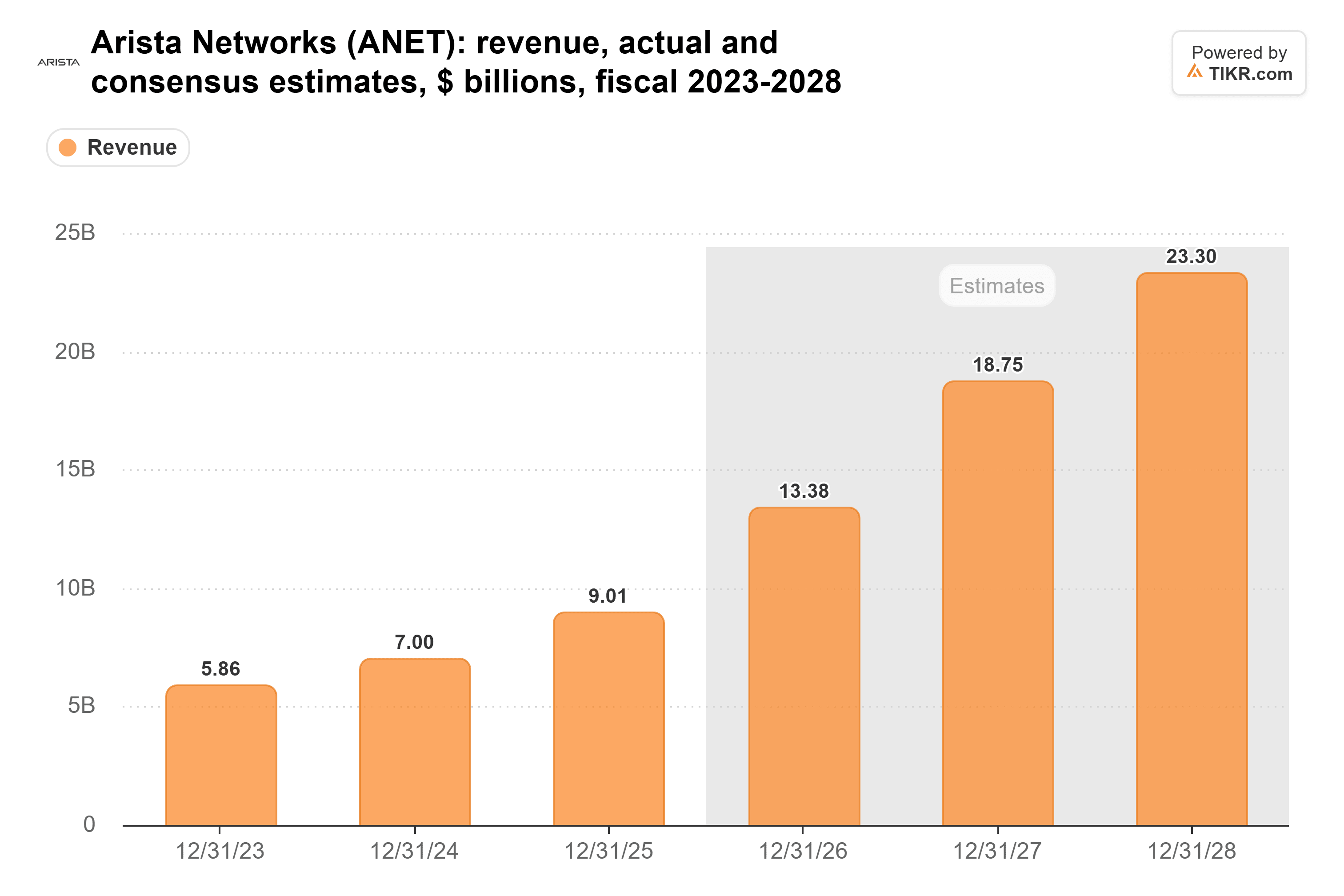
That forecast is slightly above management’s approximately $18.5 billion revenue outlook for 2027, suggesting Wall Street expects continued expansion across AI infrastructure, cloud networking, and enterprise markets.
Arista’s Revenue Growth Was Already Accelerating
The strongest argument for Arista may have little to do with NVIDIA’s leadership changes.
According to Arista’s third-quarter earnings release, revenue jumped 58.5% year over year to $3.66 billion, accelerating from 37.7% growth in the second quarter.
That marked the company’s fastest annual revenue growth since its IPO.
CEO Jayshree Ullal described the performance as reflecting Arista’s “increased relevance for the generative and agentic AI era.”
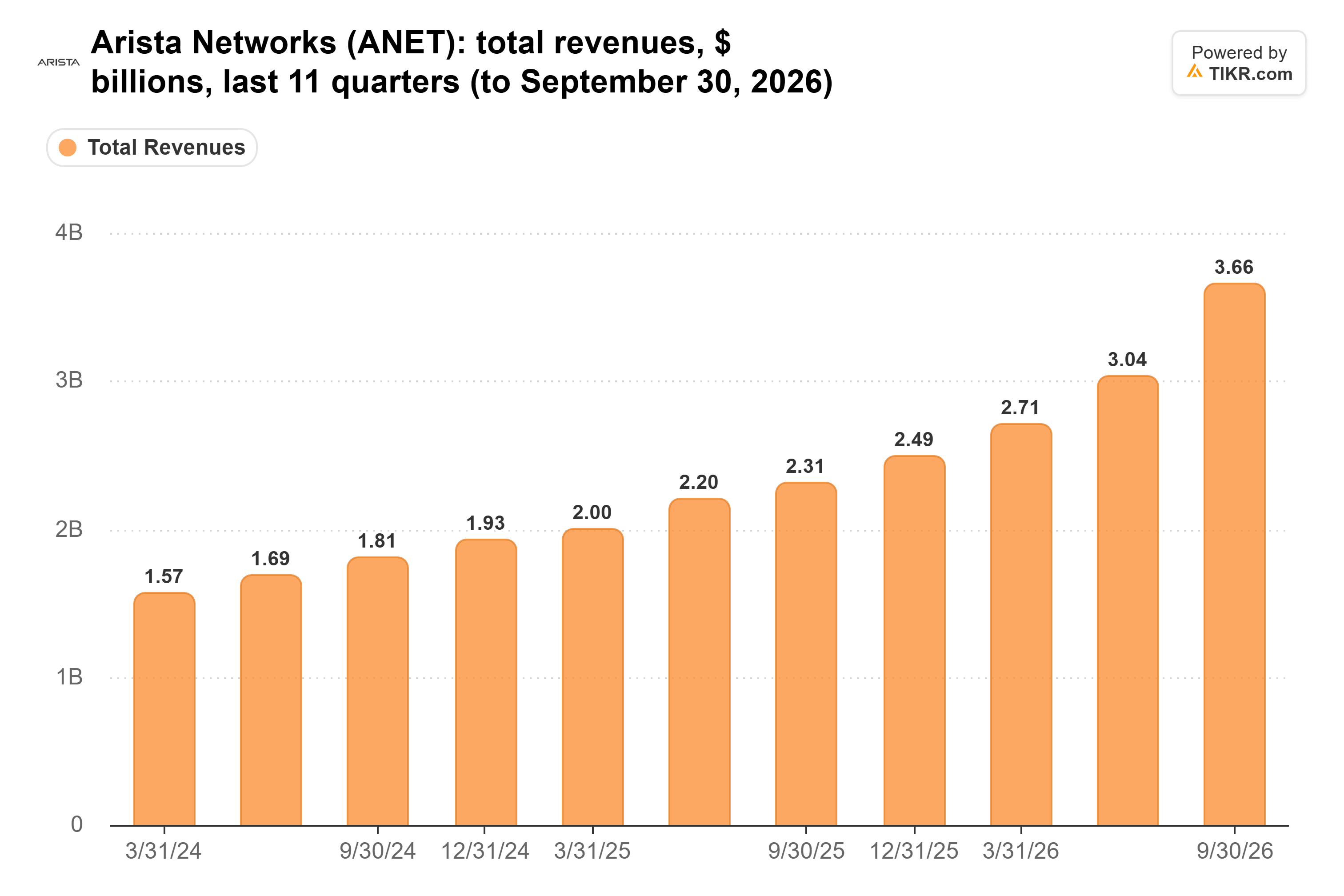
The acceleration happened before Huang’s resignation, suggesting Arista’s growth opportunity was already developing independently of NVIDIA’s problems.
Importantly, the 58.5% figure reflects Arista’s entire business, including campus networking, rather than its data center Ethernet market share alone.
Profitability has remained strong, too.
According to TIKR data, Arista’s gross margin stayed between approximately 61.9% and 65.3% over the past 11 quarters, reaching 63.6% in the third quarter.
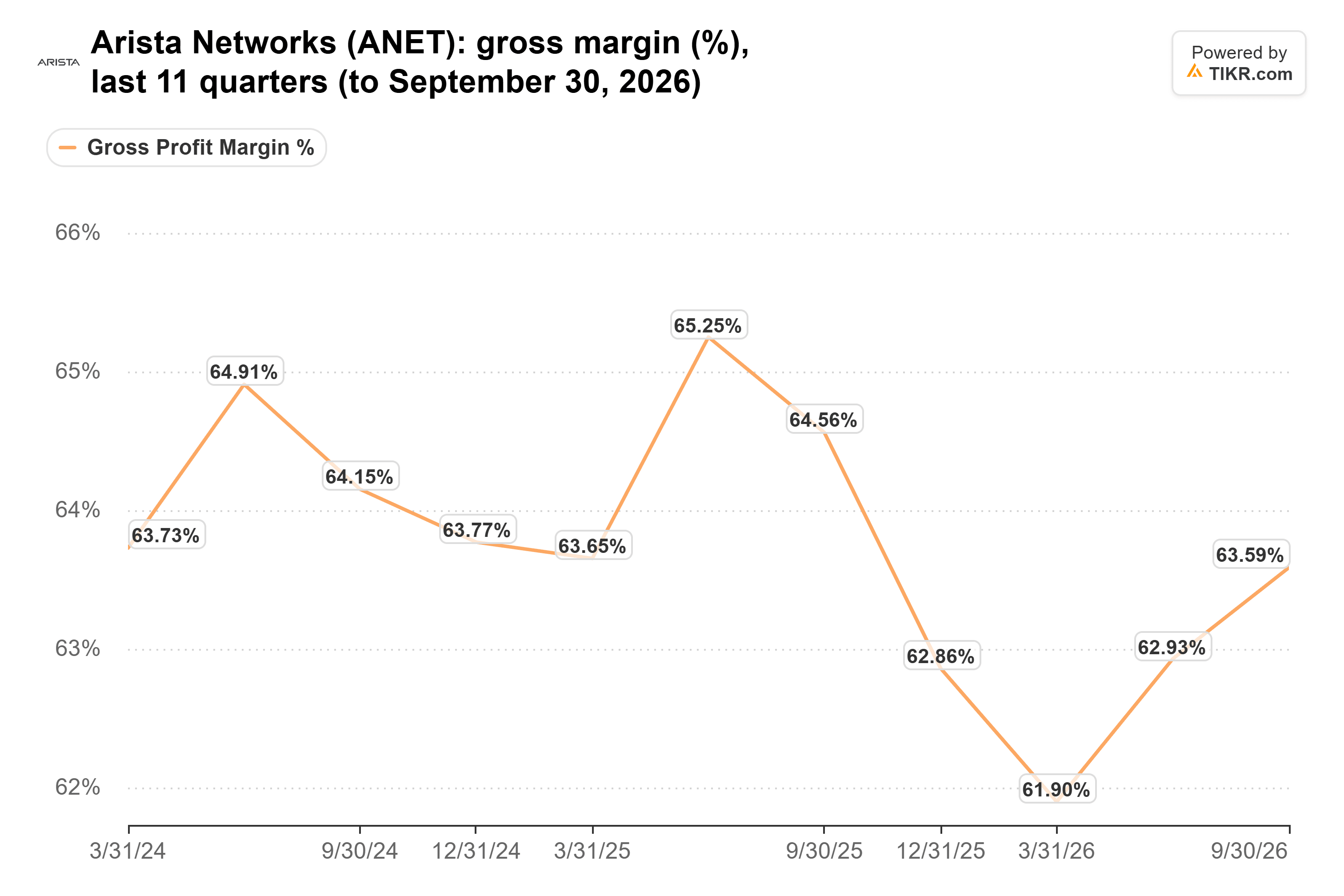
Maintaining those margins while revenue accelerates is encouraging, although the company still faces risks from competition and customer concentration.
Microsoft and Meta accounted for approximately 26% and 16% of Arista’s 2025 revenue, respectively, making their infrastructure spending plans particularly important.
If either customer slows its investment, Arista’s quarterly results could feel the impact.
Is Arista Networks Stock Undervalued or Overvalued?
Arista appears fairly valued at its recent earnings multiple, although sustained AI networking demand could support further upside if the company exceeds growth expectations.
According to TIKR’s November 16 analysis, Arista traded at approximately 35x forward earnings, broadly in line with its historical average since 2014 and below its one-year average of 42x.
Wall Street’s average price target of approximately $250 implied around 27% upside from the closing price used in that analysis, suggesting analysts still saw meaningful potential gains.
The valuation isn’t cheap in absolute terms, but it reflects a company expected to more than double revenue between 2025 and 2027 while maintaining strong profitability.
Over the next 12 months, the biggest potential catalysts include continued AI networking investment, additional customer deployments, and evidence that Arista is gaining data center Ethernet switching market share.
The main risks are NVIDIA’s integrated networking strategy, Cisco’s competitive presence, and Arista’s dependence on a relatively small number of major cloud customers.
The bottom line: Arista’s growth story was already strong before Huang left NVIDIA. Any networking opportunity created by the leadership transition could provide additional upside, but the more important question is whether Arista can deliver its 2027 growth targets while protecting margins. That’s what will ultimately determine whether its premium valuation is justified.
So what is Arista Networks stock actually worth?
TIKR lets you forecast the future price of any stock in less than a minute. Just enter a few assumptions into TIKR’s valuation model and see what Arista Networks could be worth. Start from Wall Street consensus estimates, or adjust the inputs to reflect your own view of the business. It’s free to use.
Value Arista Networks for free
Disclaimer:
Please note that the articles on TIKR are not intended to serve as investment or financial advice from TIKR or our content team, nor are they recommendations to buy or sell any stocks. We create our content based on TIKR Terminal’s investment data and analysts’ estimates. Our analysis might not include recent company news or important updates. TIKR has no position in any of the stocks mentioned. Thank you for reading, and happy investing!