Key Takeaways
- General Mills yields 7.2% and Enterprise Products Partners 6.0%, after Enterprise raised its quarterly distribution 2.8% on Oct. 29.
- Enterprise’s distributable cash flow covered its distribution 1.7x in fiscal 2025, and analysts expect 1.9x for fiscal 2026.
- General Mills’ dividend used 85% of its free cash flow over the twelve months to Aug. 30, and Piper Sandler warned on Nov. 12 that it could be cut.
- What to watch: whether General Mills keeps its dividend steady as a new CEO takes over on Jan. 1.
General Mills (GIS) now yields 7.2%. On Nov. 12, Piper Sandler downgraded the stock to Neutral from Overweight and warned that its dividend could be cut.
Enterprise Products Partners (EPD) is moving the other way. On Oct. 29, it declared a quarterly distribution of $0.56 a unit, up 2.8% from a year earlier, for a 6.0% yield.
So if I could hold only one of them for the next 10 years, which would it be?
| Metric | Enterprise Products Partners (EPD) | General Mills (GIS) |
|---|---|---|
| Dividend yield | 6.0% | 7.2% |
| Annual dividend | $2.24 a unit | $2.44 a share |
| Dividend growth, 5 years | 4.0% a year (fiscal 2020-2025) | 3.9% a year (fiscal 2021-2026) |
| Coverage, last reported | 1.7x distributable cash flow coverage (fiscal 2025) | 85% cash dividend payout ratio (TTM to Aug. 30, 2026) |
| Coverage, forward | 1.9x (fiscal 2026 consensus) | 76% (fiscal 2027 consensus) |
| Net debt/EBITDA | 3.2x | 3.7x |
| Interest coverage | 5.1x | 4.9x |
6 safe dividend stocks paying retirees 6%+ yields
There are over 100 stocks paying 6%+ annual dividends today.
But after an extensive investment review leveraging TIKR’s proprietary data, we now believe only six of them are truly safe for retirees.
They’re all yours as part of our new investment report. Learn more about how to get access right here.
Enterprise Products keeps growing into its payout
Enterprise Products is an MLP, so it pays distributions on units, and holders get a K-1 at tax time. In the third quarter, adjusted EBITDA rose 16% from a year earlier to $2.8 billion, driven by record Permian gas processing volumes and a 28% jump in marine terminal volumes.
Over the past decade, distributable cash flow per unit has grown faster than the distribution. That lifted coverage from 1.2x in fiscal 2016 to 1.7x in fiscal 2025.
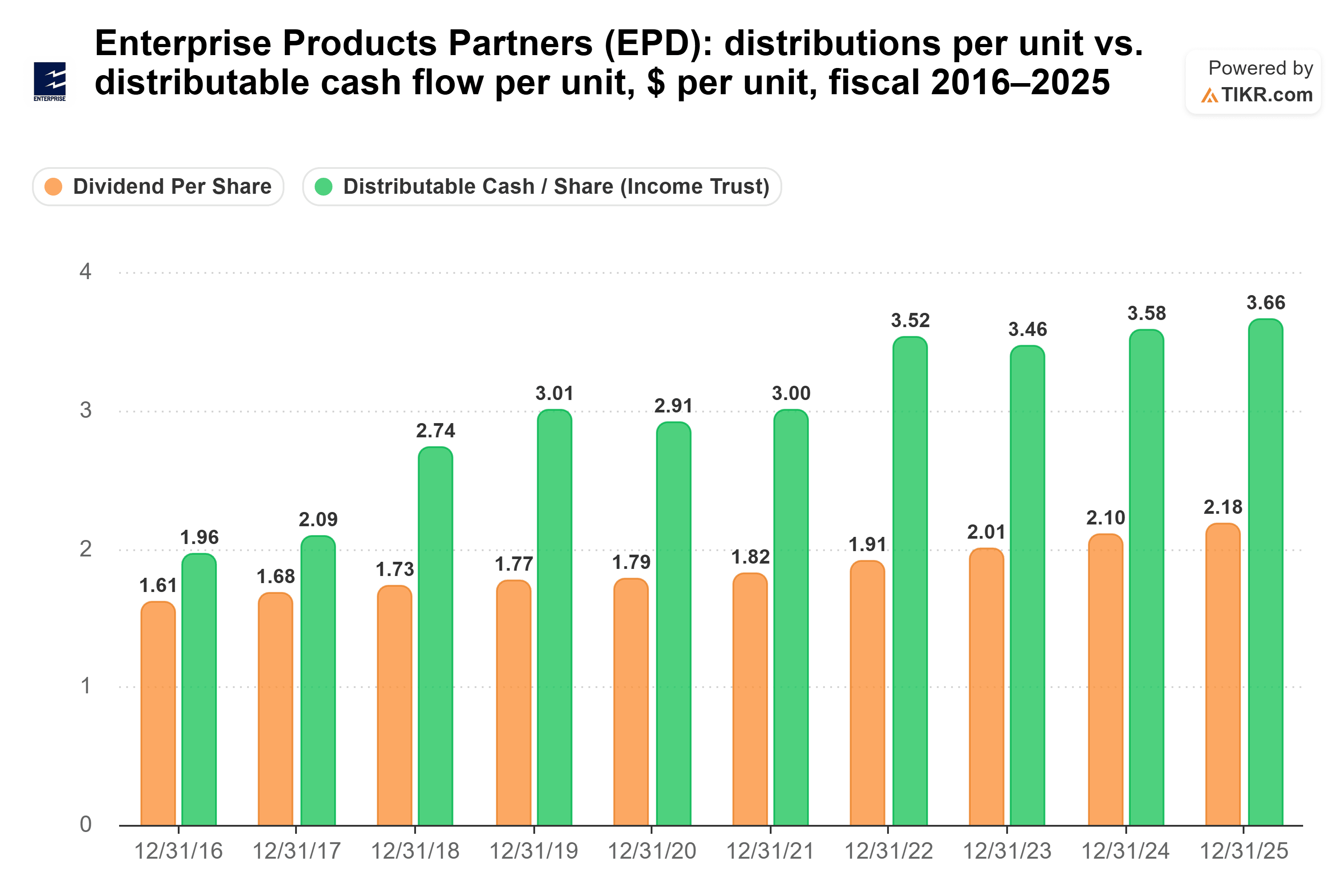
Analysts expect 1.9x for fiscal 2026, with distributable cash flow rising 14% to $4.17 a unit as this year’s record volumes and new assets come through. As Co-CEO W. Fowler said on the third-quarter call: “Rather than pursuing acquisitions at top of the cycle M&A multiples, we have been opting for targeted organic growth that historically provided us higher and more consistent returns on capital with fewer surprises.”
The main risk is slower growth: management expects more modest EBITDA growth in 2027, and the next contracts on its ATEX pipeline could come at lower rates.
General Mills’ dividend is stretched
General Mills pays the bigger check, but with far less cash behind it. In its fiscal 2027 first quarter (ended Aug. 30), organic sales were flat and adjusted EPS fell 13% in constant currency to $0.75, with cereal and snacks still weak in North America Retail.
Free cash flow fell from $2.29 billion in fiscal 2025 to $1.63 billion in fiscal 2026 (the year ended May), while dividends paid barely moved, from $1.34 billion to $1.32 billion.
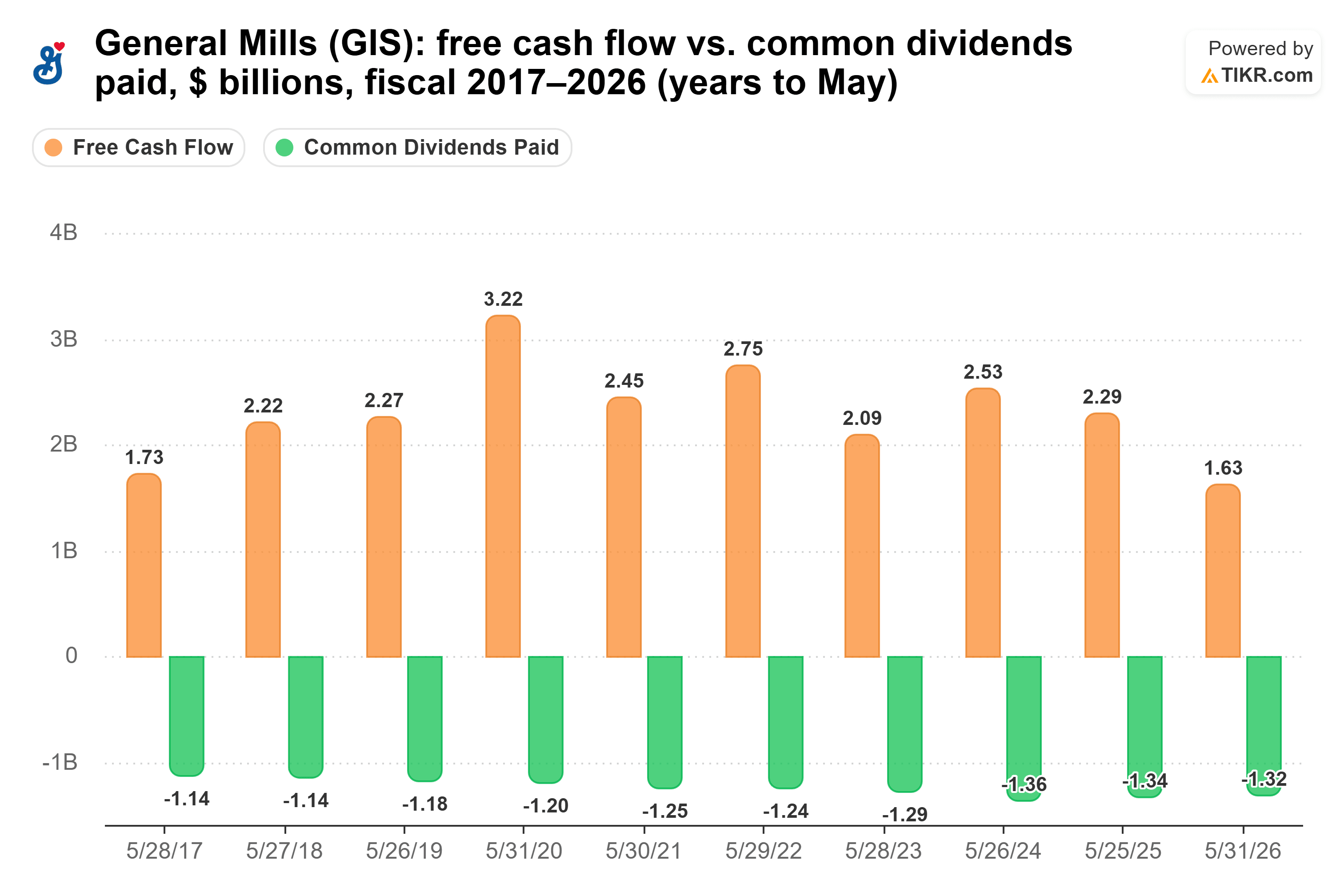
That took the cash dividend payout ratio from 58% to 81%, and to a risky 85% over the twelve months to Aug. 30. Analysts expect a still-stretched 76% in fiscal 2027.
As CFO Kofi Bruce said in September, “we remain fully committed to our dividend, and in the near term, we expect to maintain the current rate per share while we prioritize deleverage.” He expects it will take “at least a couple of years” to get leverage back to the company’s 3x target. Piper Sandler is more worried: it estimates that a cut of about 35% in fiscal 2028 would bring the payout back to its historical average near 50%.
So which dividend wins?
For the next 10 years, my pick is Enterprise Products Partners.
General Mills pays more. If each dividend kept growing at its 5-year rate, $10,000 in General Mills would pay about $8,585 over the decade, against about $7,218 from Enterprise. At each one’s pace now (the latest yearly raise was 1.7% for General Mills and 3.3% for Enterprise), the gap shrinks to about $780.
But General Mills plans to hold its dividend flat for now, and its normalized EPS fell from $4.52 in fiscal 2024 to $3.55 in fiscal 2026.
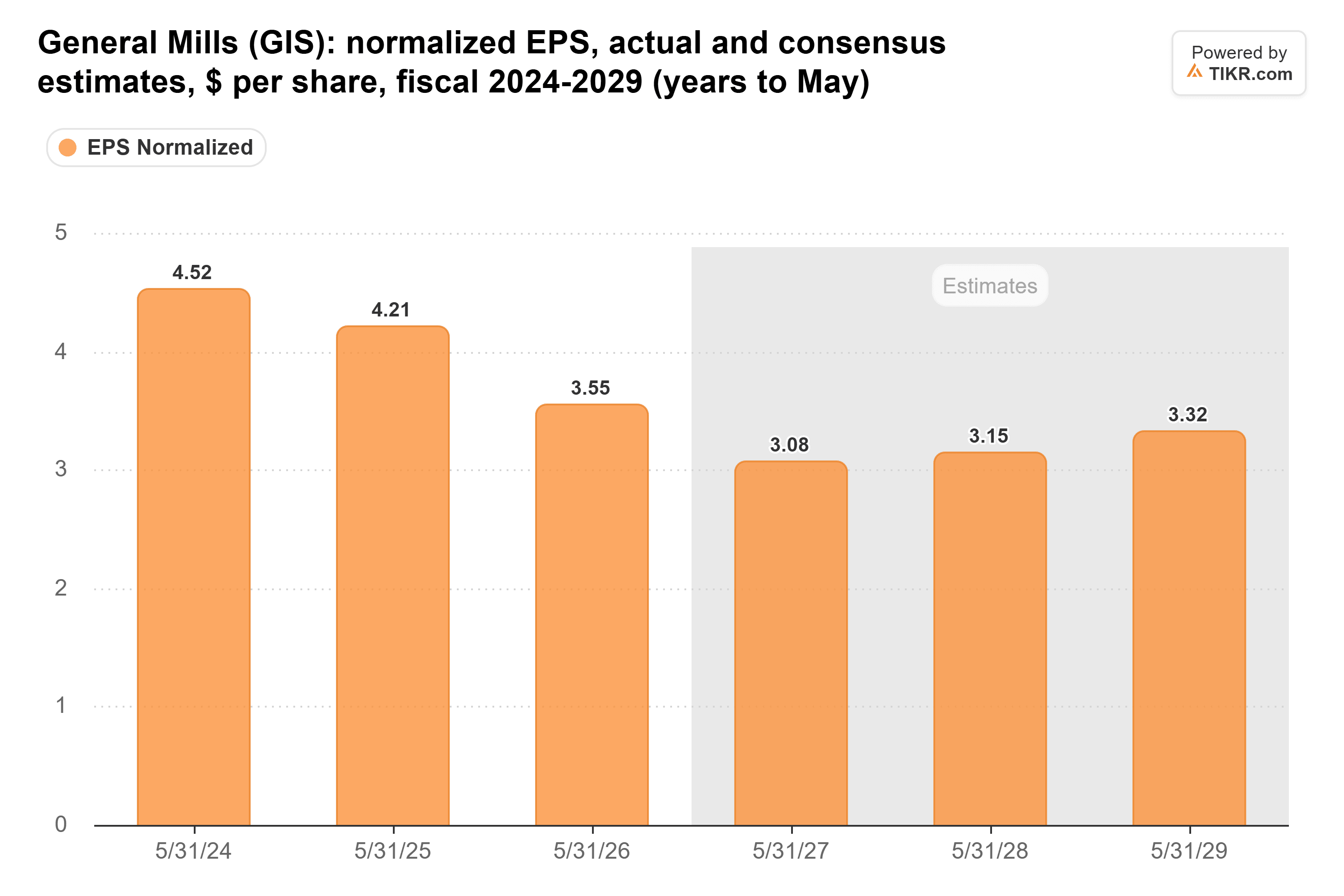
Analysts expect $3.32 in fiscal 2029, still below fiscal 2026’s level. A cut the size Piper Sandler sketched would more than wipe out that $780 edge.
Enterprise’s growth looks far easier to keep up. Coverage of 1.7x, heading to 1.9x, leaves plenty of room for more raises, and even at each dividend’s pace now, Enterprise’s yearly income would pass General Mills’ around 2038.
This isn’t to say General Mills’ dividend is doomed. It expects at least $750 million of cost savings in fiscal 2027, and if analysts are right that earnings bottom this fiscal year, a 7.2% yield is a lot of income to give up. It’s just that I trust the cash behind Enterprise’s checks more.
Of course, COO Dana McNabb takes over as CEO on Jan. 1. If she gets earnings growing and keeps paying $0.61 a quarter, that 7.2% yield will look awfully good in hindsight.
Enjoy your retirement in style with these safe 6%+ dividend yields
Dividends can hold the key to enormous wealth. But only if you buy the right ones.
Picking the right high-yield dividend stock can be the difference between a dream retirement…and scraping by every month, waiting for the next Social Security check to clear.
We’ve identified six stocks yielding 6%+ that we believe every retiree should know about right now.
Disclaimer:
Please note that the articles on TIKR are not intended to serve as investment or financial advice from TIKR or our content team, nor are they recommendations to buy or sell any stocks. We create our content based on TIKR Terminal’s investment data and analysts’ estimates. Our analysis might not include recent company news or important updates. TIKR has no position in any of the stocks mentioned. Thank you for reading, and happy investing!