
Key Takeaways
- Bank of America raised its Eli Lilly price target to $1,600 from $1,557 on Nov. 19 and kept its Buy rating. That’s 19% above the stock’s latest close, with shares up 25% in 2026.
- Lilly’s third-quarter revenue grew 39%, against 4% adjusted sales growth at Novo Nordisk, and Lilly raised its 2026 revenue guidance to $91 billion-$92 billion.
- Bank of America’s case rests on Lilly’s drugs beyond obesity, which Lilly will show at its Dec. 7 Innovation Day.
- On analysts’ 2028 earnings estimates, $1,600 is 28x, slightly below the roughly 29x the stock trades at now, so the target mainly needs those estimates to hold.
Bank of America raised its price target on Eli Lilly (LLY) to $1,600 from $1,557 on Nov. 19 and kept its Buy rating. That’s 19% above the stock’s $1,347.11 close on Nov. 20. Shares are up 25% in 2026 but sit 7% below their Nov. 13 closing high of $1,443.50.
And Lilly keeps pulling away from Novo Nordisk (NVO). Lilly’s third-quarter revenue grew 39%, while Novo’s adjusted sales grew 4% at constant exchange rates.
Lilly gave it plenty to work with
Mounjaro sales rose 65% to $10.7 billion in the third quarter, and Zepbound’s rose 49% to $5.4 billion. On Oct. 29, Lilly raised its 2026 revenue guidance to $91 billion-$92 billion from $85 billion-$87 billion. Then on Nov. 12, China approved orforglipron, the obesity pill Lilly sells as Foundayo in the U.S.
Bank of America is looking past obesity
Bank of America laid out its case on Nov. 5, when it raised its target to $1,557 from $1,497, at 26 times its 2028 earnings forecast. Analyst Jason Gerberry said the higher multiple reflects “LLY’s superior growth profile and execution,” TheStreet reported. He thinks the stock price already reflects the obesity business. Instead, he points to two brain drugs: cleminorexton for narcolepsy and AtaiBeckley’s psychedelic depression treatment. He puts their combined peak sales at $5 billion to $15 billion if they clear late-stage trials.
The Street’s average target has climbed to $1,469, up from $1,007 a year ago.
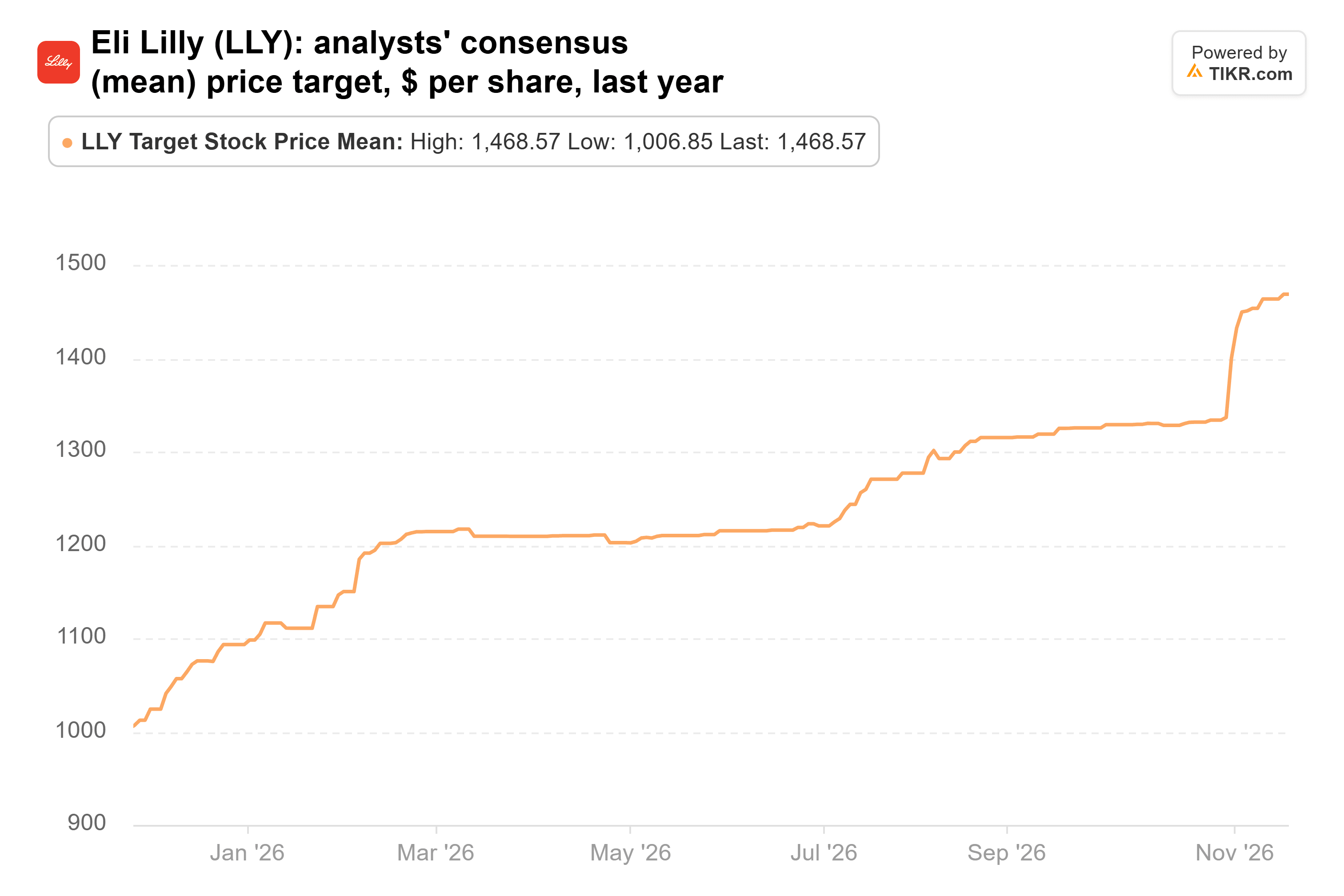
The median target is $1,570, so Bank of America’s $1,600 sits a little above the middle of the pack.
TIKR tracks 31 analysts on Eli Lilly. How many say “Buy”?
See the full breakdown of Buy, Hold, and Sell ratings on Eli Lilly, along with Wall Street’s revenue and earnings estimates, all in one place. More than 500,000 investors use TIKR to research stocks like this one. See Eli Lilly’s Analyst Ratings
Does $1,600 add up?
Analysts’ consensus EPS for 2027 is $50.80, and their 2028 estimate is $58.05.
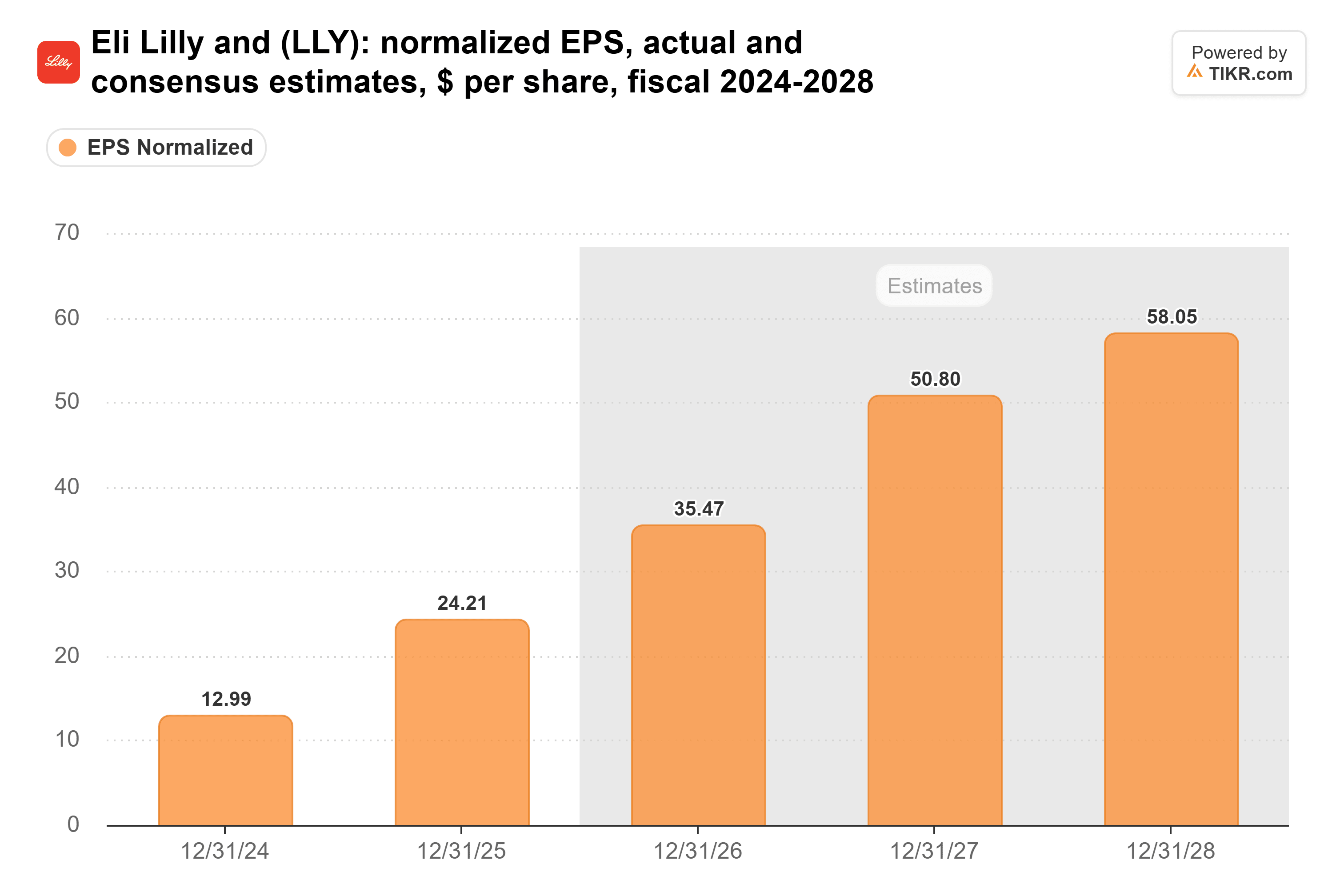
Part of the jump into 2027 comes from this year’s acquired R&D charges dropping out. Even so, analysts expect earnings to grow 14% from 2027 to 2028.
On Nov. 18, Lilly traded at 29x forward earnings. Its five-year average is 40x, and its low was 23x in August 2025.
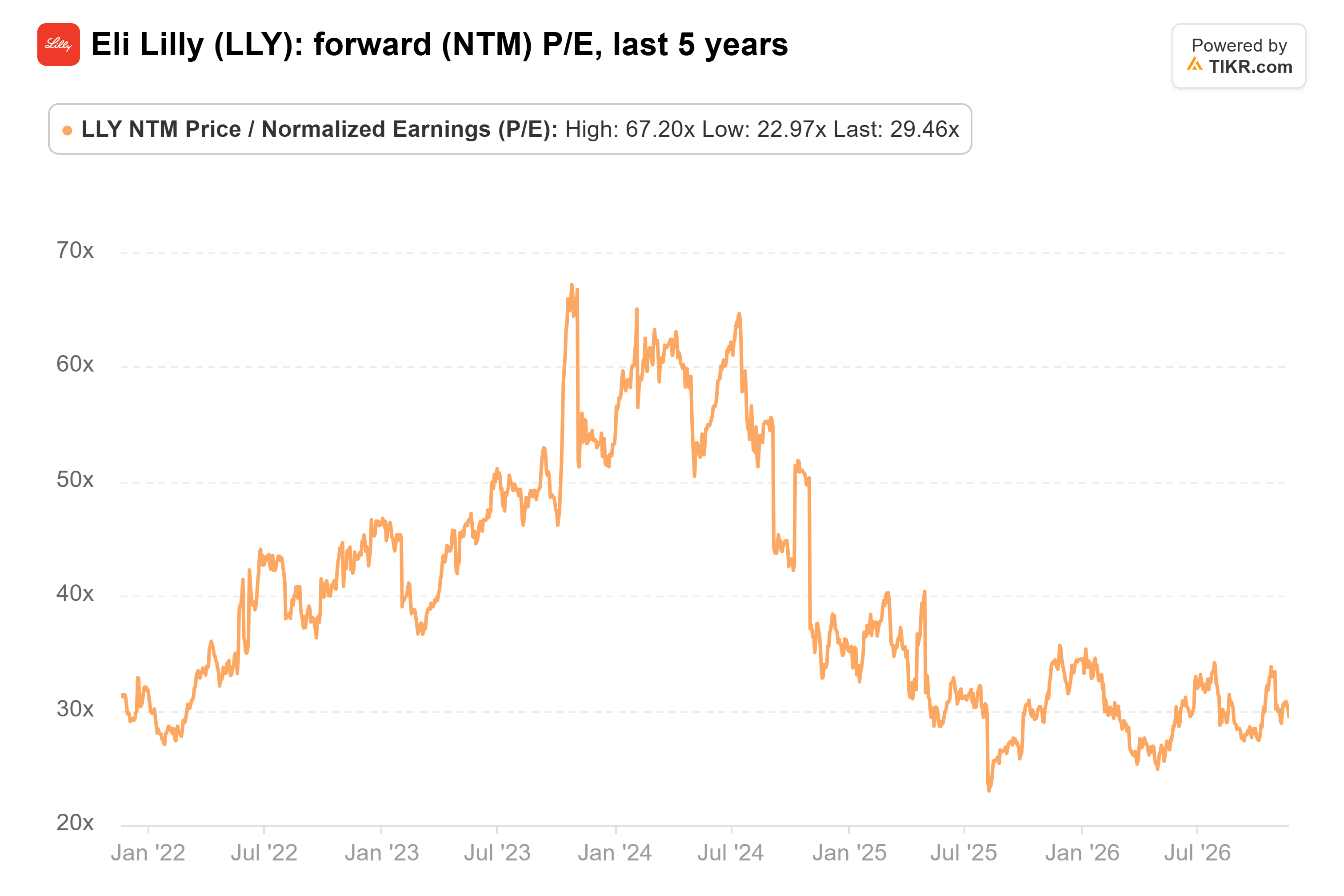
On 2028 estimates, $1,600 is 28x, a little under the multiple Lilly trades at now. The target just needs the 24% earnings growth analysts expect between the next twelve months and 2028.
Two drugs still do most of the work
Mounjaro and Zepbound made up about two-thirds of Lilly’s third-quarter revenue. Lilly’s U.S. realized prices fell 7%, mostly because of Zepbound. And Novo’s Wegovy pill brought in DKK 5.4 billion (about $810 million) in the third quarter, more than four times the $184 million Lilly booked for Foundayo.
Bank of America’s math still holds up. Its target asks Lilly to trade at a slightly lower multiple than it does now, on estimates that have risen since the Oct. 29 report. The next check is 2027 guidance: Lilly gave its 2026 outlook with fourth-quarter results on Feb. 4 this year, and EPS guidance near the $50.80 analysts expect would keep that math working. Before then, the Dec. 7 Innovation Day has to show the drugs beyond obesity that Bank of America is counting on.
So what is Eli Lilly stock actually worth?
TIKR lets you forecast the future price of any stock in less than a minute. Just enter a few assumptions into TIKR’s valuation model and see what Eli Lilly could be worth. Start from Wall Street consensus estimates, or adjust the inputs to reflect your own view of the business. It’s free to use.
Disclaimer:
Please note that the articles on TIKR are not intended to serve as investment or financial advice from TIKR or our content team, nor are they recommendations to buy or sell any stocks. We create our content based on TIKR Terminal’s investment data and analysts’ estimates. Our analysis might not include recent company news or important updates. TIKR has no position in any of the stocks mentioned. Thank you for reading, and happy investing!