Key Stats for DIS Stock
- Past week performance: -1.2%
- 52-week range: $92 to $117
- Valuation model target price: $126
- Implied upside: 19.7% over 2.0 years
Size up Disney’s recovery potential with 5 years of analyst forecasts on TIKR (It’s free) >>>
Disney Rewires Its TV Business Around Streaming
The Walt Disney Company (DIS) slipped about 1.2% over the past week, then dropped another 3.4% on Thursday to close near $101. Shares now sit about 13% below their 52-week high of $117. The selling reflects nervousness about how deep Disney’s restructuring will go. Investors are weighing cost savings against the disruption that comes with them.
Disney is reportedly planning to consolidate divisions across ABC Entertainment, 20th Television, Hulu Originals and Freeform. Debra O’Connell, who chairs Disney Entertainment Television, is leading the effort. The goal is to organize TV around streaming customers and franchises rather than old cable brands. Hundreds of jobs could be affected, although the plan may not be final before year end.
Separately, Disney laid off a few hundred employees, mostly in HR and technology. That marks the third round of cuts under CEO Josh D’Amaro this year, after about 1,000 in April. Disney also lifted ad-free Disney+ and Hulu plans by $2.50 to $21.49 a month. Higher prices boost revenue per subscriber but raise the risk of cancellations.
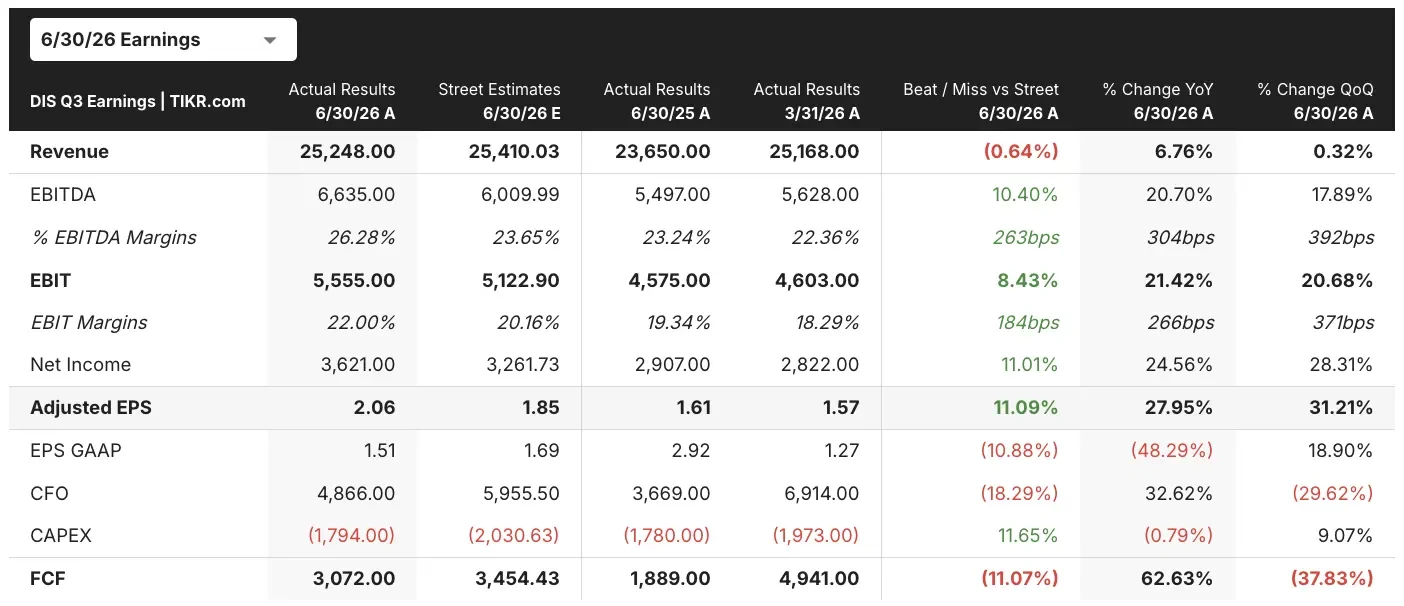
The pressure contrasts with a strong fiscal Q3. Adjusted EPS of $2.06 beat the $1.86 estimate, and streaming operating income more than doubled to $712 million. On the earnings call, D’Amaro said, “This was an excellent quarter for us.” Going forward, investors want proof that restructuring can lift margins without weakening Disney’s content engine.
Compare Disney’s segment growth with its streaming rivals on TIKR (It’s free) >>>
Is DIS Still Undervalued?
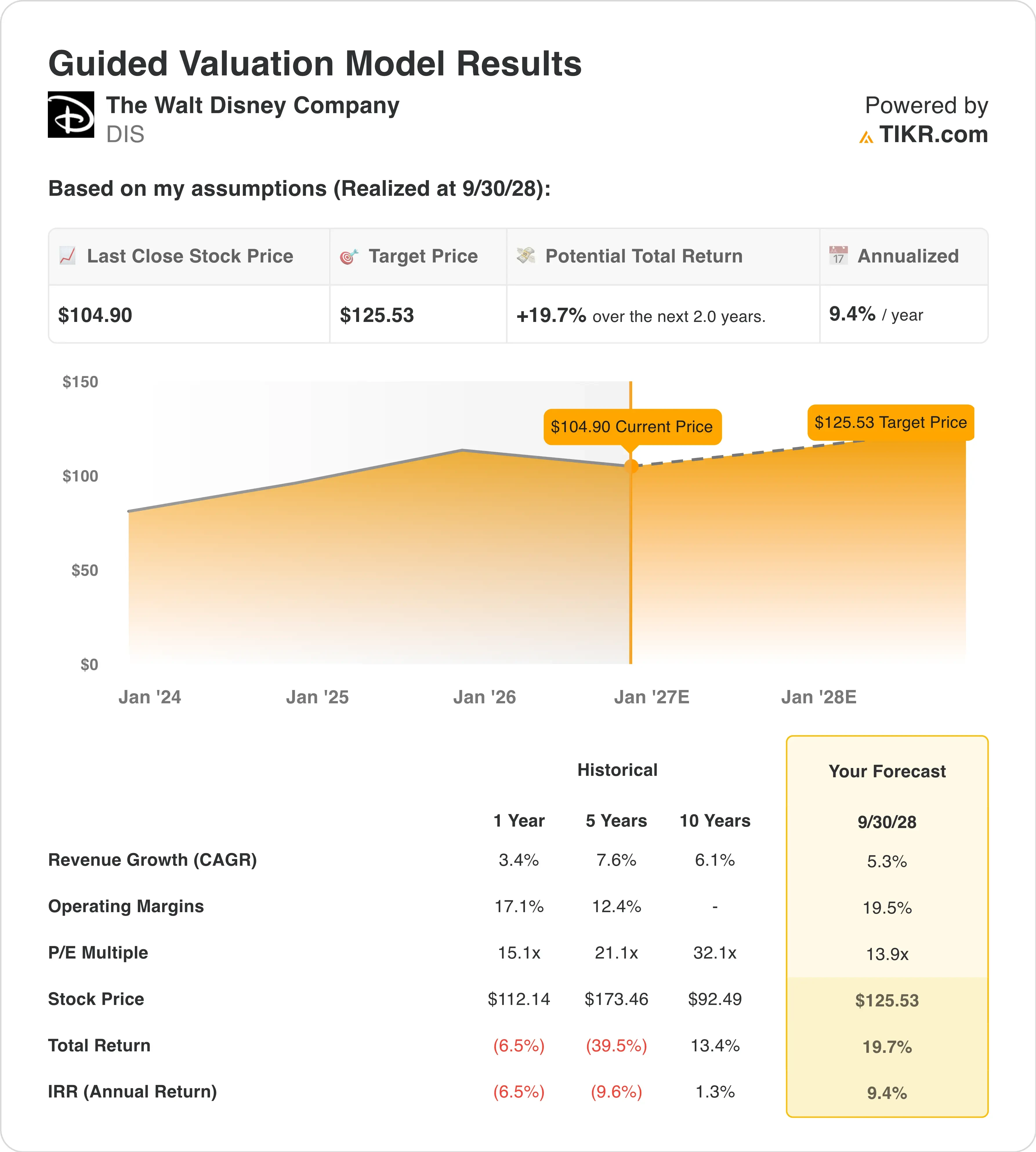
Under valuation model assumptions realized through 9/30/28, the stock is modeled using:
- Revenue Growth (CAGR): 5.3%
- Operating Margins: 19.5%
- Exit P/E Multiple: 13.9x
Based on these inputs, the model estimates a target price of $126, implying 19.7% total upside from the current share price of $105 and a 9.4% annualized return over the next 2.0 years.
A 9.4% annual return puts Disney in moderately attractive territory, just below the 10% hurdle. The model is not stretching. Its 13.9x exit P/E matches today’s forward multiple. So upside depends on earnings growth rather than a re-rating.
This is a margin recovery story. The model calls for 19.5% operating margins, up from 17.1% over the past year and 12.4% across five years. Streaming drives that climb because Disney’s subscription video business earned a 13% margin in Q3 after years of losses. Meanwhile, Experiences, its parks and cruise unit, posted roughly 30% margins through nine months.
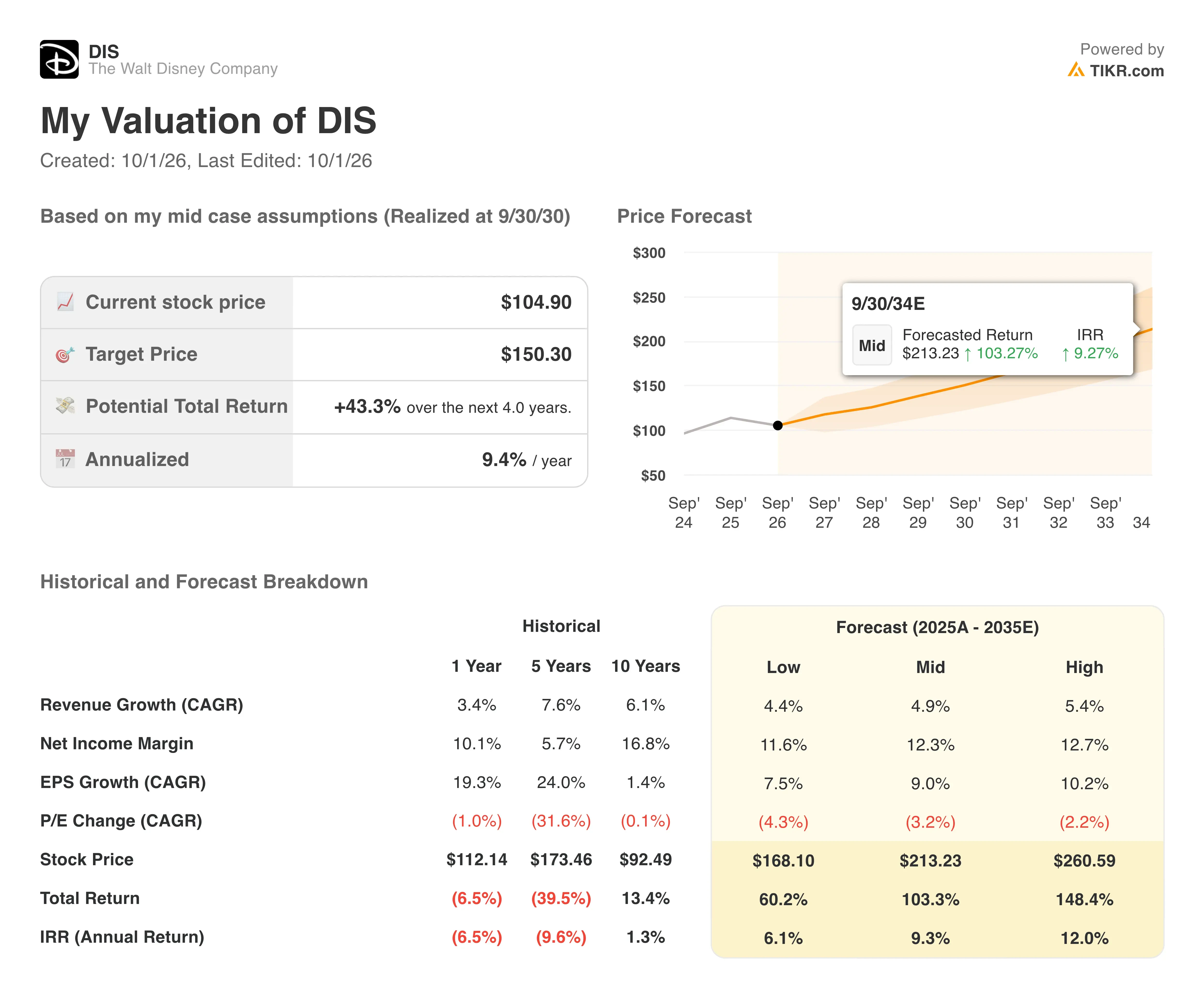
The valuation looks low against Disney’s own past. Shares averaged 21.1x earnings over five years and 32.1x over a decade. Those older multiples came when cable TV profits looked secure. Today’s 13.9x reflects doubts about that decline, which the restructuring aims to address.
Revenue growth of 5.3% trails the 7.6% five-year pace, which keeps the model grounded. Netflix earns far richer streaming margins, so part of Disney’s discount reflects that gap. If streaming margins keep rising, the discount could shrink.
Model Disney’s margin recovery under your own assumptions (Free with TIKR) >>>
How Disney Stacks Up Against Netflix and Comcast
Netflix (NFLX) remains the streaming benchmark. Its Q2 revenue rose 13% to $12.6 billion, and its operating margin reached 33.4%. Netflix also targets a 31.5% operating margin for 2026. Disney’s 13% streaming margin shows how much ground it still needs to cover.
Disney’s advantage lives outside the screen. Its total segment operating income rose 21% in fiscal Q3 while company revenue grew 7%. Experiences delivered record fiscal Q3 revenue and operating income. No pure streamer can turn a hit film into park rides, cruises and merchandise.
Comcast (CMCSA) offers the clearest parks comparison. Its NBCUniversal unit said Orlando park attendance declined during the quarter, citing weaker consumer sentiment and higher travel costs. Disney, by contrast, posted record Experiences results in the same period. That gap suggests Disney’s characters keep guests coming even in a softer economy.
Valuation reflects the trade-off. Disney trades at 13.9x forward earnings and 9.3x forward EV/EBITDA, with net debt near 1.8x EBITDA. Investors still pay a premium for Netflix’s pure growth, while Disney’s discount reflects its legacy TV exposure.
Probe if cost cuts and ESPN expansion can offset linear-TV decline >>>
What’s Driving DIS Stock Going Forward?
Fiscal Q4 results arrive in mid-November, with Disney guiding to about $4.9 billion in total segment operating income. That figure includes an extra 53rd week, which adds a week of results to the year. Disney also reiterated adjusted EPS growth of about 12% for fiscal 2026, excluding that extra week. Hitting both would show the restructuring is not derailing earnings.
Buybacks add support. Disney raised its fiscal 2026 repurchase target to at least $9 billion from $8 billion. Buybacks shrink the share count, so each remaining share owns more of the profits. At around 13.9x earnings, repurchases stretch further than they would at a premium multiple.
Management expects double-digit adjusted EPS growth in fiscal 2027, excluding the 53rd week. Consumer products will also shift into the Entertainment segment from fiscal Q1 2027. That move ties merchandise more closely to the studios creating the characters.
New leaders are in place too, including Karandeep Anand as chief technology officer and Adam Smith overseeing direct-to-consumer. Their task is to make Disney+ the digital hub D’Amaro describes. If price hikes stick without lifting cancellations, streaming margins could close more of the gap with Netflix.
Track Disney’s buybacks and fiscal 2027 estimates side by side (Free with TIKR) >>>
What is Walt Disney stock actually worth?
TIKR lets you forecast the future price of any stock in less than a minute. Just enter a few assumptions into TIKR’s valuation model and see what Walt Disney could be worth. Start from Wall Street consensus estimates, or adjust the inputs to reflect your own view of the business. It’s free to use. Value DIS for free.
Disclaimer:
Please note that the articles on TIKR are not intended to serve as investment or financial advice from TIKR or our content team, nor are they recommendations to buy or sell any stocks. We create our content based on TIKR Terminal’s investment data and analysts’ estimates. Our analysis might not include recent company news or important updates. TIKR has no position in any stocks mentioned. Thank you for reading, and happy investing!