Key Takeaways
- Six famous investors held Nvidia at Sept. 30. Three of them, Dan Loeb, Cathie Wood and David Tepper, added to it in the third quarter, and none sold.
- Nvidia stock has fallen 35% since then, as the board ousted CEO Jensen Huang and then reinstated him.
- Nvidia’s quarter beat its own guidance, analysts have raised their earnings estimates, and Microsoft is still spending heavily on AI data centers.
- At about 10x forward earnings, against a 5-year average of 35x, the numbers side with the buyers.
Six of the most-followed names in investing held Nvidia (NVDA) at the end of September, according to their 13Fs for the quarter ended Sept. 30, filed from Nov. 6 to Nov. 16. Three of them added to it, none of them sold, and the stock has dropped 35% since.
Whether the buyers look smart from here depends largely on Nvidia’s biggest customers, like Microsoft (MSFT), still pouring money into AI data centers. So far, they are.
Three buyers and no sellers
Dan Loeb’s Third Point made the biggest move in dollars: a new position of 1.50 million shares, worth $343 million at quarter-end prices. That’s 7.5% of its 13F stocks and its third-largest holding. Cathie Wood’s ARK Invest added 85% to its stake, to 2.56 million shares worth $585 million, or 3.4% of its 13F stocks. And David Tepper’s Appaloosa added 31%, to 2.00 million shares worth $457 million, which is 6.0% of its 13F stocks and its sixth-largest holding.
TIKR tracks 63 analysts on Nvidia. How many say “Buy”?
See the full breakdown of Buy, Hold, and Sell ratings on Nvidia, along with Wall Street’s revenue and earnings estimates, all in one place. More than 500,000 investors use TIKR to research stocks like this one. See Nvidia’s Analyst Ratings
The big holders stayed put
The other three famous holders didn’t sell either. Nvidia is the biggest holding at Brad Gerstner’s Altimeter Capital, at 23.3% of its 13F stocks after a 6% addition. It’s also the biggest at Ken Fisher’s Fisher Investments, whose 92.83 million shares were worth $21.20 billion. George Soros’ Soros Fund Management trimmed its stake by 19%, to 858,822 shares, and also held put options with a notional value of $80 million.
Across a wider group of big funds, buyers outnumbered sellers last quarter as well. Of course, Nvidia’s 35% drop since Sept. 30 doesn’t tell us what any of these funds paid, or whether they still own the shares.
The business held up
In its third-quarter release on Nov. 17, Nvidia reported revenue of $115.8 billion. That was up 103% from a year earlier and above the top of its own guidance of $108.0 billion, plus or minus 2%. It guided to $130.0 billion for the quarter ending in January.
The trouble was in the boardroom and in Washington. Nvidia’s board ousted Huang this month amid reports that he’d been targeted by a foreign intelligence effort, then reinstated him on Nov. 23. He’s due to testify before a Senate committee on Dec. 3. And this week, the Commerce Department added Megaspeed, an Nvidia customer, to its Entity List over the risk of AI chips being diverted. Rochefort’s Kyle Bass called the fallout “an absolute, calamitous governance failure” on CNBC.
The numbers back the buyers
Analysts expect Nvidia’s normalized earnings per share to more than quadruple from the year ended January 2026 to the year ending January 2029:
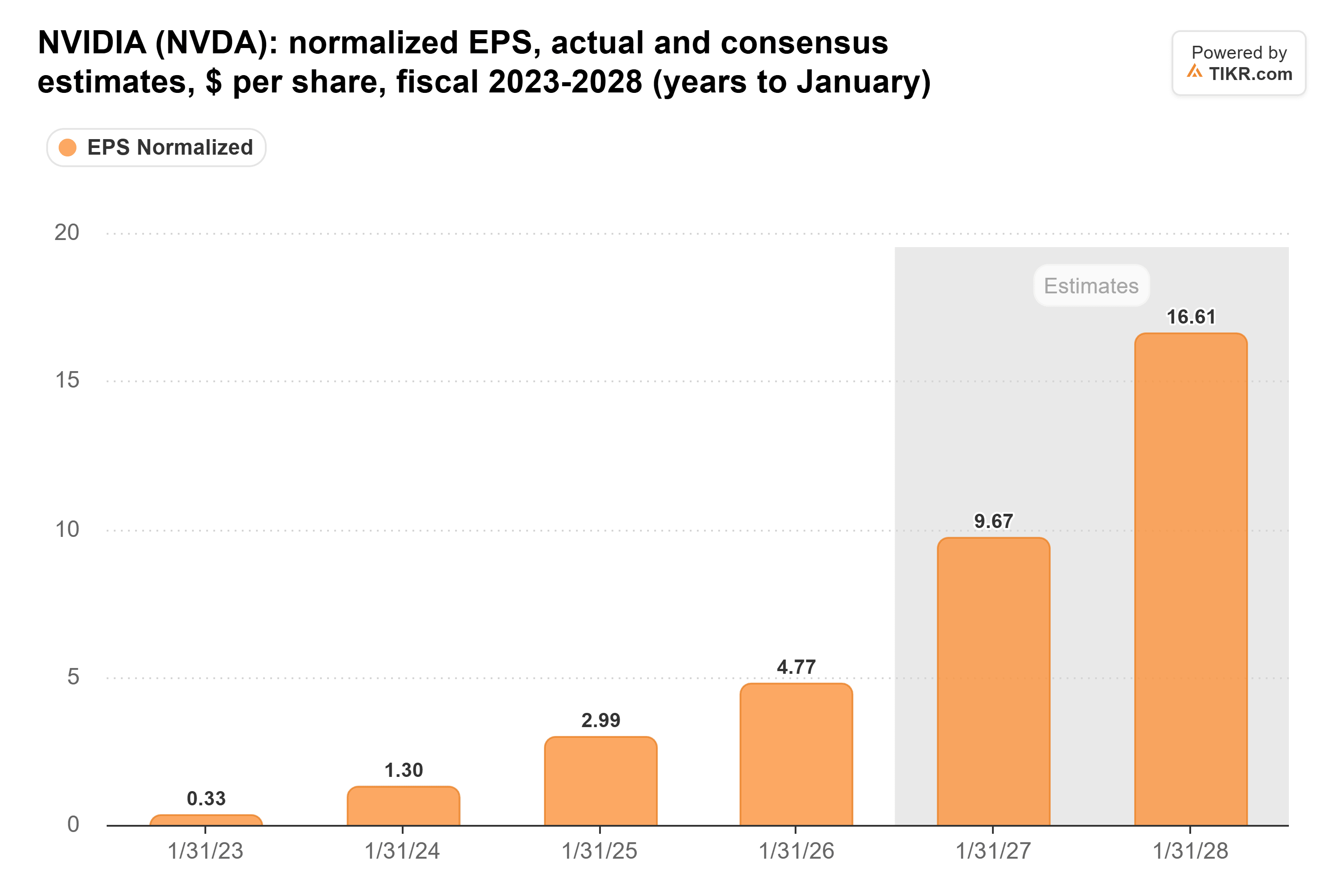
And those estimates have gone up through the selloff. The consensus for the year ending January 2028 is now $16.61, up from $15.92 in late October.
Yet the market prices Nvidia near its cheapest in five years:
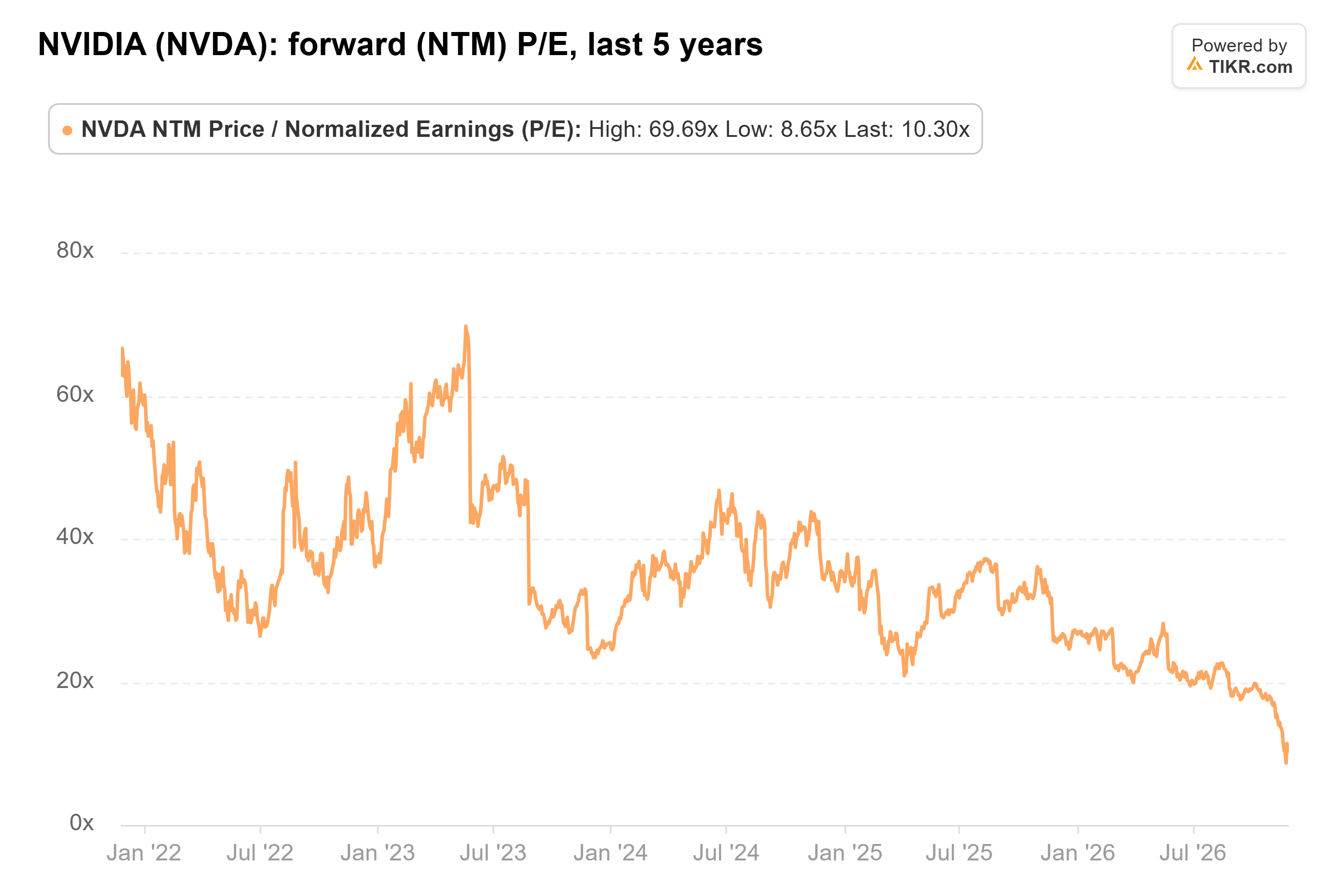
At 10x forward earnings, it trades far below its 5-year average of 35x, and it touched 8.7x on Nov. 20.
Analysts have cut their price targets, though not as far as the stock has fallen:
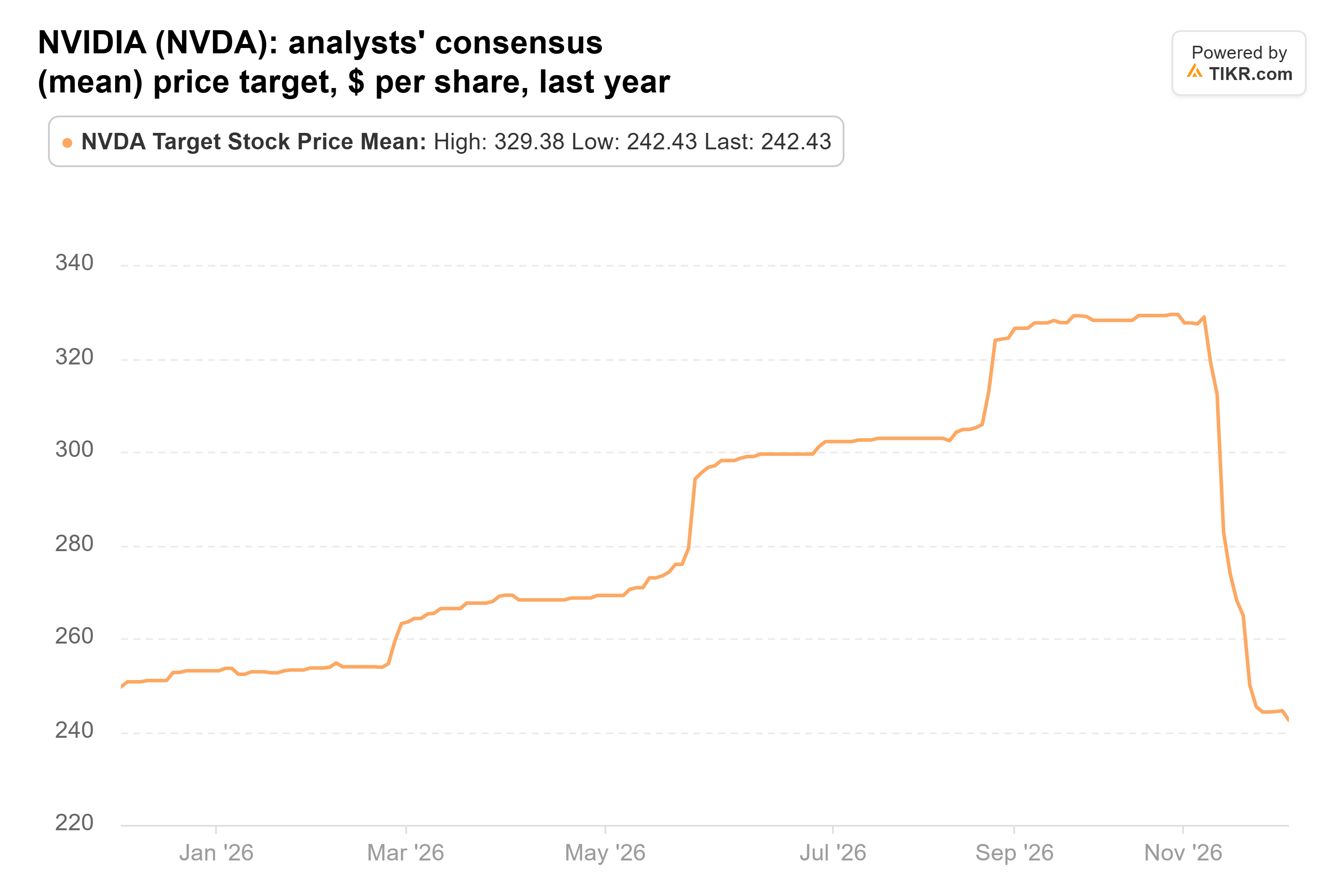
The consensus target is $242, down from $329 in late October but still 62% above the last close. Targets run from $130 to $425.
The demand behind those estimates looks solid at the top. In its September quarter, Microsoft’s Azure revenue grew 48% and its commercial remaining performance obligation rose 73% to $677 billion. Its spending on property and equipment more than doubled to $39.4 billion. Microsoft also designs its own AI chips, so Nvidia has to keep winning that spending. For now, its biggest customers are still spending more.
I’d side with the buyers
At about 10x earnings that analysts keep raising, the market is pricing Nvidia as if its growth is about to stall. The third quarter and the January guide say otherwise. Anyone who bought at the Sept. 30 price is down 35%, but at today’s price the numbers are on the buyers’ side.
The risk is that Nvidia is carrying more of its customers’ financing: it has guaranteed up to $105 billion of lease payments on OpenAI’s Ohio campus. The board’s probe into the reports about Huang is also still open.
Huang’s Senate testimony on Dec. 3 comes first. After that, the buyers should look right if Nvidia’s January quarter lands near $130.0 billion, with gross margin of 71% to 72% as guided. The funds’ next 13Fs, due in mid-February, will show whether these three kept buying.
So what is Nvidia stock actually worth?
TIKR lets you forecast the future price of any stock in less than a minute. Just enter a few assumptions into TIKR’s valuation model and see what Nvidia could be worth. Start from Wall Street consensus estimates, or adjust the inputs to reflect your own view of the business. It’s free to use.
Disclaimer:
Please note that the articles on TIKR are not intended to serve as investment or financial advice from TIKR or our content team, nor are they recommendations to buy or sell any stocks. We create our content based on TIKR Terminal’s investment data and analysts’ estimates. Our analysis might not include recent company news or important updates. TIKR has no position in any of the stocks mentioned. Thank you for reading, and happy investing!