Key Takeaways
- Philip Morris International yields 3.4% and Enterprise Products Partners yields 6.2%, so $10,000 pays $340 a year in one and $625 in the other.
- Philip Morris’s dividend took 68% of free cash flow over the twelve months to Sept. 30, 2026, after taking 101% in fiscal 2023.
- Enterprise covered its distribution 1.7x with distributable cash flow in fiscal 2025, but it carries more debt, at 3.2x EBITDA against Philip Morris’s 2.0x.
- Philip Morris trimmed its 2026 earnings forecast on Oct. 21, and Enterprise sold $1.5 billion of new notes in November.
Any retiree hunting for dividend income is going to look hard at Philip Morris International (PM) and Enterprise Products Partners (EPD).
Philip Morris raised its quarterly dividend 8.8% to $1.60 a share on Sept. 18, then trimmed its 2026 earnings forecast on Oct. 21. Enterprise, meanwhile, declared a third-quarter distribution of $0.56 a unit on Oct. 29, up 2.8% from a year earlier.
Retirees living off their portfolios want a check they can count on. So which of these two is the better dividend stock to own?
| Metric | Philip Morris (PM) | Enterprise Products (EPD) |
|---|---|---|
| Dividend yield | 3.4% | 6.2% |
| Annual dividend | $6.40 a share | $2.24 a unit |
| Dividend growth, fiscal 2020-2025 | 3.5% a year | 4.0% a year |
| Coverage | 68% cash dividend payout ratio (TTM) | 1.7x distributable cash flow coverage (fiscal 2025) |
| Net debt/EBITDA (TTM) | 2.0x | 3.2x |
| Interest coverage (TTM) | 12.2x | 5.1x |
Source: TIKR and StockAnalysis, today’s prices. TTM is the twelve months to Sept. 30, 2026.
6 safe dividend stocks paying retirees 6%+ yields
There are over 100 stocks paying 6%+ annual dividends today.
But after an extensive investment review leveraging TIKR’s proprietary data, we now believe only six of them are truly safe for retirees.
They’re all yours as part of our new investment report. Learn more about how to get access right here.
Philip Morris is spending to grow
Philip Morris’s growth is coming from smoke-free products like IQOS and ZYN, which brought in about 42% of its net revenue in the first nine months of 2026. Third-quarter net revenue rose 5.5% to $11.4 billion from the same quarter a year before.
Free cash flow topped dividends paid in every year but one from fiscal 2016 to fiscal 2025:
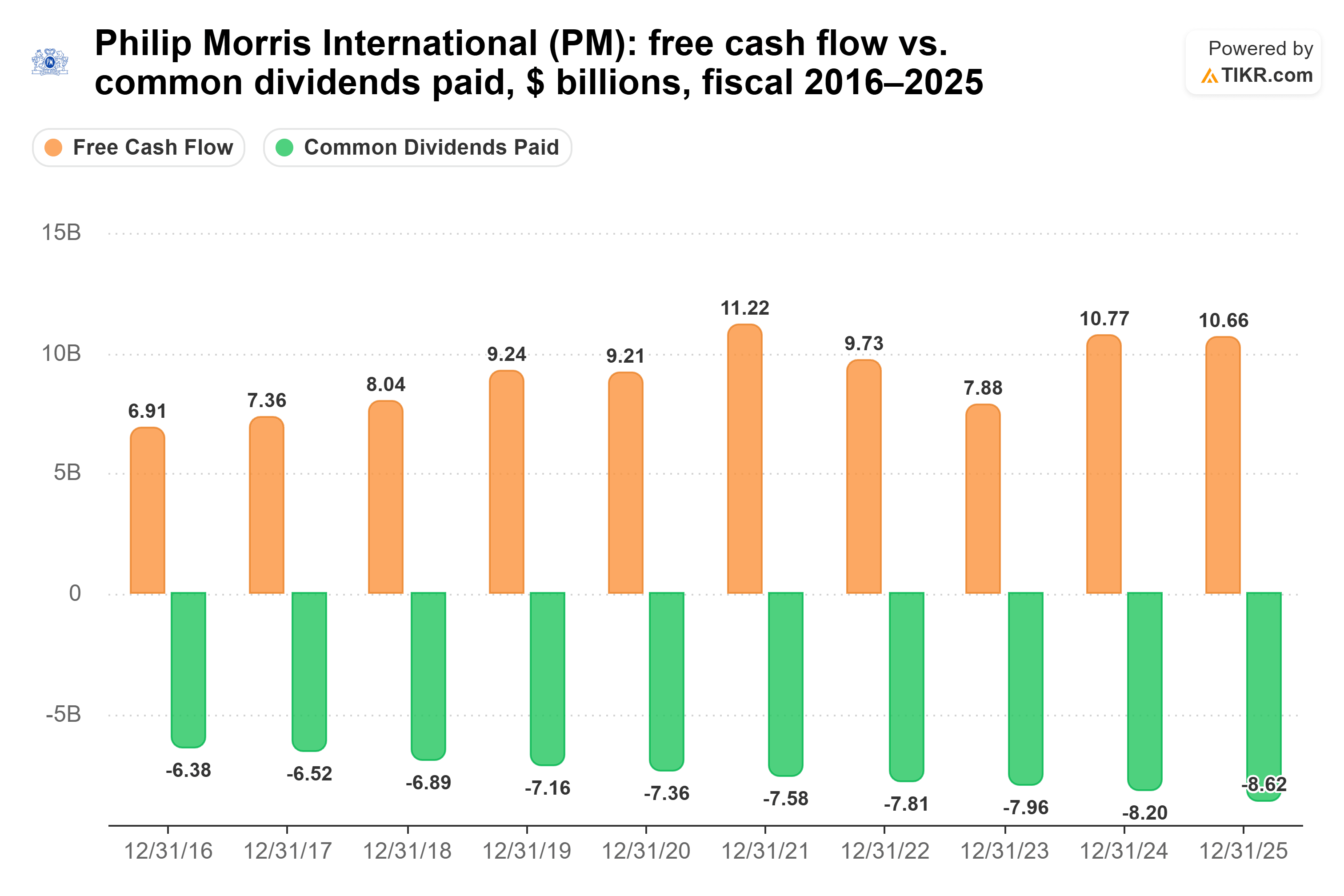
That one year was fiscal 2023, when dividends took 101% of free cash flow, and the ratio was still a high 80.9% in fiscal 2025. Over the twelve months to Sept. 30, 2026, it fell to a more comfortable 68%: $9.20 billion of dividends against $13.60 billion of free cash flow.
On its Oct. 21 call, Philip Morris said, “We remain a highly cash-generative business with an unwavering commitment to our progressive dividend policy and to rewarding shareholders.”
The same day, though, it trimmed its 2026 adjusted EPS forecast to $8.29-$8.44 from $8.35-$8.50, citing higher costs tied to the conflicts in the Middle East and Ukraine and heavier spending behind ZYN in the US. If those costs keep climbing, they’ll eat into the free cash flow behind the payout.
Enterprise is building its way to more cash
As a pipeline, Enterprise is judged on distributable cash flow, which leaves out the growth projects it chooses to build. (It’s a partnership, so it pays distributions on units and sends holders a K-1 at tax time.)
Third-quarter adjusted EBITDA rose 16% from the same quarter a year before to $2.8 billion, on record natural gas processing volumes in the Permian and marine terminal volumes up 28%.
Distributable cash flow per unit rose from $1.96 in fiscal 2016 to $3.66 in fiscal 2025, well ahead of the distribution’s climb from $1.61 to $2.17:
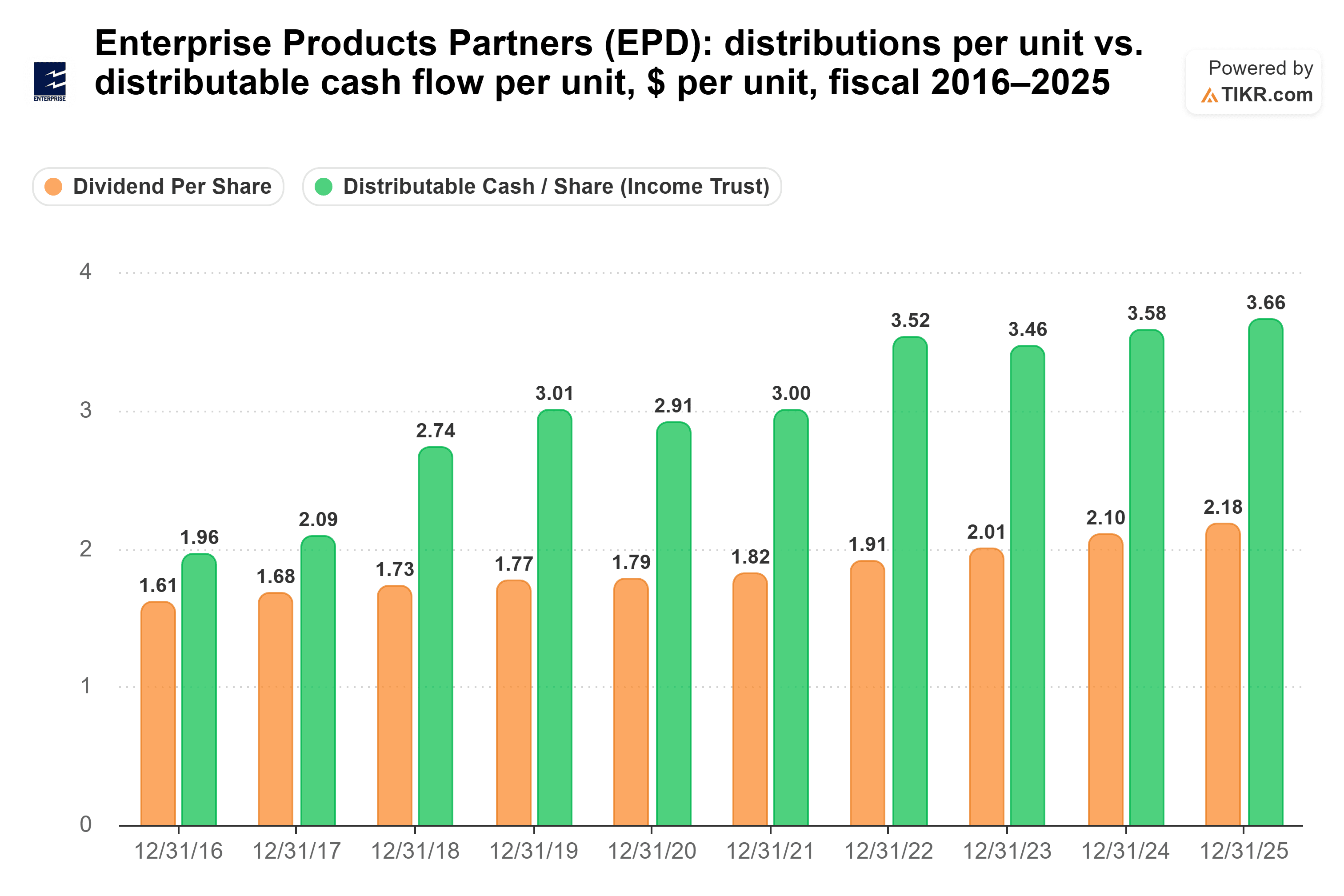
That took coverage from 1.2x to a well-covered 1.7x.
The catch is debt. On Nov. 5, Enterprise priced $1.5 billion of notes at 5.20% and 5.65%, partly to repay $1.58 billion of notes due in early 2027 that carry 4.60% and 3.95%. Its interest bill will rise, though 1.7x coverage leaves plenty of room for that.
So which dividend wins?
For retirees, Enterprise Products Partners is the better dividend stock. It pays the bigger check, has covered it more consistently, and grew it faster over the last five years. $10,000 in Enterprise pays $625 a year at today’s 6.2% yield, against $340 from Philip Morris. Grow each at its 5-year rate, and in year 10 Enterprise would pay about $893, call it an 8.9% yield on your cash today, against about $465, or 4.6%, from Philip Morris. At those rates, Philip Morris never catches up.
Enterprise has covered its distribution at least 1.5x in every fiscal year since 2018, while Philip Morris’s payout ratio ranged from 68% to 101% between fiscal 2021 and fiscal 2025.
Philip Morris has raised its dividend every year since going public in 2008, and its balance sheet is the stronger of the two. It’s just that a retiree gives up $285 a year in income today on every $10,000 to own it, and Enterprise’s record of coverage gives me more confidence in its check.
Of course, Enterprise said on the Oct. 29 call that 2027’s EBITDA growth may be more modest than 2026’s, so I’d watch whether next year’s distribution raises hold their pace.
Enjoy your retirement in style with these safe 6%+ dividend yields
Dividends can hold the key to enormous wealth. But only if you buy the right ones.
Picking the right high-yield dividend stock can be the difference between a dream retirement…and scraping by every month, waiting for the next Social Security check to clear.
We’ve identified six stocks yielding 6%+ that we believe every retiree should know about right now.
Disclaimer:
Please note that the articles on TIKR are not intended to serve as investment or financial advice from TIKR or our content team, nor are they recommendations to buy or sell any stocks. We create our content based on TIKR Terminal’s investment data and analysts’ estimates. Our analysis might not include recent company news or important updates. TIKR has no position in any of the stocks mentioned. Thank you for reading, and happy investing!