Key Takeaways
- Of 460 big funds that have filed 13Fs for the quarter ended Sept. 30, 46 bought Nvidia and 27 sold, with David Tepper’s Appaloosa and Cathie Wood’s ARK Invest among the buyers.
- The three biggest sellers mostly trimmed, and Nvidia was still one of the six largest holdings for each of them at Sept. 30.
- Several of the same funds also bought or cut Taiwan Semiconductor and Broadcom, so the disagreement covers AI chips as a group.
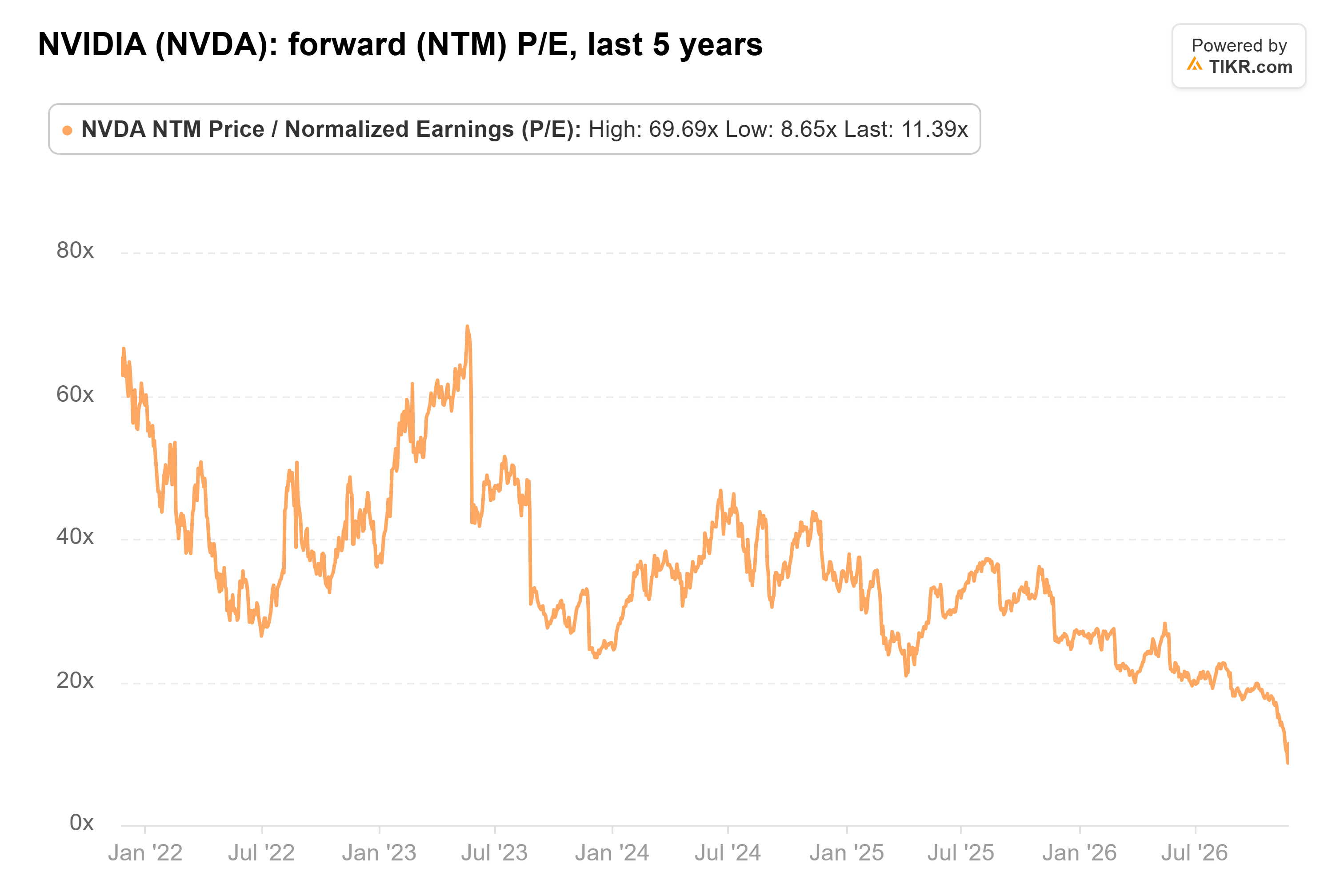
- At about 11x forward earnings, near its five-year low, Nvidia’s numbers back the buyers, and its late quarterly filing, due by Dec. 4, is the next test.
The biggest funds in the market split hard on Nvidia (NVDA) last quarter.
Of the 460 big funds that have filed 13Fs for the quarter ended Sept. 30, 46 bought the stock, either opening a position or adding 20% or more. Another 27 sold out or cut 20% or more. These are funds readers know, or ones with $1 billion or more of US stocks, with quant and index funds left out. In all, 175 of them held Nvidia at the quarter’s end.
The buyers went big
David Tepper’s Appaloosa added 31% to its stake and ended September with 2.00 million shares worth $457 million, 6.0% of its 13F stocks. Cathie Wood’s ARK Invest added 85%, to 2.56 million shares worth $585 million. Dan Loeb’s Third Point opened a new position of 1.50 million shares, which made Nvidia its third-largest holding at 7.5% of its 13F stocks.
The biggest dollar amounts came from firms most readers won’t know by name. GQG Partners, which manages $164 billion, nearly quintupled its stake to 14.04 million shares. That’s about $2.53 billion of buying at quarter-end prices. It also added 562% to its stake in Taiwan Semiconductor (TSM) and 459% to its stake in Broadcom (AVGO). Sanders Capital added $1.69 billion of Nvidia, and Dodge & Cox went from 3,400 shares to 4.99 million.
TIKR tracks 63 analysts on Nvidia. How many say “Buy”?
See the full breakdown of Buy, Hold, and Sell ratings on Nvidia, along with Wall Street’s revenue and earnings estimates, all in one place. More than 500,000 investors use TIKR to research stocks like this one. See Nvidia’s Analyst Ratings
Most of the sellers only trimmed
None of the sellers is a household name, and most of them kept plenty of stock. H&H International Investment, a $25 billion firm, made the biggest sale: it cut its shares by 63%, about $905 million at quarter-end prices, and still held $530 million of Nvidia at Sept. 30. Edgewood Management cut 35% and Polen Capital cut 26%. Nvidia was still Edgewood’s largest holding, at 10.9% of its 13F stocks, and Polen’s second-largest, at 7.3%.
Both firms also cut Broadcom, Edgewood by 31% and Polen by 26%. Broadcom’s AI revenue rose 221% to $16.7 billion in its quarter ended Aug. 2, and most of that came from custom chips that compete with Nvidia’s. Tepper went the other way on Broadcom: his filing shows none at Sept. 30, after 150,000 shares a quarter earlier. Taiwan Semiconductor’s biggest customer, widely reported to be Nvidia, made up 19% of its 2025 revenue. The same 460 funds split on these stocks too: 38 bought Taiwan Semiconductor and 27 sold, and Broadcom’s buyers and sellers came out even at 27 each.
On price alone, the sellers look smarter so far: Nvidia is down 28% since Sept. 30.
Does Nvidia’s math hold up?
Nvidia gave the buyers plenty to like on Nov. 17. Revenue rose 103% to $115.8 billion, and the company guided its January quarter to $130.0 billion, plus or minus 3%, with no data center chip sales to China in that figure. Analysts expect normalized EPS to roughly double to $9.67 in the year ending January 2027, then rise to $16.61 and $21.77 over the next two years:

The estimate for the year ending January 2028 has gone up since late October, when it was $15.92. The stock hasn’t kept pace. Nvidia trades at about 11x forward earnings, against a five-year average of 35x, and it hit a five-year low of 8.7x on Nov. 20:
Analysts have cut their price targets anyway. The average fell from about $329 in late October to $243, a little below where it was a year ago:
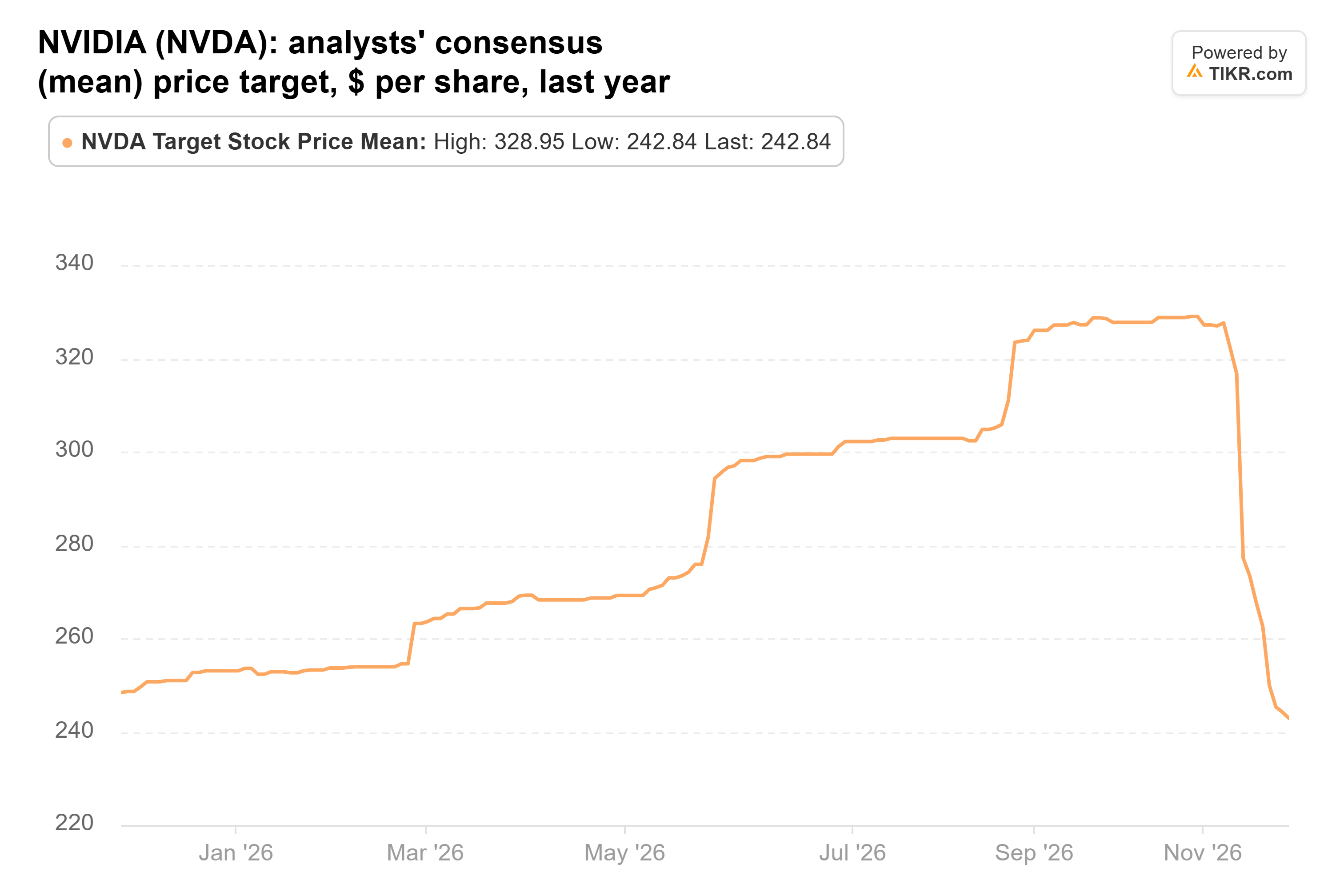
On our math, $243 is about 11x the $21.77 analysts expect for the year ending January 2029, which is the year the market will be pricing a year from now. So the average target doesn’t need a higher multiple. It only needs those estimates to hold, and it sits about 47% above the last close.
I’m with the buyers
The sellers’ best case is Nvidia’s balance sheet. Receivables rose to $63.1 billion on July 26 from $38.5 billion in January, and days sales outstanding reached 60. Reuters reported that the SEC is looking at possible accounting issues. The New York Times says that inquiry is in its early stages and could end without charges. The 10-Q that would update those receivables is late and due by Dec. 4, after Nvidia had filed on results day for nine straight reports.
Still, at 11x forward earnings, the market is pricing Nvidia as if this cycle is about to peak, even as the company beats its own guidance and analysts raise their earnings estimates. That’s a price I’d take, and it’s the bet the buyers made.
The 10-Q is the near-term test. If receivables grow no faster than revenue and days sales outstanding drops back toward the mid-50s, the buyers’ case gets stronger. The next round of 13Fs, due in mid-February, will show who stuck with it.
So what is Nvidia stock actually worth?
TIKR lets you forecast the future price of any stock in less than a minute. Just enter a few assumptions into TIKR’s valuation model and see what Nvidia could be worth. Start from Wall Street consensus estimates, or adjust the inputs to reflect your own view of the business. It’s free to use.
Disclaimer:
Please note that the articles on TIKR are not intended to serve as investment or financial advice from TIKR or our content team, nor are they recommendations to buy or sell any stocks. We create our content based on TIKR Terminal’s investment data and analysts’ estimates. Our analysis might not include recent company news or important updates. TIKR has no position in any of the stocks mentioned. Thank you for reading, and happy investing!