Key Takeaways
- Among the big funds that filed 13Fs for the third quarter, 9 bought Capital One Financial and 15 sold, and Berkshire Hathaway made the biggest sale.
- Capital One’s card losses fell in the third quarter, and Synchrony and American Express also reported lower loss rates than a year earlier.
- The buyers look right on the numbers: the stock trades at 7.8x forward earnings, below its 9.1x five-year average, while estimates keep rising.
- The main risk is a 10% cap on credit card interest rates, which President Trump said on Nov. 21 he’d work with Democrats to pass.
Capital One Financial (COF) is down 31% from its January high, and big money split on it last quarter.
460 big funds have filed 13Fs for the quarter ended Sept. 30. These are funds readers know, or ones with $1 billion or more in US stocks, with quant and index funds left out. Of them, 9 bought Capital One, by opening a stake or adding 20% or more, and 15 sold out or cut 20% or more. Another 50 held it on Sept. 30.
Berkshire Hathaway (BRK.B) led the sellers, and Dan Loeb’s Third Point was one of the buyers. Meanwhile, Capital One’s card losses are falling, and it isn’t the only one. Losses also fell last quarter at Synchrony Financial (SYF) and American Express (AXP), which compete with it for card borrowers and spending.
The sellers moved more money
Berkshire’s 13F for the quarter ended Sept. 30, filed Nov. 16, shows it cut its Capital One stake 62% in the third quarter, to 1.15 million shares from 3.00 million. That’s about $357 million of stock at quarter-end prices, the biggest move on either side. What’s left is worth $222 million, a tiny 0.1% of the $304.2 billion of US stocks its 13F holds. Lee Ainslie’s Maverick Capital cut its stake 78%, about $208 million worth, and PointState Capital cut 63%, about $103 million worth.
TIKR tracks 23 analysts on Capital One Financial. How many say “Buy”?
See the full breakdown of Buy, Hold, and Sell ratings on Capital One Financial, along with Wall Street’s revenue and earnings estimates, all in one place. More than 500,000 investors use TIKR to research stocks like this one. See Capital One Financial’s Analyst Ratings
59 North made it a top-five holding
The buyers moved fewer dollars, but several made bigger bets. 59 North Capital Management, a firm that manages $7.5 billion, more than doubled its stake to 1.86 million shares, adding about $201 million at quarter-end prices. That made Capital One its fourth-largest holding, at 6.7% of its 13F stocks.
Andreas Halvorsen’s Viking Global roughly tripled its stake to 1.20 million shares, adding about $156 million, though that’s still just 0.7% of its 13F stocks. Dan Loeb’s Third Point added 35%, to 1.11 million shares, which made Capital One its eighth-largest holding at 4.7% of its 13F stocks. Leon Cooperman added 49%.
So far, the sellers have the better of it: Capital One stock is down 7% since Sept. 30.
Card credit is getting better
Capital One reported its third-quarter results on Oct. 20. GAAP net income was $3.5 billion, or $5.61 a share, up 16% per share from a year earlier. Excluding acquisition-related items, it earned $6.69 a share. Both figures got help from a $225 million release of loan-loss reserves. Its domestic card charge-off rate fell to 3.98% from 4.63% a year earlier, and its 30-plus-day card delinquency rate eased to 3.74% from 3.89%.
Synchrony lends to the same kind of card borrowers and reported the same improvement. Its net charge-off rate fell to 4.79% from 5.16% a year earlier, and loans 30-plus days past due slipped to 4.34% from 4.39%. American Express’s card write-off rate dipped to 1.8% from 1.9%, and it raised its full-year GAAP EPS guidance to $18.30-$18.60.
The numbers side with the buyers
Analysts expect Capital One’s normalized EPS to keep climbing, from $19.61 in 2025 to $21.74 this year and $27.51 in 2028:

Those estimates were set before Trump’s Nov. 21 comments, and a rate cap would pull them down fast.
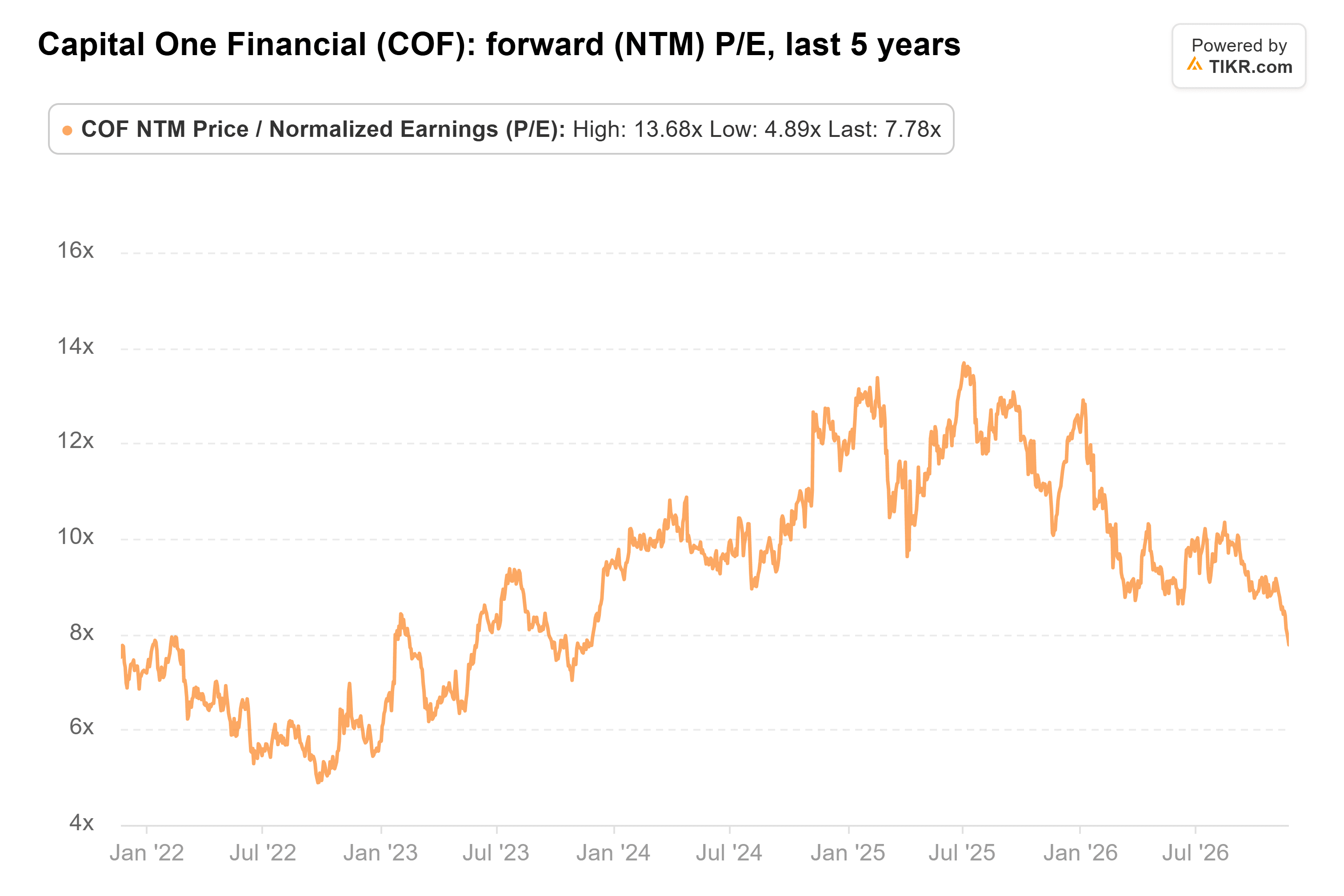
Yet the stock trades at 7.8x forward earnings. That’s below its five-year average of 9.1x and well off its July 2025 peak of 14x:
Analysts’ average price target has slipped to $254 from $260 a year ago, and it’s still 42% above the stock’s last close:

On the 2028 estimate of $27.51, $254 works out to about 9x earnings by my math, right at the stock’s five-year average. About half of that upside would come from earnings growth, and the other half from the multiple getting back to its usual level.
Washington is the wild card
The risk is a cap on what Capital One can charge. On Nov. 21, President Trump told Fox News Channel’s “Saturday in America” that he’d work with Democrats to cap credit card interest rates at 10%: “I would do it. These credit card companies have made a lot.”
When he called for a one-year cap in January, it went nowhere with Republicans. But Democrats take control of Congress in January. Sen. Elizabeth Warren, who’s in line to chair the Senate Banking Committee, wants to write the cap into law. I’d guess Capital One and Synchrony would feel a cap more than American Express, since they lend to riskier borrowers at higher rates.
Still, I side with the buyers. At under 8x forward earnings, with card losses falling across the industry, Capital One is already priced for plenty of bad news. And a cap still needs a bill to pass Congress.
Fourth-quarter results in late January should show whether the domestic card charge-off rate stays below the year before. The funds’ next 13Fs, due by mid-February, will show which side stuck with it.
So what is Capital One stock actually worth?
TIKR lets you forecast the future price of any stock in less than a minute. Just enter a few assumptions into TIKR’s valuation model and see what Capital One could be worth. Start from Wall Street consensus estimates, or adjust the inputs to reflect your own view of the business. It’s free to use.
Disclaimer:
Please note that the articles on TIKR are not intended to serve as investment or financial advice from TIKR or our content team, nor are they recommendations to buy or sell any stocks. We create our content based on TIKR Terminal’s investment data and analysts’ estimates. Our analysis might not include recent company news or important updates. TIKR has no position in any of the stocks mentioned. Thank you for reading, and happy investing!