

Key Takeaways
- Clearway Energy yields 5.9%, nearly twice Consolidated Edison’s 3.0%, and its dividend grew 7.3% in fiscal 2025 against Con Edison’s 2.4%.
- At those paces, $10,000 in Clearway would pay about $8,257 over 10 years, against about $3,347 from Con Edison.
- Con Edison’s dividend took 60% of normalized earnings in fiscal 2025 and Clearway’s took 76%, and Clearway carries net debt of 7.5x EBITDA against Con Edison’s 4.4x.
- The choice comes down to whether Clearway’s bigger check can hold up under that debt for a decade.
Anyone building dividend income to last the next decade will look hard at a power company like Consolidated Edison (ED). It raised its annualized dividend 4.4% in 2026, which by its own count makes 52 straight years of increases.
Clearway Energy (CWEN) makes a different pitch to the same investor. It has a 5.9% yield, nearly twice Con Edison’s, and on Nov. 9 it raised its quarterly dividend again, to $0.4824 a share from $0.4750 in August.
So if I can hold only one of them for the next 10 years, which one gets my money?
| Metric | Consolidated Edison (ED) | Clearway Energy (CWEN) |
|---|---|---|
| Dividend yield | 3.0% | 5.9% |
| Annual dividend | $3.55 | $1.93 |
| Dividend growth, fiscal 2020-2025 | 2.1% a year | 11.0% a year |
| Payout ratio of normalized EPS, fiscal 2025 | 60% | 76% |
| Net debt / EBITDA, LTM | 4.4x | 7.5x |
| Interest coverage (EBIT / interest), LTM | 3.0x | 0.8x |
Source: TIKR and StockAnalysis, at today’s prices.
6 safe dividend stocks paying retirees 6%+ yields
There are over 100 stocks paying 6%+ annual dividends today.
But after an extensive investment review leveraging TIKR’s proprietary data, we now believe only six of them are truly safe for retirees.
They’re all yours as part of our new investment report. Learn more about how to get access right here.
Con Edison’s earnings are outrunning its dividend
Con Edison’s third-quarter release on Nov. 5 showed adjusted EPS of $2.07, up from $1.90 a year earlier. It also narrowed its 2026 guidance to $6.05-$6.15 a share, from $6.00-$6.20. Much of that growth comes from electrification in New York City. New building electric demand requests are up 20% to 25%, and the company puts the growth of its regulated investment base at 8.7% a year over five years.
Earnings have also grown faster than the dividend. Normalized EPS rose from $4.18 in fiscal 2020 to $5.70 in fiscal 2025, while the dividend went from $3.06 to $3.40 a share:
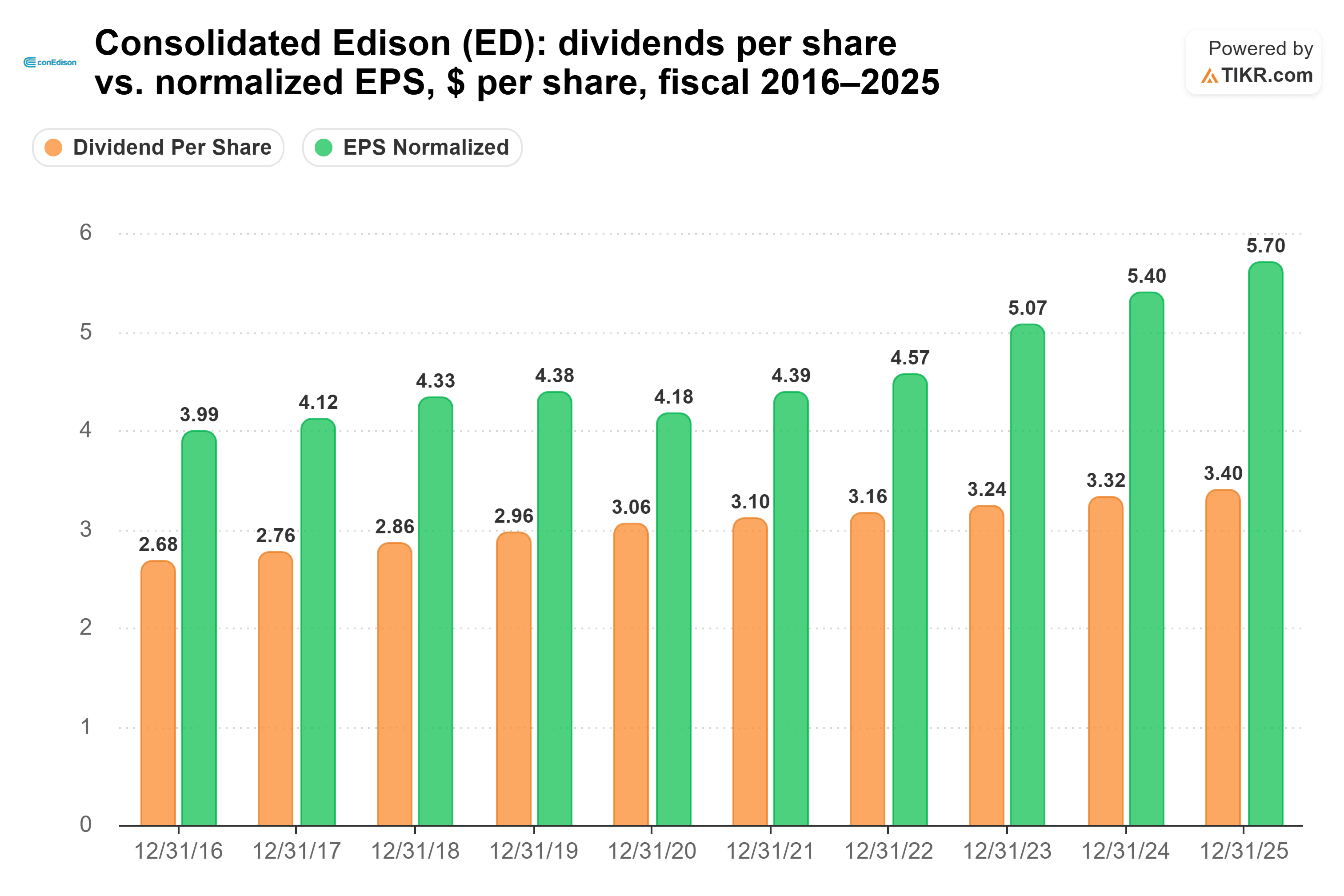
That took the payout ratio of normalized EPS from 73% in fiscal 2020 to a comfortable 60% in fiscal 2025, which leaves room for raises like this year’s 4.4%. The main risk is regulation. The company warns that its rate plans may not provide a reasonable return, and it plans to spend about $797 million on climate resilience from 2026 through 2030.
Clearway’s check is bigger, and its cushion thinner
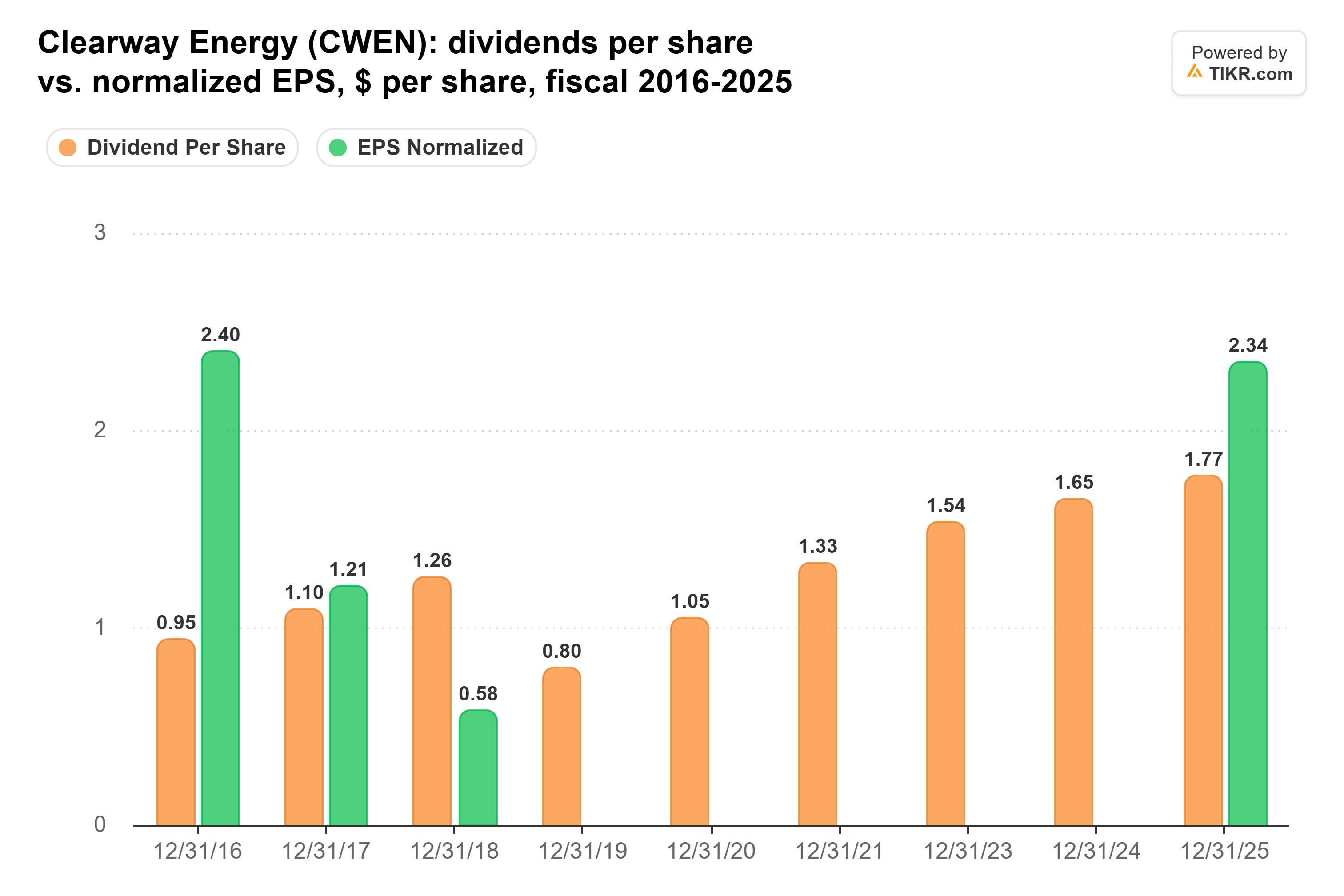
Clearway’s dividend has grown much faster than Con Edison’s, from $1.05 in fiscal 2020 to $1.77 in fiscal 2025. Its cash flow is growing too. Cash available for distribution (CAFD) was $173 million in the third quarter, up from $166 million a year earlier, and generation in its renewables and storage segment rose 12% on new investments. Clearway reiterated its 2026 CAFD guidance of $430 million to $470 million and set 2027’s at $520 million to $590 million.
Its earnings cushion is thinner. The dividend took 76% of normalized EPS in fiscal 2025, and the record shows a drop in the dividend from $1.26 a share in fiscal 2018 to $0.80 in fiscal 2019:
CEO Craig Cornelius said on the third-quarter call that the company aims to “bring our payout ratio below 70%.” Its Nov. 9 release also set a 2027 dividend target of $1.98 a share, only a little above the $1.93 a year it pays now. My read is that Clearway’s raises slow from here. The bigger worry is that over the last twelve months, Clearway’s EBIT came to only 0.8x its interest expense.
So which dividend wins?
Clearway Energy gets my dividend dollars for the next 10 years. At each dividend’s current pace, $10,000 in Clearway pays about $8,257 over the decade, against about $3,347 from Con Edison. Clearway’s raises will likely slow toward that $1.98 target. But it starts with a check nearly twice the size, $590 a year on $10,000 against $300, so Con Edison’s income never catches up at these rates. And the cash that actually pays the dividend is guided higher for 2027.
The trade-off is debt. Clearway’s net debt has run between 7.0x and 8.4x EBITDA every fiscal year since 2021:
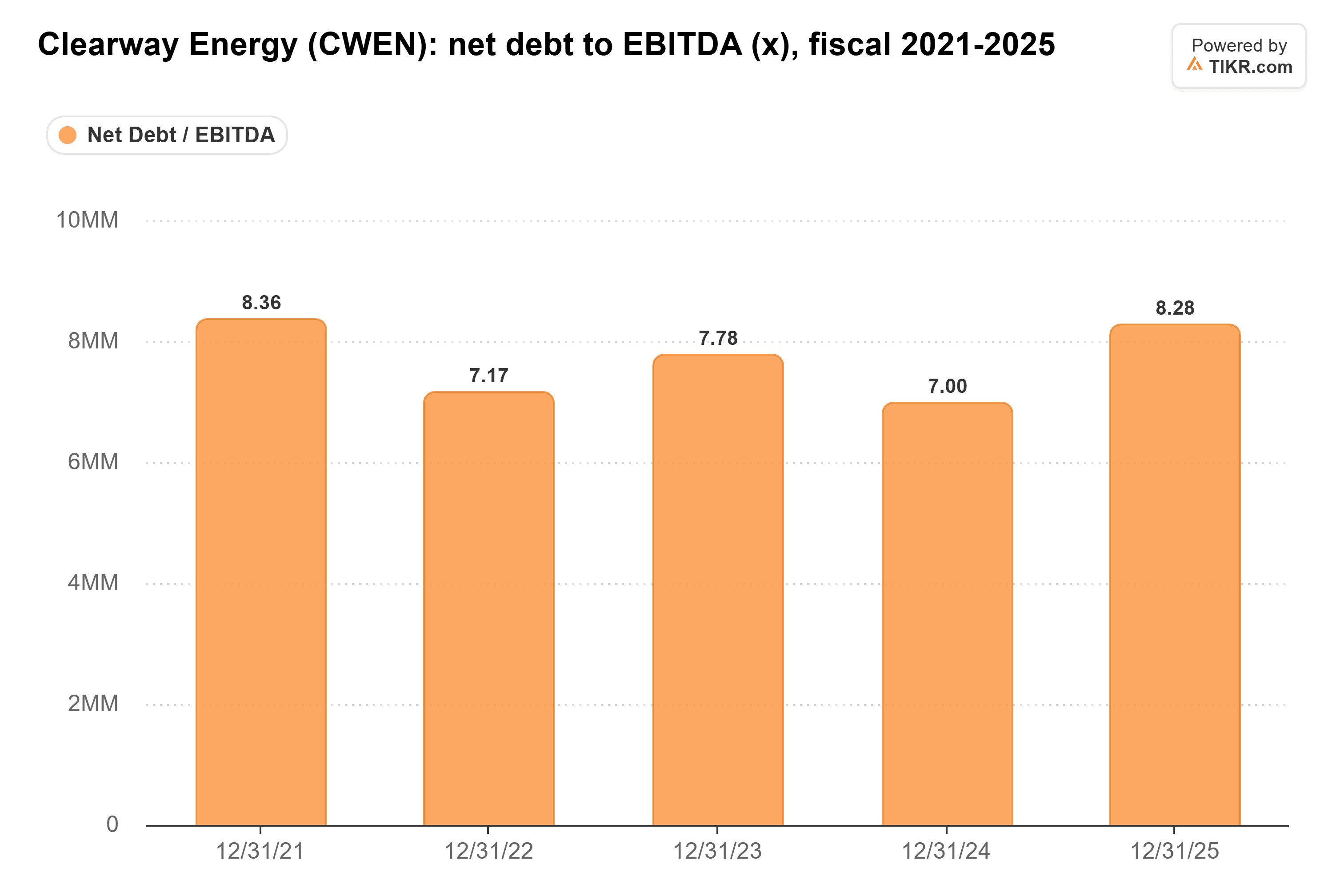
At 7.5x over the last twelve months, that’s far heavier than Con Edison’s 4.4x.
None of this makes Con Edison’s dividend anything but safe. It took a comfortable 60% of earnings in fiscal 2025, the company’s EBIT covers its interest 3.0x, and management will work hard to keep a 52-year record of raises alive. It’s just that over 10 years, Clearway’s bigger check is too much income to pass up, and its rising cash flow gives me reason to think it can keep paying it.
Of course, that depends on Clearway hitting its 2027 CAFD guidance and refinancing its debt at sensible rates. If either slips, Con Edison’s slow, steady raises start to look a lot better.
Forget Clearway Energy: 6 safe 6%+ dividend yields you can buy right now
Dividends can hold the key to enormous wealth. But only if you buy the right ones.
Picking the right high-yield dividend stock can be the difference between a dream retirement…and scraping by every month, waiting for the next Social Security check to clear.
We’ve identified six stocks yielding 6%+ that we believe every retiree should know about right now. (And Clearway Energy isn’t one of them.)
Disclaimer:
Please note that the articles on TIKR are not intended to serve as investment or financial advice from TIKR or our content team, nor are they recommendations to buy or sell any stocks. We create our content based on TIKR Terminal’s investment data and analysts’ estimates. Our analysis might not include recent company news or important updates. TIKR has no position in any of the stocks mentioned. Thank you for reading, and happy investing!


