

Key Takeaways
- Fox closed its $22 billion purchase of Roku on November 6, months ahead of plan, after the Justice Department ended its review.
- Roku’s last report as a public company showed revenue up 24% to $1.5 billion and net income of $183 million.
- To win clearance, Fox promised to keep carrying rival content on Roku and not favor its own programming in search for at least three years.
- Former Roku holders now own about 26% of Fox, so Fox’s February report and its $400 million savings target are what to watch.
Roku’s run as a public company is over. Fox Corporation (FOXA) closed its $22 billion purchase of Roku (ROKU) on November 6. Roku shares stopped trading on Nasdaq that same day.
The deal landed months early. Back in June, both companies had pointed to a close in the first half of 2027.
So what did Roku holders walk away with? Each share became $95.30 in cash plus 0.9799 of a Fox Class A share. That’s slightly less cash and slightly more stock than June’s terms of $96 and 0.9693 shares.
As a result, former Roku holders now own about 26% of Fox. Their bet has shifted from an independent streaming platform to a broadcaster that owns one.
Washington settled for three-year promises
The Justice Department sent both companies a second request in September. On November 6, it closed its investigation after Fox made a set of commitments:
- Fox will keep carrying non-Fox content on Roku for at least three years.
- It won’t favor its own programming in search, and users can still rearrange home screen tiles.
- Firewalls around rivals’ sensitive viewing data stay in place for at least three years.
Those pledges matter because Roku’s home screen is the front door for rival apps like Netflix and HBO Max. Fox owns that door now, and it sells Tubi and Fox One behind it.
By closing day, the stock had little left to prove…
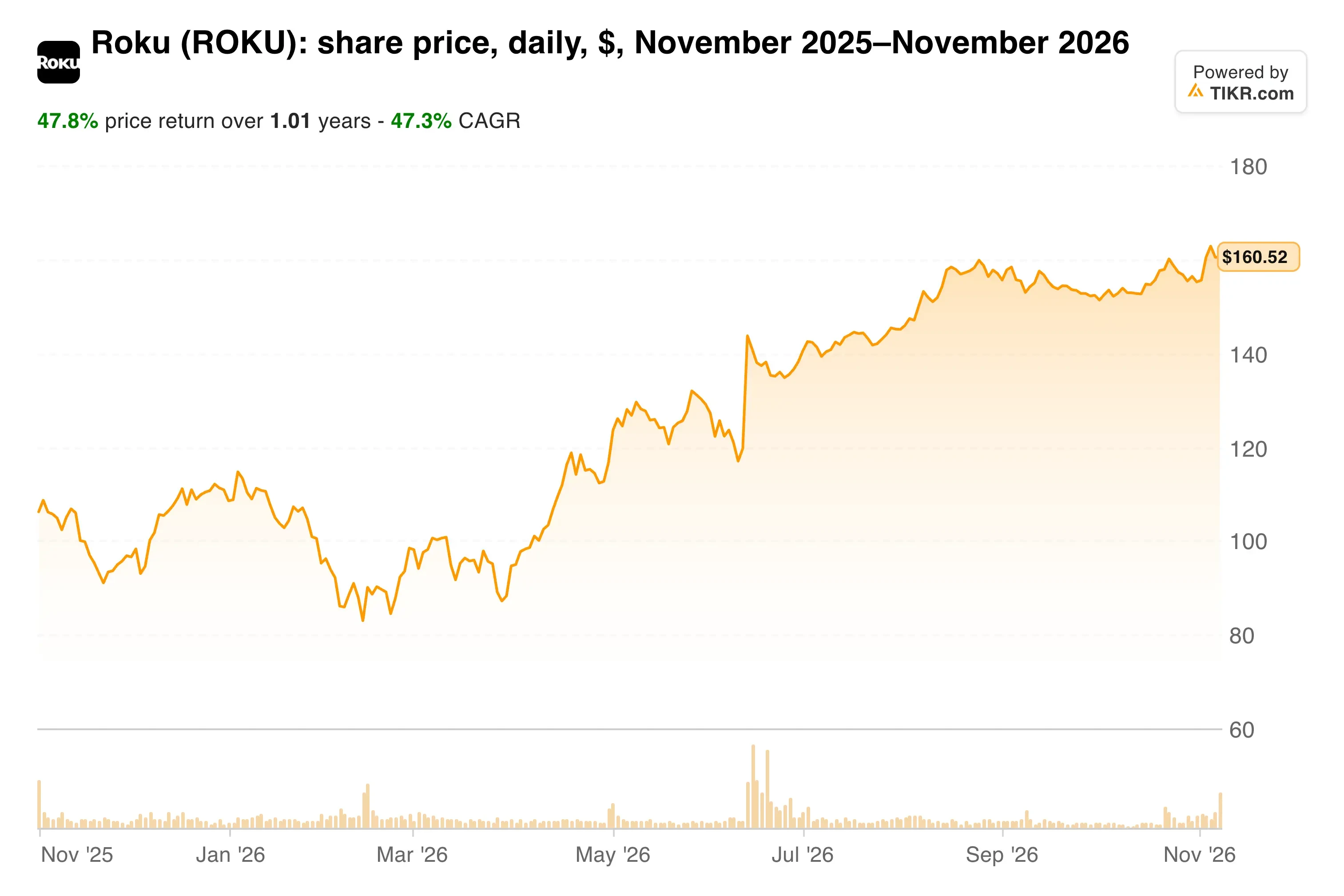
Shares traded on the deal terms after June, so the close brought little drama.
Roku sold at full speed
Roku’s last report as a public company, released November 2, showed why Fox paid up. Revenue rose 24% to $1.5 billion, and platform revenue climbed 23% to $1.3 billion.
- Advertising revenue grew 23% to $727 million, its ninth straight quarter of double-digit growth.
- Ad gross margin rose 4.7 points to 63.2%.
- Net income jumped to $183 million from $25 million, or $1.20 per diluted share.
Even better, that profit turned into cash.
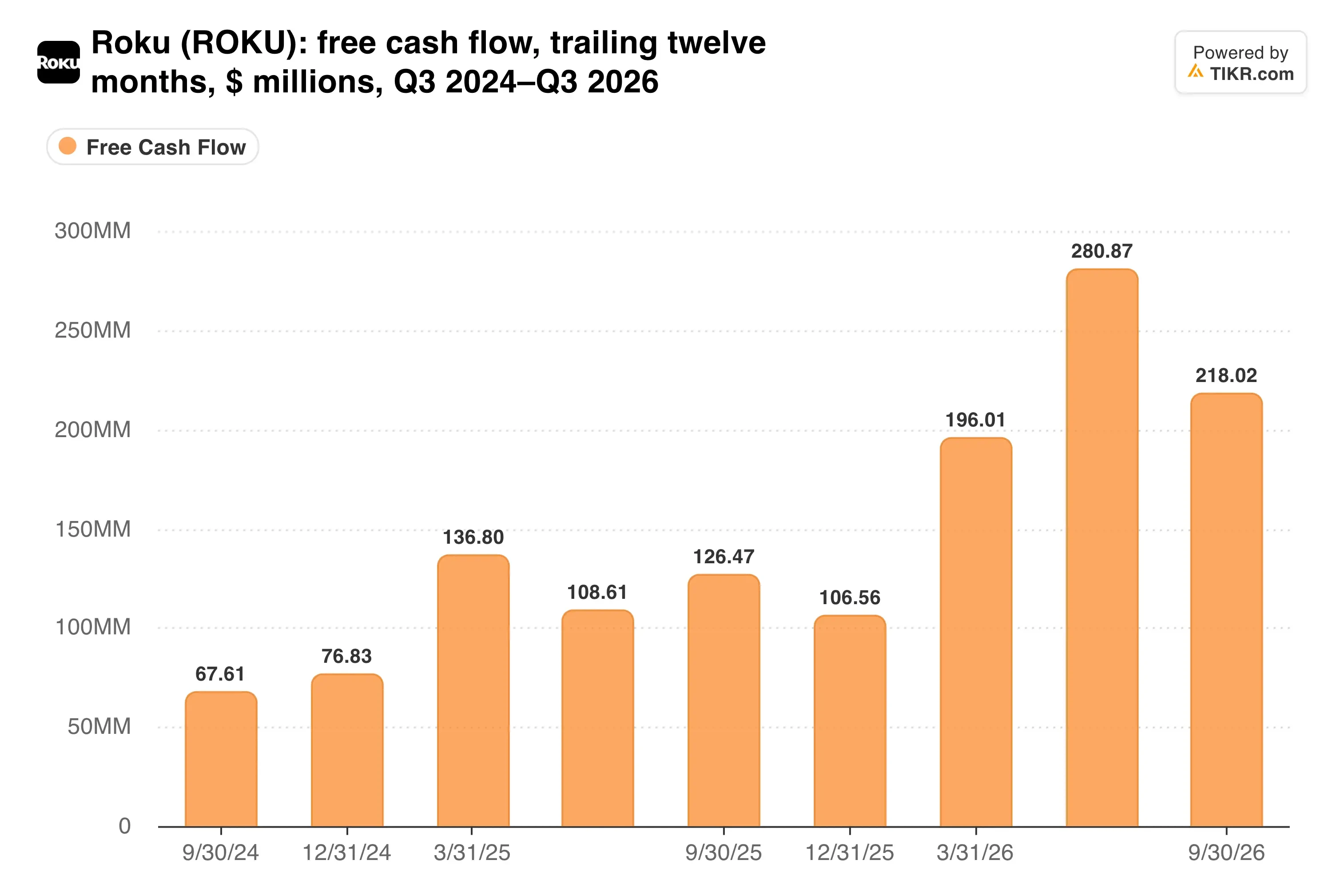
Trailing free cash flow hit $796 million, up 80% from a year earlier.
Devices remain the weak spot, however. That revenue rose 33% to $194 million, yet gross margin sank to (25.1%) because memory costs climbed.
Tubi, meanwhile, grew revenue 35% in Fox’s fiscal first quarter while view time rose 23%. Roku’s streaming hours grew 9%, so Tubi brings the faster engagement and Roku brings the reach.
TIKR tracks 27 analysts on Roku. How many say “Buy”?
See the full breakdown of Buy, Hold, and Sell ratings on Roku, along with Wall Street’s revenue and earnings estimates, all in one place. More than 500,000 investors use TIKR to research stocks like this one. See Roku’s Analyst Ratings
Fox now carries the integration risk
Fox lined up $12 billion of committed bridge financing from Morgan Stanley for the cash portion. Management expects about $400 million of run-rate cost savings within two years. It also expects the deal to lift free cash flow per share by the second full year.
Roku founder Anthony Wood joins Fox’s board and will co-chair the new Fox Digital Platforms division. Wood said Fox “wholly shares our commitment to staying open to every content partner.” Regulators will enforce that for three years, which limits how hard Fox can push its own apps.
Fox enters this phase off a strong quarter, although a tough comparison is coming…
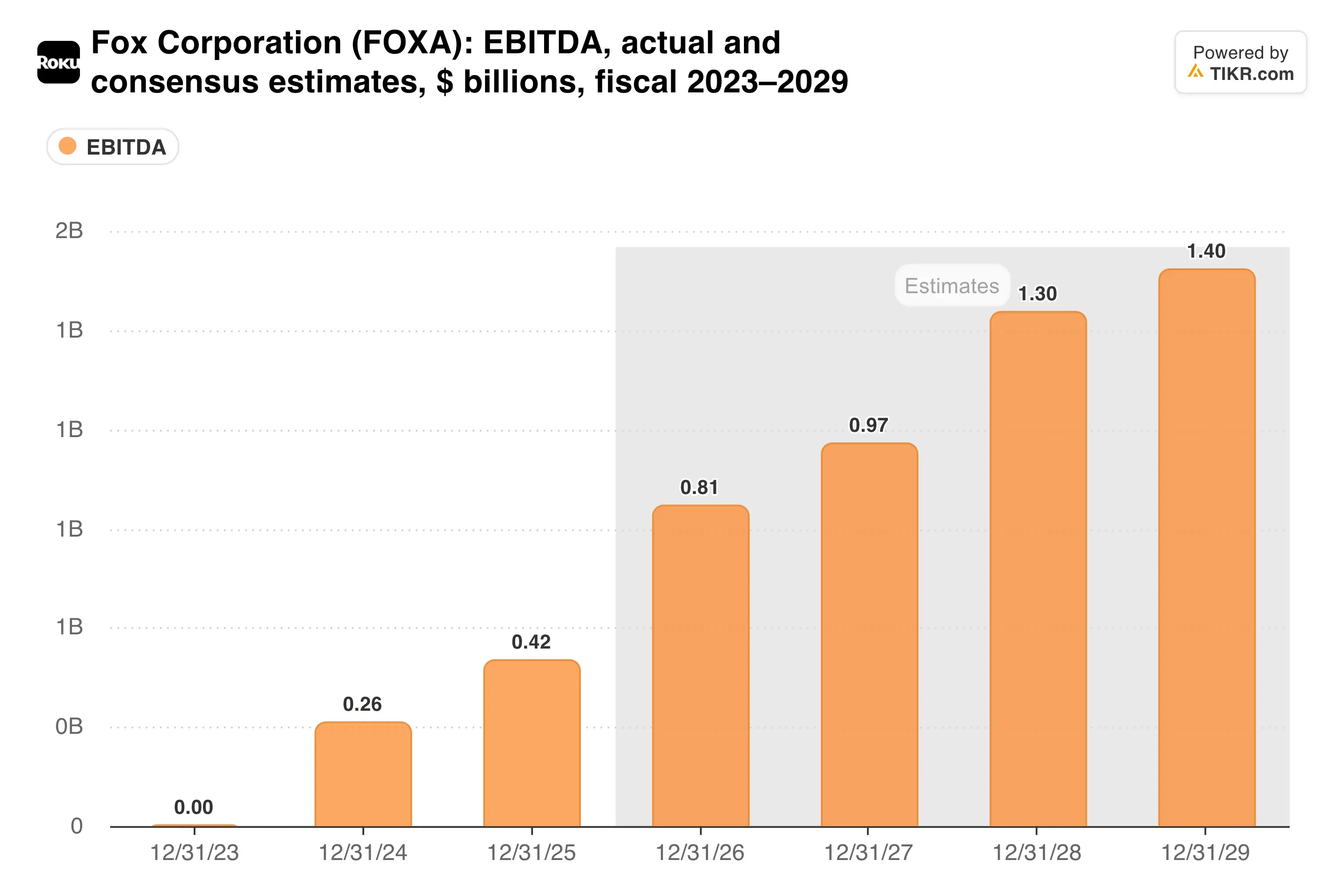
Fiscal first-quarter EBITDA rose 54% to a first-quarter record $1.64 billion. But the World Cup and midterm political ads drove that jump, and neither repeats next year.
My take: Roku holders got a full price for a business that was just hitting its stride. Still, the neutrality pledge caps the easiest synergy, which is steering Roku viewers toward Tubi and Fox One. So I’d wait for the cost savings to show up first.
Fox’s fiscal second-quarter report, expected in early February, is the first real checkpoint. It will include about eight weeks of Roku and show whether that ad growth holds inside Fox.
So what is Roku stock actually worth?
TIKR lets you forecast the future price of any stock in less than a minute. Just enter a few assumptions into TIKR’s valuation model and see what Roku could be worth. Start from Wall Street consensus estimates, or adjust the inputs to reflect your own view of the business. It’s free to use.
Disclaimer:
Please note that the articles on TIKR are not intended to serve as investment or financial advice from TIKR or our content team, nor are they recommendations to buy or sell any stocks. We create our content based on TIKR Terminal’s investment data and analysts’ estimates. Our analysis might not include recent company news or important updates. TIKR has no position in any stocks mentioned. Thank you for reading, and happy investing!


