
Key Takeaways
- Coinbase is reportedly aiming to launch its own prediction markets in the first half of 2027, moving beyond its Kalshi partnership.
- Coinbase needs the business more than Robinhood needs to worry about it, with analysts expecting a normalized loss in 2026.
- Robinhood starts far ahead, with $173 million of prediction-market revenue in the third quarter, and DraftKings and Flutter are spending heavily to win the same traders.
- Coinbase’s fourth-quarter report early next year should show whether its prediction business keeps growing past a $200 million run rate.
Coinbase (COIN) is targeting the first half of 2027 to offer its own event contracts in the US, Bloomberg reported, citing a person familiar with the matter. That puts it on a collision course with Robinhood (HOOD), and makes it one more competitor for DraftKings (DKNG) and Flutter Entertainment (FLUT), which are already paying up to win prediction-market customers.
Coinbase wants to run its own contracts
Coinbase offers prediction markets through Kalshi today, and exchange fees from them helped push its “other” transaction expense to $37.5 million in the second quarter of 2026, up from $7.1 million a year earlier. Running its own contracts would give Coinbase more control over what it lists and let it keep more of the revenue from each trade.
It has been building toward this since December 2025, when it agreed to buy The Clearing Company, a prediction-markets startup. In September, it won CFTC approval for its own clearinghouse.
TIKR tracks 37 analysts on Coinbase. How many say “Buy”?
See the full breakdown of Buy, Hold, and Sell ratings on Coinbase, along with Wall Street’s revenue and earnings estimates, all in one place. More than 500,000 investors use TIKR to research stocks like this one. See Coinbase’s Analyst Ratings
Coinbase needs something beyond crypto
Prediction markets passed a $200 million annualized revenue run rate in the third quarter, and on Coinbase’s October earnings call, CFO Alesia Haas called them “one of our fastest-growing new revenue products.”
Coinbase needs every bit of that growth. Analysts now expect Coinbase to post a normalized loss of $0.30 a share in 2026. It earned $4.45 in 2025 and $9.48 in 2024:
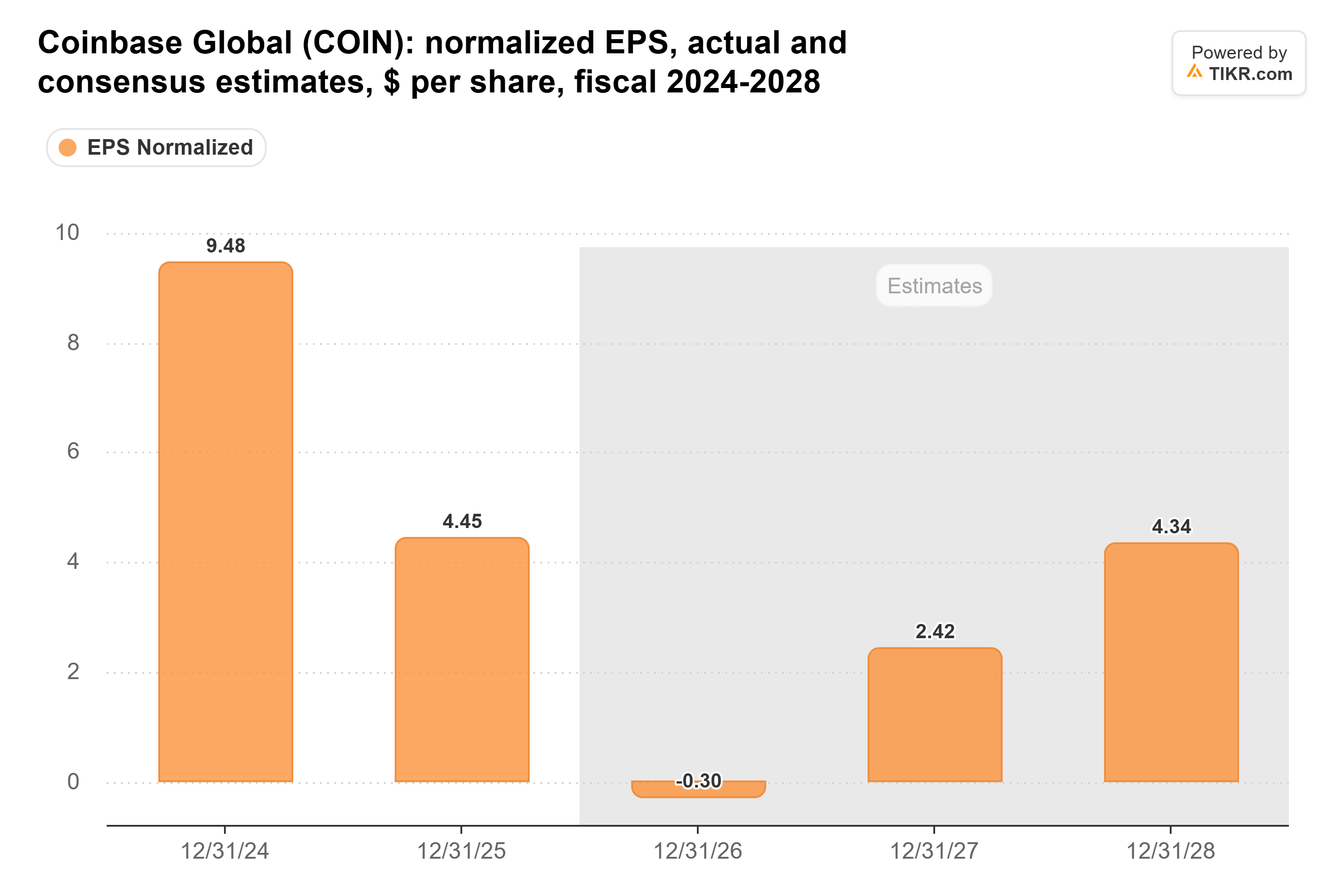
Even the 2028 estimate of $4.34 is just below 2025’s level. A launch in the first half of 2027 shouldn’t move those estimates much on its own. A $200 million run rate is about 3% of Coinbase’s $6.88 billion of 2025 revenue.
Robinhood got there first
Robinhood has already made the shift Coinbase is chasing. In the third quarter, its prediction-market revenue grew more than sixfold from a year earlier to $173 million, beating its crypto revenue, which fell 55% to $120 million. That makes Robinhood’s prediction business roughly 3x the size of Coinbase’s. Kalshi still matters to Robinhood, though, and Robinhood has the most to lose if Kalshi faces charges.
Analysts expect Robinhood’s revenue to keep climbing, from $4.47 billion in 2025 to $6.88 billion in 2027:
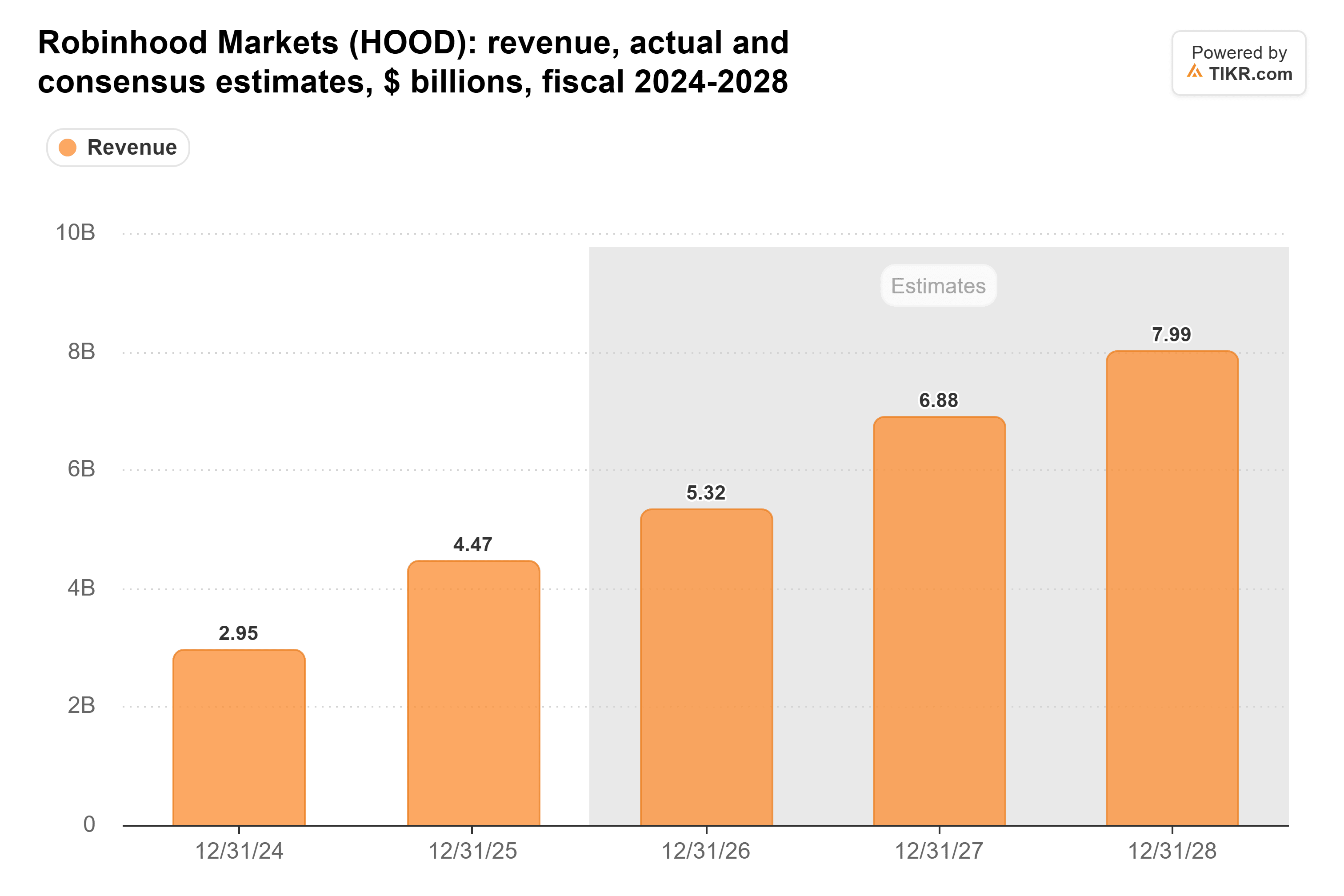
Those estimates came before Coinbase’s plan, and a rival that is still months from launch shouldn’t move them.
Everyone’s paying up for the same traders
DraftKings is guiding to $650 million to $750 million of Predictions revenue in 2027, roughly Robinhood’s pace today, and plans to spend $250 million to $350 million of adjusted EBITDA to get there.
At Flutter, which runs FanDuel, CEO Dan Taylor said in its third-quarter results that the company is “beginning to see an impact on our overall media costs as prediction market operators increase marketing spend.” Another big platform promoting its own contracts will push those costs up for DraftKings, FanDuel and Robinhood. And because Coinbase is arriving last, I’d expect it to pay the most for each new customer.
A real rival, eventually
Coinbase has the infrastructure, the brand and a strong reason to take this market seriously. But Robinhood starts with a much bigger prediction business.
The way I see it, Coinbase needs prediction markets a lot more than Robinhood needs to worry about Coinbase. Every company here faces the same regulatory risk, since state authorities have challenged whether some event contracts should be regulated as gambling.
If Coinbase’s fourth-quarter report early next year shows its prediction business growing well past the $200 million run rate, it can build an audience before its own contracts arrive.
So what is Coinbase stock actually worth?
TIKR lets you forecast the future price of any stock in less than a minute. Just enter a few assumptions into TIKR’s valuation model and see what Coinbase could be worth. Start from Wall Street consensus estimates, or adjust the inputs to reflect your own view of the business. It’s free to use.
Disclaimer:
Please note that the articles on TIKR are not intended to serve as investment or financial advice from TIKR or our content team, nor are they recommendations to buy or sell any stocks. We create our content based on TIKR Terminal’s investment data and analysts’ estimates. Our analysis might not include recent company news or important updates. TIKR has no position in any of the stocks mentioned. Thank you for reading, and happy investing!