Key Takeaways
- Social Security’s cost-of-living adjustment for 2027 is 3.6%, while Chevron’s dividend per share grew 5.8% a year from fiscal 2020 to fiscal 2025.
- Chevron pays $7.12 a share a year at its current rate, a 3.37% yield, and says it has raised its dividend for 39 consecutive years.
- Its dividend took 41% of free cash flow over the twelve months to Sept. 30, 2026, but 76.9% in fiscal 2025, so the cushion moves with oil.
- Chevron’s dividend looks safe and growing, and its 2027 spending plan in December is the next thing to watch.
If you collect Social Security, your benefit goes up 3.6% next year. That’s the cost-of-living adjustment for 2027, and it shows up in the checks paid from January.
That’s a solid raise. But Chevron (CVX) has given its shareholders bigger ones: its dividend per share grew 5.8% a year from fiscal 2020 to fiscal 2025, from $5.16 to $6.84. It now pays $1.78 a share each quarter, or $7.12 a year.
For a retiree, though, a raise only matters if it keeps coming. Social Security’s COLA doesn’t depend on the price of oil, and Chevron’s dividend does.
| Metric | Chevron (CVX) |
|---|---|
| Share price (Nov. 9, 2026, 12:57 p.m. ET) | $211.90 |
| Current dividend | $7.12 a share a year ($1.78 quarterly) |
| Yield at the current rate | 3.37% |
| Dividend growth, fiscal 2020-2025 | 5.8% a year |
| Dividend growth, fiscal 2015-2025 | 4.8% a year |
| Cash dividend payout ratio, TTM to Sept. 30, 2026 | 41% |
| Net debt / EBITDA, LTM | 0.36x |
Source: TIKR and StockAnalysis, Nov. 9, 2026. Social Security’s 2027 COLA: Social Security Administration.
6 safe dividend stocks paying retirees 6%+ yields
There are over 100 stocks paying 6%+ annual dividends today.
But after an extensive investment review leveraging TIKR’s proprietary data, we now believe only six of them are truly safe for retirees.
They’re all yours for free as part of our new investment report, which you can access right here.
Chevron is spending to grow and paying down debt
Chevron’s third quarter gave the dividend plenty to work with. Adjusted earnings came to $10.4 billion, up from $3.6 billion in the third quarter of 2025. Free cash flow was $12.0 billion, against $4.9 billion a year earlier. Its U.S. refineries ran a record 1.09 million barrels of crude a day, even as net production slipped to 3,980 thousand barrels of oil equivalent a day, from 4,086.
CEO Mike Wirth summed up the plan: “We’re reinvesting to bring more energy to a supply-constrained market.” That includes Venezuela, where Chevron plans to roughly double production to about 600,000 barrels a day by 2031. It also expects to spend 50% more on exploration next year than in 2025.
Chevron is cutting debt at the same time. Total debt fell $3.5 billion in the third quarter, and net debt fell $7.8 billion from the second. And on Oct. 6, Chevron agreed to sell its stakes in Hess Midstream, along with its DJ Basin gathering assets, for $200 million in cash and better Bakken terms. It expects the deal to cut its Bakken midstream costs by roughly 50% and take about $3.7 billion of Hess Midstream’s debt off its books when it closes, which it expects by year-end.
41% of free cash flow, for now
Chevron’s dividend is well-covered over the trailing 12 months, eating up 41% of free cash flow: $13.92 billion of dividends against $34.07 billion of free cash flow in the twelve months to Sept. 30, 2026. The longer record is bumpier. Free cash flow covered the dividend every year from fiscal 2021 through fiscal 2025, but fell short in fiscal 2016, 2017 and 2020:
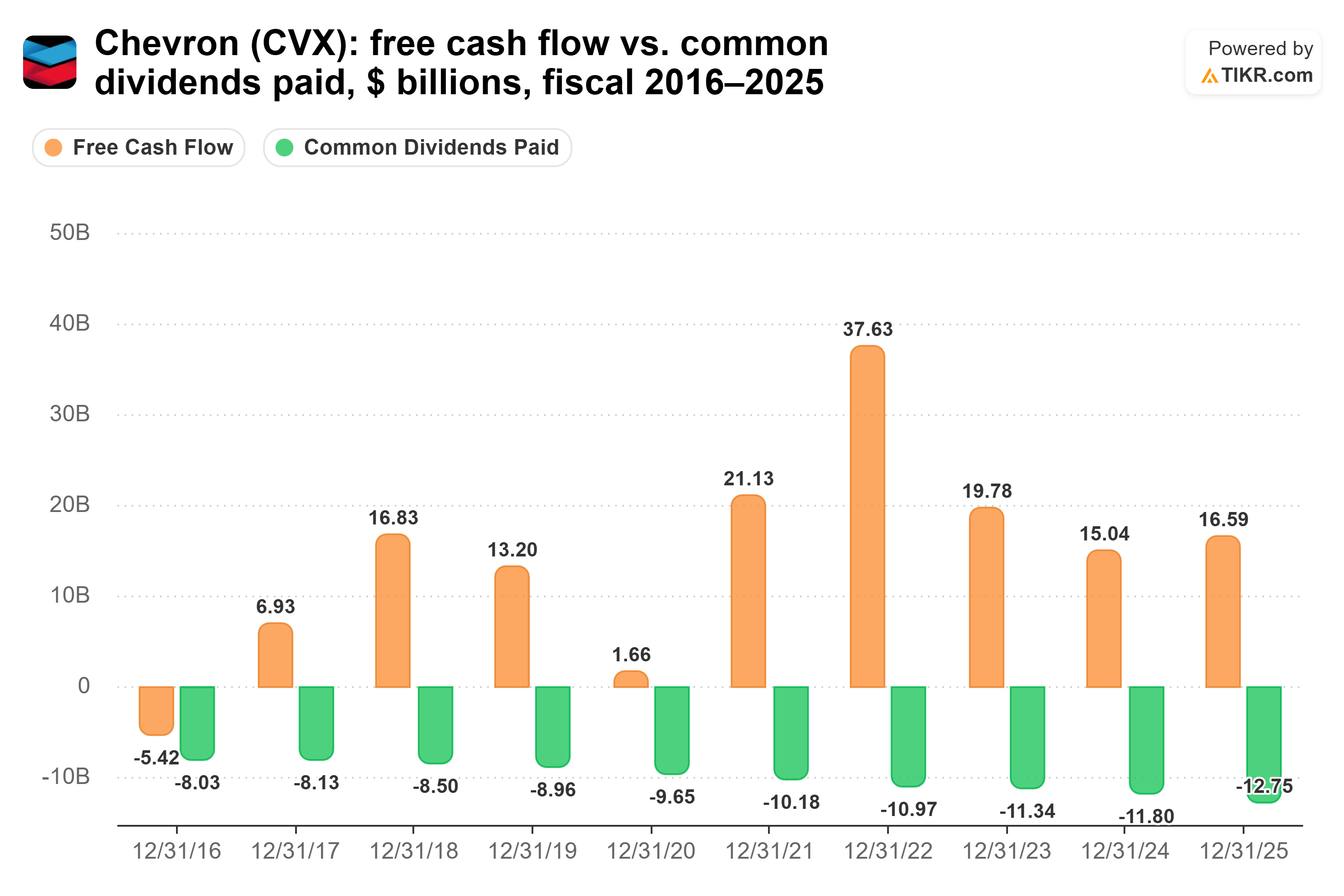
The payout ratio ran a tight 78.4% in fiscal 2024 and 76.9% in fiscal 2025. So today’s 41% leans on a third quarter that more than doubled free cash flow from a year earlier.
Chevron says the dividend comes first anyway. On the third-quarter call, CFO Eimear Bonner listed the company’s priorities: “the first priority within that is to grow the dividend consistently.” The balance sheet and buybacks rank behind it. Chevron’s record backs that up: “We’ve done that for 39 consecutive years.”
What a cut would cost you
Chevron is the check to test here, because its coverage swings so much from year to year. Chevron lists volatile oil prices among its risks, including a $64-a-barrel swing within the third quarter alone. With one payer, a cut goes straight to your income. If Chevron halved its dividend, the income it pays you would be halved, and if it stopped, that income would be gone, while Social Security keeps adding its COLA.
The best evidence on how Chevron handles a bad year is fiscal 2020. Free cash flow came to $1.66 billion that year, against $9.65 billion of dividends paid, and the record still held. Its balance sheet leaves even more room now: net debt is just 0.36x EBITDA, and operating profit covers interest 25.1x over the last twelve months.
Safe and growing, if you can live with oil
At the end of the day, I’d call Chevron’s dividend safe and growing. Its 4.8% a year over the decade to fiscal 2025 also beats the 2027 COLA. For a retiree who wants part of their income to outrun inflation, that’s a pretty compelling combination. Just know that the cushion can thin quickly when oil prices fall.
Of course, spending is going up. Chevron expects its capex to rise in the fourth quarter, and it plans to share more on its 2027 capital program in December, after it meets with its board. I’ll be watching that plan for how much cash it leaves for next year’s raise.
Forget Chevron: 6 safe 6%+ dividend yields you can buy right now
Dividends can hold the key to enormous wealth. But only if you buy the right ones.
Picking the right high-yield dividend stock can be the difference between a dream retirement…and scraping by every month, waiting for the next Social Security check to clear.
We’ve identified six stocks yielding 6%+ that we believe every retiree should know about right now. (And Chevron isn’t one of them.)
Disclaimer:
Please note that the articles on TIKR are not intended to serve as investment or financial advice from TIKR or our content team, nor are they recommendations to buy or sell any stocks. We create our content based on TIKR Terminal’s investment data and analysts’ estimates. Our analysis might not include recent company news or important updates. TIKR has no position in any of the stocks mentioned. Thank you for reading, and happy investing!