

Key Takeaways
- Carvana sold a record 217,385 retail cars in the third quarter, up 39%, as revenue climbed 42% to $8.04 billion.
- CarMax grew retail used units 13.8% in its latest quarter, so Carvana now trails its old rival by roughly 10,000 cars a quarter.
- Total gross profit per car fell $365, mostly because Carvana gave buyers lower loan rates, and gross margin slipped to 18.9%.
- Carvana will stop giving quarterly and annual outlooks with its fourth-quarter report, expected in February, so that report becomes the next real test.
Carvana (CVNA) just posted the biggest quarter in its history. It sold 217,385 retail cars in the third quarter, up 39%, while revenue climbed 42% to $8.04 billion.
That growth is closing a gap that once looked permanent. CarMax (KMX), the country’s largest used car retailer, grew retail used units 13.8% to 227,391 in its quarter ended August 31. So Carvana now trails its old rival by roughly 10,000 cars a quarter.
Management sounded confident. “The moat is widening,” CEO Ernie Garcia and CFO Mark Jenkins wrote in their shareholder letter.
Still, two details deserve more attention than the record. Profit per car fell, and Carvana plans to stop giving financial outlooks starting with its next report.
A record quarter in a flat market
Carvana set company records for units, revenue, gross profit, operating income and adjusted EBITDA. A few figures stand out:
- Net income rose to $483 million from $263 million, and net margin improved to 6.0% from 4.7%.
- Adjusted EBITDA reached $800 million, although its margin slipped to 10.0% from 11.3%.
- Operating cash flow hit $900 million over nine months, up from $606 million a year earlier.
Diluted EPS came in at $0.39, nearly double last year’s $0.21. Meanwhile, the broader used car market was roughly flat.
Eight straight quarters of roughly 40% unit growth now show up plainly in the top line.
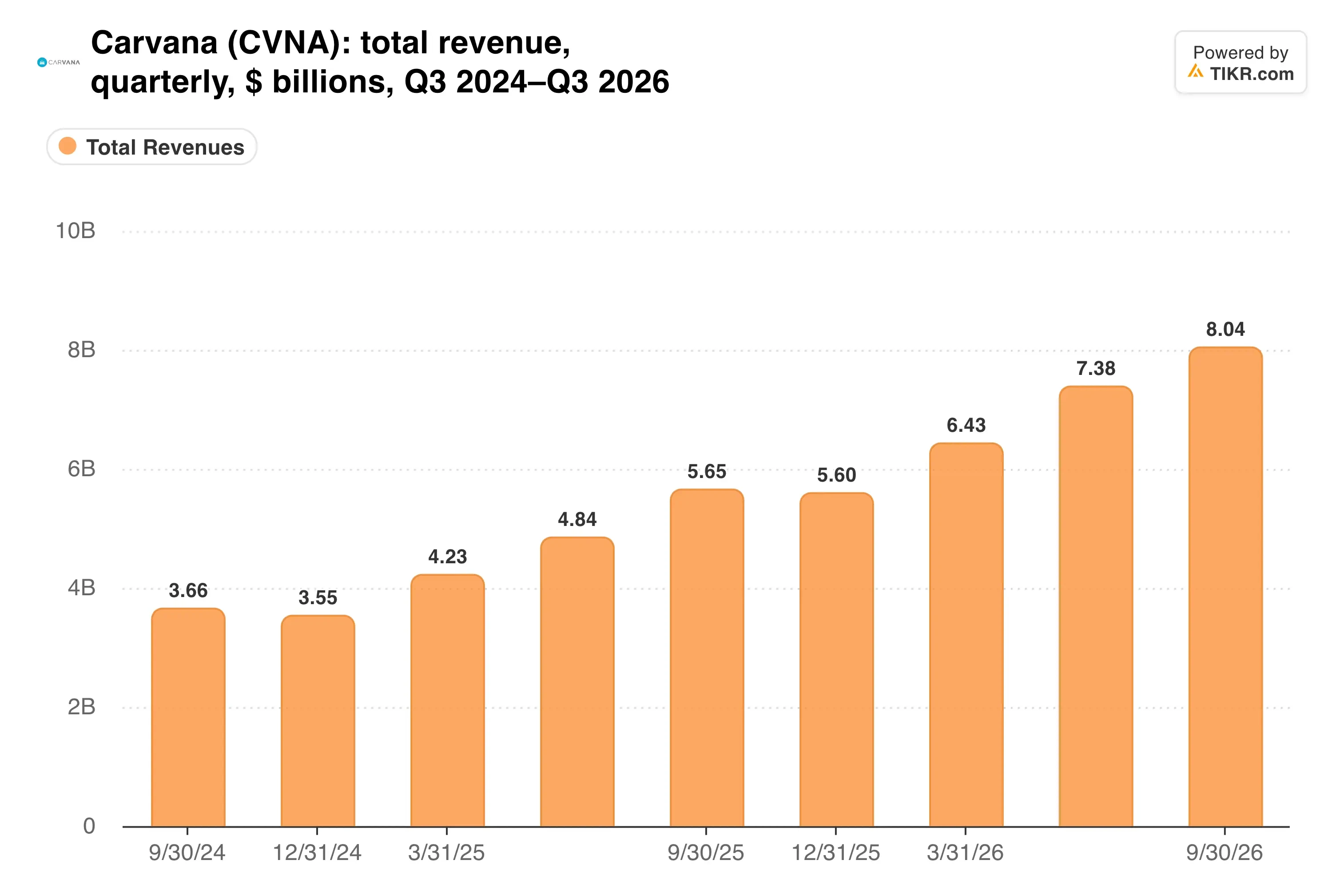
Retail units have doubled from 108,651 two years ago, and that scale is what Garcia means by a widening moat.
Cheaper loans buy the growth
Here is the tradeoff. Total gross profit per car fell $365 to $6,997, mainly because Carvana offered buyers lower loan rates relative to benchmarks.
Retail gross profit per car actually rose $100 to $3,556. The pressure sat in other gross profit, which covers financing and add-ons and fell $307 per car. Rising fuel prices and benchmark rates also cost about $200 per car, by Carvana’s estimate.
CarMax is making a similar bet. Its retail gross profit per used car fell $111 to $2,105 because it cut prices to lift sales.
So how much margin is Carvana actually giving up?
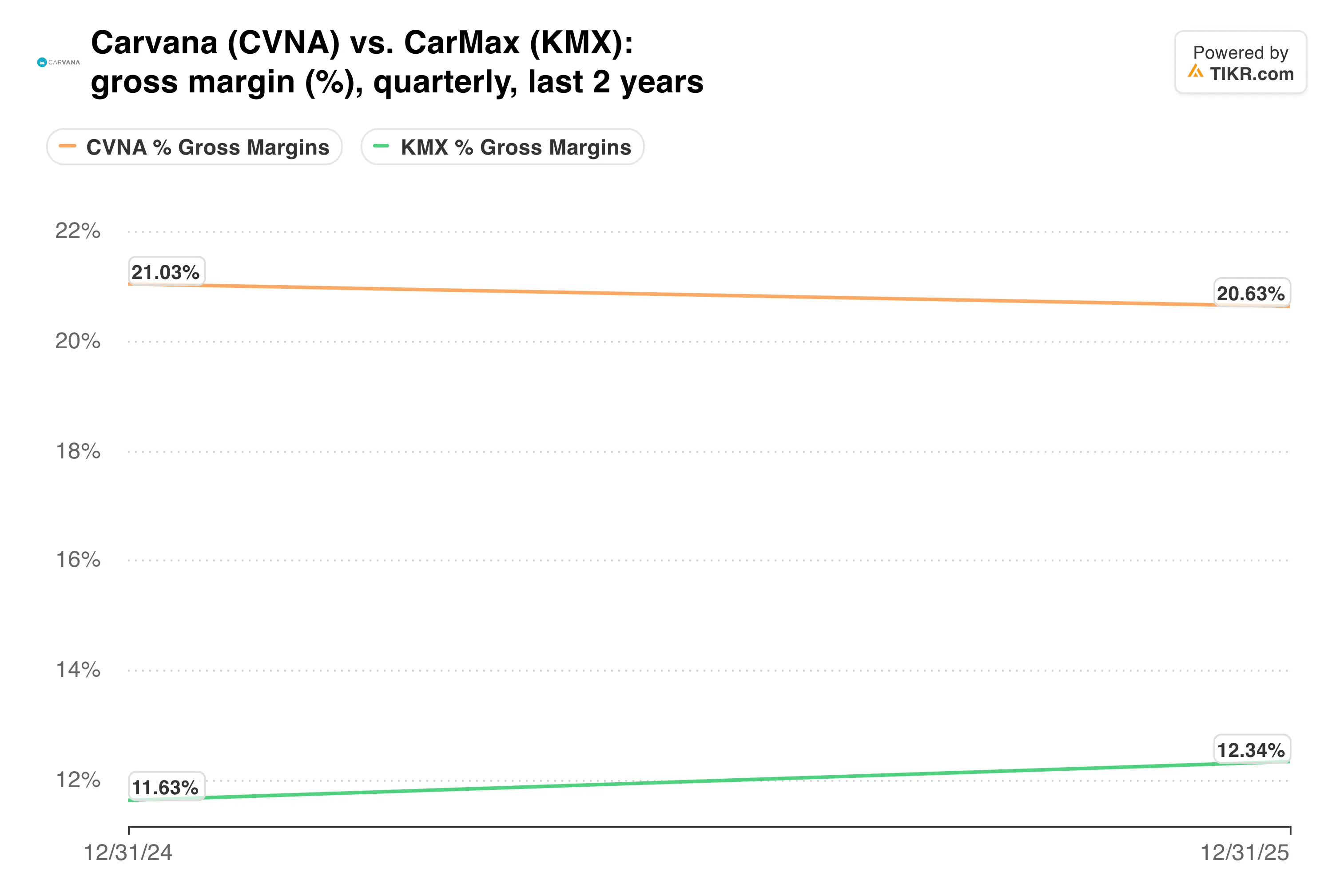
Gross margin slipped to 18.9% from 20.3%. Even so, Carvana still earns roughly twice CarMax’s gross margin on each dollar of sales.
TIKR tracks 24 analysts on Carvana. How many say “Buy”?
See the full breakdown of Buy, Hold, and Sell ratings on Carvana, along with Wall Street’s revenue and earnings estimates, all in one place. More than 500,000 investors use TIKR to research stocks like this one. See Carvana’s Analyst Ratings
Less guidance, more trust required
The bigger change is in how Carvana talks to investors. Starting with its fourth-quarter call, it won’t provide quarterly or annual outlooks. In 2027, it will also shift its reporting focus from non-GAAP metrics to GAAP operating income and net income.
Its long-term goal stays the same in spirit: 3 million retail units a year at a 12.5% operating margin between 2030 and 2035. For now, operating margin dipped to 8.9% from 9.8%, since SG&A climbed 35% and advertising jumped 49%.
Capacity isn’t the constraint. Carvana’s built-out sites can handle about 1.5 million units a year, while the current run rate sits at 870,000.
With the company stepping back from outlooks, Street models will carry more of the load…
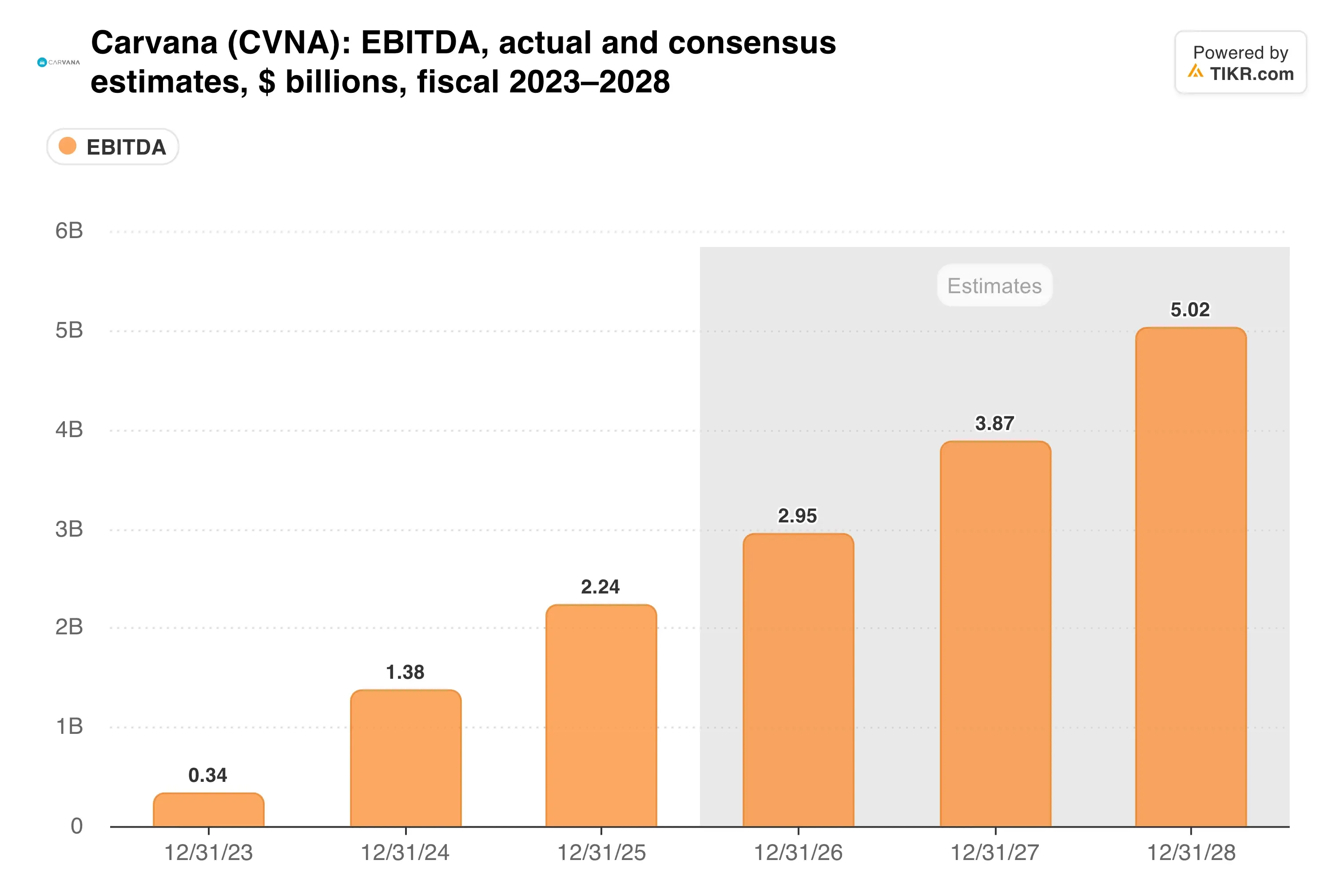
The last official marker is 2026 adjusted EBITDA at the higher end of $2.7 billion to $3.0 billion.
My take: I like the trade Carvana is making. Giving buyers cheaper loans to grow 39% in a flat market is a smart use of a cost advantage, and $3.05 billion in cash gives it room. But dropping guidance while per-car profit slides asks for more trust at an awkward moment. And a stock this volatile rarely forgives surprises.
The fourth-quarter report, expected in February, is the next checkpoint. It should show whether units rise sequentially as promised and whether profit per car finally stops shrinking.
So what is Carvana stock actually worth?
TIKR lets you forecast the future price of any stock in less than a minute. Just enter a few assumptions into TIKR’s valuation model and see what Carvana could be worth. Start from Wall Street consensus estimates, or adjust the inputs to reflect your own view of the business. It’s free to use.
Disclaimer:
Please note that the articles on TIKR are not intended to serve as investment or financial advice from TIKR or our content team, nor are they recommendations to buy or sell any stocks. We create our content based on TIKR Terminal’s investment data and analysts’ estimates. Our analysis might not include recent company news or important updates. TIKR has no position in any stocks mentioned. Thank you for reading, and happy investing!


