Key Takeaways
- Cathie Wood’s ARK Invest and 17 other big funds owned more NVIDIA stock on Sept. 30 than three months earlier, and two of them bought it for the first time.
- NVIDIA has fallen 29% since Sept. 30 after CEO Jensen Huang resigned. That’s more than Taiwan Semiconductor fell over the same stretch.
- Analysts have barely changed their earnings estimates, so NVIDIA now trades at its lowest forward multiple in five years.
- At this price, the funds look like they have the better side of the trade. The Nov. 17 report and the CEO search are the next tests.
The third quarter’s 13Fs are in, and some of the biggest money managers around spent the quarter adding to NVIDIA (NVDA).
Cathie Wood’s ARK Invest grew its stake 85% to 2.56 million shares, worth $585 million on Sept. 30, according to its 13F for the quarter ended Sept. 30, filed Nov. 13. ARK is one of 18 big funds whose filings show more NVIDIA at the end of the quarter than at the start. Several of them added Taiwan Semiconductor (TSM), Broadcom (AVGO) and Micron (MU) too.
Some of these bets are huge
NVIDIA is now ARK’s fifth-largest holding, at 3.4% of its 13F stocks. Others went bigger. GQG Partners, which manages $164 billion, grew its NVIDIA stake 376% to 14.04 million shares. Those shares were worth $3.21 billion on Sept. 30, or 6.0% of its 13F stocks. Sanders Capital, which manages $122 billion, added 33% to reach 29.95 million shares worth $6.84 billion, 6.6% of its 13F stocks.
Three of the 18 funds made NVIDIA the largest holding in their 13Fs, at more than 10% of their 13F stocks each. GQG bought the rest of the chip trade as well. It grew its Taiwan Semiconductor stake 562% and its Broadcom stake 459%, and it opened a Micron position worth $1.41 billion.
TIKR tracks 63 analysts on Nvidia. How many say “Buy”?
See the full breakdown of Buy, Hold, and Sell ratings on Nvidia, along with Wall Street’s revenue and earnings estimates, all in one place. More than 500,000 investors use TIKR to research stocks like this one. See Nvidia’s Analyst Ratings
Then Jensen Huang quit
A lot has changed since Sept. 30. NVIDIA is down 29% from its price that day. Over the same stretch, Taiwan Semiconductor fell 13%, Broadcom 1% and Micron 27%. (Those are the stocks’ moves since the filings’ snapshot. A 13F doesn’t show what a fund paid, or whether it still owns the shares.)
The biggest news came before the open on Nov. 12, when Jensen Huang resigned as CEO. Four days earlier, NVIDIA’s board had said it would investigate reports that he had been the target of a foreign intelligence effort. Downgrades followed, including one from HSBC. Analyst Frank Lee cut the stock to Hold and lowered his target to $170 from $365. He cited tighter US export rules and uncertainty “until a permanent succession plan is laid out and the new CEO is able to demonstrate execution capabilities.”
The estimates barely moved
Through all of it, analysts still expect NVIDIA’s earnings to more than triple in two years:
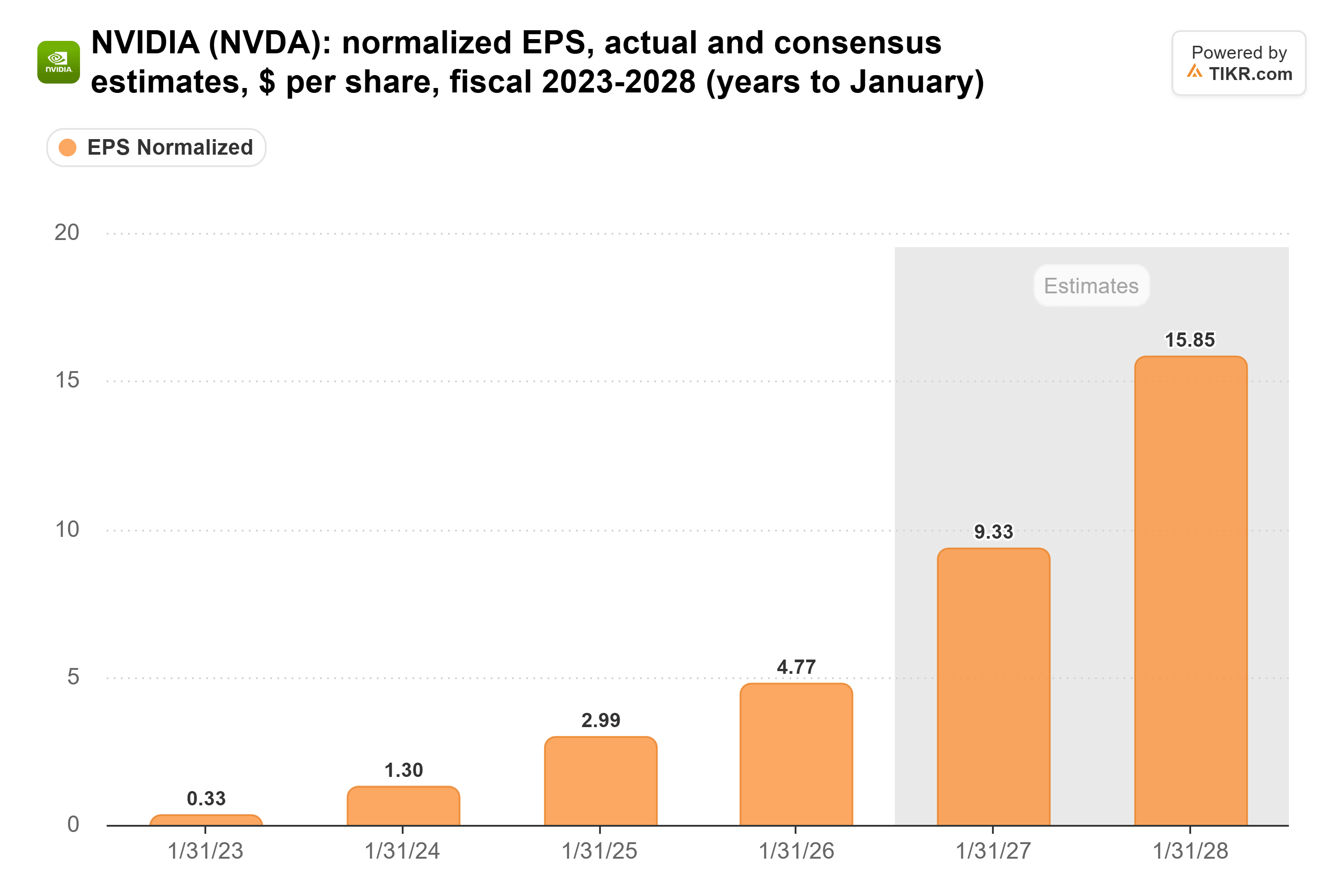
The consensus is $9.33 of normalized EPS for the fiscal year ending January 2027 and $15.85 for the year after. NVIDIA earned $4.77 in the year ended January 2026. That $15.85 stood at $15.92 in late October, so a CEO’s exit and a run of downgrades cut it by 7 cents.
The multiple on those earnings, meanwhile, is the lowest it’s been in five years:
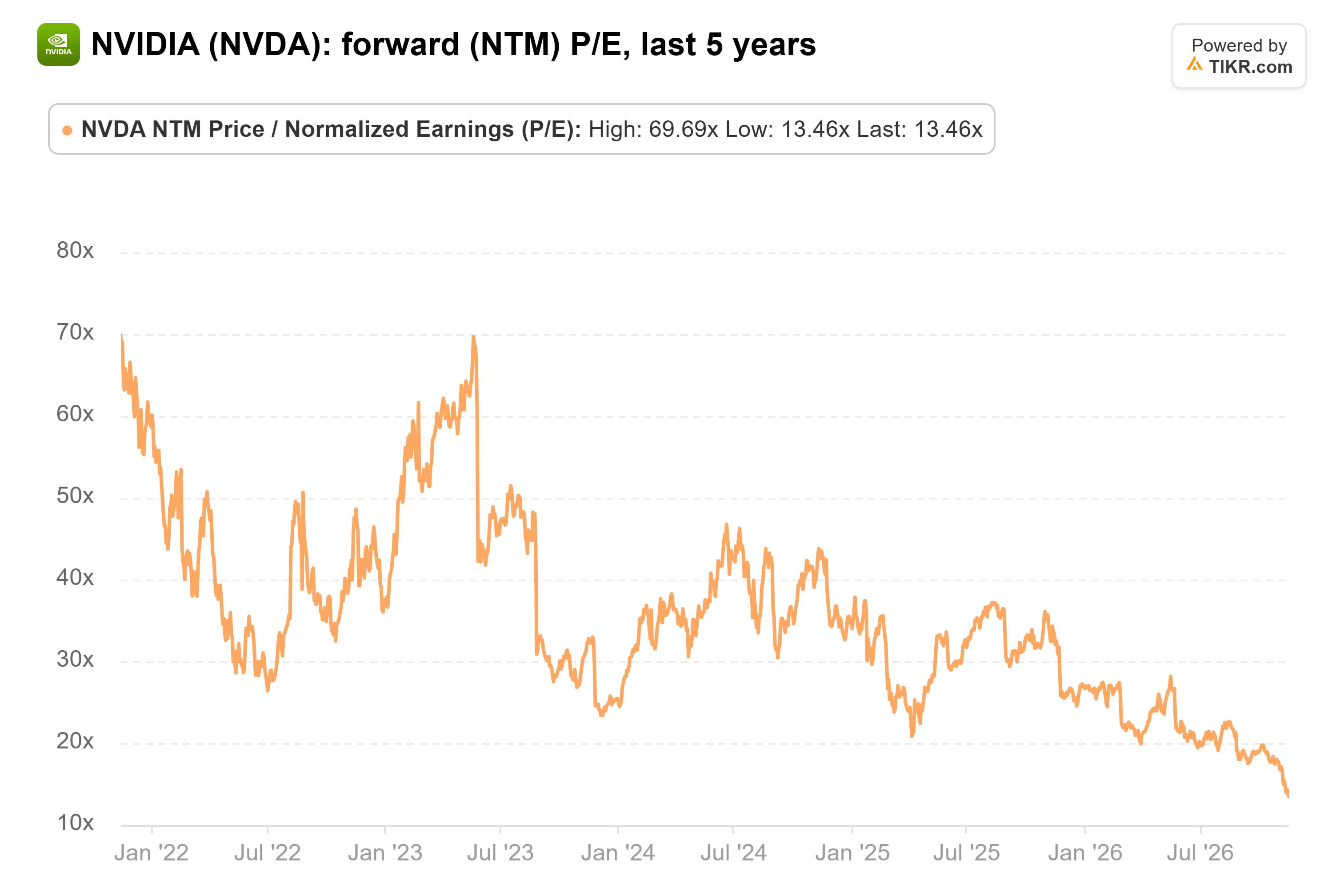
NVIDIA trades at about 14x forward earnings. Its five-year average is 36x, and it peaked at 70x in May 2023. That makes it cheaper than Taiwan Semiconductor at about 19x and Broadcom at about 20x. Only Micron is cheaper, at about 4x, and memory stocks have traded that low near the top of past cycles.
Analysts have pulled back their price targets, though not by much:
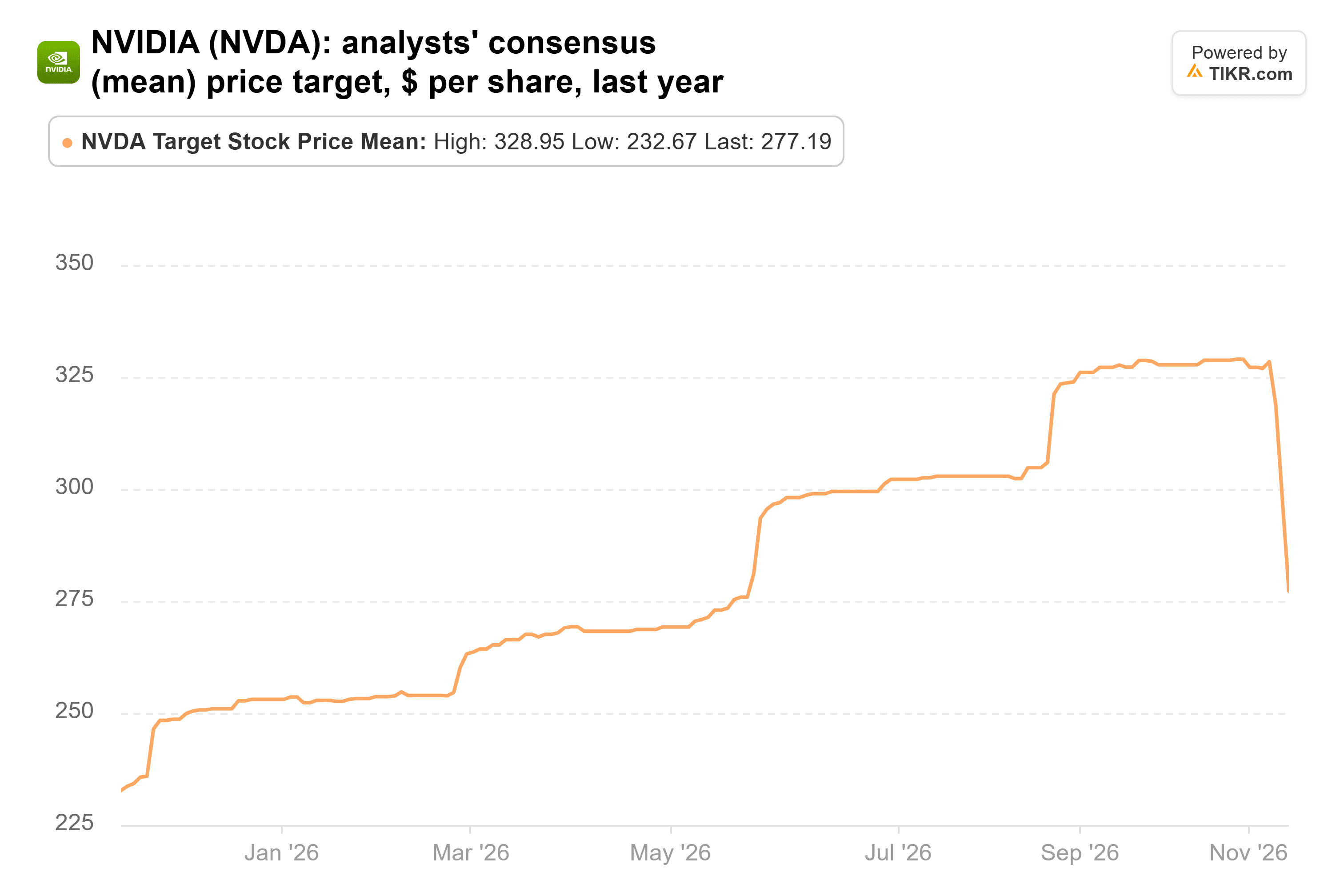
The average target is $277. That’s down from $329 on Oct. 23 but still above $233 a year ago, and roughly 70% above the stock. NVIDIA now trades below even the Street’s lowest target, $170.
The funds have the better side of this one
The risks are real. NVIDIA has no permanent CEO. HSBC sees about 11% of revenue at risk from tighter export rules. And management expects gross margin to bottom at 71% to 72% in the quarter ending January 2027 as memory costs climb. Still, HSBC’s own bear case, which takes out that 11% of revenue, has NVIDIA earning $13.57 a share in the year ending January 2028. That’s about 12x the last close.
I think that’s too cheap. The market is pricing NVIDIA as if its earnings are about to peak, while the analysts who follow it have barely touched their numbers. So yes, I’d buy before earnings, and I’d expect some volatility while the board looks for Huang’s successor.
The Nov. 17 report is the first real test. Management guided October-quarter revenue of $108 billion, plus or minus 2%. Its guide for the January quarter will show whether that 71% to 72% gross margin holds. We’ll see which of these funds held on when their next 13Fs come out in mid-February.
So what is NVIDIA stock actually worth?
TIKR lets you forecast the future price of any stock in less than a minute. Just enter a few assumptions into TIKR’s valuation model and see what NVIDIA could be worth. Start from Wall Street consensus estimates, or adjust the inputs to reflect your own view of the business. It’s free to use.
Disclaimer:
Please note that the articles on TIKR are not intended to serve as investment or financial advice from TIKR or our content team, nor are they recommendations to buy or sell any stocks. We create our content based on TIKR Terminal’s investment data and analysts’ estimates. Our analysis might not include recent company news or important updates. TIKR has no position in any of the stocks mentioned. Thank you for reading, and happy investing!