


Key Stats for Capital One
- 52-Week Range: $174.24 – $259.64
- Market Cap: $133.6B
- Street Mean Target: $256.50
- NTM P/E: 9.91x
- LTM ROE: 9.0%
- Dividend Yield: 1.5%
- Fwd 2-Yr EPS CAGR: ~11%
Capital One (COF) has always been one of the more analytically interesting names in financial services. Richard Fairbank, the founder and CEO who has run the company since its inception in 1994, built it on the premise that data and technology could be used to underwrite credit card risk better than traditional banks. That thesis has held up well over three decades.
What the company is working through right now, though, is something of a different scale entirely: the integration of Discover Financial Services, the largest credit card acquisition in US history, and a deal that effectively transforms Capital One from a large card issuer into something closer to a full-stack payments network.
Now Live: Discover how much upside your favorite stocks could have using TIKR’s new Valuation Model (It’s free)>>>
What the Discover Deal Actually Created
Discover Financial was not just a credit card company. It owned and operated the Discover payment network, one of only four major card networks in the United States, alongside Visa, Mastercard, and American Express.
When Capital One acquired Discover, it did not just add tens of millions of cardholders and a large loan book. It added a payment network that it now controls end-to-end, giving it a competitive position that no other bank card issuer in the country has.
The implications for long-term economics are significant: owning the network means Capital One captures interchange revenue on both sides of a transaction rather than paying network fees to a third party.
The free cash flow chart below reflects the scale of what has been assembled.
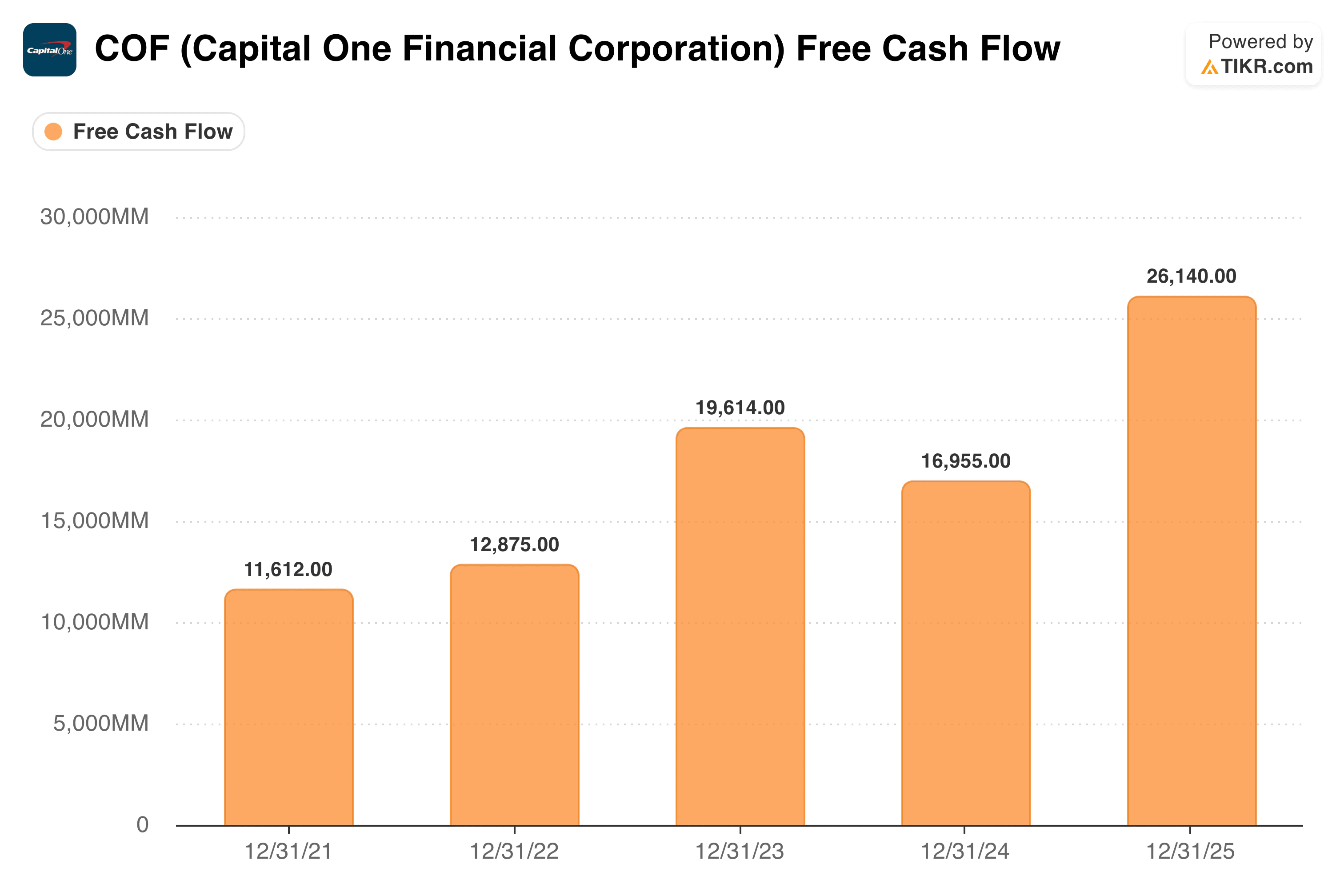
Free cash flow expanded from $11.6 billion in 2021 to $26.1 billion in 2025, with the 2025 jump directly reflecting the Discover combination. Total loans held for investment now stand at $457 billion, with credit card loans of $275 billion representing the core of the portfolio.
CEO Richard Fairbank said on the Q2 call that Capital One is now 14 months into a planned 24-month integration, has completed the conversion of Capital One debit customers to the Discover network, and has already captured the full quarterly run-rate of debit revenue synergies.
The Discover card migration to Capital One’s back-office systems began on July 27, right in the middle of the current quarter.
See historical and forward estimates for Capital One stock (It’s free!) >>>
Reading the Numbers Through the Integration Noise
Capital One’s financial results have been genuinely difficult to read since the Discover deal closed, and that confusion is part of why the stock has underperformed.
Integration costs, amortization of acquisition-related intangibles, and a temporary suppression of Discover card growth during system migrations are all running through the income statement simultaneously. The beats and misses table captures the pattern well.
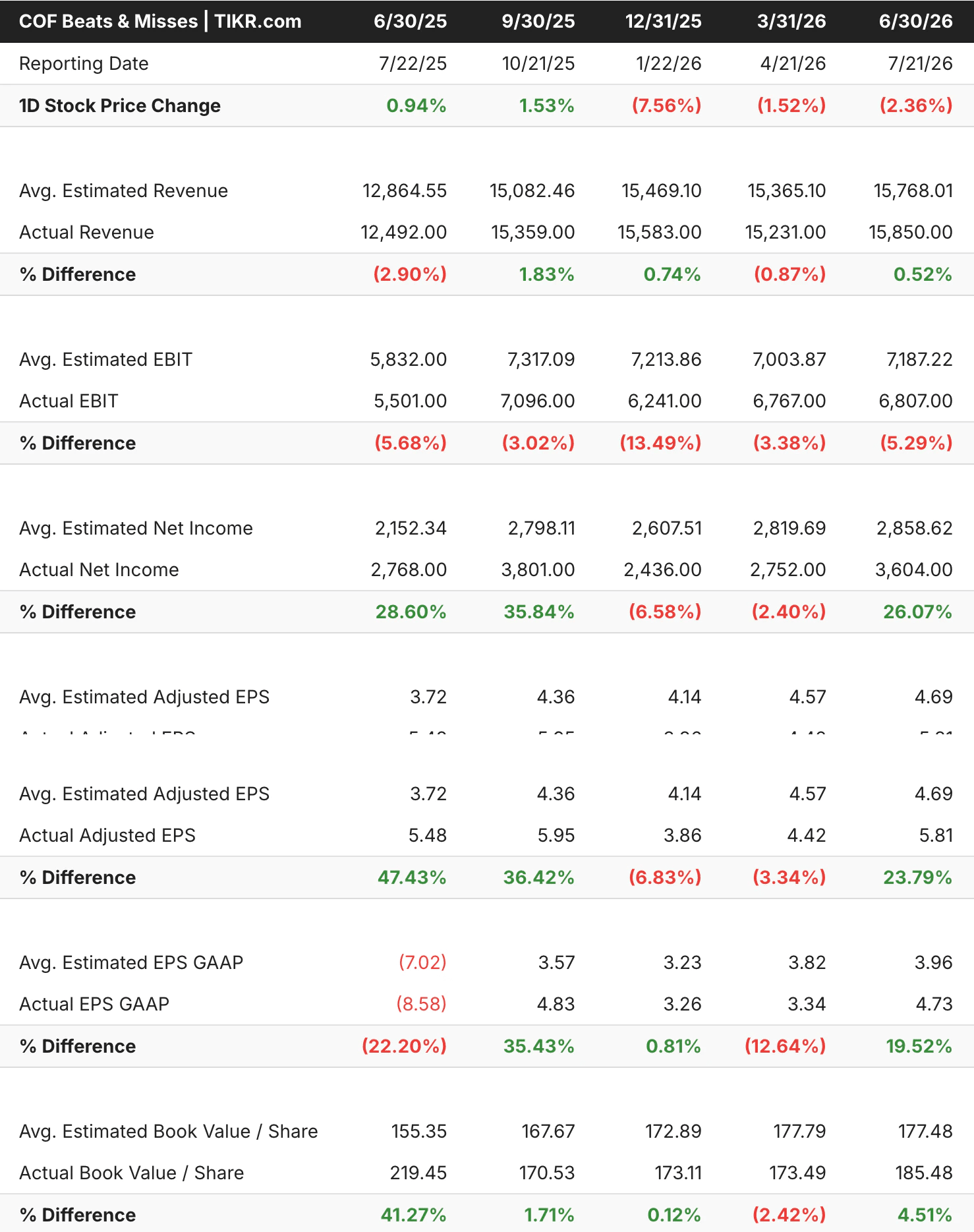
Adjusted EPS has beaten consensus estimates by wide margins in three of the last five quarters: roughly 47% in Q2 2025, 36% in Q3 2025, and 24% in Q2 2026. The two softer quarters in between reflected integration-related expense drag.
EBIT has missed consistently, which is exactly what you would expect when a company is running elevated transition costs through its operating expenses. Net income has been beaten by more than 25% in multiple quarters when Discover-related distortions work the other way.
The Q2 2026 adjusted EPS of $5.81 came in nearly 24% above the consensus estimate of $4.69. Provision for credit losses declined $1.1 billion year over year to $3.0 billion, and the net interest margin improved 14 basis points to 8.01%. The credit quality story, which was a major source of concern for investors through 2024 and early 2025, is clearly moving in the right direction.
Value your favorite stocks like COF with 5 years of analysts’ forecasts using TIKR’s new Valuation Model (It’s free) >>>
What the Valuation Model Says
At roughly 10x forward earnings, Capital One trades at a meaningful discount to most large-cap financial peers and well below where it has historically traded as a standalone business.
The market appears to be pricing in ongoing integration uncertainty and a slower-than-expected payoff from the Discover synergies, which management targets at $2.5 billion in total operating expense savings.

The TIKR valuation model targets around $336 per share on mid-case assumptions, implying a total return of roughly 54% through the end of 2030 and an annualized IRR of around 10% per year.
The high case reaches approximately $451, assuming around 6% annual revenue growth and net income margins near 19%. Even the low case of around $340 sits well above the current price.
The Street mean target of $256.50 implies roughly 17% upside from here, suggesting most analysts view the current valuation as undemanding relative to what the combined franchise should eventually earn.
Should You Invest in Capital One Stock?
Capital One is not a complicated story at its core: it is a well-run financial institution with a founder-led management team, a data-driven underwriting edge, and a newly acquired payment network that could meaningfully expand margins over time.
The complication is timing. The next twelve months involve completing the Discover card migration, capturing a growing share of the $2.5 billion synergy target, and demonstrating that Discover card growth reaccelerates once the platform conversion is finished.
If those things happen on schedule, the 10x earnings multiple will look cheap in retrospect. If integration costs run longer or credit quality softens unexpectedly, the stock will stay under pressure. Investors with a multi-year horizon and comfort with financial sector complexity will find a lot to like here at current prices.
Build your own Valuation Model to value any stock (It’s free!) >>>
Looking for New Opportunities?
- See which stocks billionaire investors are buying to follow the smart money.
- Analyze stocks in as little as 5 minutes with TIKR’s all-in-one, easy-to-use platform.
- The more rocks you overturn… the more opportunities you’ll uncover. Search 100K+ global stocks, global top investor holdings, and more with TIKR.
Disclaimer:
Please note that the articles on TIKR are not intended to serve as investment or financial advice from TIKR or our content team, nor are they recommendations to buy or sell any stocks. We create our content based on TIKR Terminal’s investment data and analysts’ estimates. Our analysis might not include recent company news or important updates. TIKR has no position in any of the stocks mentioned. Thank you for reading, and happy investing!


