Key Takeaways
- British American Tobacco yields 5.6% and Chevron 3.5%, but Chevron raised its dividend faster, 5.8% a year from fiscal 2020 to fiscal 2025 against BAT’s 2.2%.
- BAT’s dividend took 78% of its free cash flow over the trailing 12 months to June 30, 2026, and Chevron’s took 41% over the trailing 12 months to Sept. 30, 2026.
- Chevron’s net debt is 0.4x EBITDA, against 2.9x at BAT.
- At those growth rates, $10,000 in BAT pays about $13,935 over 20 years and $10,000 in Chevron about $12,600, though Chevron’s yearly income would pass BAT’s around 2040.
Anyone buying a dividend stock to hold for the next 20 years is betting on two decades of raises, and on a business that can afford them through the bad years.
That’s the test for British American Tobacco (BTI) and Chevron (CVX). BAT yields 5.6% to Chevron’s 3.5%. But on Oct. 30, Chevron reported third-quarter free cash flow of $12.0 billion, up from $4.9 billion a year earlier. Two weeks before that, BAT was reported to be closing its South African cigarette plant, in a market where illicit cigarettes are estimated to hold about 75% share.
So if I could hold only one of them until 2046, which would it be?
| Metric | British American Tobacco (BTI) | Chevron (CVX) |
|---|---|---|
| Dividend yield | 5.6% | 3.5% |
| Dividend growth, fiscal 2020-2025 | 2.2% a year | 5.8% a year |
| Dividend growth, fiscal 2015-2025 | 4.5% a year | 4.8% a year |
| Cash dividend payout ratio (TTM) | 78% | 41% |
| Net debt/EBITDA | 2.9x | 0.4x |
| Interest coverage | 5.2x | 25.1x |
Source: TIKR. BAT’s payout ratio covers the 12 months to June 30, 2026; Chevron’s, the 12 months to Sept. 30, 2026.
6 safe dividend stocks paying retirees 6%+ yields
There are over 100 stocks paying 6%+ annual dividends today.
But after an extensive investment review leveraging TIKR’s proprietary data, we now believe only six of them are truly safe for retirees.
They’re all yours as part of our new investment report. Learn more about how to get access right here.
BAT pays more, with less room to spare
On its July 30 first-half call, BAT’s management guided for mid-teens growth in New Categories this year, led by Velo nicotine pouches in the US, and for full-year revenue at the low end of its range.
From fiscal 2021 to fiscal 2024, the dividend took about half of BAT’s free cash flow each year. Then free cash flow fell to £5.79 billion in fiscal 2025 from £9.64 billion in fiscal 2024, and the dividend took 91% of it:
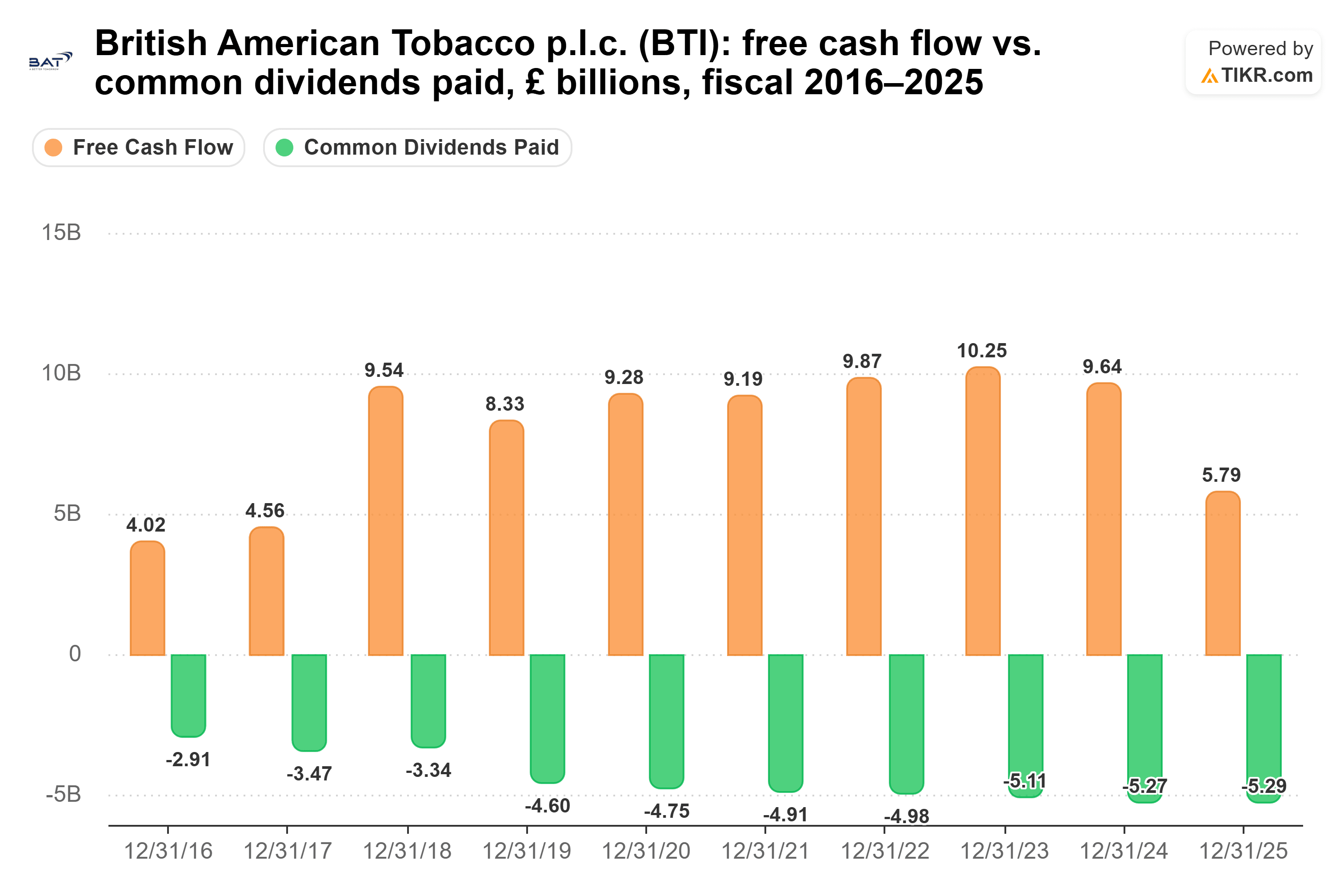
Over the trailing 12 months to June 30, 2026, the ratio was back down to 78%, which is still a thin cushion. Management promised on the call to keep rewarding shareholders “through strong cash returns, including our progressive dividend and sustainable share buyback.” But that progressive dividend grew just 2.2% a year from fiscal 2020 to fiscal 2025, from £2.99 to £3.34 a share. (BAT sets it in pounds, so the dollar amount a US holder collects moves with the exchange rate.) With illicit trade eating into markets like South Africa, there isn’t much slack.
Chevron kept paying through the busts
Where BAT’s cushion has thinned, Chevron’s has grown. Adjusted earnings rose to $10.4 billion in the third quarter of 2026 from $3.6 billion a year earlier.
That brought its cash dividend payout ratio down to a comfortable 41% over the trailing 12 months to Sept. 30, 2026, from 77% in fiscal 2025. The longer record is bumpier. Free cash flow fell short of the dividend in fiscal 2016 and fiscal 2020, and Chevron kept paying through both:
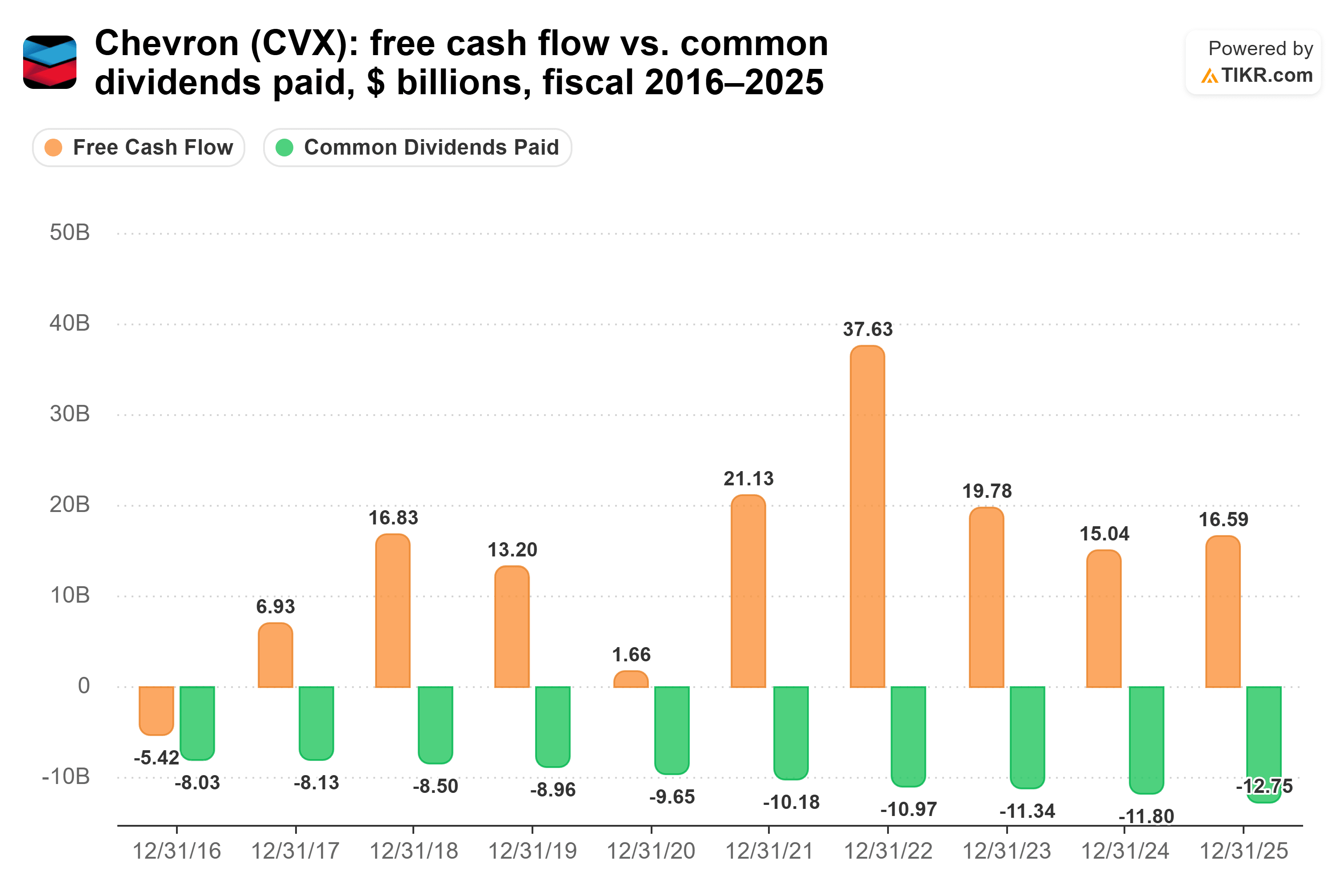
CFO Eimear Bonner said on the Oct. 30 call that Chevron’s first priority for its cash is “to grow the dividend consistently,” and the company has “done that for 39 consecutive years,” as management put it. The dividend grew 5.8% a year from fiscal 2020 to fiscal 2025, from $5.16 to $6.84 a share. Oil prices swing, though, and third-quarter cash flow also had help from significant asset sales, so I wouldn’t count on 41% as the norm.
So which dividend wins?
If I could hold only one dividend stock for the next 20 years, it’d be Chevron. It has more room to keep raising through the bad years, on coverage, on the balance sheet and on its record.
Its balance sheet is what carried the dividend through the last two busts. Net debt rose to 2.9x EBITDA in fiscal 2016 and 3.2x in fiscal 2020, then came back down:

It’s at 0.4x over the last 12 months, and net debt fell $7.8 billion in the third quarter alone. BAT already carries 2.9x, the level Chevron hit in its 2016 slump.
BAT’s case is still a strong one. $10,000 in BAT pays $560 a year today against Chevron’s $350. At each stock’s growth rate from fiscal 2020 to fiscal 2025, that adds up to about $13,935 over 20 years, against about $12,600 for Chevron, and Chevron’s yearly income wouldn’t pass BAT’s until around 2040.
It’s just that BAT’s lead rests on raises of 2.2% a year from a dividend already taking 78% of free cash flow. I trust Chevron’s room to keep raising more than BAT’s.
Chevron gives more color on its 2027 capital program in December. And if BAT’s dividend gets back to taking about half its free cash flow, as it did from fiscal 2021 to fiscal 2024, I’d take a second look.
Forget Chevron: 6 safe 6%+ dividend yields you can buy right now
Dividends can hold the key to enormous wealth. But only if you buy the right ones.
Picking the right high-yield dividend stock can be the difference between a dream retirement…and scraping by every month, waiting for the next Social Security check to clear.
We’ve identified six stocks yielding 6%+ that we believe every retiree should know about right now. (And Chevron isn’t one of them.)
Disclaimer:
Please note that the articles on TIKR are not intended to serve as investment or financial advice from TIKR or our content team, nor are they recommendations to buy or sell any stocks. We create our content based on TIKR Terminal’s investment data and analysts’ estimates. Our analysis might not include recent company news or important updates. TIKR has no position in any of the stocks mentioned. Thank you for reading, and happy investing!